Israel and the Middle East: Geopolitics, Alliances, and Networks of Influence
From the Balfour Declaration, the British Mandate and the Nakba to the post-1967 occupation, the rise of Hamas, policies that entrenched Palestinian political division, October 7 and the war in Gaza. This standalone chronology follows documented actions by Israel, the United States, Hamas and other actors, with particular attention to how Israeli policies themselves helped strengthen Hamas and shape the present catastrophe.
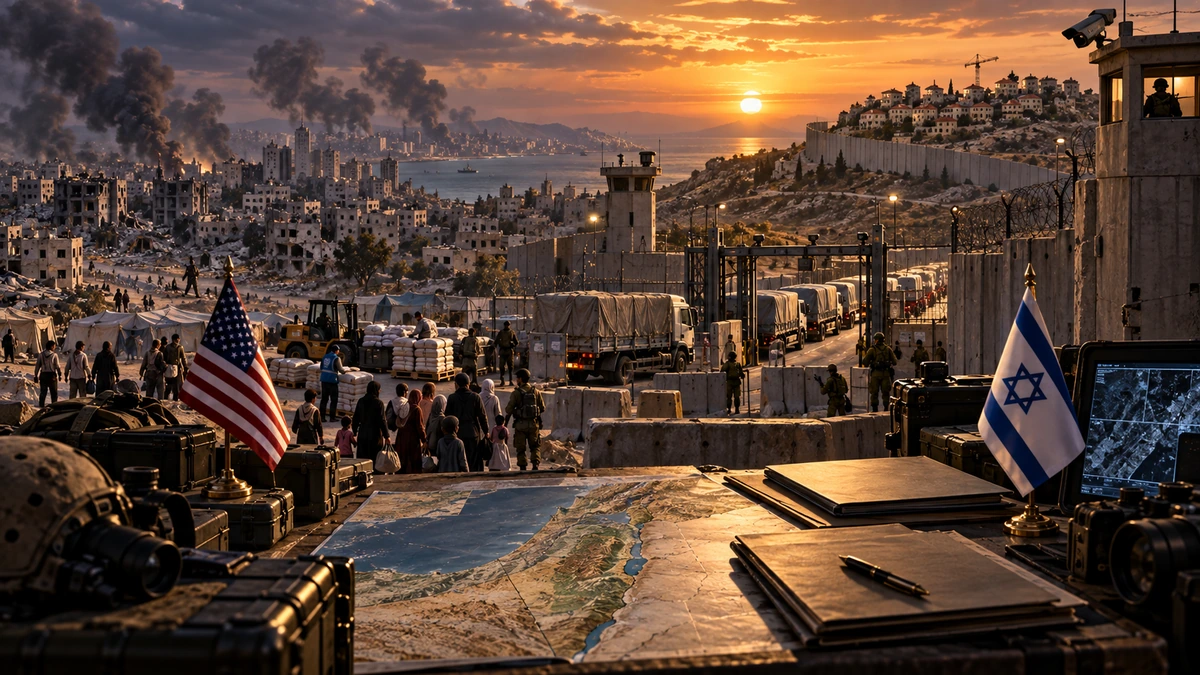
This article is not a commentary on an earlier text and not a review of a single theory. It is a standalone chronology of the conflict: how British imperial policy, Zionist settlement, Palestinian displacement, wars, occupation, settlements, the collapse of the peace process, internal Palestinian division and the U.S.-Israel alliance accumulated into the present catastrophe.
This history should not be flattened by language that treats materially and legally unequal positions as interchangeable. Hamas and other Palestinian armed groups committed war crimes against civilians and took hostages on October 7, 2023. Israel, however, is a state with a powerful military, a long-term occupying apparatus, control over major aspects of Palestinian territory and extensive U.S. military support; its power and legal obligations are therefore of a different order.
The article therefore names findings by competent institutions directly. In 2024 the International Court of Justice held Israel’s continued presence in the occupied Palestinian territory to be unlawful and called for an end to new settlement activity; the International Criminal Court issued arrest warrants for Benjamin Netanyahu and Yoav Gallant; and in 2025 an independent UN Commission of Inquiry concluded that Israeli authorities and security forces had committed genocide in Gaza — a finding Israel rejects.
Hamas requires separate treatment. The public record does not establish that Hamas was a covert operational arm of Mossad. It does establish something more concrete: before Hamas was founded, Israeli authorities tolerated and at times encouraged Islamist structures as a counterweight to the PLO, while Netanyahu governments later approved Qatari money flows into Hamas-ruled Gaza. Shin Bet’s 2025 inquiry explicitly listed this policy and the flow of Qatari money among the factors that enabled Hamas’s military buildup before October 7.
Palestine before Balfour: society, empire and the rise of political Zionism
At the end of the nineteenth century Palestine was not an empty territory. It was part of the Ottoman Empire, with an Arab Muslim and Christian majority, longstanding Jewish communities, and growing Jewish immigration. Political Zionism organized in Europe as a modern nationalist movement, especially after the First Zionist Congress in Basel in 1897.
Zionism emerged in the context of European antisemitism, nationalism and the colonial world. For many Jews it offered an answer to persecution and a project of political security; for Palestinian Arabs it increasingly appeared as a national settlement project on land where they already lived and where they had not been asked to consent to a future political order.
This dual history — real Jewish fear of persecution and real Palestinian presence and political rights — is essential to understanding what followed. Neither history erases the other.
The Balfour Declaration of 1917: a British imperial decision over land Britain did not own
The Balfour Declaration of November 1917 expressed British government support for the establishment of a “national home for the Jewish people” in Palestine. Britain did not privately own Palestine, and the declaration was not an agreement with the Palestinian population; it was issued during the First World War while the territory was still part of the Ottoman Empire.
Religious imagination formed part of the environment in which some British leaders operated. Lloyd George, Balfour and others had been shaped by biblical and Protestant culture in which the “return of the Jews to the Holy Land” was a familiar motif. Historical research, however, also emphasizes strategic and imperial motives: wartime diplomacy, influence in the eastern Mediterranean, protection of the route to Suez and India, and British competition for influence in the collapsing Ottoman Empire.
It is therefore too simple to say Britain merely “gave away biblically promised land.” More precisely, an imperial government made a commitment — without the political consent of the Arab majority — that advanced another national project in the same territory, with religious, strategic and imperial motives intertwined.
The British Mandate: promises to communities, power retained by empire
The League of Nations Mandate of 1922 embedded Balfour policy within the international framework of British rule. Over the following decades Jewish immigration increased and institutions of the Jewish national movement expanded, while Palestinian Arab resistance grew in response to loss of political control, land changes and the prospect of political subordination.
British authorities attempted to manage a conflict they had helped institutionalize. At different times they restricted or enabled immigration, suppressed Arab revolt and negotiated with both sides, but did not establish Palestinian self-determination comparable to the national project written into the Mandate.
By the end of the Mandate, the fundamental question remained unresolved: who had the right to decide the political future of a land inhabited by two national communities with increasingly incompatible projects.
Partition in 1947, the 1948 war and the Nakba
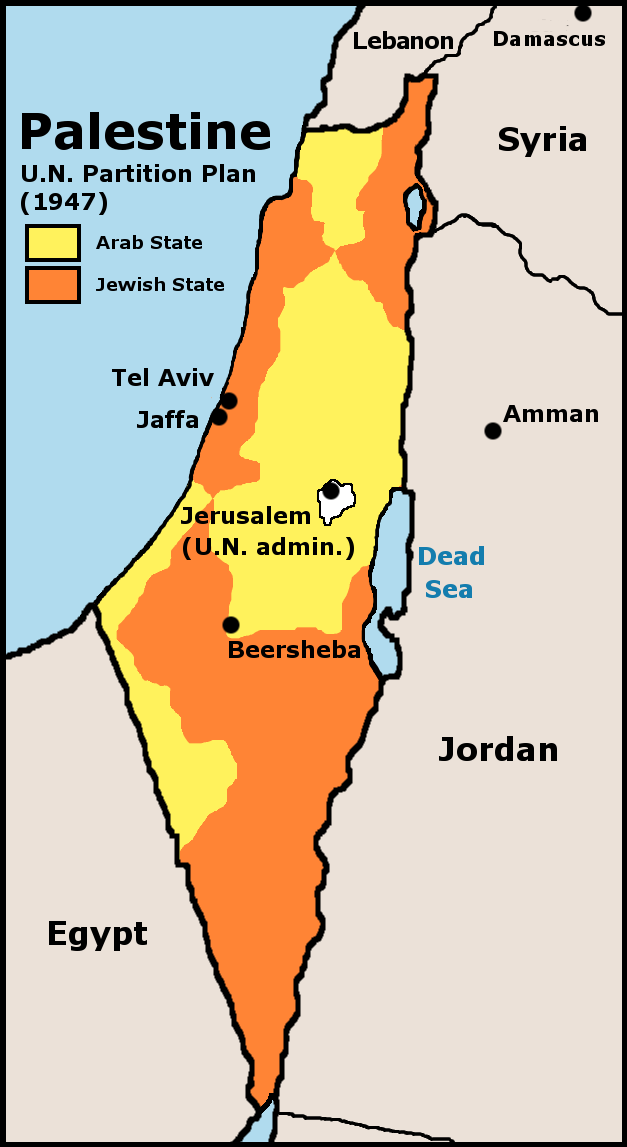
In 1947 the UN General Assembly recommended partitioning Palestine into Jewish and Arab states. Jewish leaders accepted the plan as a basis for statehood; Palestinian Arab leaders and Arab states rejected it. Civil war in Mandatory Palestine was followed, after Israel declared independence in May 1948, by a wider Arab-Israeli war.
For Palestinians, 1948 became the Nakba — catastrophe. The United Nations states that roughly 750,000 Palestinians were expelled or fled their homes. Many localities were depopulated and refugees were largely prevented from returning after the war. The refugee question remained unresolved and became central to Palestinian historical experience.
For Israeli Jews the same period marked the creation of a state after decades of Zionist organization and immediately after the Holocaust. The historical significance of Israeli statehood does not erase Palestinian displacement; both are part of the same decisive transformation.

After the 1967 war: occupation becomes a durable structure
In the 1967 Six-Day War Israel occupied the West Bank, East Jerusalem, Gaza, Sinai and the Golan Heights. Sinai was later returned to Egypt, while the West Bank, East Jerusalem and Gaza became the core territorial arena of the Israeli-Palestinian conflict.
In the West Bank and East Jerusalem Israel developed settlements, roads and security infrastructure alongside separate legal regimes affecting Israeli settlers and Palestinians. UN Security Council Resolution 2334 reiterated in 2016 that the settlements have no legal validity.
In July 2024 the International Court of Justice concluded that Israel’s continued presence in the occupied Palestinian territory is unlawful, that Israel must end that unlawful presence as rapidly as possible, immediately cease new settlement activity and evacuate settlers. Israel disputes this legal interpretation.
From the PLO to an Islamist counterweight: the environment from which Hamas emerged
After 1967 the PLO was Israel’s principal Palestinian adversary. In Gaza, however, Israeli authorities during the 1970s and part of the 1980s tolerated networks of the Palestinian Muslim Brotherhood, including Sheikh Ahmed Yassin’s Mujama al-Islamiya. Contemporary Washington Post reporting in 1987 described an Israeli strategy of encouraging Islamic structures as a conservative counterweight to secular PLO nationalists.
Hamas was formally founded in 1987 during the First Intifada as a Palestinian movement rooted in the broader Muslim Brotherhood tradition. The strong claim that “Mossad created Hamas” is therefore not supported by the movement’s own organizational genealogy. But it is equally misleading to ignore the fact that Israeli policy in an earlier period objectively eased the growth of Islamist structures because they were regarded as a counterweight to the PLO.
That history matters as a case of blowback: a division of an adversary that appears useful in the short term can help produce a stronger and more radical rival in the long term.

Oslo: a peace process without the end of occupation
The Oslo agreements of 1993–1995 created the Palestinian Authority and established an interim period in which final-status issues were supposed to be negotiated. The hardest questions — borders, Jerusalem, refugees, settlements and security — remained unresolved.
In the following years Yitzhak Rabin’s assassination, Palestinian suicide bombings, Israeli military operations, settlement expansion and mutual distrust undermined the process. The Second Intifada then remilitarized the conflict on a much larger scale.
Oslo did not eliminate the structural imbalance: the Palestinian Authority gained limited powers over fragmented areas while Israel retained decisive military, border and spatial control. The “peace process” therefore did not mean the end of the occupation structure.
Gaza after 2005: settlement withdrawal, blockade and Palestinian political division
Israel removed permanent troops and settlers from inside Gaza in 2005, but after Hamas won the 2006 Palestinian legislative elections and took control of Gaza in 2007, Israel and Egypt sharply restricted movement of people and goods. Gaza became politically separated from the West Bank: Hamas ruled Gaza while the Palestinian Authority retained limited authority in parts of the West Bank.
Israel argued that restrictions were necessary because of Hamas’s armament and rocket attacks. Critics argued that the regime of restrictions affected the entire civilian population and that a prolonged blockade entrenched economic, medical and humanitarian dependency.
Repeated cycles of rocket fire, Israeli bombing and ground operations followed. Each round further entrenched a logic in which security management became increasingly detached from a political settlement.
Netanyahu’s conflict-management strategy and Qatari money
Beginning in 2018, Israel under Netanyahu approved the entry of Qatari money into Hamas-ruled Gaza, initially including cash transfers. The public rationale was to prevent humanitarian collapse and buy calm along the border. At various points Israeli security agencies backed the transfers as a short-term stabilization policy.
Within Israeli politics, however, the policy was also described as a way to preserve the separation between Hamas in Gaza and the Palestinian Authority in the West Bank. Netanyahu denies the famous 2019 quotation saying that bolstering Hamas would help prevent a Palestinian state; nevertheless, political allies and Israeli reporting openly described this logic of division, while the transfer policy itself is undisputed.
The most consequential later finding came from Israel’s own security system. Shin Bet’s March 2025 inquiry listed the policy of buying quiet, the flow of Qatari money into Gaza and its reaching Hamas’s military wing among the factors that enabled Hamas’s military buildup before October 7.
Did Hamas work for Mossad? What the public record shows — and what it does not
There is an important difference between saying “Israeli policy helped strengthen Hamas” and saying “Hamas was a covert operational project of Mossad.” The first claim can be supported by documented conduct: tolerating an Islamist counterweight to the PLO, later preserving Palestinian political division, and allowing Qatari funding into Hamas-run Gaza.
The second claim would require a different class of evidence: verified communications with Hamas leadership, a proven handler or command relationship, identities of agents, operational orders, financing tied to command and an uninterrupted chain of control. No such publicly verified evidentiary chain has been established.
The article therefore does not declare the hypothesis metaphysically impossible, but it does not present it as historical fact. What can be said with much greater confidence is that certain Israeli policies indirectly helped create the political and material environment in which Hamas consolidated power, after which the same organization carried out a mass attack on Israel.
The United States and Israel: alliance, arms and political protection
The U.S.-Israel alliance is institutional and material. A 2016 memorandum provided for $38 billion in U.S. military assistance over 2019–2028. The United States has also supplied weapons, missile-defense cooperation, intelligence links and major diplomatic support.
This means Israeli military capacity cannot be analysed independently of U.S. support. When U.S. weapons, financing or diplomatic protection enable operations, American responsibility becomes a material question rather than a rhetorical one. In 2024 UN special procedures warned about the risk that arms transfers were contributing to serious violations of international law.
The support has continued after years of war in Gaza. In September 2026 the U.S. administration was planning another $2.8 billion munitions package for Israel, including tens of thousands of 2,000-pound bombs, despite continuing concerns about their use in densely populated areas.
Iraq, Syria and the wider regional policy: consequences of intervention
After September 11, 2001 the United States launched a broader military and security transformation of the Middle East. The 2003 invasion of Iraq was publicly justified above all by weapons of mass destruction; later U.S. investigations identified major failures and exaggerations in prewar intelligence assessments.
Occupation decisions — especially dissolving the Iraqi army and de-Baathification — contributed to a security vacuum and political exclusion from which the insurgency, Al Qaeda in Iraq and later Islamic State grew. This supports a form of indirect causal responsibility for the conditions of emergence, not proof that Washington directly founded ISIS as a covert organization.
In Syria, the United States and regional partners supported various opposition structures; Israel had documented contacts with armed opposition groups near the Golan and treated wounded individuals who crossed the ceasefire line. Those facts demonstrate cooperation with parts of the opposition, not by themselves command links to ISIS.
October 7, 2023: Hamas war crimes and the failure of Israel’s security system
The October 7 attack was a planned and coordinated assault by Hamas and other Palestinian armed groups on southern Israel. A UN Commission of Inquiry found intentional killing of civilians, hostage-taking, torture, inhuman treatment, indiscriminate rocket fire and other war crimes. Recognizing these crimes is necessary and does not diminish accountability for what followed in Gaza.
The same day exposed an enormous Israeli intelligence and operational failure. The IDF and Shin Bet later acknowledged serious failures: parts of Hamas’s attack plan were known, warning signs were not correctly integrated, Hamas’s intentions were underestimated, and the system placed excessive confidence in the border barrier, technology and the assumption that Hamas did not seek a large war.
Shin Bet’s inquiry added a wider political layer: the long-running policy of buying quiet, Qatari money, erosion of deterrence and avoidance of offensive initiatives helped create the conditions for Hamas’s buildup.
Was Netanyahu personally warned before October 7? New reporting in September 2026
In September 2026 Haaretz reported that UAE President Mohammed bin Zayed personally warned Netanyahu roughly ten days before the attack that Hamas was preparing a major operation. An Emirati source familiar with the conversation confirmed the warning to the Times of Israel, and the Associated Press reported the allegation as well.
The reporting says the warning traced back to messages from Yahya Sinwar speaking of a “huge surprise” or an “earthquake.” Netanyahu’s office categorically denies that the conversation took place and has threatened legal action. The New York Times said it could not independently confirm the report.
The accurate formulation is therefore strong but qualified: there is new reporting, partly corroborated by an Emirati source, that Netanyahu received a personal warning; he denies it, and no publicly available state inquiry has finally resolved the allegation. Together with other pre-attack warnings, it strengthens the case for an independent investigation of political responsibility before October 7.
Gaza after October 7: from military response to mass destruction
After the attack Israel declared the goals of destroying Hamas and freeing the hostages and launched a massive air and ground war. A UN Commission of Inquiry found war crimes and crimes against humanity during the early phase of operations, including starvation as a method of war, forcible transfer and attacks on civilians and civilian infrastructure. Israel rejects these findings and emphasizes Hamas’s operations from civilian areas.
In November 2024 the International Criminal Court issued arrest warrants for Benjamin Netanyahu and Yoav Gallant for alleged war crimes and crimes against humanity. Amnesty International concluded in December 2024 that Israel had committed genocide in Gaza. In September 2025 an independent UN Commission of Inquiry reached the same legal conclusion; Israel strongly rejects the genocide characterization.
The humanitarian catastrophe is not merely a history of the war’s first year. In September 2026 OCHA was still reporting Israeli airstrikes, new casualties, mass displacement, shortages of medical supplies and restrictions on materials needed to restore water, sanitation and shelter.
The West Bank during the war: settlements, violence and territorial transformation
While global attention has focused on Gaza, settlement expansion, demolitions, movement restrictions and settler violence have continued in the West Bank. In 2026 OCHA recorded sharply rising displacement of Palestinian communities linked to demolitions, settler attacks and access restrictions.
The International Court of Justice emphasized in 2024 that the combination of settlements, infrastructure, transfer of Israeli civilians, application of Israeli law and restrictions on Palestinian self-determination creates irreversible effects associated with annexation. This matters because the conflict is not confined to Gaza or Hamas.
When Palestinian territory is simultaneously fragmented, settled and militarily controlled, a political settlement becomes progressively harder. Settlement policy is therefore not a side issue but one of the conflict’s central mechanisms.

Why the present catastrophe happened — and why it persists
There is no single cause of the present bloodshed. It emerged through overlapping layers: British imperial policy without Palestinian self-determination; the displacement of 1948; the post-1967 occupation; the settlement project; collapse of the peace process; political division between Gaza and the West Bank; Hamas violence and rocket attacks; an Israeli strategy of conflict management rather than resolution; regional wars; and sustained U.S. military and diplomatic support for Israel.
Israeli governments were not simply passive victims of Hamas’s growth. Part of Israeli policy treated Hamas rule as a manageable counterweight to the Palestinian Authority, permitted money flows and preserved political division that later Israeli security reviews said contributed to Hamas’s buildup. This does not transfer responsibility for October 7 from its perpetrators, but it means Israeli state policy is itself part of the causal history of the attack.
The U.S. role is likewise not a footnote. Without American financing, weapons and diplomatic support, the scale of Israeli military capability and the durability of current policy would be different. Criticizing these actions is therefore not a judgment on an ethnicity or religion but an inquiry into the responsibility of states, leaders and institutions for conduct that can be documented.
Sources and further reading
- Central Zionist Archives — The First Zionist Congress (1897) and the Basel Program.
- U.S. Department of State, Office of the Historian — Creation of Israel, 1948.
- U.S. Department of State, FRUS 1948 — historical record discussing the Balfour Declaration and U.S. policy toward partition.
- United Nations General Assembly Resolution 181 (II), Future Government of Palestine, 29 November 1947.
- United Nations Security Council Resolution 242 (1967), 22 November 1967.
- United Nations Security Council Resolution 2334 (2016), settlements in territory occupied since 1967.
- International Committee of the Red Cross (1990) — Israel and the Occupied Territories; applicability of the Fourth Geneva Convention.
- U.S. Department of State, Office of the Historian — The Oslo Accords and the Arab-Israeli Peace Process.
- United Nations Peacemaker — Israeli-Palestinian Interim Agreement on the West Bank and Gaza Strip (Oslo II), 28 September 1995.
- U.S. Department of State — 2021 Country Reports on Human Rights Practices: Israel, West Bank and Gaza.
- U.S. Department of State — Country Reports on Terrorism 2021: Israel, West Bank, and Gaza.
- UN OCHA — Escalation in the West Bank, Gaza Strip and Israel, Flash Update #3, 13 May 2021.
- U.S. Department of State — Ten-Year Memorandum of Understanding Between the United States and Israel; $38 billion security assistance framework.
- U.S. Department of State — The United States-Israel Relationship, 2021.
- Mearsheimer, J. J., & Walt, S. M. (2006). The Israel Lobby and U.S. Foreign Policy. Harvard Kennedy School Working Paper RWP06-011.
- Lieberman, R. C. (2009). The “Israel Lobby” and American Politics. Perspectives on Politics 7(2).
- Mearsheimer, J. J., & Walt, S. M. (2009). The Blind Man and the Elephant in the Room: Robert Lieberman and the Israel Lobby. Perspectives on Politics 7(2).
- Likud Party — Original Party Platform (1977), including sovereignty language concerning the territory between the Mediterranean and Jordan.
- Yinon, O. (1982). A Strategy for Israel in the Nineteen Eighties. English translation of the Kivunim essay.
- Democracy Now! (2 March 2007) — Interview transcript documenting Wesley Clark’s “seven countries in five years” recollection.
- Project for the New American Century (2000). Rebuilding America’s Defenses: Strategy, Forces and Resources for a New Century.
- U.S. Senate Select Committee on Intelligence — Committee Activities 2003–2004, summary of findings on prewar Iraq WMD assessments.
- U.S. Senate Select Committee on Intelligence (2006). Postwar Findings about Iraq’s WMD Programs and Links to Terrorism and How They Compare with Prewar Assessments.
- U.S. Department of State (2013) — U.S. Government Assistance to Syria; non-lethal support to Syrian opposition and Supreme Military Council.
- Citizen Lab (2021) — Devices of Palestinian Human Rights Defenders Hacked with NSO Group’s Pegasus Spyware.
- UN OHCHR Special Procedures (2021) — communication concerning reported use of Pegasus spyware against journalists, human-rights defenders and political leaders.
- Human Rights Watch (2021). A Threshold Crossed: Israeli Authorities and the Crimes of Apartheid and Persecution.
- Amnesty International (2022). Israel’s Apartheid against Palestinians: Cruel System of Domination and Crime against Humanity.
- U.S. Department of State, press briefing, 1 February 2022 — U.S. rejection of Amnesty’s apartheid characterization while affirming human-rights concerns.
- Reuters (2 February 2022), via Euronews — Amnesty apartheid report and the Israeli government’s public rejection of its conclusions.
- U.S. Department of State — Israel background note: implementation of the 2005 Gaza disengagement and dismantling of settlements.
- U.S. Department of State — 2020 Country Reports on Terrorism: West Bank and Gaza; Hamas, PIJ, rocket attacks, and Palestinian Authority security coordination.
- United Nations — Declaration of Principles on Interim Self-Government Arrangements (Oslo Accord), 13 September 1993.
- League of Nations — Mandate for Palestine (1922), incorporating the Balfour Declaration and granting Britain administrative authority as Mandatory.
- UK Parliament, Hansard, 21 February 1946 — parliamentary debate noting that Palestinian Arabs were not consulted before the Balfour Declaration.
- RAND Corporation — Rolling Back the Islamic State: U.S. invasion, de-Baathification and dissolution of the Iraqi Army fed conditions for insurgency and the eventual rise of the Islamic State.
- RAND Corporation — Foundations of the Islamic State of Iraq and the Iraq War; U.S.-led post-2003 decisions and Sunni political dispossession.
- UN Secretary-General, S/2014/665 — UNDOF observations of armed Syrian opposition members interacting with IDF and transferring wounded persons across the ceasefire line.
- International Court of Justice (19 July 2024) — Advisory Opinion on the Legal Consequences arising from Israel’s Policies and Practices in the Occupied Palestinian Territory, including East Jerusalem.
- International Court of Justice — South Africa v. Israel, provisional-measures orders under the Genocide Convention (2024); merits not finally decided in those orders.
- International Criminal Court (21 November 2024) — arrest warrants issued for Benjamin Netanyahu and Yoav Gallant concerning alleged war crimes and crimes against humanity.
- Human Rights Watch (2024) — findings on forced displacement, obstruction of aid, starvation, war crimes and crimes against humanity in Gaza.
- Amnesty International (5 December 2024) — report concluding that Israel has committed genocide against Palestinians in Gaza; conclusion disputed by Israel.
- UN OHCHR Special Procedures communication to the United States (2024) — concerns that arms exports enabled operations involving grave IHL/IHRL violations and calls regarding arms transfers.
- United Nations — historical overview of the Palestine refugee question; hostilities surrounding Israel’s establishment produced roughly 750,000 Palestinian refugees.
- UN Assistant Secretary-General (15 May 2026) — Nakba commemoration; more than 750,000 Palestinians were uprooted in 1948, many forcibly.
- Washington Post (20 October 1987) — contemporary reporting that Israel had quietly encouraged Islamic activism in the occupied territories as a conservative counterweight to PLO-linked nationalism.
- U.S. Congressional Research Service — Hamas: Background and Issues for Congress; historical background on Mujama al-Islamiya, the Muslim Brotherhood in Gaza and Hamas’s emergence in 1987.
- Times of Israel (24 January 2019) — Israeli cabinet approval of a $15 million Qatari transfer into Hamas-run Gaza, backed at the time by senior Israeli security bodies as a stabilization measure.
- Times of Israel (2024) — reporting on Netanyahu’s Gaza policy, including Qatari transfers and the reported 2019 claim linking Hamas-PA separation to preventing a Palestinian state; Netanyahu later denied the quotation.
- Reuters (4 March 2025) — Shin Bet internal inquiry admitting pre-October 7 failures and finding that Hamas’s intentions were misjudged.
- Times of Israel (4 March 2025) — published summary of the Shin Bet inquiry listing the policy of quiet, Qatari money reaching Hamas’s military wing, eroding deterrence and defensive conflict management among factors enabling Hamas’s buildup.
- UN Independent International Commission of Inquiry (2024) — detailed findings on the October 7 attacks: deliberate attacks on civilians, killings, hostage-taking, torture and other war crimes by Hamas and other Palestinian armed groups.
- Associated Press (September 2026) — report that UAE President Mohammed bin Zayed warned Netanyahu days before October 7 of a major Hamas operation; Netanyahu denies receiving the warning.
- Times of Israel (8 September 2026) — Emirati source confirms to the newspaper that Mohammed bin Zayed warned Netanyahu of a planned Hamas attack; Netanyahu’s office denies the conversation occurred.
- UN Independent International Commission of Inquiry (16 September 2025) — legal analysis concluding on reasonable grounds that Israeli authorities and security forces committed genocide in Gaza; Israel rejects the conclusion.
- UN OCHA — Humanitarian Situation Report, 11 September 2026; continuing Israeli attacks, casualties, displacement, medical shortages and restrictions on critical reconstruction materials in Gaza.
- Reuters (15 September 2026) — planned U.S. $2.8 billion munitions sale to Israel, including tens of thousands of 2,000-pound bombs, amid continuing concerns over civilian harm and international law.
- Gutwein, D. (2016). The politics of the Balfour Declaration: Nationalism, imperialism and the limits of Zionist-British cooperation. Journal of Israeli History, 35(2), 117–152.
- Mathew, W. M. (2013). The Balfour Declaration and the Palestine Mandate, 1917–1923: British Imperialist Imperatives. British Journal of Middle Eastern Studies, 40(3), 231–250.