“Silent Weapons for Quiet Wars”: document provenance, social engineering and internet myth
What can be established about the origin of “Silent Weapons for Quiet Wars”, what does Van Dyke’s authorship claim mean, and which of its techniques have real analogues in economics, data and social engineering?
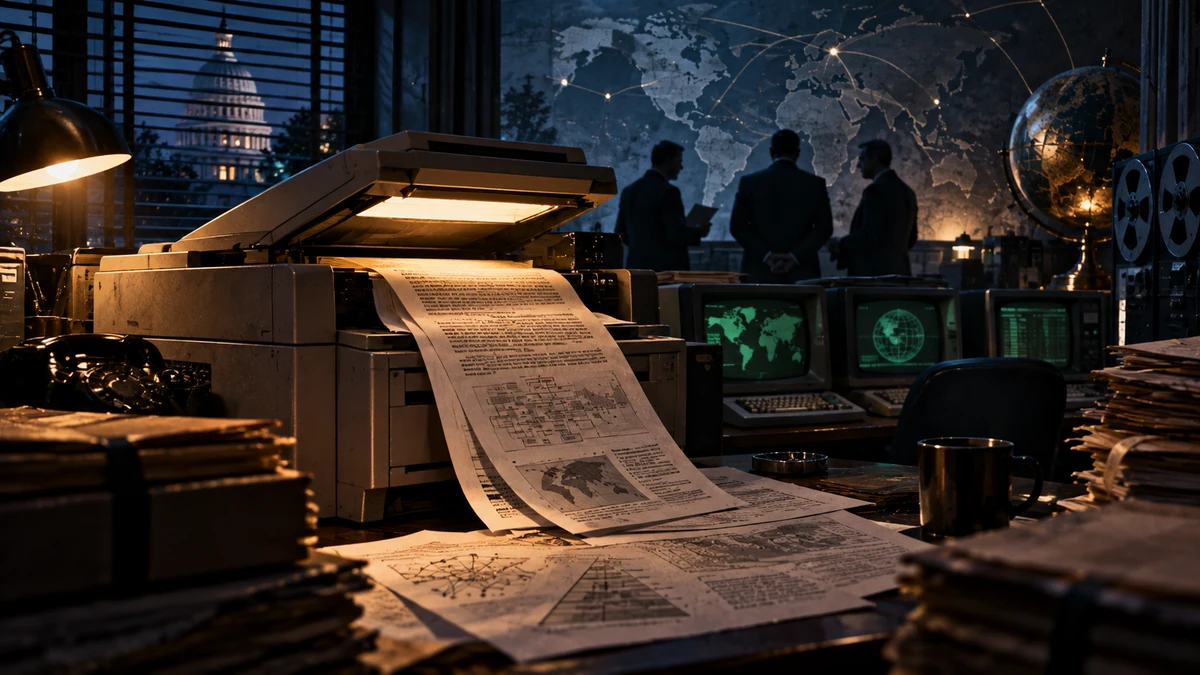
Silent Weapons for Quiet Wars is one of those documents in which text and legend have become so entangled that we must first separate the document itself, the story of its origin, and later interpretations. It presents itself as a secret operations-research manual for social and economic control, dated May 1979.
The document’s authenticity is uncertain, so its content should not automatically be read as a direct window into the thinking of a “ruling elite”. A tighter distinction is: the document is important and worth analysing, but until provenance is demonstrated, its narrator cannot automatically be equated with a real state, intelligence or elite institution. At the same time, disputed provenance does not by itself exclude the possibility that influential state, financial, corporate or other networks use similar methods.
The most important new finding is that the story of discovery inside an IBM copier in 1986 is not a secure point of origin. There is bibliographic evidence for publication around 1986; William Cooper unquestionably popularised it in 1991; and Hartford Van Dyke claimed authorship in 2003, saying he compiled it in 1978–79. There is also a reproduced October 1985 trace which, if its date is original, would mean the text circulated before the famous copier story.
The purpose of the article is therefore not to choose between two extremes — “proven secret elite manual” or “worthless fabrication”. The more useful questions are: how far back can the document be traced, which real ideas were incorporated into it, which of its techniques have genuine analogues in economics and social engineering, and where does mythology begin?
The document, the “Top Secret” label and the earliest trace
Its title page presents it as Operations Research Technical Manual TM-SW7905.1. The introduction describes a “quiet war” waged not with conventional weapons but through information, economics, data, behavioural patterns and feedback systems. Society is described almost as an electronic circuit: a population becomes a system that can be measured, stimulated, loaded and steered.
The document deliberately adopts a cold, dehumanising register. It speaks of social automation, economic shock-testing, control of energy, population as a resource, and manipulation of education, entertainment, family, credit and consumption. This is one reason it feels like a plausible internal manual — and also why it works so effectively as political literature.
The document has the appearance of a classified technical manual, but appearance is not a chain of origin. For genuine classified material we would want a traceable archival collection, document number in an institutional system, credible classification markings, authorship or signatures, distribution records, declassification trail or independent institutional confirmation.
The public record for Silent Weapons currently provides none of that. Library catalogues establish printed editions from the 1980s, but they do not establish that the text originated inside the CIA, Pentagon, Bilderberg Group or another institution later associated with it.
WorldCat catalogues a printed work titled Top secret: silent weapons for quiet wars and dates it approximately to 1986, with Delamer Duverus listed as author or contributor. Google Books records a 56-page Lord's Covenant Church edition from 1986.
This matters: by the mid-1980s the text was concrete enough to exist as a physical publication. But a bibliographic record does not authenticate the story that it was a genuine 1979 government manual; it authenticates the existence of a publication or reproduction.
1985–1991: the copier story and the document’s spread
A reproduced text by Gordon “Jack” Mohr dated October 1985 discusses Silent Weapons as a manual already available from The American Sunbeam for four dollars. Mohr says Delamer Duverus allowed him to summarise it.
If that date is authentic and was not inserted in a later reproduction, the consequence is significant: public circulation would predate July 1986, when the document was supposedly first “discovered” inside a copier. We therefore treat this not as final proof but as a serious chronological problem for the standard origin legend.
The best-known story says a Boeing employee bought a surplus IBM copier on 7 July 1986 and found the document inside. A November 1986 America's Promise Newsletter notice, as later described by Hartford Van Dyke, appears to have publicised this version.
The copier story has the structure of an urban legend and should be treated as a provenance claim until independently documented. The article goes further: we currently lack an independent chain of custody from a specific copier to a preserved original, so the event cannot be written as a confirmed discovery. It is a provenance claim, not provenance itself.
Milton William Cooper included Silent Weapons for Quiet Wars as the first chapter of Behold a Pale Horse in 1991. The book linked it to Bilderberg, secret power structures and a broader theory of covert warfare against the population.
This is the central moment of popularisation. Cooper’s book proves what he published and how he interpreted the document; it does not independently prove the accuracy of his Bilderberg or intelligence-community attribution.
Hartford Van Dyke and the authorship question
In December 2003 Hartford Van Dyke wrote to Paranoia magazine claiming that he had compiled the document himself. He said he began the project around October 1978, finished it in December 1979 and initially distributed roughly 65 copies.
Van Dyke described the work as a collage or compilation of many authors. He named operations-research texts, Wassily Leontief, Report from Iron Mountain, systems-analysis material and other technical sources. This is a significant primary provenance claim, but it remains a 2003 self-attribution, not independent forensic confirmation.
Van Dyke said that around 1980 he gave one copy to a uniformed hitchhiker whom he drove to McChord Air Force Base. In his later account, that copy was probably the one found by a Boeing worker in a surplus copier in 1986.
The story explains how his own document might have entered a military environment without being a government manual. But the chain rests on his recollection more than two decades later. No publicly available independent record presently links his specific copy, the specific serviceman, the specific copier and the later discovery.
His account is more detailed than a bare “I wrote it”. He described the work as a compilation and identified the origins of specific concepts and even design elements. In particular, he said the military-looking cover was borrowed from a military manual and that Report from Iron Mountain inspired the operations-research framing.
Such details are compatible with an author or very well-informed editor. But without early drafts, correspondence, typescripts or independent 1978–79 witnesses, they should not be converted into a definitive verdict.
Iron Mountain, Leontief and the boundary between method and conspiracy
Van Dyke identified the 1967 Report from Iron Mountain as one of his sources. This matters because that “secret government report” was in fact an anti-war satirical hoax by Leonard C. Lewin. Lewin later publicly acknowledged authorship; the work was designed to explore the logic of militarism and the war economy through convincing bureaucratic fiction.
If Silent Weapons was partly built from a work that itself only pretended to be a secret report, a methodological warning follows: realistic bureaucratic language can generate a powerful impression of internal state reality. This does not invalidate every idea in the document, but it strongly weakens the argument that “it sounds official, therefore it is official”.
Another layer is entirely real. Wassily Leontief developed input-output analysis, a mathematical method for describing interdependence among sectors of an economy, and received the 1973 Nobel Prize in Economic Sciences for that work.
Leontief also applied input-output modelling to disarmament and world-development questions. His 1980 article used a world-economy model to discuss development, partial disarmament and the gap between rich and poor countries. This validates part of the technical vocabulary in Silent Weapons — but not Van Dyke’s interpretation that Leontief thereby created a secret weapon for controlling humanity.
This is one of the article’s central distinctions. Econometric models, operations research, surveys, psychometrics, advertising, data analysis and behavioural sciences are real tools. States, corporations, militaries, banks and political campaigns use them.
But the existence of a tool does not establish one central organisation using it according to the Silent Weapons script. That requires a direct evidence chain: institution, programme, documentation, budget, operators, tasks and outcomes. Without such a chain, we have an analytical model of possible control, not a proven operation.
Economics, information and dehumanising language
The document is correct in a limited but important sense: monetary policy, credit conditions, debt, taxation, inflation, access to capital and economic shocks can substantially change behaviour by individuals and institutions. Governments and central banks openly use economic instruments to influence aggregate demand, inflation and investment.
Political manipulation of those instruments is therefore a legitimate subject of investigation. The error comes when every recession, inflationary episode or interest-rate change is automatically labelled an intentional episode in one hidden war. Each case requires its own evidence of intent.
The document describes control of attention, information, education and entertainment as methods for producing a more predictable population. Again, the basic possibility is not fantasy: propaganda, political advertising, commercial marketing, psychological operations and modern recommendation systems demonstrably seek to influence perception and behaviour.
But Silent Weapons unifies these mechanisms under a single war metaphor. That can be a useful critical lens; it is not evidence that the different systems share a single command structure or objective.
The document often treats people as resources, population units or components of a system. The language is morally chilling and resembles extreme technocratic reductionism.
Its evidentiary meaning depends on authorship. If this were a genuine internal document of a powerful institution, such language would reveal that institution’s perspective. If it is Van Dyke’s political compilation, the same language may be a deliberately exaggerated simulation of the mindset he was criticising. Without provenance, both interpretations remain open.

Bilderberg, CIA and “the elite”: an open hypothesis
William Cooper associated the document with the Bilderberg Group and claimed it represented an adopted doctrine. Other reproductions invoke the CIA, military intelligence and unnamed technical writers who supposedly “authenticated” it.
In the public corpus reviewed here, no primary Bilderberg, CIA or Defense Department record has been found identifying Silent Weapons as its manual. This means those specific attributions cannot be treated as established. It does not mean the possibility of coordinated activity among influential elite networks is thereby excluded. Structures of power are not expected to be perfectly transparent; missing documentation therefore leaves the question open rather than settling it in either direction.
What is supported and what requires qualification
It is right that the document is unusual and that it links economics, data, psychology and control with unusual clarity. It is also right that many of the instruments it describes are themselves real: debt, credit, information environments, propaganda, behavioural analysis and institutional design can influence human conduct.
Its central warning is also useful: modern power does not operate only through physical force. It often operates through rules, incentives, information, prices, norms and infrastructure. That thesis can be supported with many documented cases independently of whether Silent Weapons is authentic.
The text should not be described as a proven “inside view of how the opposing elite thinks” as if the speaker’s identity were already established. Nor should the copier story be treated as a confirmed origin. The most accurate status is: an anonymous or disputed-attribution political-technical text traceable in public circulation at least to the mid-1980s, with a strong later authorship claim by Hartford Van Dyke. The possibility that it describes methods actually used by influential elite networks remains an open hypothesis and must be tested with separate evidence in each concrete case.
The “1979” date also requires caution. The text bears that date and Van Dyke later said he completed it then, but we currently lack an independently verified physical copy with continuous provenance from 1979.
Final meaning: the document is more useful without needing it as “proof”
The greatest value of Silent Weapons for Quiet Wars does not lie in declaring it proof of a secret world plan. Its provenance is too weak for that conclusion. But this does not make the broader question of coordinated activity among influential state, financial, corporate or other elite networks disappear. The document can be read as a possible model of such technocratic or elite thinking, after which its individual mechanisms can be tested against real-world cases.
That model is provocative enough to use as a checklist for the real world: who collects data, who designs incentives, who controls information channels, who can alter economic conditions and what oversight limits those powers? Each answer can then be tested against its own sources.
This preserves the strongest conclusion without an evidentiary leap: quiet instruments of social influence are real; the possibility of coordinated use remains open, but who uses them, for what purpose and on what scale must be established case by case. Absence of public evidence is not proof of non-existence — and it is not, by itself, proof of concealment either.
Sources and further reading
- WorldCat. Top secret: silent weapons for quiet wars: an introductory programming manual, OCLC 47068820, dated [1986?].
- Google Books. Top Secret: Silent Weapons for Quiet Wars; contributor Delamer Duverus; Lord's Covenant Church, 1986, 56 pp.
- Cooper, Milton William. Behold a Pale Horse. Light Technology Publishing, 1991 — contents include 'Silent Weapons for Quiet Wars'.
- Paranoia Magazine material reproduced as 'Letters from the Author of Silent Weapons for Quiet Wars' — Hartford Van Dyke letter, 17 Dec 2003.
- Rex Research mirror of the Van Dyke letters and Silent Weapons text.
- Hack Liberty. Silent Weapons for Quiet Wars — provenance reconstruction including Jack Mohr / American Sunbeam chronology.
- Gordon 'Jack' Mohr. The Mind Slaves — reproduced text attributing October 1985 circulation through The American Sunbeam.
- The Lawful Path. Silent Weapons for Quiet Wars — composite transcription with diagrams and Duverus/APN prefatory material.
- FamGuardian. Silent Weapons for Quiet Wars — transcription of the Cooper-version text.
- Nobel Prize. Wassily Leontief — 1973 prize for development of the input-output method.
- Scientific American. Wassily W. Leontief, 'The World Economy of the Year 2000', September 1980.
- Scientific American. Wassily Leontief author archive — input-output economics, disarmament and economic structure articles.
- Los Angeles Times. Leonard Lewin; Author of Satire on Dangers of Peace, 1 Feb 1999.
- Google Books. Report from Iron Mountain: On the Possibility and Desirability of Peace, Leonard C. Lewin, 1996 reissue.
- Scientific American, September 1980 issue — Leontief article in issue context.
- Google Books. Silent Weapons for Quiet Wars: An Introductory Programming Manual, TGS Publishers, 2005, attributed to Delamer Duverus.
- Google Books. Silent Weapons for Quiet Wars, Book Tree edition, 2018 — later anonymous reprint.