1666: Redemption Through Sin — Robert Sepehr: Sabbatai Zevi, Jacob Frank, and a Theory of Historical Continuity
A presentation of *1666: Redemption Through Sin*: Sabbatai Zevi, Jacob Frank, antinomianism, secret societies, the Illuminati, the Rothschilds, Zionism, and Sepehr’s theory of historical continuity.
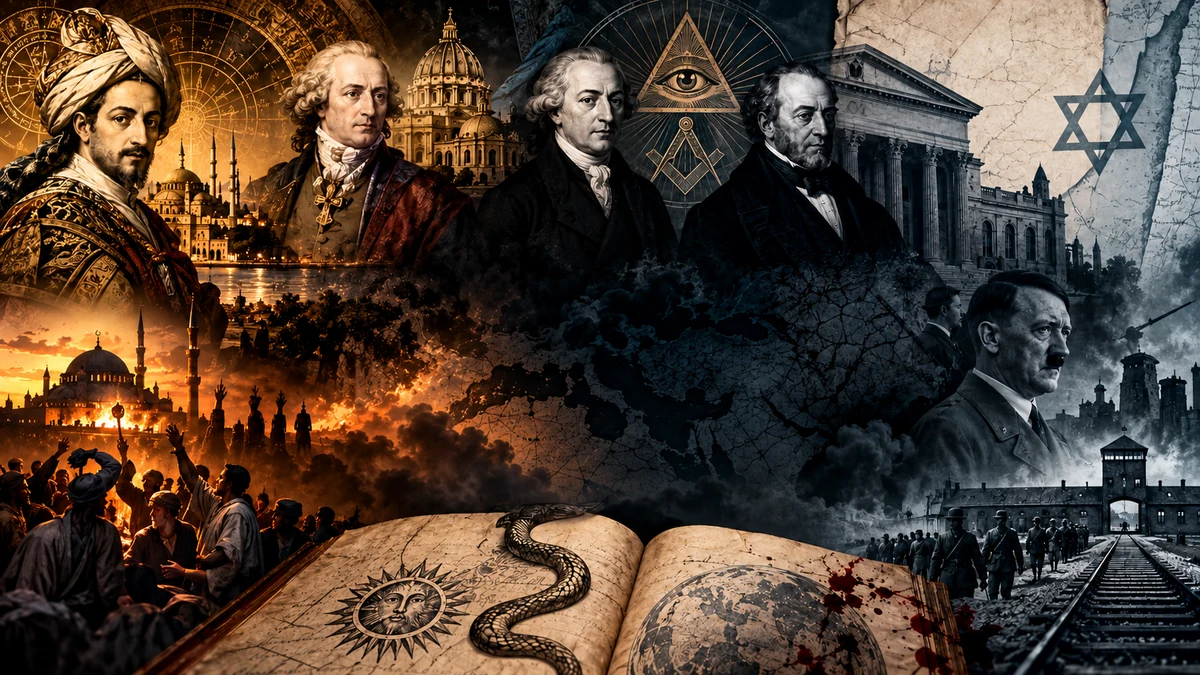
In 2015, Robert Sepehr published 1666: Redemption Through Sin — Global Conspiracy in History, Religion, Politics and Finance. Its central idea is continuity: it begins with the messianic movement of Sabbatai Zevi in the seventeenth century, continues through Jacob Frank and Frankism, and then connects the story to European secret societies, Adam Weishaupt, the Rothschilds, international finance, Zionism, the First World War, Nazi Germany and the Holocaust.
The book contains eight chapters — Sabbatai Zevi, Jacob Frank, Adam Weishaupt, Lord Rothschild, The Illuminated, The Secrets of Zion, Ending the Swastika and The Burnt Offering. Their sequence shows the author’s purpose: to place events normally treated as separate historical episodes on one timeline and search for ideological, personal and institutional continuity among them.
From this point Sepehr makes a broader connecting move: he argues that the story did not disappear but migrated into hidden political and financial structures. The article therefore keeps three levels distinct — what a historical document shows, what Sepehr claims, and what connection the author constructs between those elements.[1][2][1]
1666 and Sabbatai Zevi
Sabbatai Zevi was born in 1626 in Smyrna, modern-day Izmir. He had appeared as a messianic claimant before 1666, but the movement expanded especially rapidly in the mid-1660s. Historical scholarship documents that his ideas reached numerous Jewish communities across the Ottoman Empire and Europe and that the movement became one of the largest Jewish messianic movements of the early modern period.
The year 1666 also carried broader apocalyptic associations. Christian Europe had its own millenarian expectations, so Sepehr begins his narrative in a period in which expectations of radical religious transformation were present in several parts of the religious world.
In September 1666, Ottoman authorities brought Zevi before Sultan Mehmed IV. Zevi then converted to Islam. For his followers this was a shock: the man expected to inaugurate a messianic age had apparently abandoned the religion from which his movement emerged. Even so, the movement did not simply disappear.
Redemption through Sin. In different Sabbatean currents, traditional religious rules could acquire altered meanings, some fast days were reinterpreted, and transgression could acquire symbolic or theological significance. Historiography, especially the work associated with Gershom Scholem, used the phrase “redemption through sin” for some of the more radical developments.
Sepehr presents this antinomian principle very broadly and later uses it as a key for reading political and social history. Sepehr extends antinomianism from religious practice into a broader key for reading political and social history.[3][3][3][3][4][4]

Jacob Frank and the Second Generation of Messianic Heresy
Jacob Frank emerged in the eighteenth century from an environment in which Sabbatean traditions remained active. A movement formed around him that is now known as Frankism. Frank rejected rabbinic authority, while his movement came into sharp conflict with Jewish authorities and later moved closer to Catholic ecclesiastical and political structures.
In 1759 Frank accepted Catholic baptism, and in the broader wave associated with the movement approximately 3,000 followers converted in Lwów, Lublin and Warsaw. Church authorities soon questioned the orthodoxy of his Christianity; in 1760 he was arrested and sent to the monastery at Częstochowa, where he remained for years.
Frankism was a heterodox movement in conflict both with rabbinic Judaism and later with church authorities. Sabbateans and Frankists therefore cannot be used as synonyms for Jews or Judaism as a whole.
Frankism and the European World of Secret Societies. Eighteenth-century Europe experienced the growth of Masonic lodges, Rosicrucian groups, alchemical circles, occult orders and other initiatory associations. Frankist circles moved within parts of the same social environment. Modern research places Frankism in the broader world of Western esotericism and documents meaningful connections with Masonic networks.
An especially unusual figure was Moses Dobruška, later Franz Thomas von Schönfeld and finally Junius Frey. He came from a Frankist background and was related to Jacob Frank. He converted to Catholicism, entered the nobility, operated in Masonic and broader illuminist environments and later appeared in revolutionary France, where he was guillotined in 1794.
Dobruška’s life therefore shows that connections among Frankist, Masonic, esoteric and revolutionary environments were not merely later literary constructions. Sepehr then builds a much broader continuity from such connections.[5][5][5][6][7][6][7]
Adam Weishaupt and the Bavarian Illuminati
Adam Weishaupt was a professor of canon law in Ingolstadt. In 1776 he and a small group founded a secret society that became known as the Bavarian Illuminati. The organisation possessed a secret hierarchy, sought members in educated and influential circles and attempted to expand its reach through relationships with Masonic lodges.
The historical Bavarian Illuminati were therefore not an invented organisation. They existed, operated secretly and sought social influence. In the 1780s the Bavarian authorities prohibited the group, while Weishaupt lost his professorship and left Bavaria.
Sepehr incorporates this historical organisation into a continuation of the Frankist story. In his account, Jacob Frank entered a wider alliance in which Adam Weishaupt, Mayer Amschel Rothschild and Frankist circles played different organisational, financial and network roles.
Frank, Weishaupt, and Rothschild. Historical scholarship documents real connections between Frankist figures and Masonic or wider esoteric circles. Sepehr’s more specific construction of a unified Frank–Weishaupt–Rothschild alliance is the next connecting step in his narrative.[8][8][1][1][6]
From Secret Order to Financial Power
The fourth and fifth chapters move the narrative from religion and secret societies into finance. In Sepehr’s account, the Rothschild family becomes a central link through which historical continuity moves from the eighteenth century toward the modern financial system. The book then discusses central banks, political influence, revolutions, wars and groups said to operate behind formal institutions.[1]
*The Secrets of Zion* and the Move into the Twentieth Century
In the sixth chapter Sepehr connects the story with Zionism, British policy and the creation of a Jewish national home in Palestine. One important document is the Balfour Declaration. On 2 November 1917, British Foreign Secretary Arthur James Balfour wrote to Lord Rothschild expressing the British government’s support for the establishment in Palestine of a “national home for the Jewish people,” while referring to the civil and religious rights of non-Jewish communities and the rights of Jews in other countries.
Sepehr places the declaration within a wider story of British, Zionist and financial interests and also connects it with American entry into the First World War. Chronology matters here: the United States declared war on Germany on 6 April 1917, while the Balfour Declaration was issued on 2 November 1917.
The US Office of the Historian identifies renewed German unrestricted submarine warfare and the Zimmermann Telegram among the immediate factors in the American decision to enter the war, while wider political and economic causes remain subjects of historical discussion. This chronology does not exclude broader diplomacy or lobbying, but it places Sepehr’s specific connection within the actual sequence of events.
From Zionism to Nazi Germany. In the final two chapters Sepehr extends the historical continuity established earlier to Nazi Germany, the Second World War, Zionism and the Holocaust. He incorporates Germany’s economic crisis, reparations, international financial flows, political radicalisation, Nazi economic policy, persecution of Jews, migration and the later establishment of Israel into the narrative.
After Hitler came to power, unemployment in Germany fell sharply. Modern economic research using archival data finds that rearmament played an important role; one study estimates that military expenditure may account for roughly one third of the total decline in unemployment during the period it examined from 1932 to 1936.
That is an economic question. Separate from it is the political and criminal history of the Nazi regime: after 1933 the regime dismantled political opposition, introduced racial legislation, persecuted Jews and other groups, and later conducted aggressive war and mass killing. Sepehr interprets these events within his wider theory of historical continuity.[10][11][1][10][12][12][1][13][1][14]
*The Burnt Offering* and the Holocaust
The title of the final chapter, The Burnt Offering, indicates the direction of Sepehr’s conclusion: he seeks to place the Holocaust within the same long narrative that begins with Sabbatai Zevi and Jacob Frank.
Alongside that interpretation stands an extensive independent historical record. The Holocaust was the systematic, state-organised persecution and murder of approximately six million European Jews by Nazi Germany and its allies and collaborators. Victims were murdered through mass shootings, killing centres and camps, and through deportation, forced labour, starvation, disease and deliberately imposed conditions of life. The Nazi regime also persecuted and murdered many members of other groups.
In the final part of the book, Sepehr incorporates Nazi persecution, deportations, mass killing, and the Holocaust into the continuity he constructs from Sabbatean history onward.[1][14][1]
One Story, Many Histories
Sepehr’s distinctive contribution is to draw one long line among those points. The book is therefore not merely a history of Sabbatai Zevi or Jacob Frank but an attempt to construct a genealogy of hidden power.
Sepehr uses personal connections, organizational memberships, financial relationships, and correspondence as building blocks from which he constructs a broader shared purpose and historical continuity.
If breaking a rule is simply sin, it represents departure from religious order. If transgression is presented as a way to move beyond an old order, it can take on another meaning: destruction of existing boundaries becomes a precondition for the creation of a new order. This is central to Sepehr’s interpretation of Sabbatean and Frankist antinomianism.
Sepehr then transfers the same concept to political history. Revolutions, the dismantling of traditional institutions, changes in sexual norms, financial crises, wars and political projects begin to appear in the book as manifestations of the same principle: the old order must be destroyed before a new one can emerge.
In this way the expression “redemption through sin” moves from a specific seventeenth- and eighteenth-century religious environment into a general explanatory key for modern history. That is Sepehr’s connecting framework.
Conclusion: Sepehr’s Theory of Historical Continuity. 1666: Redemption Through Sin begins with the messianic movement around Sabbatai Zevi: a messianic leader creates a large movement, then converts to Islam, while some followers incorporate his apostasy into a theology of redemption. A century later Jacob Frank continues a radical heterodox tradition, his followers convert to Catholicism and enter wider European society.
A document shows an event. A connection shows a relationship. An interpretation assembles them into a story. 1666: Redemption Through Sin is Robert Sepehr’s version of that story.[1][1][4][1][3][5]
Sources and further reading
- Robert Sepehr — 1666: Redemption Through Sin: Global Conspiracy in History, Religion, Politics and Finance, Atlantean Gardens, 2015 Source
- WorldCat — bibliographic record for 1666: Redemption Through Sin by Robert Sepehr Source
- David J. Halperin — Sabbatai Zevi: Testimonies to a Fallen Messiah, Cambridge / Littman Library; introduction and primary-source context Source
- Jay Michaelson — scholarship on Sabbatean/Frankist sexual transgression and the limits of older generalizations Source
- Paweł Maciejko — Frankism, YIVO Encyclopedia of Jews in Eastern Europe Source
- Paweł Maciejko — The Heresy of Jacob Frank: From Jewish Messianism to Esoteric Myth; chapter on Frankism and Western esotericism Source
- Historical research on Moses Dobruška / Franz Thomas von Schönfeld / Junius Frey and his Masonic-esoteric milieu Source
- Ludwig-Maximilians-Universität München — historical overview of Adam Weishaupt and the Bavarian Illuminati founded in 1776 Source
- National Geographic History — Adam Weishaupt and the Illuminati; editorial correction concerning an unsupported Rothschild claim Source
- British Library — The Balfour Declaration, 2 November 1917, Add MS 41178 A Source
- UK House of Commons Library — Balfour Declaration: historical background and competing interpretations Source
- U.S. Department of State, Office of the Historian — U.S. entry into World War I and the 1917 chronology Source
- Kiel Institute for the World Economy — The Economic Effects of Rearmament: Evidence from Nazi Germany Source
- United States Holocaust Memorial Museum — Introduction to the Holocaust and the documented murder of approximately six million European Jews Source
- United States Holocaust Memorial Museum — The Final Solution: coordination, deportations and killing operations Source