Ring of Power — Amenstop Productions / Grace Powers: a series about hidden power, its sources, and proposed connections
Ring of Power links 9/11, symbolism, genealogy, banking, and elite networks. The article tests individual claims against documents and history.
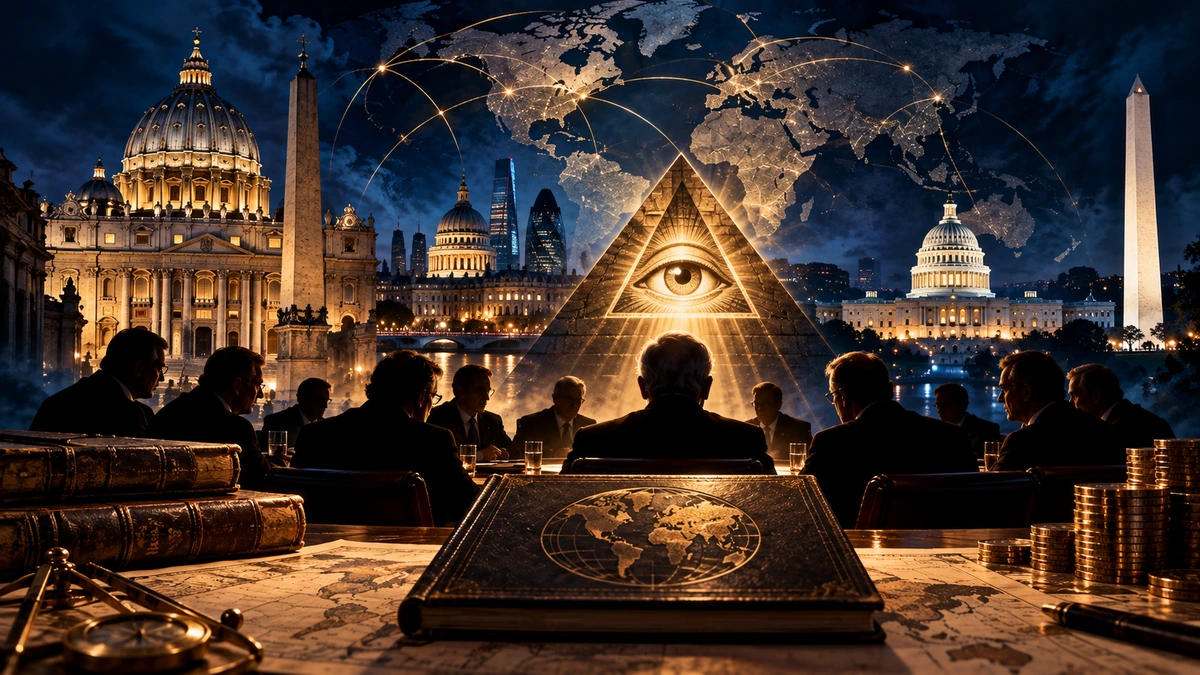
Ring of Power is a nearly five-hour documentary series associated with Amenstop Productions and an author using the name Grace Powers. Preserved copies from the 2007–2008 period divide it into ten parts, moving from 9/11 and the “Empire of the City” through religion, royal genealogy, central banking, monopoly power, the “New World Order,” and proposed solutions.[1][2] In preserved 2009 author material, “Grace Powers” is explicitly identified as a pseudonym.[3]
The series is relevant because many of the institutions and historical episodes it invokes are real and important. The City of London has an unusually old and distinct local governance structure; Vatican City is a sovereign state; the 1910 Jekyll Island meeting was genuinely secret and helped shape the later U.S. central-banking framework; the Bank of England was privately owned for centuries; the Federal Reserve contains both public and private-member elements; the Crown Estate is a major institutional property structure; and elite financial and political networks are historically traceable.[4][5][6][7][8]
The film then connects these facts with symbols, genealogies, religious traditions, banking families, intelligence claims, and theories of global rule. this article does not judge the film as a whole. It separates its component claims and asks, for each one: what does the film say, what do primary or institutional sources show, which part is directly documented, which part remains an interpretation or open claim, and where the legal or historical record gives a different description.
The aim is not to protect an “official narrative” from criticism. It is to preserve the value of real evidence. A documented structure remains documented even when a wider interpretation is uncertain; an uncertain wider interpretation does not erase the documented structure beneath it.
What *Ring of Power* is — Grace Powers and the limits of biographical verification
Preserved copies list ten chapters and a total running time of roughly five hours.[1][2] The series attempts to connect: 9/11, the City of London, Vatican City, and Washington, D.C., ancient Egyptian religion and symbolism, biblical history, European royal genealogies, central banks, oil, gold, and drugs, transnational financial elites, the “New World Order” and and a future unified global authority. Its method is synthetic: it assembles many historical facts, symbols, institutions, and claims into one large interpretive framework. That is why this article checks the claims separately rather than accepting or rejecting the synthesis in one step.
Grace Powers and the limits of biographical verification
Preserved 2009 author material explicitly reserves the author's identification under the pseudonym Grace Powers.[3] Later promotional material includes autobiographical claims about psychology, film training, documentary production, and a father allegedly connected with Freemasonry. In this article these are treated as author self-description unless independently corroborated. The documentary claims themselves can be evaluated without resolving the author's private identity.
Episode 1 — 9/11 and attribution — Collective labels versus named actors
The first episode frames responsibility for 9/11 through a broad contrast between “Muslims” and “Israeli Zionists.”[1][2] For historical attribution, both labels are too broad. Operational responsibility is established through named people, organizations, financing, communications, training, logistics, and command relationships. The FBI's PENTTBOM investigation identified 19 hijackers and states that all 19 were trained by al-Qaeda.[9] The 9/11 Commission likewise reconstructed the attacks as an al-Qaeda operation.[10] In the public documentary corpus reviewed for this article, no comparable operational chain was found establishing that the Israeli state or the broad category “Zionists” planned and executed the attacks. That finding does not close investigation of intelligence anomalies, foreknowledge claims, or political consequences; it only separates those questions from operational attribution.
Collective labels versus named actors
The film moves at points between specific bankers, dynasties, Jews, “Zionists,” Israel, Freemasons, royal houses, and central banks. For research purposes these categories cannot be treated as interchangeable. A specific bank can be examined through ownership records and transactions. A specific intelligence service can be examined through operations and documents. A family can be examined through shareholdings, offices, trusts, or political relationships. Ethnic, religious, or broad ideological labels do not substitute for named actors, institutions, money flows, documents, and actions.
Episode 2 — “Empire of the City”
The film links three places: the City of London, Vatican City and Washington, D.C.
and interprets them as three “city-states” associated with finance, religion, and military power.[1][2] Their legal status is different. Vatican City is a sovereign state established by the Lateran Treaty in 1929.[5] Washington, D.C. is a federal district under a special constitutional and congressional framework, not a sovereign state.[11] The City of London Corporation has a very old and distinctive local constitution, its own Lord Mayor, and its own police force. But the UK Parliament and the City itself state that the City of London is not an independent sovereign state and that UK law applies within the Square Mile.[4][12] The film therefore brings together three genuine centers of institutional power, while the reviewed legal sources describe three different constitutional statuses.
The three stars on the flag of Washington, D.C. — Obelisks in Rome, London, and Washington
The film and related material connect the three red stars on the District of Columbia flag with London, the Vatican, and Washington.[1] The official D.C. history gives a different provenance. The flag, adopted in 1938, derives from George Washington's family coat of arms: three red mullets above two red horizontal bars.[13] this article therefore presents the symbolic interpretation alongside the documented heraldic origin.
Obelisks in Rome, London, and Washington
The film points to obelisks in the Vatican, London, and Washington. The shared visual motif is real, but the three monuments have different histories. The obelisk in St. Peter's Square is an ancient Egyptian monument transferred to Rome and moved to its current position in 1586.[14] Cleopatra's Needle in London is also an authentic ancient Egyptian obelisk, brought to London in the nineteenth century.[15] The Washington Monument is a modern American memorial consciously designed in the form of an Egyptian obelisk.[16] The sources therefore confirm symbolic continuity. Establishing continuity of a single organization would require a separate historical transmission chain.
Episode 3 — Egypt, religion, and transmission — Episode 4 — Jesus, Mary Magdalene, and royal bloodlines
Trail of the Pharaohs places biblical narratives within a broader field of Egyptian religion and older mythic motifs. Comparative religion can legitimately identify: recurring symbols, parallel motifs, adaptation between traditions and layered composition of religious texts. A resemblance between myths, however, does not by itself establish direct copying or an uninterrupted secret priesthood. A historical transmission claim requires dated texts, archaeology, documentary contacts, and a traceable chain of transmission.
Episode 4 — Jesus, Mary Magdalene, and royal bloodlines
The series presents genealogical claims connecting Jesus and Mary Magdalene with Merovingian and later European royal lines.[1][2] The historical record does not provide an uninterrupted first-century genealogy establishing that Jesus and Mary Magdalene were married, had descendants, and that those descendants can be followed through the Merovingians into the British royal family. Modern scholarship distinguishes: early canonical sources, later apocryphal traditions, medieval legends and and modern bloodline theories.[17][18]. Mary Magdalene's importance among Jesus' followers is historically significant. The proposed dynastic genealogy is a separate and much stronger claim.
Episode 5 — monarchy, property, and the Crown Estate — Episode 6 — Bank of England: historical and present ownership
The British monarchy is connected with substantial and complex institutional property arrangements. These include: private property, the Crown Estate, the Duchy of Lancaster, official residences, the Royal Collection and and public funding for official functions. The Crown Estate states that it is not the monarch's private property, cannot be freely sold by the monarch, and is managed independently; its net revenue is paid to the Treasury.[19][20] That does not make the institution insignificant. It defines the legal distinction between institutional property held “in right of the Crown” and the monarch's private assets.
Episode 6 — Bank of England: historical and present ownership
The Bank of England was founded in 1694 as a privately owned institution and raised capital that supported a government loan during war with France.[7] Private Bank stock and shareholder voting existed for centuries. The Bank was nationalized in 1946. Today it is wholly owned by the UK government, with its capital held for HM Treasury, while some central-banking functions operate with statutory independence.[7][21] this article therefore presents both layers: a long private-ownership history and a different present legal ownership structure.
Federal Reserve: a hybrid institutional structure — Jekyll Island: a documented secret meeting
The Federal Reserve is neither a conventional ministry nor an ordinary private corporation. The Board of Governors in Washington is a federal government agency. The twelve regional Reserve Banks have corporate features, and member commercial banks are required to subscribe to stock in their regional Reserve Bank.[8] That stock is not ordinary tradable equity: it cannot be freely sold or pledged, it does not carry the normal residual ownership claims of commercial shares and it exists as part of the statutory membership structure.[8][22].
Member banks nevertheless have real institutional roles, including the election of some regional Reserve Bank directors. A precise description is therefore a statutorily created public-private central-banking system with public governance and real private-member components.
Jekyll Island: a documented secret meeting
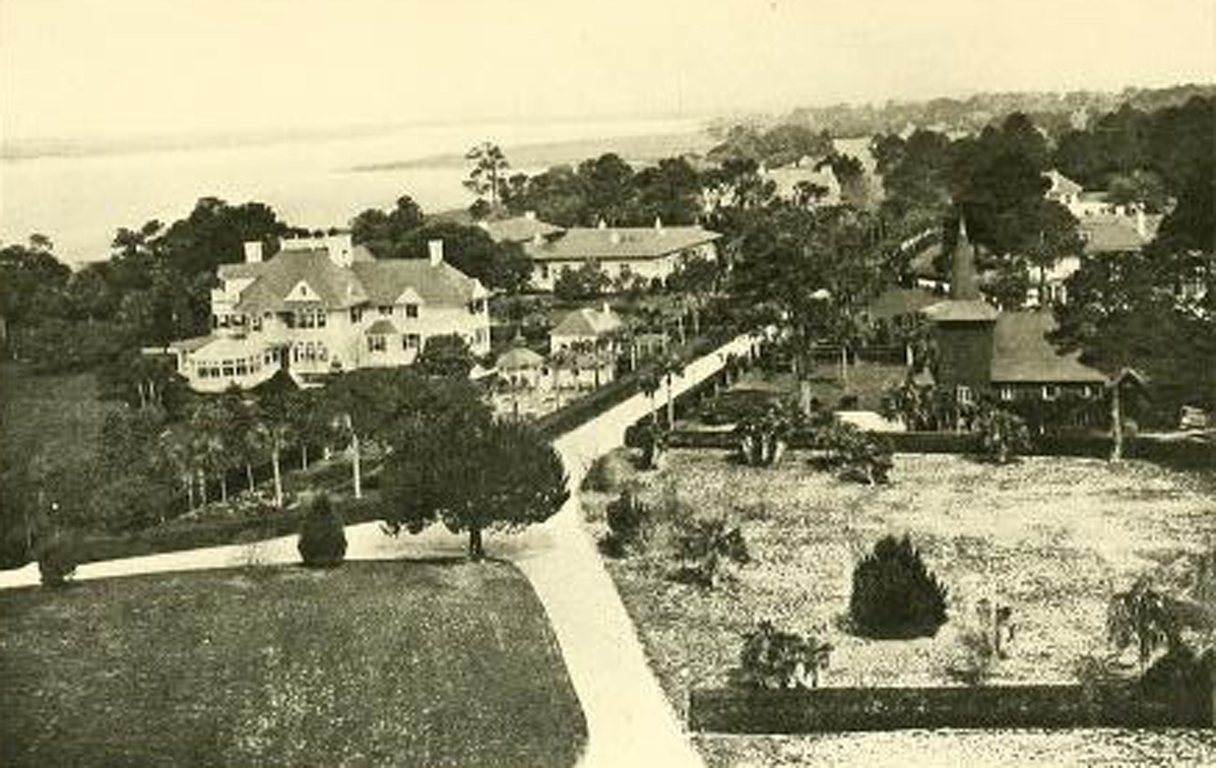
The Jekyll Island meeting is not a legend. Federal Reserve History states that six men secretly met there in November 1910: Nelson Aldrich, A. Piatt Andrew, Henry Davison, Arthur Shelton, Frank Vanderlip and Paul Warburg.[6]. The purpose and participants were deliberately concealed, and the gathering produced a plan that became an important foundation for the later Federal Reserve system.[6] This is a significant historical example of elite financial planning conducted in secrecy. It also illustrates why this article checks each wider banking claim separately: confirmation of Jekyll Island establishes Jekyll Island; broader claims require their own evidence.

Ownership is only one form of central-banking power — Episode 7 — *Cheating at Monopoly*
A central bank's structure cannot be reduced to the single question “who owns it?” Relevant questions include:
- legal ownership;
- appointments;
- voting rights;
- statutory mandate;
- operational independence;
- private-sector access;
- revolving doors;
- monetary-policy authority.
The film often places these under one word—control. this article separates them so the actual architecture can be seen.
Episode 7 — Cheating at Monopoly
The Monopoly metaphor asks whether a system is materially equal if some actors can influence rules, obtain credit on different terms, receive emergency support, or accumulate assets from structurally advantaged positions. Those are legitimate political-economic questions. Concentrated outcomes can arise through several mechanisms: legislation, lobbying, regulatory capture, historical accumulation, network effects, inheritance, monetary policy and crisis interventions. The film's broader claim can therefore be decomposed into measurable questions: who writes the rules, who has privileged access, who receives support, who bears losses, and how wealth and credit become concentrated.
Episode 8 — “New World Order Mafia”
The film uses “New World Order Mafia” as an umbrella category for bankers, royal families, politicians, intelligence networks, corporations, Freemasonry, and global institutions. the previous article on elite networks already documented that organizations such as Bilderberg, CFR, and the Trilateral Commission are real elite infrastructures of access, agenda-setting, personnel circulation, and policy production. this article therefore does not reduce such structures to fiction. It does, however, separate each organization, person, financial relationship, and policy mechanism rather than treating a broad umbrella label as a single legal or operational entity.
Episode 9 — global authority and disarmament — Episode 10 — personal sovereignty and verification
The film interprets international cooperation, arms-control agreements, and global institutions as movement toward a unified world authority. Several component facts are documented: international arms-control agreements exist, supranational and international institutions exist, states sometimes pool or coordinate authority by treaty and political and economic elites openly discuss “global governance.”. A further claim—that these institutions form a single concealed command structure moving toward one world government—requires evidence of a common strategic authority and implementation chain. The terms global governance and world government therefore remain separate categories in this article.
Episode 10 — personal sovereignty and verification
The final part moves from analysis of institutions to personal responses. For THY-REALITY, the useful research principle is not to replace one authority with another. Practical epistemic sovereignty means: reading primary documents, checking financial records, identifying legal status, building timelines, separating individuals from collective labels, tracing ownership and control mechanisms and and keeping a hypothesis open to disconfirmation. That approach allows the reader to retain documented evidence without being forced into a predetermined overall conclusion.
Themes directly supported by the reviewed sources
The reviewed sources directly support or strongly support several central themes raised by the documentary:
- The Jekyll Island meeting was secret and historically important.
- Its plan influenced the development of the Federal Reserve framework.
- The Federal Reserve contains real private-member components.
- The Bank of England was historically privately owned.
- The City of London has an unusual, old, and influential local governance structure and is a major financial center.
- Vatican City is a sovereign state.
- The British Crown is connected with large institutional property structures.
- Egyptian symbolism is visibly present in Rome, London, and Washington, though the individual monuments have different documented histories.
- Elite financial, political, and institutional networks are real and historically traceable.
These documented elements remain important regardless of how one interprets the documentary's larger synthesis.
Claims where the reviewed record gives a different or incomplete picture
For several points, the legal, historical, or documentary record gives a different or less complete picture than the film's larger interpretation:
- The City of London is not legally a sovereign independent state.
- Washington, D.C. is a federal district, not a sovereign city-state.
- The three stars on the D.C. flag derive from George Washington's family arms.
- Shared obelisk symbolism does not by itself establish a single continuing organization.
- No uninterrupted genealogy from Jesus and Mary Magdalene to the British royal house is established by the reviewed historical record.
- The Crown Estate is not the monarch's private personal property.
- The Bank of England has been owned by the UK government since 1946.
- Federal Reserve stock is not ordinary freely tradable private-company equity.
- Jekyll Island establishes a secret banking-planning meeting but does not, by itself, establish every later theory about banking dynasties.
- The reviewed public record does not establish an operational chain attributing 9/11 to the broad category “Israeli Zionists.”
- Elite-network overlap does not, by itself, identify one legal entity or a single command center.
- Symbolic continuity and organizational continuity are separate historical questions.
A wider interpretation does not erase a documented component
this article avoids the reverse error as well. If one symbolic interpretation is unsupported, that does not make Jekyll Island disappear. If a property claim is legally overstated, that does not erase the Crown's unusual institutional position. If one global-command theory is not directly documented, that does not erase the elite networks documented in the previous article on elite networks. The article therefore treats the film as a set of atomic claims rather than a single all-or-nothing proposition.
Institutional sources and their limits — A six-level information scale for documentaries about hidden power
this article relies repeatedly on the Federal Reserve, Bank of England, City of London, D.C. government, FBI, 9/11 Commission, and Crown Estate. Institutional sources are particularly strong for:
- formal legal structure;
- official records;
- documents held by the institution;
- stated governance arrangements.
They are not automatically the final word on every criticism of informal influence. For questions about lobbying, revolving doors, elite access, or informal power, a broader body of evidence is needed. The same standard applies to official and alternative sources alike.
A six-level information scale for documentaries about hidden power
this article uses descriptive rather than evaluative statuses:
Documented
A law, archive record, official record, contract, or verifiable ownership document directly supports the claim.
Supported
Several independent sources converge on the claim.
Partial / limited
A component is documented, while the wider connection remains incomplete.
Interpretation
A possible explanation exists alongside other plausible explanations.
Not confirmed
The reviewed corpus did not provide sufficiently direct evidence.
Different record in the sources
Primary legal or historical sources give a different status, provenance, or chronology. This keeps the reader informed without deciding the larger worldview for them.
Conclusion of the cross-check
Ring of Power brings together multiple documented historical components: secret financial planning at Jekyll Island, the private history of central banking, unusual institutional structures, ancient symbolism, royal property arrangements, and real elite networks. It also connects these components into a much larger explanatory framework involving bloodlines, symbolic continuity, intelligence operations, banking dynasties, and global rule. this article does not ask the reader to accept or reject that entire framework at once. Instead it preserves a simpler distinction:
where the documentary record confirms a structure, we report the structure clearly; where a wider connection is proposed, we show what evidence currently connects—or does not yet connect—the steps.
The result is not a verdict on the film. It is an information map that allows the reader to form their own conclusion.
Sources and further reading
- Amenstop Productions / Grace Powers — Ring of Power, preserved copies and episode descriptions Source
- Preserved chapter listing and episode descriptions Source
- Grace Powers — William / Powers Publishing (2009), pseudonym notice Source
- City of London Corporation — governance and institutional role Source
- Vatican City State — history and sovereign status Source
- Federal Reserve History — The Meeting at Jekyll Island Source
- Bank of England — ownership and history Source
- Federal Reserve Board — Who owns the Federal Reserve? Source
- FBI — 9/11 Investigation Source
- National Commission on Terrorist Attacks Upon the United States — 9/11 Commission Report Source
- Government of the District of Columbia — Statehood FAQ / Governance Source
- UK Parliament / City of London — state-within-a-state claim record Source
- Office of the Secretary of the District of Columbia — D.C. symbols and flag history Source
- Historical reference — St Peter’s Square Egyptian obelisk Source
- London Museum — How Cleopatra’s Needle came to London Source
- U.S. National Park Service — Washington Monument history Source
- Bart D. Ehrman — Truth and Fiction in The Da Vinci Code Source
- Joan E. Taylor — Defining the Real Mary Magdalene Source
- The Crown Estate — history and ownership status Source
- The Crown Estate — governance / FAQs Source
- Bank of England — governance and public ownership Source
- St. Louis Fed — Reserve Bank stock and public-private structure Source