The New World Order — A. Ralph Epperson: Symbols, Secret Societies, and a Political-Financial Model of the New World Order
A presentation of Epperson’s *The New World Order*: the Great Seal, the Illuminati, Freemasonry, Marx, the Thule Society, humanist manifestos, and the author’s model of a new world order.
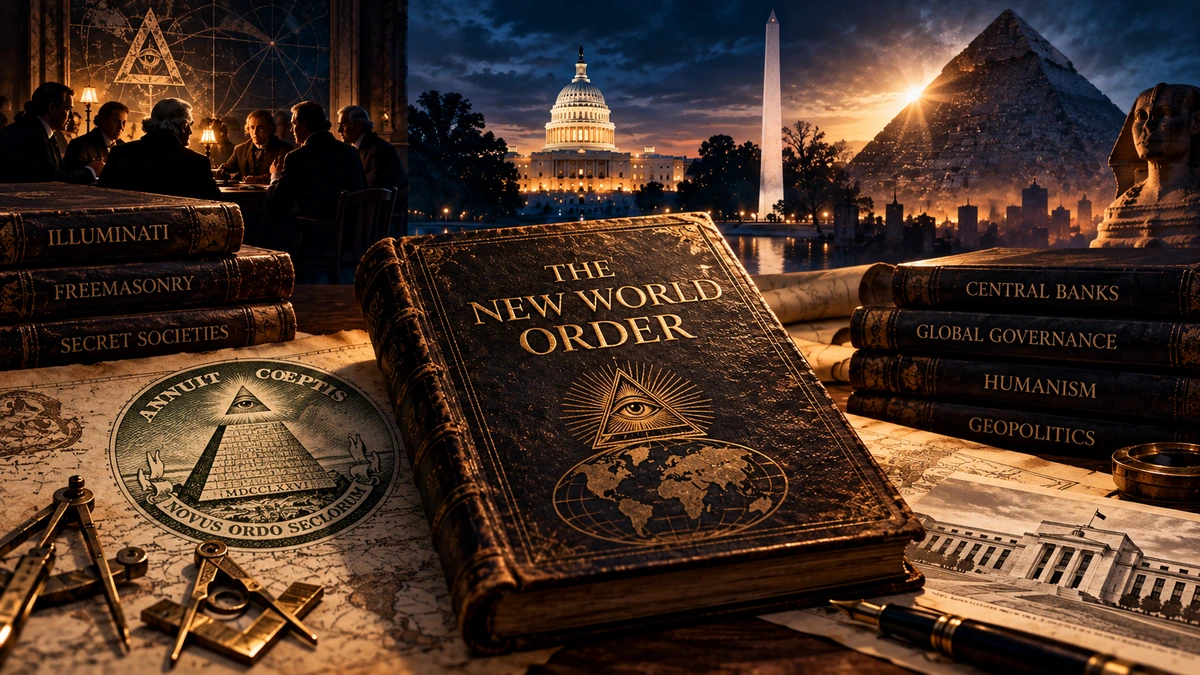
A. Ralph Epperson published The New World Order in 1990 through Publius Press in Tucson. Bibliographic records describe an xxi + 357-page volume with 39 numbered chapters ranging from the New Age movement, Maitreya, ancient mysteries, and the Illuminati to Karl Marx, Adolf Hitler, the Great Seal of the United States, Freemasonry, Albert Pike, humanism, education, property, nationalism, Ronald Reagan, and George H. W. Bush. The book is not built around one archival proposition. It presents a historical model in which symbols, secret societies, political doctrines, financial institutions, and individuals are linked across centuries into a long-term “New World Order” project.
Epperson builds his narrative around the Bavarian Illuminati, Adam Weishaupt, and later references to Illuminati ideas by George Washington. In the book, these elements serve as the historical foundation for a wider story about how secret-society ideas are said to move through political and Masonic environments.[1][2][3][4]
Epperson’s Basic Thesis and the Great Seal
Epperson structures the book around two ways of understanding history. The first is the ordinary model in which visible political, economic, social, and military causes interact, organizations have limited lifespans, and different actors pursue different interests. The second is the “conspiratorial view of history” developed throughout the book: apparently separate events are said to form part of a long-term plan; symbols and secret societies carry ideas across generations; financial, political, and religious elites cooperate in the construction of a new world order; and public events are treated as the visible surface of a deeper structure.
Epperson builds the model as a sequence of connected questions and historical links, moving from organizations and ideas to personal networks, symbols, and claims of long-term continuity.
The Great Seal of the United States
Charles Thomson, the Eye above the Pyramid, and Symbolic Language. Thomson wrote that the pyramid signified strength and duration; the eye and Annuit Coeptis referred to the “signal interpositions of Providence” in favor of the American cause; MDCCLXXVI marked the year of the Declaration of Independence; and Novus Ordo Seclorum marked the beginning of the new American era. The seal was adopted on June 20, 1782. This primary record establishes the official explanation available at the time. Any claim of an additional concealed meaning requires a further evidentiary layer concerning the intention of the designers.
Is the eye over the pyramid a Masonic sign?
For Epperson, the Great Seal is more than a state emblem. He reads the unfinished pyramid, the eye, and the Latin mottos as a symbolic summary of a political program extending beyond the American republic itself. The book therefore begins with a symbol before moving to organizations, people, and ideologies: the symbol is meant to show from the start that the history he tells is both political and esoteric.[10][11][10]

1776 and the Bavarian Illuminati
The Ban, Continuity, and Washington’s Letters. The Bavarian Illuminati were exposed and prohibited during the 1780s. LMU describes their decline, Weishaupt’s loss of his professorship in 1785, and the ban on the Illuminati and Freemasons. The same institutional history also notes that some former members were later rehabilitated and returned to important positions. That leaves several distinct continuity questions: formal organizational continuity, personal networks among former members, continuity of ideas and movement of people or ideas into other organizations.
The administrative suppression of a formal organization does not, by itself, establish either total disappearance or uninterrupted centralized command. Those are separate historical propositions.[2]
George Washington and the Illuminati: both letters matter
Freemasonry and Albert Pike
In the book, Freemasonry is not merely a symbolic category but an organizational world of lodges, Grand Lodges, rites, degrees, ritual systems, constitutions, and archives. Epperson focuses particularly on the 33rd Degree, Albert Pike, Morals and Dogma, Hiram Abif, oaths, and hierarchy, then connects these elements with his wider political model.
Albert Pike and Morals and Dogma
Pike, Lucifer, Benjamin Creme, and Maitreya. In the section associated with Grand Pontiff, Pike does write the famous words “Lucifer, the Light-bearer!” Immediately around that sentence, however, the text also speaks of a “Sublime Faith” that “despises all the pomps and works of Lucifer” and calls Lucifer the “Spirit of Darkness,” while reflecting on the paradox of the name “Light-bearer.” Elsewhere Pike discusses Satan, Lucifer, and related motifs through Kabbalistic, mythological, and symbolic frameworks.
The documentary point is therefore twofold: Pike genuinely uses Luciferian language, but the broader passage is more complex than a standalone slogan stating that Freemasons worship Lucifer. Epperson’s interpretation is presented alongside the primary text from which it is drawn.
Benjamin Creme and Maitreya
Epperson extends the Maitreya and Share International material into the same wider framework that already contains Freemasonry, the Illuminati, and a coordinated program of cultural change.[14][15][8][16]
Marx, Joanna Southcott, and Religious Motifs
Epperson reads this dramatic language alongside his wider treatment of ritual, symbolism, and esoteric tradition.
Marx’s later critique of religion
Marx plays a role similar to other historical figures in the book: Epperson treats him not only as an economic theorist but as a link in a broader story about the erosion of traditional religion, property, and social order. Early poetry, family background, and later political writings are placed on one developmental axis intended to show the spiritual and political transformation of modernity.
Hitler and the Thule Society
Eric Kurlander discusses organizational and ideological links between German occult or völkisch groups and the early Nazi movement; Epperson uses that milieu as a historical bridge between the Thule Society and early Nazism. He then moves from the organizational environment to the question of Hitler’s personal connection with the Thule Society.[9]
Humanist Manifestos I and II
Humanist Manifesto I was published in 1933 and is available through the American Humanist Association as a historical text. It uses the term religious humanism, describes the universe as self-existing rather than created, treats human beings as part of a natural process, rejects traditional mind-body dualism, calls for transformation of inherited religious forms, and speaks in its economic section of a socialized and cooperative economic order oriented toward the common good. Epperson connects these ideas to a wider program of transforming religion, economics, property, and society. The ideas themselves are present in the manifesto; the claim that they belong to the same operational structure as the Illuminati, communism, New Age movements, and Freemasonry is a further organizational proposition.
The manifestos appear in the book as political-philosophical texts that Epperson connects with wider cultural change.
The chapters on religion, family, education, property, and nationalism gather secularization, education reform, family-law change, social policy, international institutions, and socialist criticism of private property into one story about coordinated cultural transformation.[6][7][1]
Reagan, Bush, and “Thousand Points of Light”
In the final chapters, Epperson gives particular attention to Ronald Reagan, George H. W. Bush, and the phrase “a thousand points of light.” He treats the phrase not only as civic language but as a symbolic sign within his broader narrative of a coming new world order.
The planned Giza event and the Millennium Society become part of Epperson’s symbolic chronology of the turn of the millennium.
Bush’s “New World Order”. Chronology is important here. Bibliographic records date Epperson’s book to January 1990. George H. W. Bush’s best-known presidential address explicitly using the phrase “a new world order” came later, on September 11, 1990, during the Kuwait crisis. In that speech, Bush described a new era of international cooperation in which law would replace the law of the jungle, nations would cooperate, the United Nations would respond collectively to aggression, and stronger states would respect the rights of weaker ones. The 1991 National Security Strategy then stated: “A new world order is not a fact; it is an aspiration — and an opportunity.” It linked the concept to the post-Cold War international system, the United Nations, collective security, democratic and market values, and peaceful resolution of disputes.
The phrase “new world order” later became part of presidential and national-security language, giving Epperson’s earlier use of the phrase an additional layer of reception history.
The same phrase can carry different definitions
A long-running and partly hidden structure linking secret societies, finance, religion, politics, and cultural transformation.
A post-Cold War model of international order, collective security, international law, the United Nations, and cooperation.[1][25][26][26]
Institutions and Structures Connected by the Book
This documentary core remains visible independently of how the reader interprets the larger synthesis.
Continuity and Coordination in Epperson’s Model. Epperson’s broader model requires additional bridges, including: Great Seal ↔ Bavarian Illuminati, Illuminati ↔ uninterrupted modern Masonic command, Pike’s symbolic language ↔ institutional Luciferian worship, Share International ↔ an operational Illuminati/Masonic structure, Marx ↔ a Satanist organization, Hitler personally ↔ formal Thule membership, Humanist Manifestos ↔ the same operational structure as the Illuminati, social reforms ↔ one central plan and Bush’s public “new world order” ↔ the same program described by Epperson.
Conclusion: a Map of Symbols and Connections. Epperson combines organizations, quotations, historical relationships, political phrases, and symbols into a single long continuity. The book’s distinctive feature is precisely this cumulative architecture:
Sources and further reading
- Open Library — A. Ralph Epperson, New World Order, Publius Press, 1990 Source
- Ludwig-Maximilians-Universität München — 1776: The Illuminati Source
- Library of Congress — George Washington to G. W. Snyder, 25 September 1798 Source
- Library of Congress — George Washington follow-up on Illuminati/Jacobin doctrines, October 1798 Source
- Project Gutenberg — Albert Pike, Morals and Dogma (1871) Source
- American Humanist Association — Humanist Manifesto I (1933) Source
- American Humanist Association — Humanist Manifesto II (1973) Source
- Share International — About Share International / Benjamin Creme Source
- Eric Kurlander — From the Thule Society to the NSDAP, in Hitler’s Monsters (2017) Source
- U.S. National Archives — Original Design of the Great Seal of the United States (1782) Source
- U.S. National Archives — The Great Seal: Celebrating 233 Years of a National Emblem Source
- Scottish Rite of Freemasonry — Is the eye in the pyramid a Masonic symbol? Source
- Scottish Rite of Freemasonry — History / development of the Scottish Rite Source
- Albert Pike — Morals and Dogma, XIX: Grand Pontiff Source
- Albert Pike — Morals and Dogma, public-domain complete text Source
- Share International — Maitreya’s emergence / messages Source
- Charles Barbour — Marx’s poetic unconscious: secrecy, literature, and the political Source
- Karl Marx — youthful writings / Oulanem, collected works archival reproduction Source
- National Portrait Gallery — Joanna Southcott (1750–1814) Source
- Reginald H. Phelps — Before Hitler Came: Thule Society and Germanen Orden Source
- Eric Kurlander — Hitler’s Monsters, Thule/NSDAP chapter Source
- A. Ralph Epperson — The New World Order, chapter Reagan and Bush, preserved reproduction Source
- Los Angeles Times — Bush Has a Date With a Pyramid, 3 January 1989 Source
- Los Angeles Times — millennium celebrations / Giza event planning, 29 December 1996 Source
- Miller Center — George H. W. Bush, Address Before a Joint Session of Congress, 11 September 1990 Source
- The White House — National Security Strategy of the United States, August 1991 Source