The Biggest Secret — David Icke: Anunnaki, Reptilian Bloodlines, Genealogy, and Hidden Power
A presentation of *The Biggest Secret*: Anunnaki, reptilian bloodlines, elite genealogy, the Babylonian Brotherhood, ritual, the Rothschilds, and Icke’s model of hidden power.
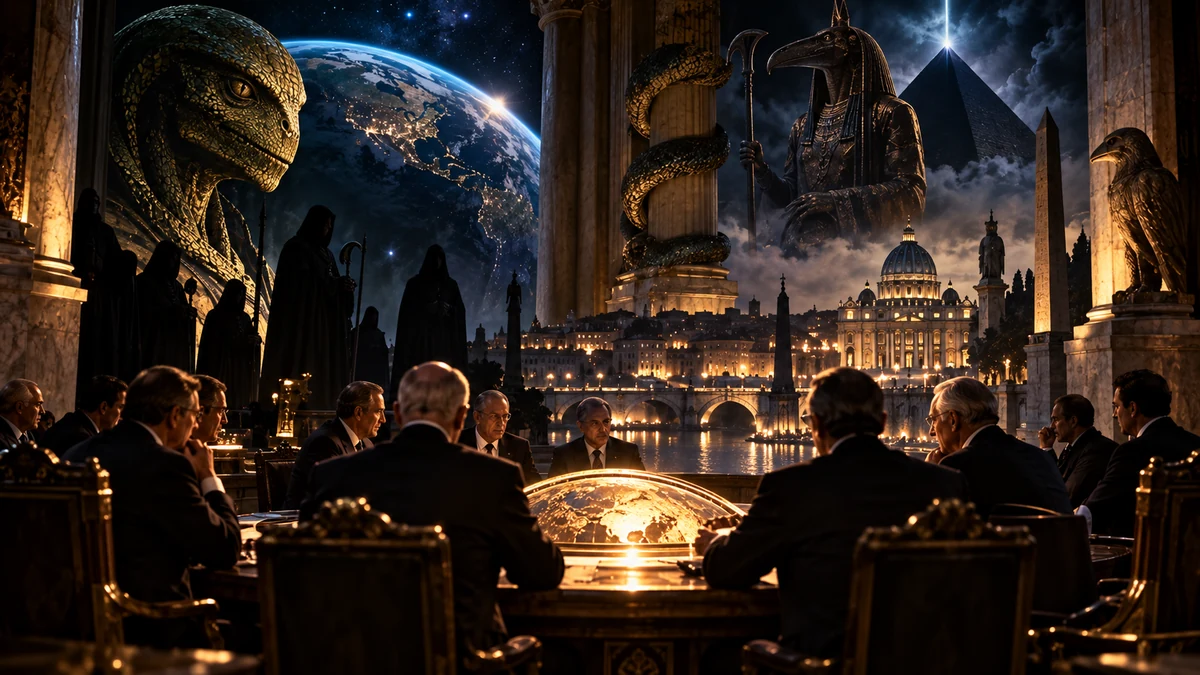
The Biggest Secret is one of the key texts in which Icke developed his reptilian-bloodline theory at the end of the 1990s. The book combines Anunnaki, serpent symbolism, European elite genealogies, secret societies, ritual themes, the Rothschilds, and narratives of non-human beings into the model of the “Babylonian Brotherhood.”
The 1999 Book and Three Layers of Its Central Construction
The table of contents shows the scale of the project. Twenty-one chapters move from “Martians” and reptiles through the Babylonian Brotherhood, religion, Britain, America, money, global networks, symbols, and the royal family to a final “Breaking the spell,” followed by bibliography, index, and appendices. This is not a narrow UFO book or a study of one political institution; it is designed as a unified map of history and the present.
That is its historical importance within Icke’s work. In later retrospectives he himself points to The Biggest Secret as one of the books through which he developed the idea of reptilian control of human society. Scholar of religion David G. Robertson treats the reptilian thesis as a key development in Icke’s work and places it within the transformation of the New Age milieu of the 1990s.
In its shortest form, the architecture is this. The first layer is non-human or interdimensional reptilian beings. The second is hybrid bloodlines produced by interbreeding with humans. The third is the political, financial, religious, and esoteric institutions through which those bloodlines allegedly direct society. In interviews from the period, Icke described the connection directly: the Anunnaki were reptilian and interbreeding produced the lines that continued the control structure.
Anunnaki, Serpent Symbolism, and Human Origins. The name Anunnaki is not invented. The ORACC academic project at the University of Pennsylvania describes Anunnaki as the Akkadian form of Anunna, a group of gods in the Mesopotamian pantheon. The meaning changes over time; in some texts they are major gods, while later traditions can associate them with the netherworld. ORACC also notes that there are no known group depictions of the Anunna/Anunnaki, only depictions of individual deities.
Icke makes an additional move by reading the mythological group as a memory of a reptilian non-human race. That is not a translation of the cuneiform term but an interpretation. The specialist description does not identify the Anunnaki as a reptilian species, genetic engineers of humanity, or beings from Draco. We can therefore document Anunnaki as Mesopotamian deities without deriving Icke’s biology from the same source.
The first layer is mythological: Icke searches for ancient stories of serpent and dragon beings and connects them with the Anunnaki. The second is genealogical: he carries the same motifs into royal and aristocratic bloodlines. The third is contemporary and political: banks, institutions, secret societies, and political elites become the modern expression of the same system. The book moves between these three levels without a hard boundary, so myth, genealogy, and politics reinforce one another.[2][4][5][8][7][9][7][9]

Elite Genealogy and the Merovingians
Icke treats the dense intermarriage of royal and aristocratic houses as the genealogical infrastructure of his bloodline theory and follows those family connections across European dynasties and modern elite families.
The Biggest Secret uses Merovingian genealogy and material associated with the Priory of Sion as part of the historical framework through which Icke traces elite bloodlines and hidden continuity.
The Babylonian Brotherhood is Icke’s name for a network said to survive through different historical periods while adapting to the political forms of each age. In the book it consists of royal and aristocratic lines, financial families, secret societies, religious structures, and political institutions.
Icke uses the term “Babylonian” because he places the origin of the system in the ancient civilizations of Mesopotamia and then follows it through Egypt, Rome, European aristocracy, and modern financial centers. “Brotherhood” does not mean one public organization but a transhistorical network that, in his model, changes names and forms while preserving the same goal of control.[10]
Testimony and Personal Narratives
One of the book’s most prominent rhetorical mechanisms is testimony from people who tell Icke about shape-shifting, reptilian bloodlines, or rituals. Icke still cites, as an important support, an account he says came from a friend of Princess Diana and insists that the description of the royal family as non-human was meant literally.
Testimony matters because it allows Icke to extend the genealogical and symbolic model into personal experience. Narratives of shape-shifting, ritual, royal families, and secret meetings are presented as individual points that the author connects with the larger picture.
Ritual abuse and satanic motifs are not peripheral in the book. Icke connects them with the idea of an intergenerational elite said to preserve power through trauma, secrecy, and ritual. This gives the political-genealogical model an additional psychological and religious layer.
The ritual layer also has a biological and metaphysical function in the book. Icke connects it with the idea that particular emotional and hormonal states generate energy required or used by non-human beings. In this way the motif of abuse is linked with his wider theory of frequency, consciousness, and interdimensional influence.[6]
The Rothschilds and Financial Dynasties
The book’s treatment of financial dynasties and hidden rule also draws on motifs with a long history in antisemitic literature, especially the idea of secret Jewish financial control and global conspiracy.
The Rothschilds are one of the central financial dynasties in the book. Icke places them within his genealogy of European power and connects them with banking, aristocracy, and the wider bloodline system, while also drawing on older motifs from literature about secret societies and financial elites.
Hitler’s Ancestry and the “Black Nobility”. Icke links European royal and aristocratic houses to a longer line he calls the Black Nobility and assigns that genealogy a reptilian origin and an operational role in modern control. The first component—that European dynasties form a dense web of marriage, inheritance, and political connection—is ordinary history. The second—that the network is biologically non-human—is a separate proposition.
Icke moves from ordinary human genealogy to a biological and non-human interpretation of bloodlines, making ancestry itself part of his wider reptilian model.[13][14][11]
The Cumulative Method of Connection
But accumulation works only when the components are at least partly independent and actually measure the same thing. If multiple claims derive from the same author, the same fabricated pedigree, or the same interpretive premise, their number does not create independent corroboration. Harambam and Aupers discuss such all-encompassing structures as “superconspiracy” models in which separate conspiracies become a hierarchical theory of everything; Icke is one of the best-known examples.
The Kinds of Material Used by the Book. If reptilian genealogy were removed, much of the remaining material would fall into familiar genres of political criticism: concentration of wealth, dynastic privilege, secrecy, lobbying, intelligence operations, propaganda, religious authority, and private elite forums. All of these can be investigated with documents without a metaphysical premise.
The book uses very different kinds of material: mythology, genealogy, historical books, secondary sources, personal testimony, and the author’s own interpretations. Icke’s distinctive move is not to leave them separate but to assemble them into a cumulative model in which each new motif joins an existing network.[19]
Conclusion: a Map of Icke’s System
The Biggest Secret is historically significant because it assembled many older motifs into a recognizable modern model: Anunnaki, reptiles, bloodlines, royal dynasties, secret societies, banks, rituals, symbols, and control as components of one system. Its later cultural influence is easier to understand once we see how early it fused elements that had previously circulated more separately.
Taken as a whole, The Biggest Secret functions as an early map of Icke’s later system: reptilian bloodlines, the Babylonian Brotherhood, ritual, banking dynasties, symbolism, and non-human intelligence are connected here into the recognizable whole he would continue to develop in later books.
The combination of these layers is what made the book a turning point in Icke’s work. Older themes about secret societies and financial dynasties acquired a non-human genealogy, while historical symbols were connected with biology, ritual, and consciousness. Later Icke books would expand and modify this model, but The Biggest Secret already contains nearly all of the basic elements of his recognizable system.[8][19]
It is precisely this fusion of mythology, genealogy, politics, and metaphysics that gives the book its distinctive character and explains why it became one of the central works in Icke’s later system.
Sources and further reading
- Open Library — The Biggest Secret, 1999 edition; David Icke Books/Bridge of Love, 517 pages, ISBN 0952614766 Source
- Google Books — The Biggest Secret, Bridge of Love Publications USA, 1999; publisher summary and contents Source
- WorldCat — The biggest secret: the book that will change the world, updated second edition, 1999 Source
- BiggerBooks — table of contents for The Biggest Secret, including 21 chapters and appendices Source
- David Icke — 2025 retrospective describing The Biggest Secret and Children of the Matrix as books on reptilian control Source
- David Icke — 2026 retrospective on the Diana/Windsor claim attributed to The Biggest Secret Source
- Kenneth Burke interview with David Icke — contemporary exposition of the reptilian/Anunnaki and bloodline thesis Source
- David G. Robertson — David Icke’s Reptilian Thesis and the Development of New Age Theodicy, IJSNR 4(1), 2013 Source
- ORACC / University of Pennsylvania — Anunna (Anunnaku, Anunnaki), Ancient Mesopotamian Gods and Goddesses Source
- Ralph & Coop — The Geography of Recent Genetic Ancestry across Europe, PLOS Biology 11(5), 2013 Source
- Lazaridis et al. — Ancient human genomes suggest three ancestral populations for present-day Europeans, Nature 513, 2014 Source
- Massimo Introvigne / CESNUR — The Priory of Sion: The End of the Hoax? Source
- United States Holocaust Memorial Museum — An Antisemitic Conspiracy: The Protocols of the Elders of Zion Source
- Anti-Defamation League — Antisemitism Uncovered: myth of excessive Jewish power and Rothschild conspiracy tropes Source
- U.S. Department of Justice / NCJRS — Kenneth Lanning, Investigator’s Guide to Allegations of 'Ritual' Child Abuse, 1992 Source
- James R. Lewis — Satanic Ritual Abuse, The Oxford Handbook of New Religious Movements, Vol. II Source
- United States Holocaust Memorial Museum — Adolf Hitler: Early Years, 1889–1921; myths about family background Source
- Leonard Sax — Revisiting the question of Adolf Hitler’s paternal grandfather, Journal of European Studies 49(2), 2019 Source
- Harambam & Aupers — From the unbelievable to the undeniable: epistemological pluralism and extraordinary truth claims, European Journal of Cultural Studies, 2021 Source
- Council on Foreign Relations — About CFR; formal mission, history and membership structure Source
- Bilderberg Meetings — official description of the private annual forum and its rules Source