The David Icke Guide to the Global Conspiracy — David Icke: Elite Networks, Crises, Symbols, and Consciousness
A presentation of *The David Icke Guide to the Global Conspiracy*: elite networks, central banks, covert programs, 9/11, symbols, reptilian bloodlines, and a metaphysics of consciousness.
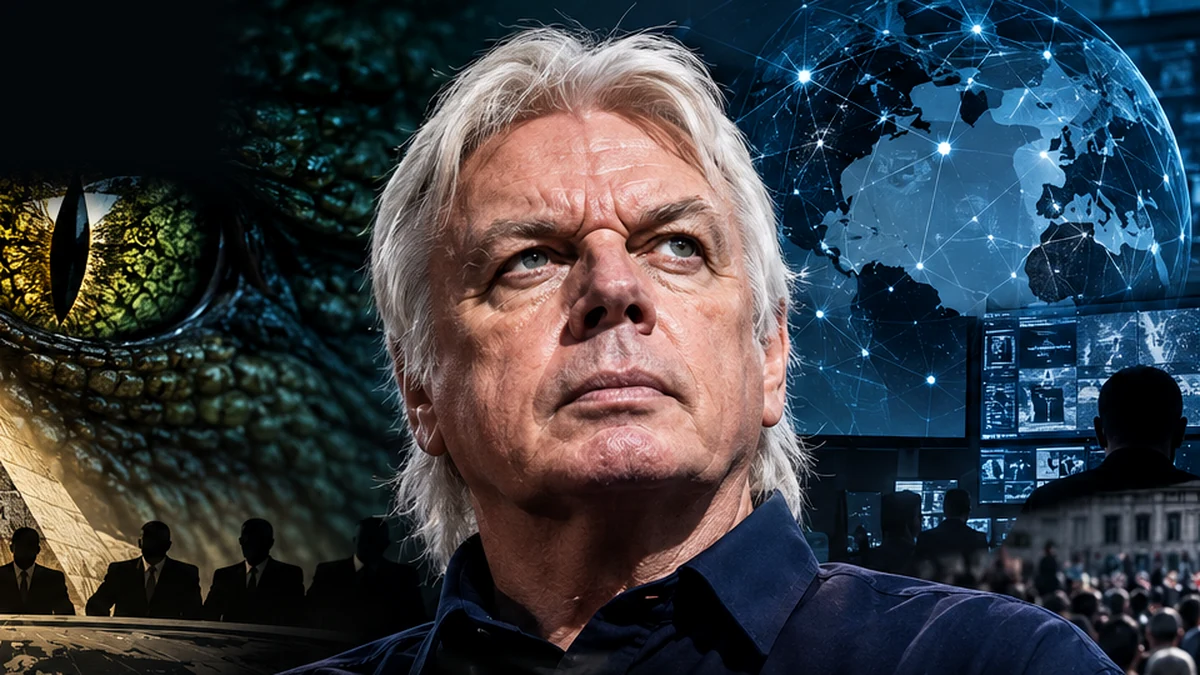
Icke’s 2007 book is constructed as a synthesis of his political, financial, and metaphysical system. The same narrative brings together the CFR, Trilateral Commission, Bilderberg, central banks, covert operations, 9/11, climate politics, symbols, reptilian bloodlines, and a theory of consciousness.
The 2007 Book and a Layered Map of Power
Although the title speaks of a “global conspiracy,” the book reaches far beyond an ordinary political conspiracy theory. Icke places his older themes about the Illuminati, elite families, central banking, secret societies, media, and wars inside the same framework as consciousness, DNA, perception, and non-human intelligences. The publisher description itself stresses his ambition to “connect the dots” among apparently unrelated people, events, and subjects.
The central logic of the book is hierarchical. Public politics, corporations, media, and state institutions form the visible surface. Beneath them Icke places private networks, think tanks, secret societies, financial structures, and family connections. Deeper still comes his theory of hybrid bloodlines and, ultimately, a non-human or inter-dimensional level. In this model, people on lower levels may not even know what the wider structure is serving; each sees only a compartment.
Consciousness, Perception, and Reptilian Bloodlines. Icke's political model begins surprisingly far from politics. The book describes human experience as the decoding of information or frequencies and relies on computer and holographic analogies. Consciousness, in this account, is not produced by the brain but is more fundamental; body and brain act as an interface that narrows a wider consciousness into a limited band of perception.
The publisher description explicitly presents the book as concerning a network of interbreeding families reaching back into the ancient world and manipulating events toward a centrally controlled global state. Within Icke's own system, the genealogy is not merely a metaphor for cold-blooded elites. It is tied to his literal idea of non-human or reptilian influence and hybrid bloodlines.
The book uses a hierarchical model of power: visible institutions are the outer layer, beneath them are connected elites, and deeper still are bloodlines and non-human or interdimensional intelligence. The political and spiritual parts are therefore not separate; both belong to the same system of perception and control.[2][1][1][2][1]

CFR, Trilateral Commission, and Bilderberg
At the institutional level, Icke is not starting from empty space. The Council on Foreign Relations describes itself as an independent, nonpartisan membership organization, think tank, and publisher that convenes experts and policymakers and seeks to affect debate about U.S. engagement with the world. Its membership includes prominent people from diplomacy, government, business, academia, and media.
The Trilateral Commission likewise states publicly that it was founded in 1973 by David Rockefeller and brings together senior policymakers, business leaders, and representatives of media and academia. The organization explicitly describes relationship-building and the incubation of ideas across sectors and regions; under its current rules, members who enter government roles rotate off the Commission.
Elite networks can influence policy without a secret central command. People who share access to the same forums, information, specialists, and funding can develop similar priorities. Institutions can generate policy proposals, personnel pipelines, and language that later appears in government. Those processes can be measured through documents, career paths, donations, minutes, and actual decisions.
The Federal Reserve and BIS. Central banking is part of the book's wider story about financial control. Here it is especially important to use the actual legal and institutional structure. The Federal Reserve System consists of the Board of Governors, the Federal Open Market Committee, and twelve regional Reserve Banks. The Board is a federal agency accountable to Congress; the regional banks combine public and private characteristics, and their nine-member boards include directors elected by member banks as well as directors appointed by the Board.
The Federal Reserve and BIS represent the financial infrastructure of the wider system in Icke’s account. The book uses money, debt, and central banking to explain how political space is constrained and how power moves from formally elected structures into financial networks.[4][5][6][7][10][11][12]
Covert Programs and “Problem–Reaction–Solution”
Icke uses MKULTRA and Operation TPAJAX as examples of covert programs through which state power, secrecy, psychological operations, and political intervention can operate outside ordinary public visibility.
Icke uses Problem–Reaction–Solution for a model in which an actor covertly creates or enables a problem, channels the public into a desired reaction, and then offers a pre-planned solution. As an abstract possibility, such a mechanism is not inconceivable. The declassified March 1962 Joint Chiefs of Staff memorandum known as Operation Northwoods really did propose manufactured provocations or pretexts for U.S. military intervention in Cuba, including scenarios involving a ship or civilian aircraft.
TPAJAX, COINTELPRO, and MKULTRA become recurring examples in Icke’s argument that covert institutions can intervene in governments, social movements, and human behavior while remaining outside normal public awareness.
9/11 in Icke’s Narrative. Icke places 9/11 inside his broader “Problem–Reaction–Solution” framework, linking the attacks with fear, war, surveillance, and the expansion of state power.
In the book, 9/11 becomes a central example of the “Problem–Reaction–Solution” model. The event is placed in a sequence of fear, security measures, war, and expanded state powers, allowing Icke to apply his general crisis model to the defining political event of the early twenty-first century.[17][18][15][18][16][19][17][20]
Climate, Control, and Global Politics
A major theme of the book is the warning that fear of terrorism creates an infrastructure of pervasive surveillance. At this level there is an important documentary record. The Bush administration publicly acknowledged the Terrorist Surveillance Program in December 2005, under which the NSA intercepted certain international communications into and out of the United States outside the ordinary individualized FISA warrant process. In January 2007, the publicly acknowledged form of the program ended or transitioned to authorization by the Foreign Intelligence Surveillance Court.
The book incorporates global warming into its broader control model and presents it as a fraud or political instrument for new taxation, regulation, and centralization. Climate-policy instruments can of course be criticized separately: whether a particular tax is effective or fair is not the same question as what causes observed warming.[22][23]
The “Reptilian Brain,” Symbols, and Analogies
Icke and popular culture sometimes connect cold, hierarchical, or instinctive behavior with the phrase “reptilian brain.” The phrase derives from Paul MacLean's triune-brain model, in which the human brain was said to have evolved as successive layers: a reptilian complex, limbic system, and neocortex.
Icke gives extensive attention to symbols, architecture, ritual, and recurring motifs. In his model, symbolic genealogy links ancient traditions, modern institutions, and the idea that the same power expresses itself through different historical forms.
The Reptilian Thesis and Historical Motifs. Icke has repeatedly denied that his reptilian thesis means a Jewish conspiracy. In an early interview he explicitly said he was speaking of a supposed genetic network across different earthly races and that by “reptilians” he meant a literal non-human component. That position should be included because it is his own stated account of the theory's intent and meaning.
At the same time, a number of scholars and organizations argue that themes in his work—secret global cabals, the Rothschilds, control of finance and media, bloodlines, and ritual-abuse narratives—overlap with older antisemitic conspiracy traditions. Allington, Buarque, and Barker Flores place Icke's discourse within that historical tradition and examine audience reception. David G. Robertson offers a different analytical emphasis, interpreting the reptilian thesis primarily as a New Age theodicy in which a non-human “Other” explains the apparent failure of spiritual transformation.[29][28][27]
Conclusion: a Political and Metaphysical Model in Layers
The book’s concluding architecture is layered. Organizations, banks, and political decisions form the visible level; covert programs and networks form a deeper one; reptilian bloodlines and the metaphysics of consciousness form the deepest. The reader therefore receives not one isolated theory but a complete world model in which politics, biology, symbolism, and perception explain one another.
Icke’s concluding political proposal follows directly from his metaphysics. If control is fundamentally control of perception, liberation cannot consist only in replacing a government or institution. The book emphasizes expanded consciousness, refusal of fear, personal non-compliance with manipulative systems, and recovery of the sense that the individual is more than a social identity. The subtitle “and how to end it” therefore has two meanings: political resistance and a transformation of consciousness.
In this sense, the book is not merely a catalogue of organizations and events but an attempt to create a complete model of the world in which inner human states, political power, and symbolic language constantly interact.
Sources and further reading
- David Icke — The David Icke Guide to the Global Conspiracy (and how to end it), 2007 edition; Open Library bibliographic record and controlled digital lending item Source
- Google Books — The David Icke Guide to the Global Conspiracy (and how to End It), publisher description and bibliographic metadata Source
- Open British National Bibliography — The David Icke guide to the global conspiracy, 2007, 619 p., bibliography and index Source
- Council on Foreign Relations — About CFR and institutional mission Source
- Council on Foreign Relations — Membership Source
- The Trilateral Commission — About Us Source
- The Trilateral Commission — Leadership, Members & Fellows Source
- Bilderberg Meetings — About / official description of the meetings Source
- Bilderberg Meetings — Frequently Asked Questions Source
- Federal Reserve Board — How is the Federal Reserve System structured? Source
- Federal Reserve Board — Who owns the Federal Reserve? Source
- Federal Reserve Board — Overview of Reserve Bank boards of directors Source
- Bank for International Settlements — About the BIS Source
- Bank for International Settlements — Member central banks Source
- National Security Archive — Joint Chiefs memorandum, Justification for US Military Intervention in Cuba / Operation Northwoods, 13 March 1962 Source
- U.S. Senate — Church Committee history and documented intelligence abuses Source
- CIA Reading Room / U.S. Senate — Project MKULTRA, the CIA's Program of Research in Behavioral Modification, 1977 hearing Source
- U.S. Department of State, FRUS — Iran 1953 / TPAJAX operational documentation Source
- FBI — And Justice for All, official history including COINTELPRO Source
- National Commission on Terrorist Attacks Upon the United States — 9/11 Commission Report, Chapter 11 Source
- NIST — Final Report on the Collapse of World Trade Center Building 7, NCSTAR 1A, 2008 Source
- U.S. Department of Justice — ACLU v. NSA opposition; public description and 2007 termination/transition of the Terrorist Surveillance Program Source
- U.S. Department of Justice — Additional Frequently Requested Documents, NSA Terrorist Surveillance Program records Source
- IPCC AR4 Working Group I — Understanding and Attributing Climate Change, 2007 Source
- Steffen et al. — The Brain Is Adaptive Not Triune: How the Brain Responds to Threat, Challenge, and Change, 2022 Source
- Raphael Bousso — The holographic principle, Reviews of Modern Physics 74, 825, 2002 Source
- David G. Robertson — David Icke’s Reptilian Thesis and the Development of New Age Theodicy, International Journal for the Study of New Religions 4(1), 2013 Source
- Allington, Buarque & Barker Flores — ‘What Others Dare Not Say’: An Antisemitic Conspiracy Fantasy and its YouTube Audience, 2020 Source
- Jon Ronson — Beset by lizards, The Guardian, 17 March 2001; reports Icke's explicit denial that his reptilian thesis refers to Jews as a people Source