Multi-Layered Ownership Chains: Holding Companies, Offshore Companies and Beneficial Owners
How holding companies, intermediary entities and cross-border structures complicate ownership tracing and how to investigate them.

AI-generated editorial illustration. It does not depict actual companies or their ownership links.
When we find another company on the list of shareholders of a major corporation, we have not necessarily reached the end of the ownership chain. That company may have owners of its own, including other companies, funds or individuals. Some links extend across several countries and legal systems; others are based on contracts that allow an institution to influence a company's operations without directly owning it.
How far must we trace these links to establish who actually holds economic power? The examples of the French group LVMH, the US company Meta and the Chinese business group Alibaba illustrate three different routes to control. In each case, the distinction between an economic interest and the power to make decisions is essential.
What Happens When Another Company Owns a Company?
A holding company holds stakes in other companies. Its primary purpose may be to manage those stakes, but it may also engage in other activities. Companies controlled by a parent company are known as subsidiaries. Each generally has its own assets, management bodies and obligations, even though it belongs to the same corporate group.
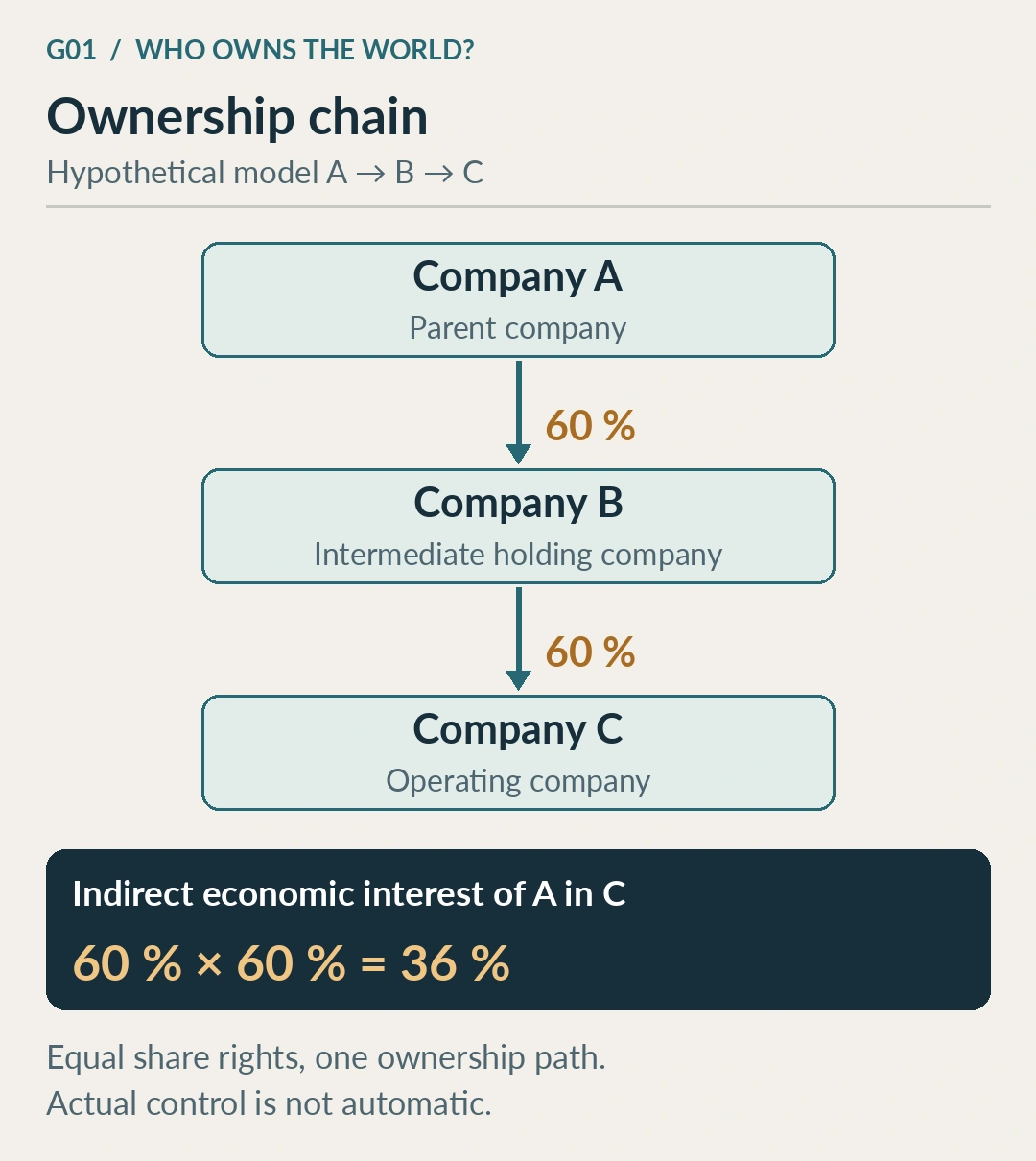
Imagine that Company A owns 60 percent of the capital of Company B, which in turn owns 60 percent of the capital of Company C. If all shares carry equal economic and voting rights and there are no other chains of ownership or special contractual rights, A has an indirect economic interest of 36 percent in C through B (0.60 × 0.60 = 0.36). At the level of Company C, however, B holds 60 percent of the voting rights, not 36 percent.
If A can control B through its majority stake, and B can control C in the same way, control over C may be concentrated at the top of the chain, even though A's indirect economic interest is less than half. A is not a direct holder of shares in C, and the actual extent of control also depends on corporate governing documents, contracts, the powers of company bodies and legislation. This is an illustrative example, not a rule by which control over every company can automatically be calculated.
Such structures are not necessarily intended to conceal ownership. They may help organise different business activities, bring in new investors or separate business risks through legal structures. At the same time, they can lengthen the chain between the assets and the person who holds decisive powers at the top of the structure. To establish the purpose of a particular structure, we need specific evidence.
LVMH, Christian Dior and Agache: An Ownership Chain
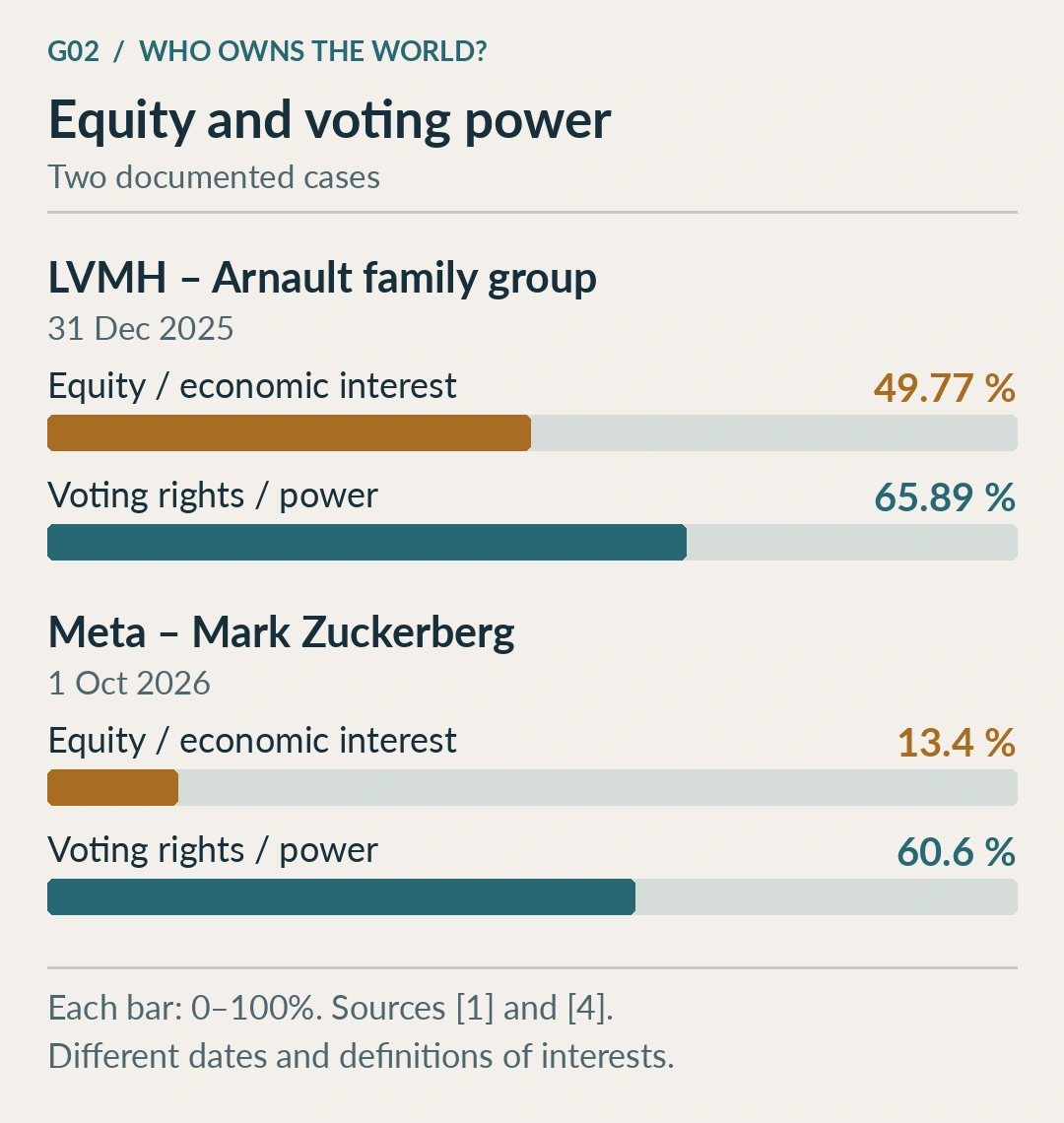
The French group LVMH illustrates how indirect ownership can be combined with a majority of voting rights. According to LVMH's annual report, at the end of 2025 the Arnault family group, which includes family members and companies under their control, held less than half of LVMH's capital but almost two-thirds of the voting rights exercisable at shareholders' meetings. [1]
| Holder or ownership link | Share of LVMH capital | Exercisable voting rights |
|---|---|---|
| Christian Dior SE | 42.17% | 56.26% |
| Arnault family and other family-group companies | 7.60% | 9.63% |
| Arnault family group in total | 49.77% | 65.89% |
Source: LVMH, 2025 annual report, Section 3.4. As of 31 December 2025. The first two rows are components of the total, not additional stakes on top of it. These percentages refer to voting rights exercisable at a general meeting, not to votes actually cast. [1]
The difference between the share of capital and the share of voting rights is partly explained by the arrangement under which fully paid-up LVMH shares generally acquire double voting rights after being registered continuously in the name of the same shareholder for at least three years. Even if someone holds a majority of the voting rights, this does not mean that the entire economic value of the company belongs to them. [1]
The ownership chain does not end at Christian Dior SE. According to its annual report, on the same date the Arnault family group directly and indirectly held 97.50 percent of Christian Dior SE's capital and 98.63 percent of its exercisable voting rights. An important intermediate entity is Financière Agache, with 96.00 percent of the capital and 97.12 percent of the exercisable voting rights of Christian Dior SE. This stake is already included in the total family-group holding. Financière Agache and Agache SCA are distinct legal entities; LVMH's annual report identifies the latter as part of the wider family group. [1] [2]
This example reveals the difference between control of a corporate group and the personal wealth of its ultimate owners. We cannot automatically calculate from publicly disclosed aggregate holdings what proportion of the economic benefits goes to individual family members. Nor can we establish from the ownership structure alone how every particular business decision was made.
Meta: How Different Share Classes Help Retain Control
At the US company Meta Platforms, the disparity between equity ownership and voting power is even more pronounced. The company has two classes of common stock with different voting rights: a Class A share carries one vote, while a Class B share carries ten votes. According to the disclosure for the 2026 annual meeting, founder Mark Zuckerberg held approximately 60.8 percent of the total voting power as of 1 April 2026. [3]
A more recent document from Meta, published on 2 November 2026, reports figures as of 1 October of the same year. According to this disclosure, Zuckerberg's stake represented approximately 13.4 percent of all economic interests in the company and 60.6 percent of the total voting power. [4]
| Measure of Zuckerberg's position | Share as of 1 October 2026 |
|---|---|
| Economic interest | 13.4% |
| Voting power | 60.6% |
Source: Meta Platforms, Definitive Information Statement, 2 November 2026. The figures are based on the company's disclosure and the US regulatory definition of beneficial ownership. [4]
This disparity means that the founder can retain majority voting power without holding a majority of the economic interests. It is a different mechanism from a simple ownership pyramid, but it has a similar effect: economic participation and voting power are not proportional.
Here we also have a documented example of the exercise of voting power. Following approval by the board of directors on 19 October 2026, seven affiliated entities whose Meta shares the disclosure attributes to Zuckerberg as their beneficial owner approved the amendment to the certificate of incorporation by written consent on 20 October. Together, they held approximately 56.1 percent of the company's voting power. The amendment introduces Class C common stock, which generally carries no voting rights. According to the November disclosure, the amended certificate is expected to take effect on 19 January 2027. As of 16 November 2026, this capital structure is not yet in effect. [4]
When researching such companies, we must also pay attention to the date and meaning of the voting rights attributed to a particular holder. Majority voting power means the ability to exert decisive influence on many matters within the remit of shareholders, not an unrestricted right to decide every aspect of the company's activities or proof of how the holder voted on a particular resolution.
Alibaba: Offshore Holding Companies and Contractual Control
Alibaba illustrates a third mechanism. Although the group's business is primarily associated with China, its ultimate holding company, Alibaba Group Holding Limited, is incorporated in the Cayman Islands. An investor in its shares or American depositary shares (ADSs), which represent shares in the holding company, does not thereby acquire direct ownership stakes in all of the group's Chinese companies. [5]
In addition to subsidiaries linked through equity ownership, Alibaba uses VIE (variable interest entity) structures for certain activities. According to its annual report, these are associated with activities in which foreign ownership in China is restricted or prohibited. Alibaba explains that the contractual arrangements give it the power to direct significant activities of the VIEs and economic exposure to their benefits or losses. On this basis, the company consolidates these entities in its financial statements under US generally accepted accounting principles (US GAAP). [5]
Accounting consolidation is not the same as direct legal ownership. In its report, the company itself warns of uncertainties over the enforceability of the contractual arrangements and potential conflicts of interest. It also states that the vast majority of its assets and operations are in its subsidiaries, so we must not portray the entire group as a VIE structure. [5]
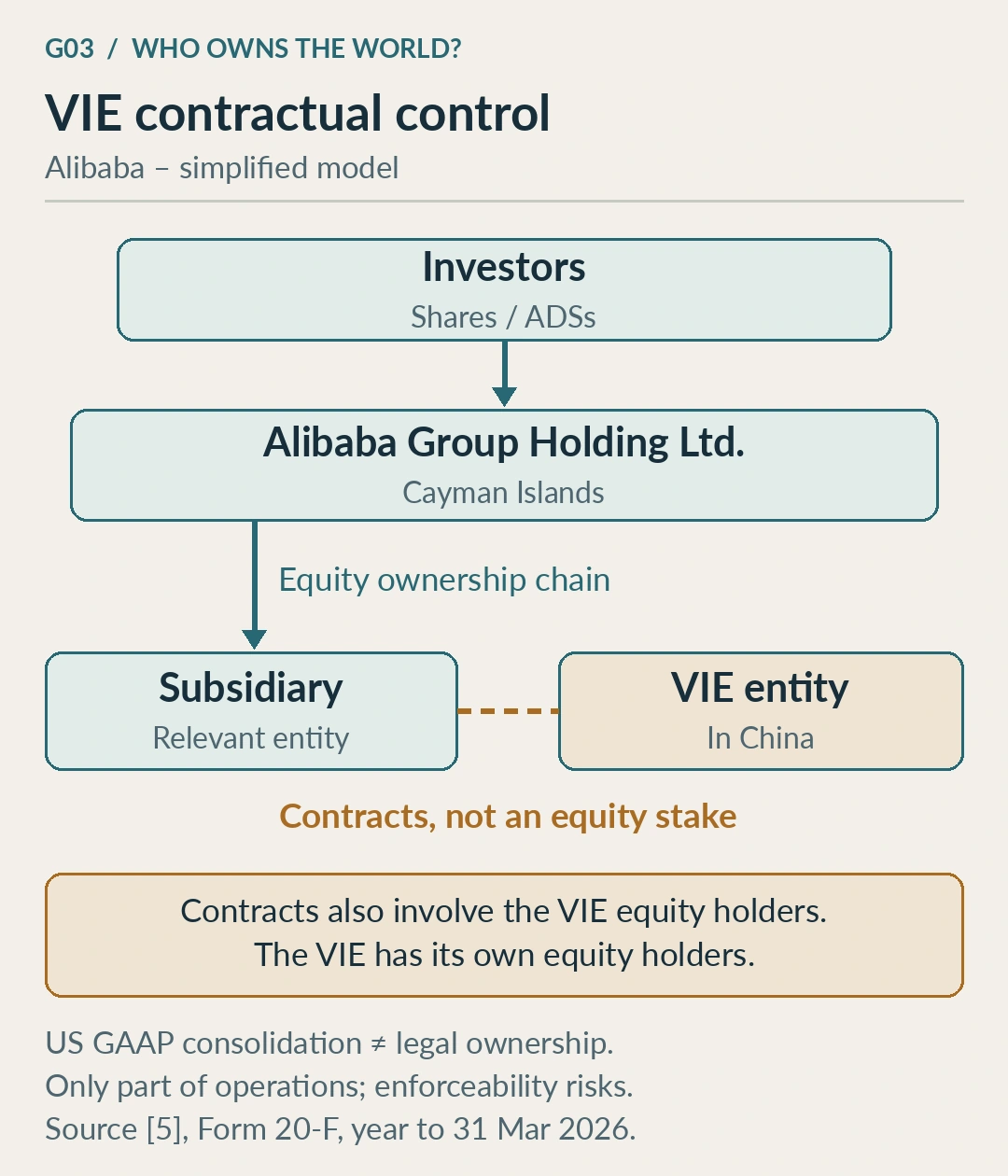
The example matters because the links between companies cannot always be described by ownership percentages alone. When examining contractual control, we are interested in the terms of the contracts, the powers of the parties, legal enforceability and the way the contracts are implemented in practice. The mere fact that a holding company is incorporated in another jurisdiction does not establish unlawful conduct.
Original document: Alibaba Form 20-F — organisational structure and VIE diagrams (Item 4.C)
Where Does the Ownership Chain End?
When we trace a company's ownership through several other legal entities, the question of beneficial ownership arises. Under its anti-money laundering standards, the international organisation FATF defines the beneficial owner of a legal person as a natural person who ultimately owns or otherwise effectively controls it. There may be more than one such person. Recommendation 24 concerns the transparency of legal persons, while Recommendation 25 concerns legal arrangements such as trusts. These international recommendations do not in themselves constitute national laws. [6] [7] [8]
A trust is a legal arrangement in which assets are entrusted to another party for management under specified terms. According to FATF guidance, when identifying beneficial owners we must take into account the roles of the settlor, trustee, protector (if any), beneficiaries or classes of beneficiaries, and other natural persons exercising ultimate effective control. We must not treat a trust as an ordinary company with shareholders. [7] Nor should we automatically equate beneficial ownership under FATF standards with beneficial ownership in US securities disclosures, as discussed in the previous article. [8]
Countries use different systems to record control. The criteria under the UK people with significant control (PSC) regime include more than 25 percent of the shares or voting rights, the right to appoint or remove a majority of directors, and the right to exercise, or the actual exercise of, significant influence or control, including in certain relationships involving trusts or other legal arrangements. These are criteria of a particular legal regime, not a universal threshold below which control is impossible. [9]
In the United States, through a final rule effective from 14 August 2026, FinCEN retained the exemption of domestic US companies from beneficial ownership reporting requirements under the Corporate Transparency Act. Certain foreign companies registered to do business in the US remain within the scope of this regime, but the relevant exemption covers reporting on US persons. The beneficial ownership information (BOI) database is not a register open to the general public. The change does not eliminate disclosure obligations that may arise under other regulations. [10] [12]
Here, the term offshore company refers to a company incorporated in a jurisdiction outside the home jurisdiction of its owners or the jurisdiction in which its business activities are based, rather than a single specific legal form. Such companies may complicate investigations when information about their owners is difficult to access or when the ownership structure spans different jurisdictions. Offshore incorporation in itself, however, is not evidence of tax evasion, money laundering or another violation. The ICIJ Offshore Leaks investigative database also draws attention to this distinction, emphasising legitimate uses of offshore structures, the age of the data and the need to verify the identities of people with similar names. [11]
Limited transparency can therefore be a genuine obstacle to research, but the absence of publicly available information does not in itself prove deliberate concealment. When we cannot obtain the information, we must distinguish between what has been established, what is a well-founded hypothesis and what remains unknown.
What Can and Cannot Be Established?
The three cases examined here reveal different mechanisms of economic power. At LVMH, a chain of holding companies is combined with a majority of voting rights. At Meta, different share classes allow economic interest and voting power to diverge. At Alibaba, certain links are based on contractual arrangements whose effects are not the same as those of direct ownership.
These mechanisms may allow decision-making to become concentrated, but taken together they still do not prove that the world economy is governed from a single centre, nor do they rule out possible links between individual actors. To demonstrate a connection between particular actors or the coordinated exercise of their influence, we would need documents establishing specific relationships, powers and actions.
In the next article, we will therefore explore how to carry out such verification: how to read ownership registers, annual reports and regulatory disclosures, how to trace equity links, and how to distinguish documented economic power from claims for which we do not yet have sufficient evidence.
Sources and further reading
- LVMH SE. LVMH — Universal Registration Document, fiscal year ended December 31, 2025. 2026. Sections 2.1, 3.1, 3.2 and 3.4. Source
- Christian Dior SE. Rapport annuel au 31 décembre 2025. 2026. pp. 441–442, Sections 3.2 and 3.4. Source
- Meta Platforms, Inc. / SEC EDGAR. 2026 Definitive Proxy Statement (DEF 14A). 2026-04-16. Security Ownership, pp. 63–66. Source
- Meta Platforms, Inc. / SEC EDGAR. Definitive Information Statement (DEF 14C). 2026-11-02. Background, pp. 15–16; General Overview of Action, pp. 4–5; Security Ownership, pp. 65–67; Votes Required, p. 68; Annex A. Source
- Alibaba Group Holding Limited. Form 20-F, fiscal year ended March 31, 2026. 2026-05-20. Introduction; Item 3.D, pp. 59–60; Item 4.C, pp. 116–120; Item 5, Principles of Consolidation, p. 151. Source
- FATF. Guidance on Beneficial Ownership of Legal Persons (Recommendation 24). 2023-03-10. Chapter 4, p. 15, paras. 31–33. Source
- FATF. Guidance on Beneficial Ownership and Transparency of Legal Arrangements (Recommendation 25). 2024-03-11. Section Parties to a trust, p. 8, paras. 22–23. Source
- FATF. FATF Glossary — Beneficial owner. Ongoing. Entry Beneficial owner. Source
- UK Government. Statutory guidance on the meaning of significant influence or control over companies in the context of the register of people with significant control. 2026-03-04. Sections 1.3–1.4 and PSC conditions. Source
- FinCEN / US Federal Register. Beneficial Ownership Information Reporting Requirement Revision, final rule, 91 FR 52508–52528, 2026-16576. 2026-08-14. Summary, Dates, II.A, II.B.4 and 31 CFR 1010.380. Source
- ICIJ. Offshore Leaks Database — Disclaimer. Undated. Database methodological disclaimer. Source
- FinCEN. FinCEN Permanently Ends Beneficial Ownership Reporting Requirements for Millions of Small Business Owners. 2026-08-11. Official press release. Source