Owner on Paper, Manager or Actual Controller?
Explains the distinct roles and powers of legal owners, managers, custodians and beneficial owners.

AI-generated editorial illustration with local retouching. It does not depict a real company, authentic documents or actual shareholdings.
When we buy a share in a company, we acquire a stake in its capital. But does that mean we own part of its buildings, machinery and land? And if we invest our savings in an investment fund, who then makes decisions about the companies in which our money is invested? Is it us, the fund manager or the institution in whose name the shares are registered?
In the modern economy, ownership rights, economic benefits and decision-making powers are often divided among different people and institutions. If we want to understand who actually holds economic power, we must first understand how these rights and powers are distributed.
Who Owns the Factory If We Hold Its Shares?
Imagine a joint-stock company that owns a factory. If we buy one-tenth of all its shares, that does not mean we can take away one-tenth of its machinery or sell one-tenth of its land. The company owns those assets; we hold shares and the rights attached to them.
This distinction also exists in Slovenia. Article 4 of the Companies Act (ZGD-1) establishes the legal personality of companies and their capacity to acquire rights and assume obligations. Article 168 specifically defines a joint-stock company. The company has its own assets, which are legally separate from the personal assets of its shareholders. [1] [2]
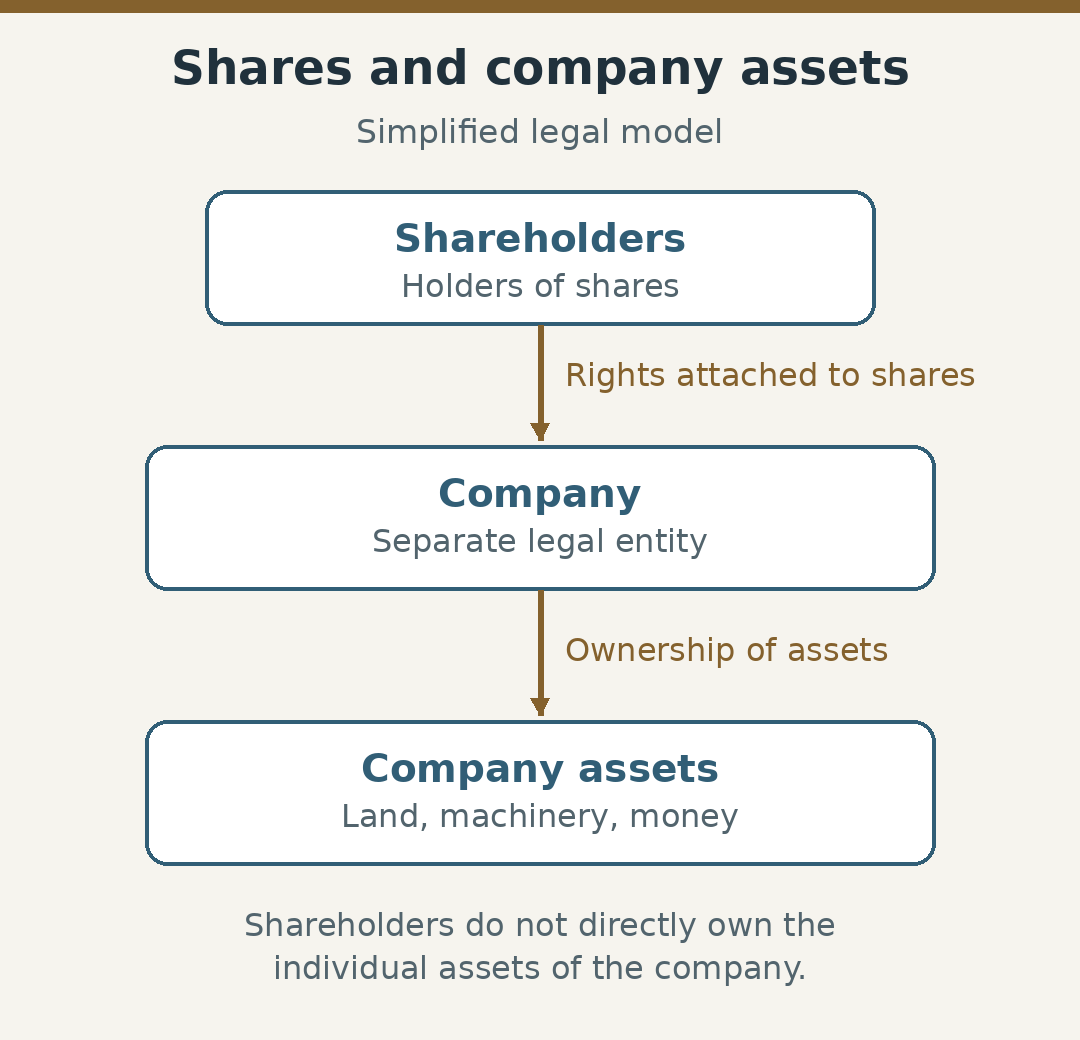
Shares may confer the right to participate in the distribution of profits and to vote at general meetings. These rights depend on the class of shares and the applicable law; the proportion of shares held is therefore not necessarily the same as the proportion of voting rights. As a rule, shareholders do not run the company's day-to-day business; that is the responsibility of management. Among other things, they can exercise influence by voting on the composition of the company's governing bodies and other important matters within the remit of the general meeting. [1] [3] The distinction is fundamental: someone may be a major shareholder without directly running the company, while someone else may run a large company without owning a substantial stake in it.
Limited Liability: Why It Exists and Where Its Limits Lie
The separation of company assets from shareholders' assets is closely associated with the principle of limited liability. In a Slovenian joint-stock company, the company is liable for its obligations to the full extent of its assets, while shareholders are generally not personally liable to creditors for the company's obligations. If the company fails, investors may lose their investment without having to pay the company's debts out of their personal assets merely because they hold shares. [1] [2]
The economic significance of such an arrangement was already being debated in the 19th century. In the British House of Commons on 29 June 1855, Edward Pleydell Bouverie discussed two related legislative proposals concerning partnerships and limited liability. He advocated a reform that would make it easier to invest capital in productive economic ventures. The debate also raised concerns about the protection of creditors and the potential for abuse. The parliamentary record provides insight into the reasons for reform at the time, but does not in itself establish its subsequent economic effects. [4]

Limiting personal risk can make it easier for people to invest in projects for which they do not individually have enough capital. But it also raises the question of how the consequences of business decisions are distributed. If a company lacks sufficient resources to meet all its obligations or remedy the harm it has caused, some of the costs may fall on other parties or society as a whole. This is not necessarily the result of abuse, but it is an important question of economic responsibility.
Limited liability does not mean the complete absence of personal liability. Article 8 of Slovenia's Companies Act (ZGD-1) provides for the piercing of the corporate veil in certain cases of abuse of a company, such as using it to harm creditors. Personal liability in a particular case depends on the relevant legal basis and the facts of the case. [1] [2] We must therefore distinguish between the lawful limitation of investment risk and the possible abuse of a legal framework to shift costs onto others. The mere existence of a company is not enough to establish such abuse.
The Registered Holder and the Person Entitled to the Benefits
Another distinction arises in securities trading. The person or institution whose name appears in the register of shareholders is not necessarily the one who derives economic benefits from holding the shares.
In the US system, an investor can hold securities through a broker, with the securities registered in the name of the broker or a nominee (known as holding securities in street name). The broker maintains a record of the individual investor's entitlement. The SEC and FINRA also identify Cede & Co., which is associated with the US central securities depository system, as a common registered holder. Where the relevant system allows it, an investor can also choose direct registration in their own name. [5]
If we find the name Cede & Co. in ownership records, that does not in itself mean that this entity receives all the returns from the shares registered in its name or has unrestricted control over them. Registration may reflect the way securities custody and settlement are organised. In general, identifying the entitled party and establishing their rights requires us to examine intermediaries' records and the applicable rules.
Here, too, we must distinguish between registration, custody and the exercise of voting rights. The OECD principles, for example, recommend that custodians and nominees vote in accordance with the instructions of beneficial owners. Within its scope, the European directive on encouraging long-term shareholder engagement requires intermediaries to facilitate the exercise of shareholder rights, for example by enabling shareholders to vote or by acting on their behalf in accordance with their explicit authorisation and instructions. These are different legal and institutional settings that cannot simply be treated as equivalent. [6] [7]
When We Entrust Our Investments to a Fund
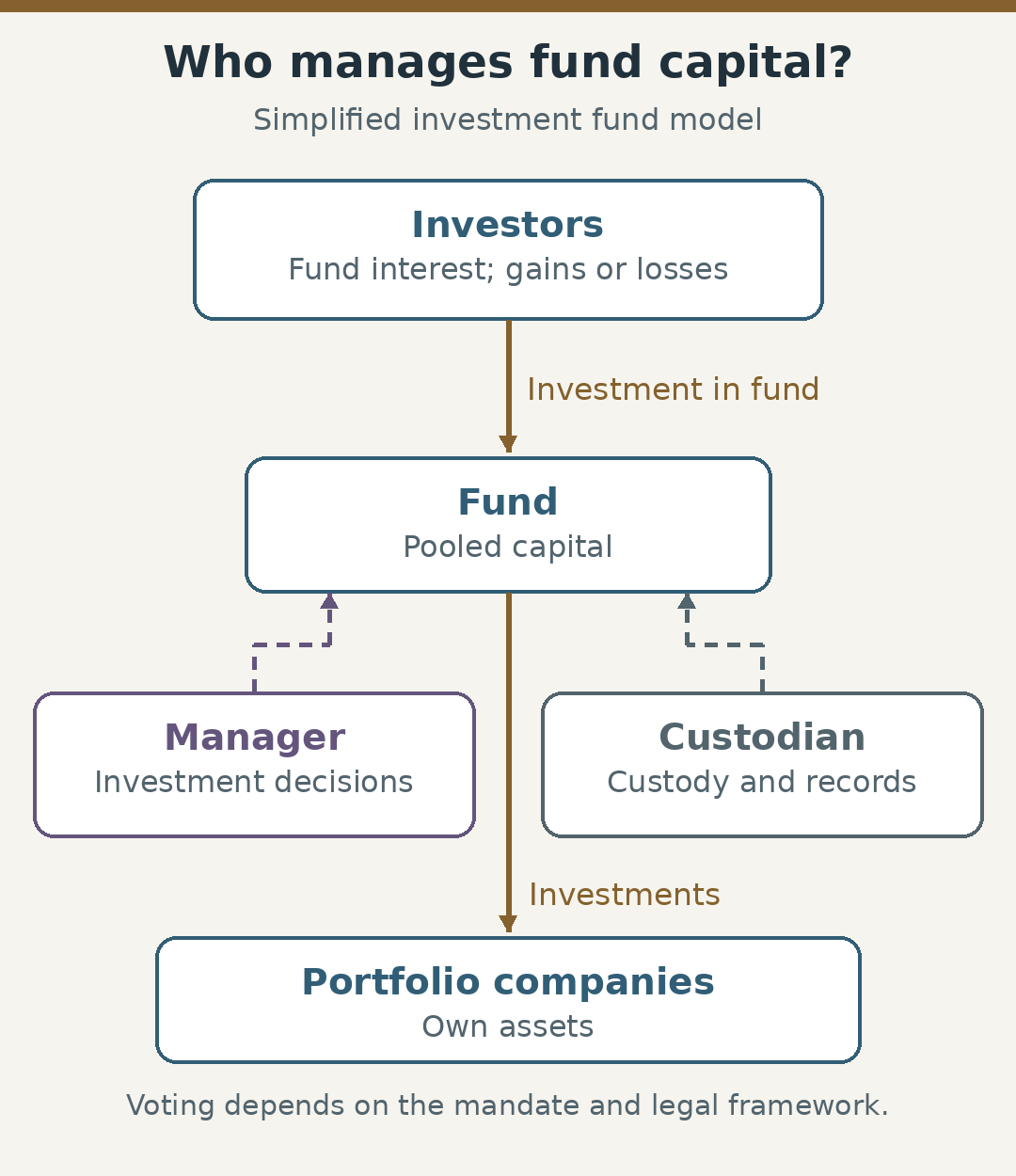
Imagine that an investor buys a stake in an investment fund rather than shares in an individual company. The fund pools investors' money and invests it in a portfolio of securities. In a US open-end investment fund (mutual fund), the investor acquires an interest in the fund and thus an economic interest in its gains and losses. This does not make the investor a direct holder of every share in the fund's portfolio. [8]
The investment manager makes decisions in accordance with the investment policy and the mandate it has been granted. The custodian carries out tasks relating to the safekeeping of securities and the maintenance of records. The scope of each party's responsibilities varies depending on the fund's legal framework, contractual arrangements and other powers. Decisions about purchases and sales and decisions about voting at company general meetings are not necessarily entrusted to the same party. [6] [8]
| Participant | Main role |
|---|---|
| Investor | Holds an interest in the fund and is exposed to its gains and losses. |
| Fund | Pools investors' money and holds an investment portfolio according to its legal structure. |
| Manager | Makes investment decisions within the terms of its mandate. |
| Custodian | Performs safekeeping and record-keeping duties. |
| Portfolio company | Conducts its own economic activity and has its own assets. |
This simplified model does not describe every type of fund. It does, however, show why we must not equate the value of a large financial firm's assets under management with its own assets. Nor should we overlook the influence that can arise from managing other people's capital. If investment or voting decisions are entrusted to a smaller number of institutions, we need to examine the scope of their powers and how they exercise them, even when economic entitlements are dispersed among many investors.
What Do Form 13F and Schedules 13D and 13G Reveal?
When we find the names of institutional investors in publicly available ownership summaries for major companies, we need to ask which documents these figures are based on. Disclosures to the SEC are particularly important when researching US securities, but different forms answer different questions.
Form 13F is a reporting form for institutional investment managers who, subject to other legal conditions, exercise investment discretion over accounts in which the aggregate fair market value of the securities covered by the reporting requirement is at least 100 million US dollars on the last trading day of any month in a calendar year. The report may cover investments held for the manager's own account or for the accounts of others. It is neither a complete inventory of all assets under management nor a list of all ultimate investors. [9] [10]
It is also important that the form distinguishes between investment discretion—the authority to make investment decisions—and voting authority. According to SEC staff guidance, which is not itself a regulation, voting authority may be classified as sole, shared or none. Even the last category has a specific meaning: authority to vote only on routine matters is reported as none in the relevant column. [9]
Schedules 13D and 13G serve a different purpose. They concern beneficial ownership of more than five percent of a class of equity securities subject to this reporting regime, taking account of exemptions and other conditions. Schedule 13D is a more extensive disclosure that includes, among other things, the purpose of the acquisition. Schedule 13G is a shorter form available to certain categories of filers. The five-percent threshold is a disclosure threshold, not a general threshold for actual control of a company. [11] [12] [13] [14]
We must be particularly careful with the term beneficial owner. Under the rules governing Schedules 13D and 13G, the term encompasses a person who, directly or indirectly, alone or jointly with others, has the power to vote or dispose of a security, or to direct those actions. [11] In this context, it does not necessarily mean the individual who receives the economic benefits of an investment; nor should we automatically equate it with a natural person identified as the ultimate beneficial owner under other legal regimes. The same share may also be covered by disclosures from more than one filer.
If we want to establish how much power a particular financial institution holds, we must therefore understand the legal definition of the data we are reading. Adding together stakes reported in different filings without checking their dates, scope and potential overlaps may lead to a mistaken understanding of ownership.
Who, Then, Actually Makes the Decisions?
The investor who receives a return is not necessarily the one who casts a vote at a general meeting. An institution with voting authority is not necessarily the economic owner of the capital. The management team that makes decisions about a company's day-to-day activities may exercise its powers without holding a large ownership stake.
Delegating rights to professional managers and other intermediaries can enable investors to manage their investments more efficiently, but it also raises questions of transparency, conflicts of interest and accountability. The OECD principles therefore address the role of institutional investors, their policies on exercising shareholder rights and the disclosure of material conflicts of interest. [6] Formal rules alone do not establish that they are always implemented effectively in practice.
To identify actual economic power, we will therefore ask specific questions: who owns the assets, who is entitled to their returns, who can make investment decisions, who votes and how these powers are actually exercised. The existence of an authority to act does not prove that it has been exercised, just as dispersed economic ownership does not mean that decision-making is equally dispersed.
But ownership relationships are not always simple enough to end with a single fund or company. A company may own another company, which in turn owns a third, while individual stakes may be distributed across different legal and tax jurisdictions. In the next article, we will examine how such multi-layered ownership chains arise and how tracing them can help us identify the beneficial owners.
Sources and further reading
- Republic of Slovenia. Zakon o gospodarskih družbah (ZGD-1) (Companies Act), unofficial consolidated text No. 24, applicable from 24 July 2026, Articles 4, 7, 8, 10 and 168. PISRS. Source
- Republic of Slovenia. Zakon o gospodarskih družbah (ZGD-1) (Companies Act), original publication, Official Gazette of the Republic of Slovenia, No. 42/2006, 19 April 2006, Articles 4, 7, 8 and 168. Source
- OECD. G20/OECD Principles of Corporate Governance 2023, Chapter II: The rights and equitable treatment of shareholders and key ownership functions. 2023. Source
- UK House of Commons. Partnership Amendment Bill. Historic Hansard, 29 June 1855, vol. 139, columns 310–358, particularly Bouverie's opening speech (columns 310–314) and the concerns raised later in the debate. Source
- SEC Office of Investor Education and Advocacy and FINRA. Investor Bulletin: Holding Your Securities. 12 July 2023, sections Street Name Registration and Direct Registration. Source
- OECD. G20/OECD Principles of Corporate Governance 2023, Chapter III: Institutional investors, stock markets, and other intermediaries. 2023. Source
- European Parliament and Council of the European Union. Directive (EU) 2017/828 amending Directive 2007/36/EC as regards the encouragement of long-term shareholder engagement. 17 May 2017, Article 1(3), inserted Articles 3a–3c. (accessible official edition: ) Source 1 Source 2
- SEC / Investor.gov. Mutual Funds, sections What are mutual funds? and How do I earn money? Source
- SEC Division of Investment Management. Frequently Asked Questions About Form 13F. 24 May 2023, updated 6 March 2026, Questions 1–6, 25–29, 45–47 and 50a. Source
- US SEC. 17 CFR § 240.13f-1 — Reporting by institutional investment managers of information with respect to accounts over which they exercise investment discretion, paragraphs (a) and (c); CFR text reproduced by Cornell LII. Source
- US SEC / eCFR. 17 CFR § 240.13d-3 — Determination of beneficial owner, particularly paragraph (a). Source
- US SEC / eCFR. 17 CFR § 240.13d-1 — Filing of Schedules 13D and 13G, paragraphs (a)–(d), (i). Source
- US SEC. 17 CFR § 240.13d-101 — Schedule 13D, particularly Item 4; CFR text reproduced by Cornell LII. Source
- US SEC. 17 CFR § 240.13d-102 — Schedule 13G, particularly Item 4; CFR text reproduced by Cornell LII. Source