Who Really Owns the World?
An introduction to ownership, management and decision-making, explaining why wealth distribution alone cannot identify every holder of economic power.

AI-generated editorial illustration; it does not depict actual ownership relationships or underground facilities.
Every day, we use goods and services without usually knowing who owns them. We buy food, pay for electricity, use banks, travel on roads and communicate through digital networks. Behind these everyday activities are companies, financial institutions, investors and public institutions. Their names are sometimes well known, but the relationships of ownership and management between them are much less visible.
When we ask who really owns the world, we are therefore interested in more than who has the most money. We also want to know who has the right to make decisions about assets, who sets the conditions for their use and who can influence the rules under which the economy operates. The differences between these forms of power hold the key to understanding the modern financial system.
What Does It Mean to Own the World?
The world is not a single company whose shareholders can be found in one register. It comprises land, natural resources, housing, businesses, financial assets, transport and energy infrastructure, and many other assets. Some are privately owned, while others belong to states, municipalities or other public institutions. Their ownership, use and management are governed by different legal frameworks.
We also need to distinguish between wealth and income. Wealth represents the value of assets at a given point in time, while net wealth is their value after deducting debts. Income is a flow of payments received over a given period. Someone with a high salary does not necessarily own substantial assets, just as someone with considerable wealth may receive relatively little current income. When we talk about who owns the world, wealth is an important starting point, but it is far from the whole answer.
How Is Global Wealth Distributed?
The World Inequality Report 2026 reveals a strikingly unequal distribution of global net household wealth. According to estimates for 2025, the wealthiest ten percent of adults held approximately 75 percent of this wealth, while the bottom half of the adult population held about two percent. The wealthiest one percent of adults, already included in the top ten percent, held approximately 37 percent. [1] [2]
| Group within the adult population | Share of global net household wealth |
|---|---|
| Bottom 50% | 2% |
| Middle 40% | 23% |
| Next 9% | 38% |
| Wealthiest 1% | 37% |
Source: World Inequality Report 2026, Figure 1.3. All four shares are given directly in the original figure and have been rounded. [1] [2]
These figures do not mean that ten percent of people own three-quarters of the Earth's land surface or state-owned infrastructure. The report examines net household wealth, which comprises financial and non-financial assets after deducting debts. These are statistical estimates that cover people over the age of 20. The individual is the basic unit of analysis, and wealth within couples is split equally under the methodology. Cross-country comparisons account for purchasing power parity, that is, differences in price levels. This is not a comprehensive list of individual legal owners. [2]
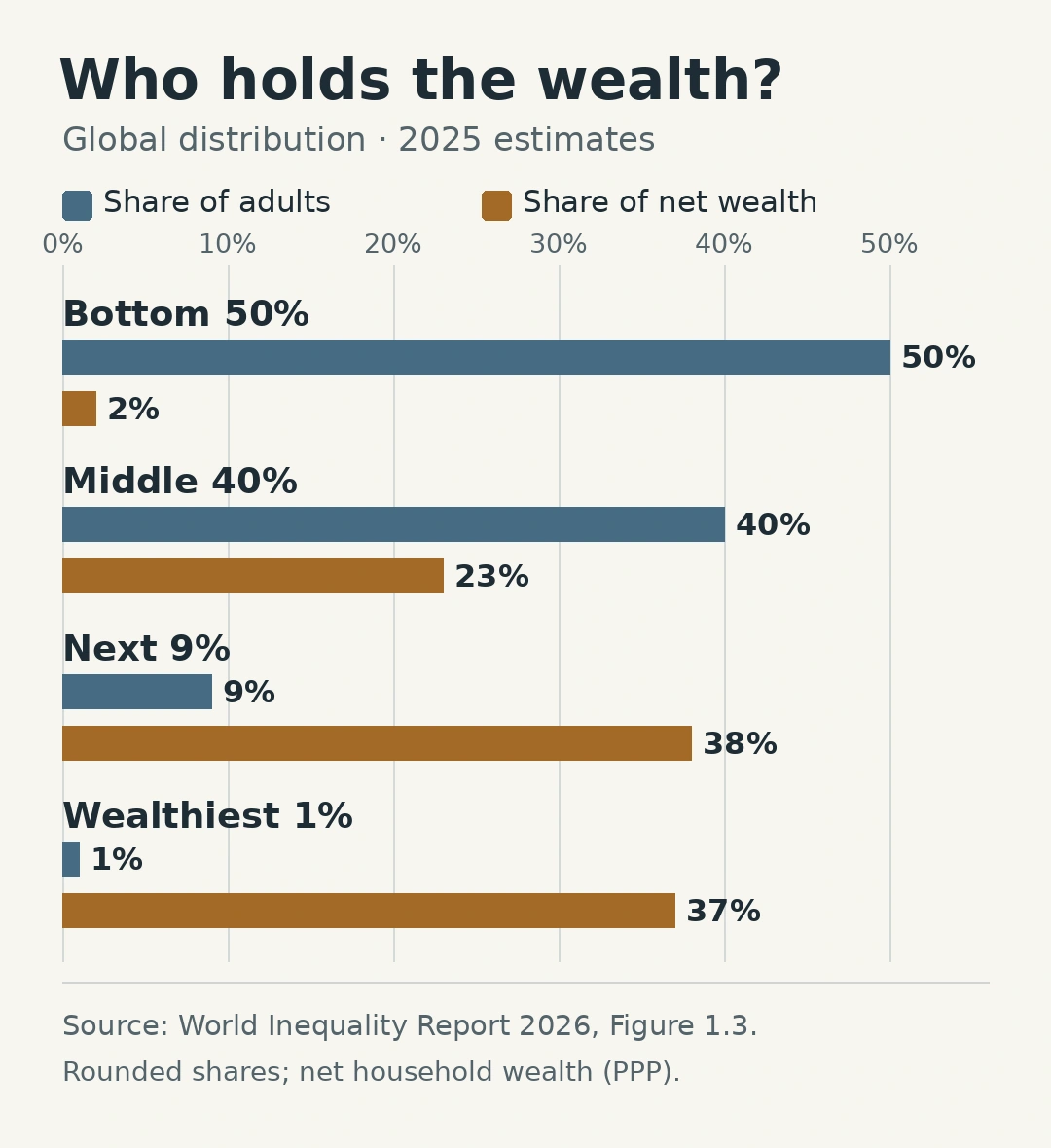
Despite these limitations, the figures reveal an important feature of the world economy: wealth is highly unequally distributed. Holding capital can open up opportunities for further investment and future returns, but a person's share of wealth alone cannot tell us how much influence they have over business or political decisions. For that, we need different kinds of data.
Ownership Is Not the Same as Decision-Making
Imagine a company whose shares are held by thousands of investors. They have certain ownership rights, but day-to-day business decisions are generally made by company management. Shareholders can use their voting rights to influence the composition of its governing bodies and certain major decisions, although the scope of their powers depends on the applicable law and the rights attached to individual shares. The OECD principles provide an international reference point in this regard, rather than a single law that applies directly in every country. [3]
The relationship becomes even more complex when people invest through funds. An individual can gain financial exposure to numerous companies without personally making each share purchase decision or voting at those companies’ shareholder meetings. Asset managers and other intermediaries may operate along the investment chain, with powers that depend on the legal structure and mandate. The value of assets under management (AUM) is therefore not a measure of the manager's own net wealth. Nevertheless, we need to examine what decisions the manager can make concerning the assets it manages. [4]
There is even a distinction between the name recorded in a securities register and the person entitled to the economic benefits of those securities. Guidance from the US SEC and FINRA, for example, describes a form of registration in which securities are held in the name of an intermediary or a person or legal entity acting on its behalf, while the investor remains their beneficial owner. This is an example from the US regulatory framework, not a rule that can automatically be applied to every country. [5]
If we want to understand an institution's financial power, it is therefore not enough to find its name in ownership records. We need to establish the capacity in which it appears there and which rights it can actually exercise.
Seven Paths to Economic Power
In this investigation, we will use seven interconnected dimensions of economic power. They are neither an official ranking of the most influential people nor a mathematical index, but a research framework that will help us distinguish the different relationships between capital and decision-making.
Ownership. The first question is who owns a particular asset or stake and who is entitled to its economic benefits. In the case of companies, we are also interested in the relationship between the direct holder of a stake and any indirect owners. Ownership can confer an important position, but it does not in itself tell us how all the associated rights are exercised. [3] [5]
Management. The second dimension is the right to make decisions within a defined scope of authority. A company's management runs its business, while an investment manager may decide how to invest entrusted assets within the terms of a mandate. Such a role does not necessarily imply ownership of the assets being managed. It is important to establish who granted the mandate, what it permits and what restrictions apply. [3] [4]
Voting rights. In joint-stock companies, we are interested in who can participate in the selection of members of corporate governing bodies and in other major decisions that shareholders vote on. Ownership stakes and voting power do not necessarily coincide, since different classes of shares may carry different rights. With institutional investors, we also need to determine who decides how votes are cast. [3] [4]
Financing. Economic power can also be acquired without purchasing an ownership stake. Under a loan agreement, a lender may set the terms of financing, require collateral or restrict certain actions by the borrower. In project finance, some contracts may also provide for a lender's right to intervene under agreed conditions. Such provisions can protect the lender against losses in the event of a breach of contract. The mere existence of a right does not mean that it has been exercised or that the creditor owns the company being financed. [6]
Contractual rights. The owner of an asset may grant another person or company the right to use it or carry out a particular activity. Imagine public infrastructure whose operation is entrusted to a private operator for a specified period. A contract may allocate tasks, responsibilities, revenue and risks without necessarily changing the ownership of the infrastructure. Only the specific contract can reveal the true extent of the operator's influence. [7]
Infrastructure. It also matters who operates the systems without which other economic activities cannot function smoothly. These include, for example, payment networks, securities custody and transaction settlement systems, and transport and energy infrastructure. The operator of such a system does not necessarily own all the assets associated with it. Its influence must be assessed in light of the system's function, access rules and regulatory restrictions. [5] [7] [8]
Institutional influence. The seventh dimension concerns participation in shaping the rules under which the economy operates. Lobbying can be a lawful way to represent interests and provide decision-makers with expert information. At the same time, insufficient transparency and unequal access to decision-makers can create a risk of disproportionate influence. Establishing that an institution has engaged in lobbying is not enough; to demonstrate its influence on a specific decision, we must examine the precise connection between its actions and the measures adopted. [9]
These dimensions can overlap. An investor may simultaneously own a stake, finance a project and participate in shaping legislation. For each of these roles, however, we need to establish separately what rights the investor has and how they are exercised.
Why a Single Ranking Cannot Explain Everything
Rankings of the wealthiest individuals are useful for understanding personal wealth. But they do not necessarily show who manages the largest investment portfolios, who sets the financing terms for major projects or who operates the systems on which economic transactions depend. An individual's net wealth, a financial company's assets under management and the value of a company's assets are different categories that cannot simply be added together to produce a single ranking of power.
The concentration of capital alone does not prove that its owners or managers act in concert. Their interests may differ, they may compete with one another, and their decision-making powers are constrained by laws, contracts and regulatory oversight. The existence of formal restrictions alone does not tell us how effectively they are enforced. Nor does the fact that ultimate investors are numerous and dispersed tell us whether certain management or voting decisions are concentrated in a smaller number of institutions.
We will therefore distinguish between the ability to exert influence, the actual exercise of authority and the demonstrable consequences of particular decisions. Where documents exist, we will examine what they establish. Where the evidence is incomplete, we will leave questions open rather than declare speculation to be fact or dismiss it without justification.
What Will We Investigate in This Series?
We will begin by clarifying the differences between formal owners, managers and beneficial owners, before examining multi-layered ownership structures. We will then turn to the history of financial dynasties, banks, money creation and debt. We will pay particular attention to major asset managers, pension and sovereign wealth funds, and institutions that provide the infrastructure of the global financial system.
We will also examine specific business and institutional cases in which we can investigate how economic power is exercised: shareholder voting, corporate takeovers, crisis measures and the shaping of legislation. Only after studying these cases will we return to the question posed in the title and attempt to formulate a more comprehensive answer.
What matters is not only how much wealth an individual or an institution holds, but also what they can do with it. Before we begin looking for the most influential actors in the world economy, we must therefore understand what it actually means to own it.
Sources and further reading
- World Inequality Lab. World Inequality Report 2026, Chapter 1, Global Economic Inequality, Figure 1.3. Source
- Marie Andreescu et al. World Inequality Report 2026: Technical Notes for Figures and Tables, 11 December 2025, pp. 14–15, Figure 1.3. Source
- OECD. G20/OECD Principles of Corporate Governance 2023, Chapter II: The rights and equitable treatment of shareholders and key ownership functions. 2023. Source
- OECD. G20/OECD Principles of Corporate Governance 2023, Chapter III: Institutional investors, stock markets, and other intermediaries. 2023. Source
- SEC Office of Investor Education and Advocacy and FINRA. Investor Bulletin: Holding Your Securities. 12 July 2023. Source
- World Bank, PPP Resource Center. Key Issues in Developing Project Financed Transactions, sections on lender protection and contractual covenants. Source
- World Bank. PPP Reference Guide, version 3.0, Introduction. 2017. Source
- CPSS–IOSCO. Principles for Financial Market Infrastructures (2012), Principles 8, 11, 16, 18 and 23; text of the principles in the appendix on the Federal Reserve website. Source
- OECD. Anti-Corruption and Integrity Outlook 2026, chapter on Lobbying. 2026. Source