How Can We Research Who Really Holds Economic Power?
A practical method for investigating ownership, voting rights, debt, management and economic influence.

AI-generated editorial illustration. It symbolises verification of ownership links, double counting and the limits of evidence; it does not depict an actual company or network.
When we read that a bank, an investment company or a family is among the largest shareholders of global corporations, we soon wonder how much power it actually holds. But an equity stake is only the starting point of an investigation. We must establish who receives the economic benefits, who has the right to make decisions, who actually exercises that right and what effects their decisions have.
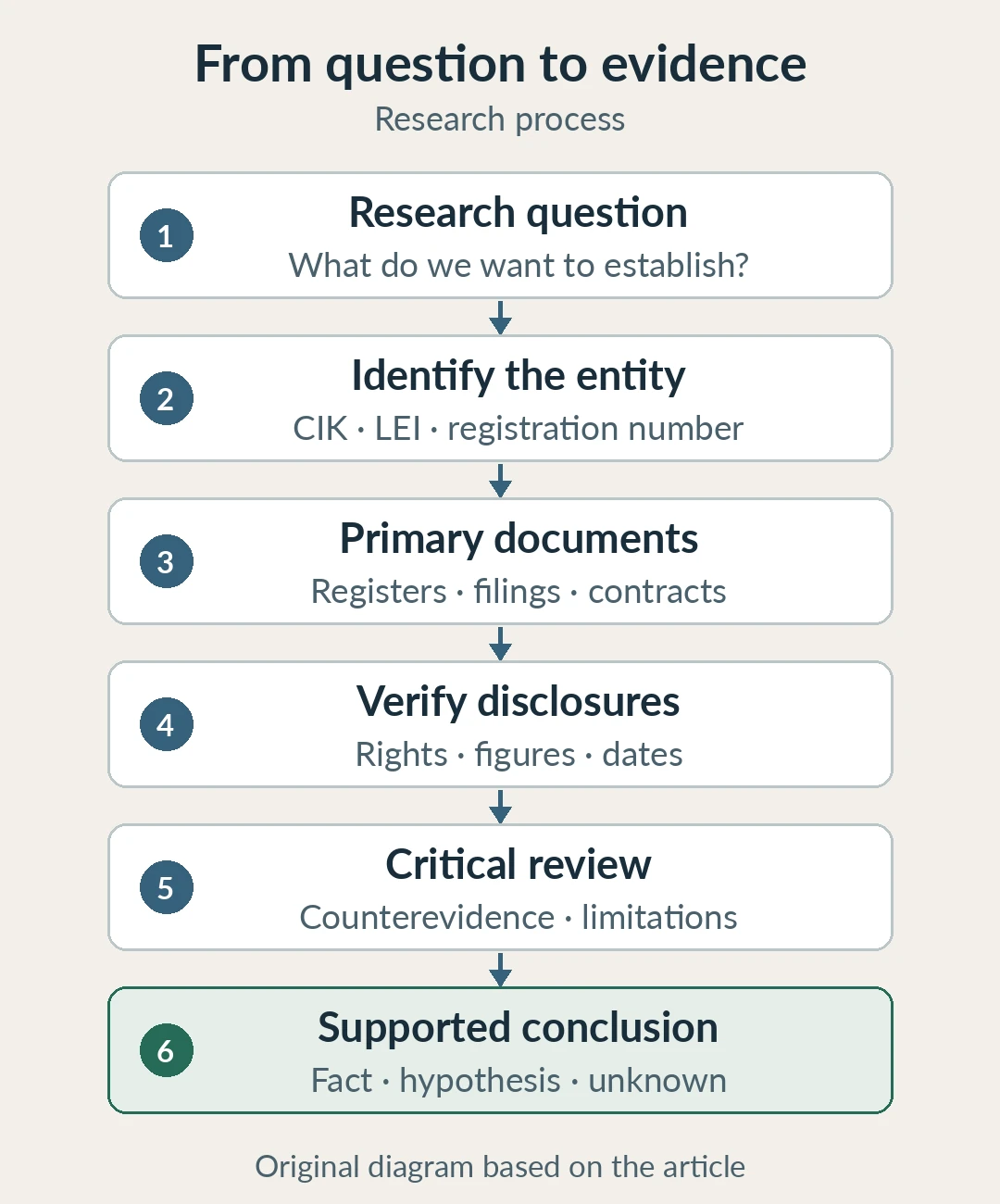
In the previous three articles, we examined different forms of ownership and control. Let us now bring them together into a research method that we can use to study financial dynasties, banks, corporations and asset managers. Its purpose is not to confirm preconceived answers, but to make our findings verifiable by another researcher.
Start with a Question, Not a Name
The question of whether a particular institution controls the world economy is too broad to be answered by a single document. Let us break it down into specific questions: does the institution hold a stake in a particular company, does it manage other investors' money, can it appoint members of the board of directors, does it hold voting rights, and did it exercise them in a particular decision?
We can assess every research claim against eight criteria. These guide us from identifying the actor to reaching a conclusion that can be supported by evidence.
| Criterion | What do we need to establish? |
|---|---|
| Subject | Which legal entity or natural person are we investigating? |
| Object | Which asset, company, right or relationship are we investigating? |
| Time | What date does the information refer to? |
| Right | What powers does the actor have, and on what basis? |
| Magnitude | What is the size of the stake or extent of the right, and how is it calculated? |
| Evidence | Which document supports the claim, and where in it can we find the information? |
| Counterevidence | What information contradicts the claim or allows for another explanation? |
| Conclusion | What can we reasonably assert, and what remains unknown? |
It is important to distinguish four levels: ownership, authority, exercise of authority and effect. A document establishing the existence of a voting right does not necessarily establish that it was exercised. A record of a vote cast does not in itself prove that this particular vote caused a resolution to pass. Each step from one level to the next requires additional evidence.
How to Identify the Right Legal Entity
A brand name is not necessarily the name of the legal entity that owns a particular asset or signed a contract. We must therefore first establish the company's official name, country of incorporation and identifier. In Slovenia, this may be its registration number; in the US EDGAR database, the filer's CIK (Central Index Key); and in the international financial system, the LEI (Legal Entity Identifier). When investigating a security, we can also use its identifier, such as an ISIN or CUSIP. [1] [6] [8]
Two useful AJPES services for researching Slovenian companies are the Slovenian Business Register (PRS), which allows users to search for business entities, and JOLP, which provides access to filed annual reports. The Register of Beneficial Owners (RDL), however, is subject to access restrictions. According to AJPES guidance checked on 16 November 2026, general public access is no longer available. Applicants without a direct right of access can apply through a procedure based on a legal interest; separate arrangements apply, for example, to obliged entities and business entities seeking information about their own beneficial owners. [8] [9] [10]
The GLEIF system is useful when examining international relationships. Level 1 data help us identify a legal entity, while Level 2 data concern the direct and ultimate parent entities that consolidate the legal entity in their financial statements. This is not a register of all shareholders or ultimate natural-person owners. The system also allows for reporting exceptions, so a missing relationship does not automatically mean that there is no parent entity. [6] [7]
When mapping these data in an ownership diagram, we must identify the type of each relationship. An equity interest, accounting consolidation, a lending relationship, investment management and contractual authority are not the same thing. If we represent them all with identical lines and no explanation, we may create an apparent network of control that the original documents do not establish.
How to Read Regulatory Disclosures
The US Securities and Exchange Commission (SEC) provides free access to searchable filings through its EDGAR database. It is important to choose the right type of disclosure for an investigation. A company's annual report may explain its operations and structure, while an investment manager's report may reveal its reported positions; the two kinds of document answer different questions. [1]
| Document | What it may reveal | What it does not establish on its own |
|---|---|---|
| Form 13F | An institutional investment manager's reported investment positions | The ultimate economic owner or votes cast |
| Schedule 13D | Beneficial ownership and the purpose of an acquisition | Implementation of the stated intention |
| Schedule 13G | Beneficial ownership under specific reporting conditions | A complete absence of influence or engagement with management |
| DEF 14A | Proposals, governance information and voting rules | The final voting results |
| Form N-PX | Reported voting decisions within the scope of the filer's reporting obligations | Every vote cast by every investor |
| Form 8-K, Item 5.07 | Disclosed voting results | The individual vote of each shareholder |
| Form 10-K / 20-F | Business operations, risks and corporate structure over the reporting year | All contractual relationships or undisclosed agreements |
Form 13F is used by certain institutional investment managers that meet prescribed conditions, including a threshold of 100 million US dollars in the market value of securities on the official Section 13(f) list over which they exercise investment discretion. Whether the threshold is met is assessed on the last trading day of each month; when the conditions are met, managers report as of the end of the relevant year and the first three quarters of the following year. The deadline is generally 45 days after the end of each quarter, with the deadline moving as appropriate when it falls on a non-business day. For the third quarter of 2026, the deadline was set for 16 November 2026. These documents do not necessarily show the entire portfolio or its current position. [2]
Schedules 13D and 13G generally concern beneficial ownership of more than five percent of an applicable class of securities. The choice of schedule depends on the legal conditions and the category of filer. The US definition of beneficial ownership includes voting power or dispositive power, or both, including shared powers. It does not necessarily mean that all economic benefits accrue to the person named in the disclosure. [3] [4]
For each document, check the date to which the information relates, the filing date, the footnotes and any subsequent amendments (also identified in EDGAR by the /A suffix). In our research record, note the link, accession number, relevant section or page and date of access. Acceptance of a document by EDGAR does not in itself establish the accuracy of its contents. [1] [2] If two disclosures differ, we must first establish whether they measure the same thing over the same period before declaring the discrepancy an error or evidence of concealment.
From the Right to Decide to Actual Action
Consider Apple Inc., which can be found in the EDGAR database under CIK 0000320193. On 8 January 2026, the company published its proxy statement for the annual meeting of shareholders, setting out the proposals, the board of directors' recommendations and the voting procedures. The meeting took place on 24 February 2026, and the company filed a Form 8-K reporting the voting results on the same day. [11] [12] [13]
The third proposal concerned a non-binding advisory vote on executive compensation. The board of directors recommended voting in favour of the proposal. The company's official filing confirms that the resolution passed and reports the following results. [11] [12]
| Category | Number |
|---|---|
| For | 8,304,055,118 |
| Against | 781,645,634 |
| Abstentions | 50,707,052 |
| Broker non-votes | 2,889,260,668 |
Source: Apple Inc., Form 8-K, 24 February 2026, Item 5.07, proposal 3. The final category does not represent votes against the proposal. [12]
Under the rules of this meeting, votes for and against were counted in determining a majority of votes cast, while abstentions and broker non-votes were also counted in determining the quorum. A separate requirement applied: the number of votes in favour had to reach a majority of the number of shares required for a quorum. The proportion of votes cast in favour is therefore not the same as the proportion of all the company's shares. [11]
Original filing: Apple Form 8-K – voting results (24 February 2026, proposal 3)
If we want to know how a particular fund voted, we look for its N-PX disclosure, provided it is subject to the relevant reporting requirement, and check the identity of the filer or fund series, the issuer, the meeting date and the proposal. Form N-PX has a broader scope for registered investment funds subject to the requirement, while institutional investment managers subject to Section 13(f) reporting must report certain votes on executive compensation in which they exercised voting power. Disclosures may also include voting instructions if the actual votes cast have not yet been confirmed, as well as information on shares loaned and not recalled. Joint reporting is also possible, so we must establish on whose behalf the votes are reported. [5]
In this case, we have the confirmed aggregate results of Apple's meeting, but not a separately verified record of an individual fund's vote. We therefore cannot attribute a particular number of votes to a specific manager. Even if we obtained such a record, we would still need to investigate separately whether its vote had a decisive effect and whether it was an independent decision or part of coordinated conduct.
Checking the Numbers and the Risk of Double Counting
A percentage without an explanation of its denominator can be misleading. The share of capital is not necessarily the same as the share of voting rights; the share of all voting rights is not the same as the share of votes cast at a particular meeting. Where different share classes exist, we must examine their rights, and in the case of beneficial ownership, we must also consider special rules for taking rights to acquire shares into account. [4]
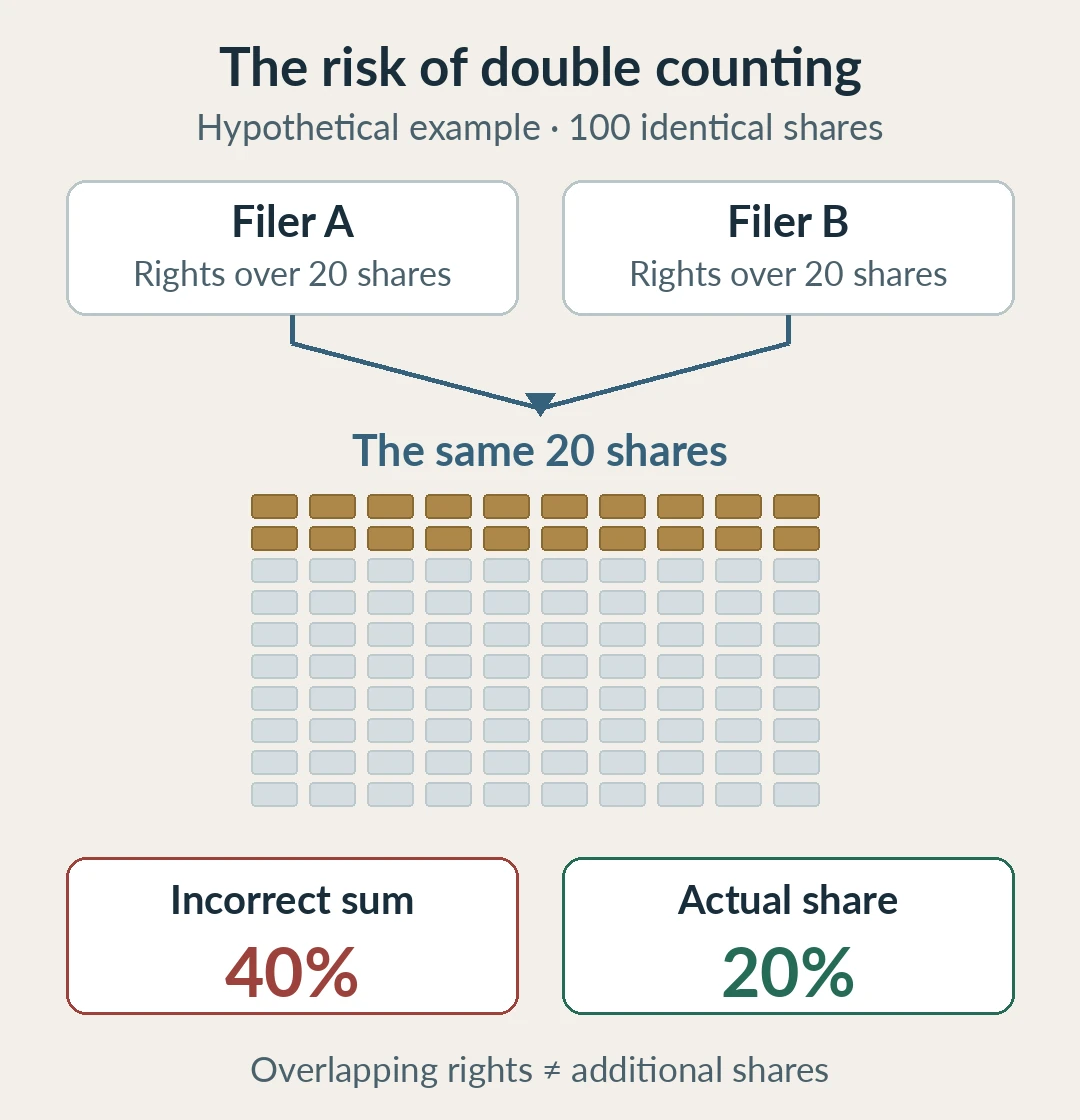
Imagine a company with 100 identical shares. According to their disclosures, Filer A and Filer B have rights over the same 20 shares. If we simply add their reported figures together, we arrive at 40 shares, even though there are only 20 such shares. This is a hypothetical example of double counting, not a description of an actual company. Shared exercise of rights or attribution of rights to different entities may create overlaps, so we must check the footnotes and reporting rules. [2] [4] [5]
It is also important to know what investment reports leave out. Form 13F distinguishes investment discretion from voting authority. It does not include short positions or subtract them from long positions, and, subject to the Form 13F rules, loaned securities are reported by the relevant filer on the lender’s side, not the borrower. We must therefore not treat reported positions as a complete picture of net exposure or as a record of votes actually cast. [2]
When we investigate major asset managers later in this series, we will not add up all disclosed stakes without checking their origins. We must distinguish between capital they own, capital they manage on behalf of others, and the rights they can exercise in doing so.
The Limits of Public Evidence and Responsible Research
Sometimes an ownership chain will be well documented; at other times, our research will reach a legal entity for which we cannot find the next link. The absence of a search result does not in itself prove either concealment or the absence of a relationship. Negative evidence may be stronger if we know that the information sought had to be filed in a particular register by the relevant deadline and that we have examined the appropriate period and all relevant records.
In our research records, we should therefore distinguish between a documented fact, an interpretation of that fact, a working hypothesis and an open question. Finding that two companies participate in the same investment or vote in the same way may justify further investigation, but it does not in itself establish an agreement. The possibility of coordinated conduct should not be ruled out merely because we do not yet have a document establishing it.
A good research record contains a clear claim, a date, a source, the precise location in the document, an interpretation and the limitations. It allows us to supplement or correct a finding later without erasing the steps that led to it. Such an approach helps us investigate even those forms of economic power for which public information is incomplete.
This concludes the first section of the series. We have examined the differences between ownership, management and control and how to verify these relationships. In the next section, we will apply the same method to the history of major financial families, beginning with the question of how great financial dynasties emerged.
Sources and further reading
- SEC. Using EDGAR to Research Investments. 2018-09-04. Sections Where to Begin and Form Types. Source
- SEC Division of Investment Management. Frequently Asked Questions About Form 13F. 2023-05-24; updated 2026-03-06. FAQ 25, 27–30, 41–42, 44–50a; SEC staff guidance. Source
- eCFR / Cornell LII. 17 CFR § 240.13d-1 — Filing of Schedules 13D and 13G. Ongoing; paras. (a)–(d), (i). ; alternative version: Source 1 Source 2
- eCFR / Cornell LII. 17 CFR § 240.13d-3 — Determination of beneficial owner. Ongoing; paras. (a), (c), (d). ; alternative version: Source 1 Source 2
- SEC. Enhanced Reporting of Proxy Votes by Registered Management Investment Companies; Reporting of Executive Compensation Votes by Institutional Investment Managers. 2022-12-21. Sections Quantitative Disclosures and Securities Lending, Joint Reporting and Say-on-Pay Vote Disclosure. Source
- GLEIF. Level 2 Data: Who Owns Whom. Ongoing. Source
- GLEIF. Download the GLEIF Golden Copy and Delta Files. Ongoing. Source
- AJPES. Poslovni register Slovenije. Ongoing. Source
- AJPES. JOLP — javna objava letnih poročil. Ongoing. Source
- AJPES. Register dejanskih lastnikov — Dostop in vpis, pogosta vprašanja. Ongoing. ; alternative version: Source 1 Source 2
- Apple Inc. 2026 Proxy Statement (DEF 14A). 2026-01-08. Notice and Voting Procedures, pp. 3, 87–89. ; issuer's PDF: Source 1 Source 2
- Apple Inc. / SEC EDGAR. Form 8-K — Item 5.07. 2026-02-24. Source
- SEC EDGAR. Filing Detail — 0001140361-26-006577. 2026-02-24. Source