Vimalakīrti Nirdeśa — Why Is the Great Mahāyāna Teacher a Layman, and Why Does He Answer the Deepest Question with Silence?
Buddhist literature is full of monks, meditators, arahants, bodhisattvas, and Buddhas. Yet one of the boldest Mahāyāna sutras places at its center **a layman.** Not a monk. Not a hermit.
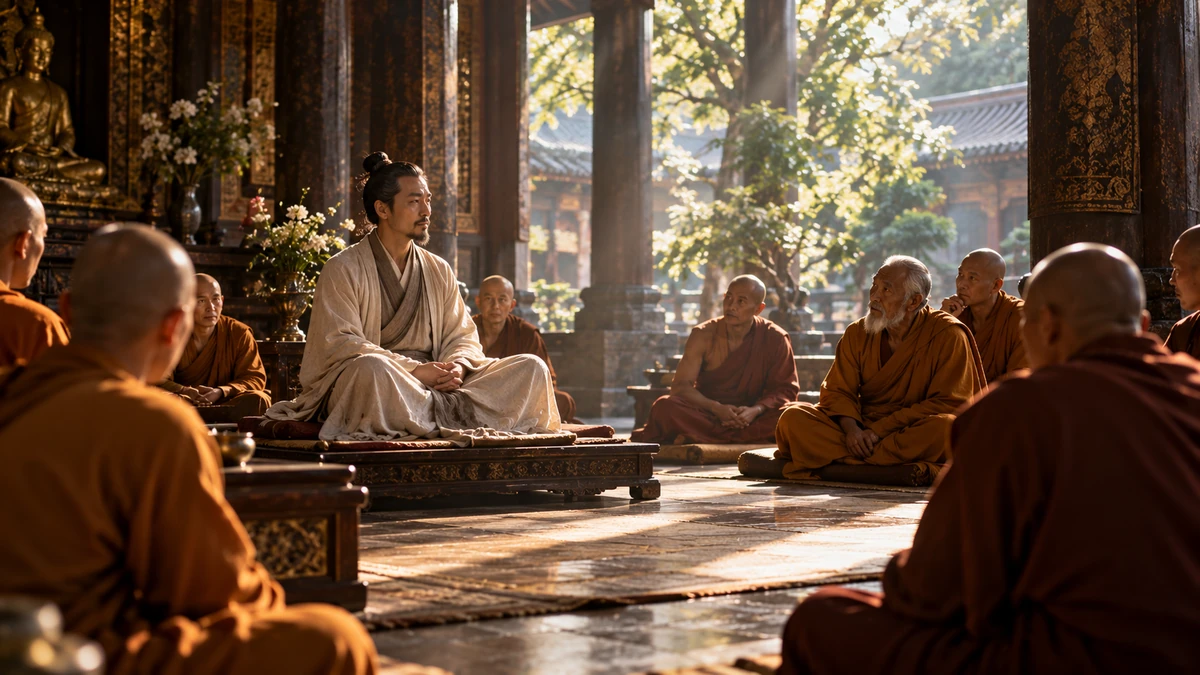
Buddhist literature is full of monks, meditators, arahants, bodhisattvas, and Buddhas. Yet one of the boldest Mahāyāna sutras places at its center a layman. Not a monk. Not a hermit. Not a monastic teacher. But a man who lives in a city, has a house, moves among merchants, officials, rich and poor, and knows both the monastic and the secular world. His name is Vimalakīrti. And when the Buddha asks his great disciples to visit him during an illness, almost all of them hesitate. Why? Because Vimalakīrti had already embarrassed them with questions showing that even correct Buddhist teaching can be turned into a new object of attachment.
What Is the Vimalakīrti Nirdeśa?
The title means approximately The Teaching of Vimalakīrti. It is one of the most literarily accomplished Mahāyāna sutras. It is at once dialogue, drama, philosophical discussion, satire, miracle story, and at times almost comedy. Vimalakīrti is presented as a great Licchavi bodhisattva from Vaiśālī who lives as a layman yet exceeds ordinary categories of monk and householder.
How Old Is the Text?
We do not know its exact date of composition. But by the first half of the third century at the latest the text must already have existed, since an early Chinese translation attributed to Zhi Qian survives. Later came two highly influential translations: Kumārajīva — 406 and Xuanzang — 650. The complete Sanskrit manuscript was long lost until it was discovered in 1999 in the collection of the Potala Palace in Tibet.
Structure. The Tibetan and Sanskrit traditions are arranged in 12 chapters. Among the most important for our article are chapter 2 — Vimalakīrti's apparent illness,
chapter 4 — Mañjuśrī's visit and the discussion of illness,
chapter 6 — the goddess,
chapter 8 — the gate of nonduality.
Why Is Vimalakīrti a Layman?
This is one of the text's central literary features. In the early Buddhist world monks and nuns have a special status. They leave the household life. They accept the Vinaya. They orient their lives toward practice. Vimalakīrti, however, shows that spiritual status is not the same as wisdom. This does not mean monasticism is unnecessary. Nor does it mean laypeople are better than monastics. It means that clothing and social position do not by themselves guarantee insight.
The Buddha sends the disciples to him. Vimalakīrti appears to be ill. The Buddha asks his greatest disciples to visit him. But one after another they recount why they would rather avoid doing so: Śāriputra, Mahāmaudgalyāyana, Mahākāśyapa, Subhūti, Rāhula, Ānanda, and then bodhisattvas as well. Each remembers a moment when Vimalakīrti exposed the limitation of his understanding.
This is also humor. The Buddha's great disciples are famous, respected, and learned, yet in the face of Vimalakīrti almost all of them effectively say: I'd rather not. The text reverses the hierarchy. The layman becomes the teacher. Monastic masters become students. But the target is not the monk as such. The target is spiritual complacency.
Vimalakīrti's Illness
The text does not present the illness simply as an ordinary medical diagnosis. When Mañjuśrī asks what kind of illness he has, Vimalakīrti answers that it is immaterial, invisible, neither simply bodily nor simply mental. When Mañjuśrī asks which element is disturbed, he answers: I am ill because the elements of living beings are disturbed by illness. This links his illness with the bodhisattva's compassion.
But the point is not rejection of the body. Vimalakīrti even explains how a sick bodhisattva should be consoled. One should tell him that the body is impermanent, but not lead him into disgust for the body. The body is dukkha, but he should not be encouraged toward an egoistic escape into liberation. The body is without self, yet for that very reason he should cultivate beings all the more. Illness should become a source of empathy.
This is the essence of the bodhisattva's illness. Not “my body is bad, so I must discard it,” but “my vulnerability shows me the vulnerability of all beings.” Illness thus becomes upāya, skillful means, and a starting point for compassion.
Who goes after all? Finally: Mañjuśrī. The bodhisattva of wisdom. He too knows that Vimalakīrti is an exceptionally demanding interlocutor. But he accepts the assignment. When others hear that Mañjuśrī will go, they join him: monks, bodhisattvas, gods, and many other beings. They all want to hear their conversation.
A small room, immeasurable space. Vimalakīrti's room is small. Yet in chapter 5 he miraculously brings into it immensely large thrones from a distant Buddha-world. The room contains them all. It does not become too small. This is a classic Mahāyāna literary method: a philosophical idea is presented through impossible space.
Why? Because our categories — large, small, inside, outside, near, far — are not as absolute as they seem. The miracle is not mere spectacle but a visualization of the non-reification of space.
Vaiśālī as a field of practice. Vimalakīrti does not need a wilderness cave; he practices in the city. This is an important Mahāyāna idea. A bodhisattva can act among people, in society, in trade, in palaces, among the poor and the rich. The world is not only a distraction from the path. It can become the field of the bodhisattva's activity.
But this does not mean everything is the same. Nonduality does not mean good = evil, wisdom = ignorance, compassion = cruelty. Emptiness does not erase ethical consequences. The text dismantles the absolutization of distinctions, not every practical distinction.
What Is Nonduality?
In Sanskrit: advaya. Roughly: not-two. But this does not necessarily mean that “everything is one cosmic substance.” Buddhist nonduality often means that two poles should not be grasped as two independent absolute realities: samsāra and nirvāṇa, pure and impure, self and other, subject and object, male and female, speech and silence.
The goddess and Śāriputra. In chapter 6 a goddess appears. Śāriputra asks why she does not change her female body. The goddess answers with a miracle. By her magical power she causes Śāriputra to take on her female form while she takes on his male form. Then she asks him why he does not change his female form back. Śāriputra realizes that he cannot simply grasp it and remove it. The goddess then explains: just as he has appeared in female form, women too appear in female form; this does not mean there is an eternal inner feminine essence.
What does this scene mean? We will not claim that the sutra teaches a modern theory of gender. That would be anachronistic. But we can quite legitimately say that the text uses gender transformation to criticize fixed metaphysical identities of male and female. Gendered form too is included in non-reification.
The Gate of Nonduality
Then comes chapter 8. Vimalakīrti asks the assembled bodhisattvas: How does a bodhisattva enter the gate of nonduality? Thirty-one bodhisattvas answer. Each takes a pair: arising and cessation, self and mine, purity and impurity, good and bad, samsāra and nirvāṇa, and so on. Each shows how absolute duality breaks down.
Then Mañjuśrī speaks. Mañjuśrī praises their answers. But then he goes a step further. He says, roughly: true entry into nonduality is where dharmas are not uttered, designated, explained, or conceptualized. Thus even the best theory of nonduality is still a theory.
Then they ask Vimalakīrti. Now comes his answer: Vimalakīrti remains silent and says nothing. Mañjuśrī praises him. This is the famous silence of Vimalakīrti.
But silence itself is not an absolute. This is a crucial safeguard. If we turned it into a formula — silence = truth and speech = error — we would create a new duality and thereby miss the point. Vimalakīrti has spoken a great deal before this. The entire sutra speaks. Mañjuśrī has just given a sophisticated verbal answer. Silence is meaningful at this precise moment in the argument.
Why is the silence so powerful? Because every further sentence — “nonduality is X” — would risk creating a new fixed X. Vimalakīrti therefore does not offer another concept. The silence is the dramatic conclusion of the non-reification of nonduality itself.
Nonduality must not become a new metaphysics. This is the same problem as with emptiness. If you say “emptiness is the ultimate substance,” you have reified it. If you say “nonduality is the ultimate thing,” you have done the same. If you say “silence is always the highest truth,” you have once again created an absolute. Vimalakīrti's logic constantly removes precisely such footholds.
Skillful Means
Much of his activity can be understood as upāya — skillful means. His illness, house, miracles, debates, humor, and silence are all adapted to the situation.
What are skillful means? Different beings have different capacities, expectations, and attachments. Therefore a bodhisattva does not use one method for everyone. But this does not mean all methods are equally good. Upāya makes sense only in connection with wisdom and compassion.
Samsāra and Nirvāṇa
The Vimalakīrti Nirdeśa frequently dismantles the strict duality of samsāra versus nirvāṇa. This does not mean suffering and liberation are practically the same. If they were, the bodhisattva path would make no sense. It means: do not turn them into two self-subsisting metaphysical realms.
Pure and impure. The same applies to pure and impure. A bodhisattva can act in the midst of an impure world without inward clinging. That is why Vimalakīrti remains in the city, among people, amid problems.
This is an important Mahāyāna ideal. Liberation is not necessarily a geographical escape. The bodhisattva can return precisely to where suffering is. Not because suffering is unimportant, but because compassion matters.
The monastic hierarchy is reversed. The sutra repeatedly and deliberately reverses expectations. A layman teaches monks, a goddess teaches Śāriputra, a small room contains immeasurable space, illness becomes teaching, and silence becomes an answer. These are literary inversions.
Why? To break the self-evident. What appears high is not necessarily absolutely high. What appears low is not necessarily without wisdom. What appears small may contain the great. What appears to be weakness may become skillful means.
Was Vimalakīrti a Historical Person?
The text presents him as a concrete great layman from Vaiśālī. But we have no independent evidence for a historical Vimalakīrti that would allow a reliable biography. We will therefore treat him primarily as the literary and religious protagonist of the sutra.
Why was he so influential in East Asia? Vimalakīrti offered a very attractive model: an educated, active, spiritually profound layperson. This fitted well with cultures that had a strong tradition of the learned householder. Later Chan and Zen were especially receptive to paradox, nonduality, criticism of attachment to words, and the famous silence. But the Vimalakīrti Nirdeśa is an older Mahāyāna sutra. Chan comes later. Influence is not origin.
What is the sutra's greatest lesson? Perhaps: do not confuse the form of practice with its essence. A monk can miss the point. A layperson can understand. A speaker can reify. Silence can cut through reification. Illness can become Dharma. A city can become the bodhisattva's field. But none of these reversals is absolute.
Vimalakīrti is not an absolute either. If we began to think “Vimalakīrti is the true teacher and monks are not,” we would create a new duality. If we thought “silence is always deeper than words,” another duality. If we thought “the layperson is higher than the monk,” the same again. The sutra constantly slips away from just such conclusions.
Vimalakīrti's silence in one sentence. We can summarize it most precisely like this: When every further definition of nonduality would create a new concept, Vimalakīrti does not offer one more concept. That is his silence. It is not proof that truth can never be expressed. It is a demonstration of the limit of conceptual grasping.
Conclusion
The Vimalakīrti Nirdeśa is one of the most playful and at the same time most serious Mahāyāna sutras. Its central figure is a layman, yet one who surpasses great disciples. He is ill, but turns illness into compassion and teaching. He lives in a small room, yet immeasurable thrones and worlds can enter it. In his house a goddess shows that gendered form too is not an unchanging metaphysical essence. And when thirty-one bodhisattvas and Mañjuśrī explain nonduality, Vimalakīrti gives no further definition. He simply remains silent. With this the sutra does not teach that silence is always higher than speech. It teaches something harder: even the deepest Buddhist concept must not become a new thing to which we cling. Monk and layperson. Pure and impure. Male and female. Samsāra and nirvāṇa.
Speech and silence. We can use all these distinctions, but not as eternal, self-subsisting absolute boundaries. And this is precisely why Vimalakīrti does not flee the world. He remains within it. Because bodhisattva wisdom without compassion is incomplete, and compassion without wisdom is blind. The Vimalakīrti Nirdeśa wants both.
Sources and Literature
Primary Texts and Reference Editions
- Thurman, Robert A. F., trans. The Teaching of Vimalakīrti (Toh 176), 84000 electronic edition.
Research and Verification Literature
- Thurman, Robert A. F., trans. The Teaching of Vimalakīrti (Toh 176). 84000 electronic edition, first published 2017; original translation 1976.
Note: verification sources are part of the editorial apparatus. Where the original edition used during reconstruction was not preserved, a standard reference edition is not presented as the article's presumed original source.