USS Liberty 1967: the attack, official investigations, and the question of intent
The Israeli attack on USS Liberty on 8 June 1967 is documented; what remains disputed is whether the attackers knew the ship was American.
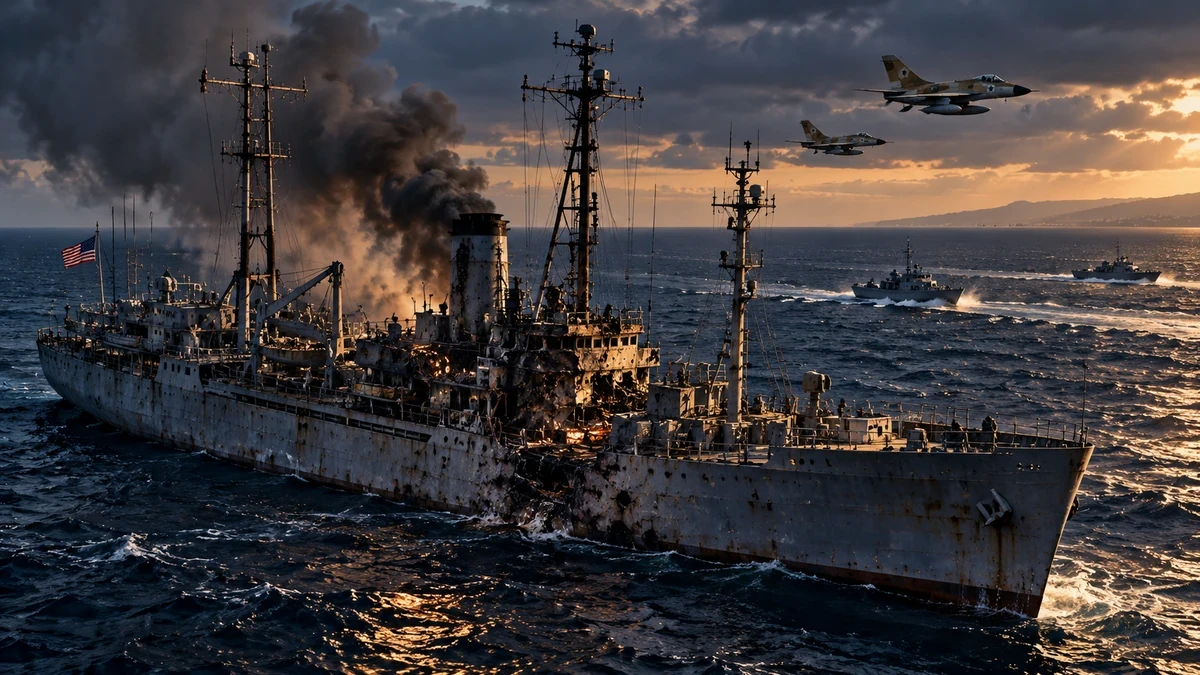
On 8 June 1967, the fourth day of the Six-Day War, Israeli fighter aircraft and motor torpedo boats attacked the American intelligence ship USS Liberty (AGTR-5) in international waters off the Sinai Peninsula. The attack unfolded in two phases — first from the air and then from the sea. Thirty-four Americans were killed, roughly 170 were wounded, and the ship was so badly damaged that it was later removed from active service.[1][2]
There is no historical dispute over who attacked Liberty: Israeli forces carried out the attack, Israel acknowledged responsibility for the strike, apologized, and later paid compensation for the dead, the wounded, and damage to the ship.[3][4] The dispute that has continued for decades is different: did the attackers know they were striking an American ship, or was this a catastrophic case of mistaken identity?
Declassified U.S. documents do not provide a simple answer. Soon after the incident, the CIA assessed that intercepted Israeli communications after the attack indicated that the attacking units had not identified Liberty as an American ship before or during the attack. At the same time, those same U.S. records found that Liberty had already been identified as American within the Israeli system hours earlier, that the weather was clear, that she displayed an American flag and large hull markings, and that the explanation that she had been mistaken for the Egyptian ship El Quseir was exceptionally difficult to accept.[5][6][7]
USS Liberty is therefore different from Operation Susannah and Operation Northwoods. The attack is documented; intent remains contested. The reviewed sources do not establish a pre-planned false-flag operation, nor do they establish a documented plan to blame the attack on Egypt and use it as a pretext for U.S. entry into the war. They do establish a real attack with grave consequences, major inconsistencies in the Israeli explanation, sharply critical U.S. findings of negligence, and investigative limitations that have prevented the question of intent from disappearing completely.[5][7][8]
First, the terminology: why USS Liberty is not automatically a “false flag”
The term false flag means more than a state denying intent or offering a disputed explanation for an event. In the stricter sense, it describes an act in which the real perpetrator deliberately creates the appearance that another party carried it out, usually to produce a political, military, or propaganda effect.
Three things about USS Liberty are clear:
- Israeli forces carried out the attack;
- Israel soon acknowledged that its forces had attacked the ship;
- Israel maintained that the incident was a tragic case of mistaken identity, not an attack that the world was meant to attribute to Egypt or another party.[3][9]
Therefore, even if it were someday conclusively demonstrated that someone in the attack chain knew Liberty was American, that fact by itself would establish a deliberate attack on an American ship, not necessarily a classic false-flag operation. A false-flag classification would also require evidence of planned deceptive attribution or of a political scenario in which the attack was intended to be blamed on someone else.
No such plan appears in the primary documents reviewed for this article.
That does not mean the official explanation is thereby proven. It means the research must separate two questions:
- was Liberty deliberately attacked as an American ship?
- was there a plan to attribute the attack to another party and use it as a manufactured pretext?
The first remains the subject of serious and enduring dispute. The reviewed documentary record does not provide an evidentiary basis for the second.
Where and why Liberty was there: an intelligence ship in a war, but in international waters
USS Liberty was a former Victory-class merchant ship converted into a U.S. technical research ship, effectively a floating platform for signals-intelligence collection (SIGINT). As the Middle East crisis escalated rapidly in May and June 1967, she was diverted from her normal operating area to the eastern Mediterranean to expand U.S. intelligence coverage of the conflict.[5][10]
On 8 June she was operating north of Sinai. U.S. records place her at roughly 15.5 nautical miles from the coast at the time of the attack, moving at about five knots. Clark Clifford’s White House review explicitly found that Liberty was in international waters before, during, and after the attack, where she had a right to be.[7]
There was also an important American communications failure. U.S. command authorities tried before the attack to move Liberty much farther from the combat zone — as far as one hundred miles from the coasts of Israel and the United Arab Republic — but the change of orders did not reach the ship in time because of failures in message handling.[5][11]
A later Joint Chiefs of Staff review attributed the delay to a combination of human error, heavy communications traffic, and inadequate appreciation of the urgency of the situation.[11]
This distinction matters. The U.S. side made serious command-and-communications errors that left the ship closer to the active battlefield than Washington intended. But Clifford’s review simultaneously rejected the notion that Liberty thereby lost her neutral status or tried to conceal her identity.[7]
Morning identification: Liberty had already been recognized as American inside the Israeli system
One of the most important facts in the case is that on the morning of 8 June Liberty was not an entirely unknown contact.
The U.S. Navy’s modern official history states that an Israeli reconnaissance aircraft located the ship early in the morning and that, after the aircraft returned, an Israeli naval intelligence officer correctly identified her as USS Liberty. The contact was marked as neutral on a situation board and later removed as stale; the information about the American vessel reportedly did not survive the change of watch.[12]
The CIA, after reviewing the Israeli investigation, likewise concluded that the IDF had identified Liberty probably more than four hours before the attack.[6]
Clifford’s review for President Johnson went further. It cited multiple prior aerial reconnaissance passes, clear and calm weather, an American flag at the mast, large identifying markings on the bow and stern, and Liberty’s highly distinctive antenna array. The memorandum concluded that the ship’s appearance and standard markings should have permitted trained observers to identify her correctly.[7]
But this still does not establish that the pilots and commanders who actually carried out the attack received that information.
That is the core of the official explanation: Liberty was correctly identified at one point within the Israeli military system, but the information was allegedly lost amid a rapidly changing battlefield picture, shift changes, and separate air and naval command chains.[6][12]
That explanation is possible — but it left U.S. investigators with an obvious problem: how could a military system first identify a large neutral American ship correctly and then, only hours later, attack it as an allegedly hostile vessel?
The attack: air strikes, torpedo boats, and 34 dead
The attack began in the early afternoon. Israeli combat aircraft conducted repeated low-level strafing and rocket attacks; soon afterward three Israeli motor torpedo boats approached.[1][7]
According to the U.S. record, roughly twenty-four minutes elapsed between the air and surface phases. The torpedo boats fired several torpedoes; one struck Liberty’s starboard side and tore a massive hole in the area where many SIGINT specialists were working.[1][5]
The consequences were catastrophic. Thirty-four crew members and intelligence personnel were killed, and roughly 170 were wounded. Official Navy historical summaries differ by one in the wounded count — 170 and 171 both appear — so this article uses the safer wording “roughly 170 wounded.”[1][2]
The ship’s commanding officer, Captain William L. McGonagle, was wounded during the attack but remained on the bridge and continued to command the ship. He later received the Medal of Honor for his actions.[1]
Despite the severe damage, Liberty remained afloat. U.S. destroyers were sent to assist, and the ship eventually reached Malta under her own power for emergency repairs.[1][13]
The physical attack is therefore not evidentially ambiguous. The ambiguity lies in identification and intent.
,_9_June_1967.jpg)
The Israeli explanation: three errors that allegedly combined into a catastrophe
The Israeli inquiry explained the attack as a chain of three mistakes.[9]
The first was erroneous information that Israeli positions near El Arish were being shelled from the sea by an unidentified vessel. Israeli naval and air headquarters accepted these reports as true even though they later proved to be incorrect.[9]
The second was a mistaken estimate of the unidentified ship’s speed. Israeli torpedo boats reported a speed of roughly 28–30 knots. Since Israeli personnel had earlier determined that Liberty’s maximum speed was about 18 knots, the high speed estimate contributed to the conclusion that the radar target could not be Liberty but must instead be a hostile vessel.[6][9]
The third error was identification of the ship as the Egyptian transport El Quseir. According to the Israeli account, the torpedo boats believed they were attacking an Egyptian vessel, not USS Liberty.[9]
The Israeli inquiry concluded that the attack had not been made with malice, that there had been no criminal negligence, and that the incident was the result of innocent error.[9]
American analysts accepted parts of this account, but not without sharp criticism. On 21 June the CIA wrote that it was difficult to understand how a trained naval commander could twice estimate Liberty’s speed at 30 knots and that it was unusual to authorize an attack on an unidentified vessel without adequate visual confirmation. The CIA described the torpedo-boat action as involving “overeager” commanders and characterized the overall chain as gross negligence.[6]
U.S. investigations did not all say the same thing — and they did not have the same remit
A common claim in debates over Liberty is that “all U.S. investigations proved it was an accident,” or, in the opposite direction, that “the U.S. government never investigated the attack.” Both formulations are too crude.
CIA and DIA
On 13 June, using the information then available and intercepted communications after the strike, the CIA assessed that there was little doubt that the attackers had failed to identify Liberty as an American ship before or during the attack.[5]
After receiving the Israeli inquiry, the CIA reassessed the case on 21 June. It concluded that Liberty had been identified within the Israeli system before the attack, but that the attacking units apparently did not know they were attacking that same ship. The final language remained severe: the attack was not assessed as malicious toward the United States, but the errors were “incongruous” and indicative of gross negligence.[6]
The DIA similarly stated that no available information conclusively showed a premeditated attack on a vessel known to be American.[6]
U.S. Navy Court of Inquiry
The Navy Court of Inquiry primarily examined the circumstances of the attack and the conduct of the American crew and command chain. Its public summary stated that the available evidence pointed toward mistaken identity.[8]
But the boundary of its jurisdiction is crucial. A White House memorandum prepared before the report’s release explicitly stated that it was not the Court’s responsibility to rule on the culpability of the attackers and it heard no evidence from the attacking nation. Walt Rostow told President Johnson that members of the Court personally believed the incident resulted from an Israeli communications-system failure, but that they should not categorically state this as an official finding on Israeli culpability or intent based on the evidence before them.[8]
Clifford’s White House review
The most striking official document is Clark Clifford’s July review for the President. After examining what the covering memorandum described as “literally thousands of pages of evidence,” Clifford concluded that the available information did not show that the Israeli high command had premeditated an attack on a ship it knew to be American.[7]
At the same time, Clifford rejected several critical parts of the Israeli explanation. He called the identification of Liberty as El Quseir unbelievable, emphasized major differences in size and configuration, and described gross and inexcusable failures of command and control. He characterized the attack as an unprovoked act of gross negligence for which, in his view, the Israeli government should be held responsible.[7]
This is not a small difference in wording. The official U.S. picture was not “everything was normal, just a sad accident.” It was closer to: we do not have evidence of a premeditated attack on a knowingly identified U.S. ship, but the explanation is riddled with errors so severe that U.S. officials described the failures as gross negligence and, in places, difficult to believe.
Why many survivors and some U.S. officials did not accept the mistake explanation
The persistence of the controversy is not difficult to understand. Several features of the attack appeared, to members of the crew and to some U.S. officials, difficult to reconcile with an ordinary mistake.
Clifford’s memorandum listed:
- clear and calm weather;
- an American flag before the attack;
- a second, larger American flag before the torpedo phase;
- large GTR-5 markings on the hull;
- a distinctive configuration and unusual antenna array;
- Liberty’s very low actual speed;
- the fact that the ship had already been correctly identified in the Israeli system hours earlier.[7]
In addition, the U.S. diplomatic note to Israel of 10 June stated that there was every reason to believe Liberty had been or should have been identified before the attack and that, under those circumstances, the strike was “literally incomprehensible.” At a minimum, the U.S. government described the event as military recklessness or reckless disregard for human life.[14]
Many crew members therefore remained convinced that the attack was deliberate. Their testimony matters as firsthand testimony from people who survived the attack, but it does not by itself establish what Israeli pilots, torpedo-boat commanders, or higher headquarters knew.
Some senior U.S. officials later expressed doubts as well. Former Secretary of State Dean Rusk wrote in his memoirs that he had never been satisfied with the Israeli explanation and did not believe it. This is significant testimony from a man who stood at the top of U.S. diplomacy during the incident — but it is his later judgment, not a newly discovered primary record of an attack order.[15]
The distinction, therefore, is between testimony and proof of intent. The former exists in substantial volume. The latter remains incomplete.
What the declassified intercepts show — and what they cannot show
Over the decades, the NSA declassified a substantial collection of documents, messages, audio recordings, and transcripts concerning Liberty. In releasing the materials publicly, the agency did not impose a single definitive interpretation, instead making the record available for researchers to evaluate.[10][16]
The most important limitation is this: the CIA wrote in June 1967 that it did not possess the communications of the attacking aircraft and torpedo boats during the attack itself. The key intercepted conversations are primarily between Israeli helicopters and ground control after the principal attack.[5]
Those recordings show confusion about the vessel’s identity. Controllers and helicopter crews after the attack attempted to determine whether the ship was Egyptian, American, or something else, searched for markings, and checked the flag. U.S. intelligence analysts relied heavily on this confusion in concluding that the attacking units probably did not know they were striking an American vessel.[5]
But the material has a limit: post-attack conversations cannot reliably reconstruct every piece of information held by every participant before the attack. They can materially support the mistaken-identification explanation, but they cannot by themselves exclude every possibility that another actor in the command chain knew more.
The reverse is also true. The fact that Liberty had been correctly identified on an Israeli situation board earlier in the day does not establish that this identification was passed to the specific pilots and torpedo-boat crews that attacked in the afternoon.
The same documents therefore support two different propositions of unequal strength:
- well supported: the Israeli military system knew before the attack that an American ship was in the area, but that identification information catastrophically broke down or failed to reach the attacking elements;
- not established: the attacking elements or higher command knowingly understood that the target was American and nevertheless received or issued an order to attack.
This is the central evidentiary boundary of this article.
What about the U.S. aircraft that were launched and then recalled?
Another powerful and frequently simplified story surrounding Liberty is that U.S. leaders deliberately withheld assistance because they did not want to damage relations with Israel politically.
The primary documents confirm part of that story, but not the entire conclusion.
During the crisis, the Sixth Fleet did issue orders to launch aircraft from USS America and USS Saratoga. There are also documented recall orders. At one point the Joint Chiefs of Staff authorized the use of force necessary to defend Liberty from further attack, and that authorization was later cancelled.[17]
The chronology, however, overlaps with rapidly changing information. Washington soon learned that Israel had carried out the attack, while the Israeli side stated that it was a mistake, offered assistance, and initiated search activity. President Johnson also informed Soviet Premier Kosygin that American aircraft had been sent toward the area to investigate the incident, so that the Soviet Union would not misinterpret their movement as a broader U.S. military action.[18]
The documents therefore establish launches, recalls, and politically sensitive crisis management of the U.S. response. They do not by themselves establish the popular claim that the President ordered the ship to be abandoned in order to conceal a deliberate Israeli attack.
It is also important that U.S. destroyers were dispatched toward Liberty and subsequently reached her.[13]
None of this diminishes the frustration of survivors who needed immediate help while under attack. It only means that a claim of a politically motivated “abandonment order” requires more direct evidence than the reviewed documents provide.
Apology, compensation, and the political outcome
Israel described the attack as a tragic mistake, expressed deep regret, and offered assistance and compensation.[3][9]
The U.S. government was substantially harsher in private and diplomatic records than is sometimes portrayed. It demanded an explanation, restitution, disciplinary measures, and assurances that a similar event would not happen again.[14][19]
The compensation process lasted years. In 1968, Israel paid $3,323,500 on claims involving the families of the 34 men killed. In 1969, it paid $3,566,457 for claims involving the wounded, medical treatment, and lost personal property. In 1980, the United States accepted a further $6 million as final settlement for damage to the ship itself.[4]
Liberty did not return to her previous SIGINT role. After temporary repairs and return to the United States, she was decommissioned in 1968 and later sold for scrap.[20]
If we ask what the attack “achieved,” the first step is therefore to reject the premise that we possess a proven operation with a documented secret objective. The record does not provide a verifiable plan of the form: “attack Liberty, blame Egypt, and thereby achieve X.”
The documented outcomes are different:
- 34 dead and roughly 170 wounded;
- severe damage and eventual loss of the ship from service;
- a serious diplomatic crisis between the United States and Israel;
- official U.S. findings of gross negligence;
- Israeli compensation payments;
- decades of distrust among survivors and parts of the public regarding the completeness of the official explanation.
Those are outcomes that can be documented. A hidden strategic objective behind the attack remains a hypothesis, not an established fact.
Final evidentiary boundary: what the evidence supports
USS Liberty is a case in which simple slogans from either side obscure the more interesting historical picture.
It is too simple to say: “All investigations proved an innocent accident.” The U.S. documents were far more severe. They described gross negligence, the implausibility of parts of the identification story, clear weather, visible markings, prior correct identification of Liberty, and serious failures in Israeli command and control.[6][7][14]
It is equally too strong to say: “The declassified documents prove that Israel knowingly attacked an American ship and intended to blame Egypt.” The reviewed U.S. intelligence record does not establish that. The CIA, DIA, and Clifford review did not find sufficient evidence to conclude that the Israeli high command had ordered a premeditated attack on a ship it knew to be American.[6][7]
The most evidence-bounded historical conclusion is therefore twofold:
First: the attack was real, devastating, and carried out by Israeli aircraft and torpedo boats against a neutral American ship in international waters. Israel’s identification and command chain failed in a manner that senior U.S. documents described as gross, even inexcusable negligence.[7]
Second: the available declassified record does not permit an evidentiary leap from “an extraordinarily severe mistake” to “a proven deliberate attack on a vessel the attackers knew was American.” Survivors and some U.S. officials argued for that interpretation for decades, but it remains an allegation about intent, not a settled documentary fact.
That is precisely why USS Liberty matters for THY-REALITY: not because the reader should be pushed toward a predetermined answer, but because the primary record shows how far the evidence can take us — and where the space begins in which we must distinguish between suspicion, argument, and proof.
Sources and further reading
- Naval History and Heritage Command (NHHC), “The Six-Day War and USS Liberty” / H-Gram 007 — official modern historical summary of the attack and casualties. Source
- NHHC, “H-Gram 007: USS Liberty,” 8 June 2017 — 34 killed, 171 wounded; official Navy historical framing. Source
- U.S. Department of State, FRUS 1964–1968, Vol. XIX, Document 251 — Israeli diplomatic note, 10 June 1967: regret, accident claim, and offer to make amends. Source
- U.S. Department of State, FRUS 1964–1968, Vol. XIX, Document 424, note 5 — compensation payments in 1968, 1969, and final ship settlement in 1980. Source
- U.S. Department of State, FRUS 1964–1968, Vol. XIX, Document 284 — CIA Intelligence Memorandum, 13 June 1967, “The Israeli Attack on the USS Liberty.” Source
- U.S. Department of State, FRUS 1964–1968, Vol. XIX, Document 317 — CIA Intelligence Memorandum, 21 June 1967; mistake + gross negligence; DIA note. Source
- U.S. Department of State, FRUS 1964–1968, Vol. XIX, Document 373 — Clark Clifford memorandum, 18 July 1967; White House culpability review. Source
- U.S. Department of State, FRUS 1964–1968, Vol. XIX, Document 324 — scope and public release of U.S. Navy Court of Inquiry; court not tasked to rule on attackers’ culpability. Source
- U.S. Department of State, FRUS 1964–1968, Vol. XIX, Document 307 — synopsis of Israeli Court of Inquiry, 18 June 1967. Source
- National Security Agency, “USS Liberty — Historical Releases” — declassified documents, recordings, and transcripts. Source
- U.S. Department of State, FRUS 1964–1968, Vol. XIX, Document 337 — JCS review of communications failures preventing movement orders from reaching Liberty in time. Source
- NHHC, “Attack on USS Liberty, 8 June 1967” — reconstruction of early-morning Israeli identification and later loss of the contact in the operational picture. Source
- U.S. Department of State, FRUS 1964–1968, Vol. XIX, Document 219 — immediate U.S. military response and dispatch of destroyers. Source
- U.S. Department of State, FRUS 1964–1968, Vol. XIX, Documents 256 and 352 — U.S. diplomatic protest concerning identification, visibility, recklessness, compensation, and discipline. Source
- Dean Rusk, “As I Saw It” (1990), p. 388 — later personal judgment rejecting the Israeli explanation; used as attributed retrospective testimony, not direct proof of an attack order. Source
- NSA/CSS press release, 6 June 2007 — release of remaining USS Liberty materials and statement leaving interpretation to researchers. Source
- U.S. Department of State, FRUS 1964–1968, Vol. XIX, Document 206 — Sixth Fleet launch/recall traffic and JCS authorization/cancellation to use force in Liberty’s defense. Source
- U.S. Department of State, FRUS 1964–1968, Vol. XIX, Document 212 — Johnson message to Kosygin explaining aircraft dispatch as investigation of the incident. Source
- U.S. Department of State, FRUS 1964–1968, Vol. XIX, Document 237 — Special Committee line seeking explanation, restitution, and disciplinary action. Source
- NSA/NHHC, “Attack on a SIGINT Collector, the U.S.S. Liberty” (1981, declassified) — mission, chronology, aftermath, decommissioning, and cryptologic context. Source