Operation Northwoods (1962): A Documented Plan for Staged Pretexts and the Boundary Between Proposal and Execution
Operation Northwoods was a documented 1962 JCS proposal for staged or manufactured pretexts that would portray Cuban aggression as justification for U.S.
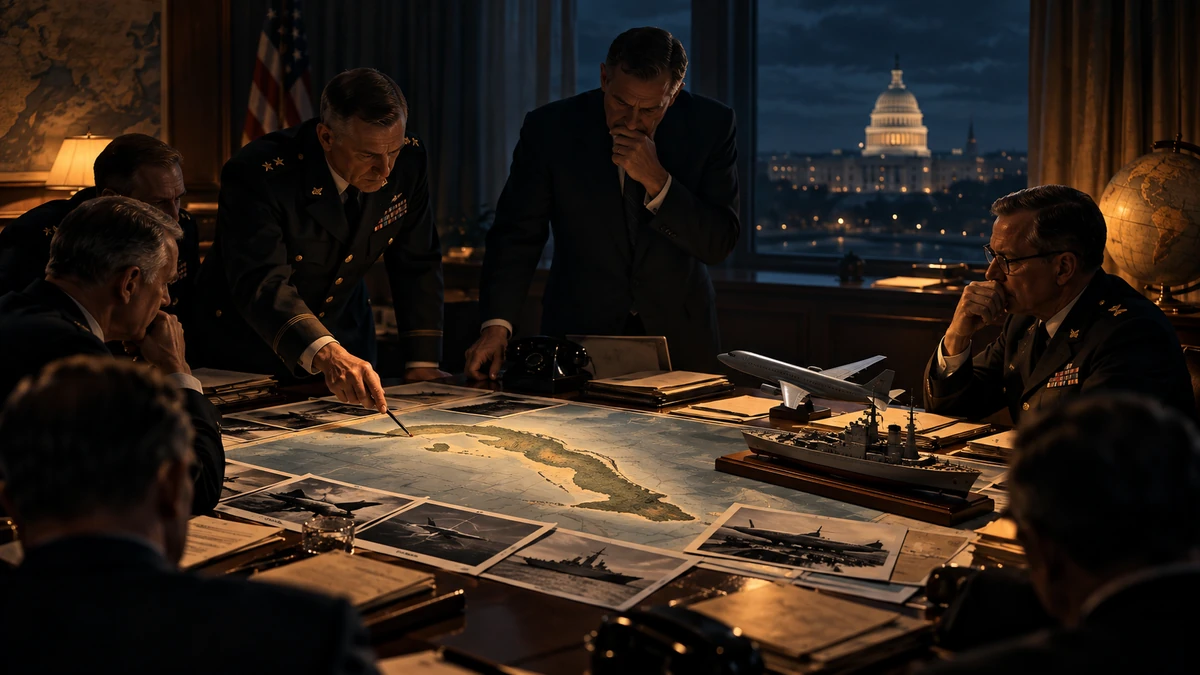
Operation Northwoods is one of the most important primary-documented cases for understanding the difference between a theory about a false-flag operation and actual state planning of such a mechanism. In March 1962 the U.S. Joint Chiefs of Staff prepared and forwarded to Secretary of Defense Robert McNamara a memorandum titled Justification for US Military Intervention in Cuba. The paper proposed a series of staged or artificially created incidents intended to portray the United States as the victim of Cuban aggression and thereby create political grounds for U.S. military intervention against Cuba.[1][2]
The proposals were not abstract. The document discusses staged incidents in and around the U.S. base at Guantánamo, the possibility of blowing up a U.S. ship or a drone vessel and blaming Cuba, a fabricated Cuban terrorist campaign in Miami and other American cities, attacks on Cuban refugees, aircraft made to look Cuban, and a specially constructed scenario in which a drone aircraft would create the appearance that a Cuban MiG had shot down a civilian passenger airliner.[2]
That is what makes Northwoods historically exceptional. It does not prove that such an operation was carried out. It does prove that in 1962 formal proposals existed at the highest level of the U.S. military leadership in which public and international attribution was deliberately intended to differ from the real origin of an incident. The JCS approved the paper as a preliminary planning proposal for onward submission, not as an execution order. The archival record does not show that Northwoods became an authorized operation or that any of these scenarios were executed as Northwoods.[2][6]
This distinction is essential. Operation Susannah, examined in the previous article, is a documented example of an executed false-flag operation. Operation Northwoods is a documented example of planning false-flag or deception scenarios. Comparing the two is useful precisely because it shows why historical claims must distinguish between an idea, a plan, authorization, and execution.
Northwoods was not the same thing as Operation Mongoose
Operation Northwoods emerged within the broader U.S. program against Fidel Castro's government, but it should not be treated as synonymous with Operation Mongoose.
After the failed Bay of Pigs invasion in April 1961, the Kennedy administration reassessed its Cuba policy. In November 1961 President John F. Kennedy approved the development of a new covert program called Operation Mongoose. Oversight was assigned to the Special Group (Augmented), while operational coordination went to Brigadier General Edward G. Lansdale.[3][4]
Mongoose sought to undermine and ultimately remove Castro's communist government. The program included political, economic, propaganda, intelligence, sabotage, and paramilitary elements. Some of those activities were actually carried out during 1962; the contemplated large-scale U.S. military intervention was not.[3]
Northwoods was a narrower set of proposals inside that environment. It arose in response to a request from the Cuba Project leadership for brief and precise descriptions of possible “pretexts” that could provide justification for U.S. military intervention in Cuba.[2]
That distinction matters because conflating the two names creates two opposite errors. One is the claim that “Northwoods was carried out” because some other Mongoose activities were implemented. The other is the claim that all of Mongoose was merely an unrealized paper exercise because Northwoods itself was not executed. Both simplifications are wrong.
The most precise distinction is:
| Program / document | What it was | Status |
|---|---|---|
| Operation Mongoose | Broader U.S. covert program against the Castro government | Some activities implemented; principal objective not achieved |
| Operation Northwoods | JCS proposals for creating or staging pretexts for military intervention | Documented planning; no documented execution |
Who prepared Northwoods: Lansdale's request, the JCS, and General Lyman Lemnitzer
The primary document makes the institutional path of the proposal unusually clear.
On 5 March 1962, Cuba Project chief Edward Lansdale requested from the U.S. military leadership a “brief but precise description of pretexts” that might justify U.S. military intervention in Cuba.[2]
The JCS response was prepared within Cuba Project military planning. The documentary case carried the code name NORTHWOODS. The central paper, Justification for US Military Intervention in Cuba, was treated by the Joint Chiefs of Staff as a preliminary planning contribution.[1][2]
On 13 March 1962, Chairman of the Joint Chiefs of Staff General Lyman L. Lemnitzer signed a memorandum to Secretary of Defense Robert McNamara. It stated that the Joint Chiefs had considered the attached proposals and recommended that they be forwarded as a “preliminary submission suitable for planning purposes.” The JCS also proposed that responsibility for the military and paramilitary aspects of any broader plan ultimately be assigned to the Joint Chiefs of Staff.[2]
That gives Northwoods a fundamentally different evidentiary status from informal brainstorming by a single officer. The paper was part of a formal JCS process, addressed to the Secretary of Defense, and signed on behalf of the Joint Chiefs of Staff.
But the other half of the story must be stated just as clearly: JCS approval to forward a planning proposal was not authorization to execute it. The document itself repeatedly treats the material as preliminary proposals from which individual projects might later be selected and developed into a coordinated schedule.[2]

The purpose: manufacture “justifiable grievances” and an international image of a Cuban threat
The most important feature of Northwoods is not the list of individual scenarios but the political logic that connects them.
The document explicitly envisaged a sequence of incidents that would place the United States in the apparent position of a country suffering justifiable grievances from an “irresponsible” Cuban government. The intended audience was not only the U.S. public but also world opinion and the United Nations.[2]
This is the basic communications mechanism of a manufactured pretext:
- create or stage an event;
- create the appearance that the opposing side caused it;
- document or publicize the event in a way that makes the attribution credible;
- build a sequence of grievances or incidents;
- use the resulting political support as a basis for military action.
Northwoods was therefore not primarily a sabotage plan for sabotage's own sake. The proposed physical incidents were instruments for producing political legitimacy for an already contemplated possibility of military intervention.
The wider Mongoose context reinforces this point. Direct U.S. military intervention in Cuba was politically sensitive, especially after the Bay of Pigs. The international cost of obvious unilateral U.S. aggression was a major concern. The JCS therefore considered how a possible intervention could be presented as a response to Cuban provocation rather than as a unilateral American decision.[2][5]
Guantánamo and “Remember the Maine”: manufacturing the appearance of a Cuban attack
One cluster of proposals focused on the U.S. naval base at Guantánamo Bay.
The paper envisaged a series of well-coordinated incidents intended to create a “genuine appearance” that hostile Cuban forces were carrying out attacks. Ideas included spreading rumors over clandestine radio, using friendly Cubans in uniform to stage an attack on the base, starting fires and sabotage, firing mortar rounds at the base, and attacking ships.[2]
One of the best-known proposals invoked the logic of “Remember the Maine.” Among the possibilities the document listed was blowing up a U.S. ship in Guantánamo and blaming Cuba. An alternative called for using a drone vessel that would be destroyed in Cuban waters, followed by a U.S. rescue operation and a media narrative designed to create the appearance of a genuine Cuban attack.[2]
The paper went so far as to consider publishing lists of mock casualties because such reports in U.S. newspapers would generate a wave of national indignation.[2]
Precision matters here. Some scenarios contemplated simulated casualties and unmanned platforms; other proposals could have involved genuine physical danger. It is therefore inaccurate to reduce the whole document to the single claim that the JCS planned “to kill Americans.” Northwoods contained a range of scenarios, from complete simulation to dangerous real sabotage and woundings. Their common denominator was manufactured or deceptive attribution of responsibility to Cuba.[2]
A “Cuban terrorist campaign” in the United States and attacks on refugees
An even more direct section proposed developing an apparent “Communist Cuban terror campaign” in Miami, other Florida cities, and even Washington.[2]
The paper mentioned attacks on Cuban refugees, explosions of plastic bombs at carefully selected locations, arrests of supposed Cuban agents, and the release of prepared documents that would “substantiate” Cuban involvement.[2]
One proposal was the sinking of a boatload of Cuban refugees en route to Florida — with the document explicitly allowing the episode to be real or simulated. It also mentioned attempts on the lives of Cuban refugees in the United States, including woundings in cases that would then receive wide publicity.[2]
This part of the memorandum matters because it shows clearly that Northwoods was not confined to military disguise at a remote base. It also contemplated events designed to influence U.S. public opinion directly on American soil.
Methodologically, this is one of the strongest answers to the claim that describing Northwoods in false-flag terms is merely a later sensational label. The document itself describes scenarios in which the real origin of an incident would be concealed and an evidentiary or media story constructed to assign responsibility to Cuba.
Aircraft, fake MiGs, and the civilian-airliner scenario
Northwoods also contained several aviation scenarios.
One envisaged U.S. pilots flying aircraft sufficiently similar to Soviet or Cuban MiGs that observers would believe they were Cuban aircraft. Such planes could harass civil aviation, attack shipping, or destroy an unmanned U.S. military aircraft while creating a visual impression that pointed toward Cuba.[2]
The best-known aviation proposal was considerably more elaborate. The document describes the possibility of duplicating a civilian aircraft belonging to a CIA-controlled organization with an identically painted aircraft. Passengers from the real aircraft would be secretly diverted to an auxiliary airfield, while an unmanned duplicate continued the filed flight toward the Cuba area. Near Cuba the drone would transmit a distress call reporting attack by Cuban MiGs and would then be destroyed by remote control.[2]
The point of the scenario was to create a convincing international impression that Cuba had shot down a civilian passenger aircraft — without actual passengers aboard the aircraft that would be destroyed.[2]
The paper also described a separate U.S. military-aircraft scenario. A pilot would falsely report attack by MiGs, secretly land at another base, and debris would be scattered at sea to support the story that the aircraft had been shot down.[2]
These paragraphs matter for two reasons. First, they show a striking level of operational detail. Second, they demonstrate why simulated deaths must be distinguished from actual fatalities. Northwoods did contain dangerous and ethically extreme proposals, but a historical description should remain faithful to each particular scenario rather than to later internet summaries of the document.
Was Northwoods approved? What we can prove — and what we cannot
This is the most important evidentiary boundary in the entire article.
On 13 March 1962 General Lemnitzer, on behalf of the JCS, recommended that the proposal be forwarded to the Secretary of Defense as preliminary planning material. Northwoods therefore had serious institutional support inside the Joint Chiefs of Staff.[2]
But that was not executive authorization to carry it out.
The next day, 14 March 1962, guidelines for Operation Mongoose were issued. They made acquisition of hard intelligence the immediate priority and directed political, economic, and covert activities to remain short of actions reasonably calculated to inspire a revolt or other developments that would require U.S. armed intervention.[6]
That is a documented contrast with Northwoods, whose explicit purpose was to build justification for U.S. military intervention.
Popular accounts often say that “Kennedy rejected Operation Northwoods.” The essential point — that the proposal did not become an executed operation — is sound. But for a strictly documentary article, more precise wording is preferable: the primary Northwoods memorandum was forwarded to the Secretary of Defense as a preliminary JCS proposal; the archival record does not show that it received authorization for execution; and the presidentially approved Mongoose guidelines issued the following day did not authorize a program of manufactured incidents to trigger a U.S. invasion.[2][6][7]
This distinction prevents two false claims:
- wrong: “Northwoods was merely the fantasy of a low-level official”;
- also wrong: “Northwoods was an approved U.S. operational program that was then carried out.”
More precisely: it was a serious, formally prepared, JCS-supported planning proposal, but it is not documented as having been authorized for execution or executed.
What did Northwoods actually achieve?
If we ask the same question posed in the Operation Susannah article — “what did the operation achieve?” — the premise first has to be corrected. Northwoods did not achieve an operational objective because it did not become an executed operation.
Its intended strategic purpose was to create sufficiently convincing incidents and an international image of Cuban aggression to make U.S. military intervention easier to justify politically.[2]
Northwoods did not achieve that objective. The proposed scenarios are not documented as having moved into execution, and a U.S. invasion of Cuba did not occur under this model. Operation Mongoose continued through other covert activities, but by the autumn of 1962 it was overshadowed by the Cuban Missile Crisis; Castro's government remained in power.[3]
Northwoods had its major impact only decades later, when it became available as an archival document. In 1997 the Assassination Records Review Board released selected military records concerning U.S. policy toward Cuba, including Northwoods material. The National Archives now lists a broader 197-page JCS record under number 202-10002-10104, containing Northwoods papers linked to contingency planning, Mongoose, and justifications for U.S. intervention.[1][8]
The National Security Archive published the central 13 March memorandum online in 2001, greatly increasing public awareness of Northwoods.[9]
The historical “result” of Northwoods is therefore not a military operation but evidence of what senior U.S. military planners formally prepared as an option.
Why Northwoods matters — and what it does not prove
Northwoods is a powerful historical example precisely because it does not need exaggeration.
It documents that in 1962 the U.S. Joint Chiefs of Staff seriously considered scenarios in which they would:
- create or stage incidents;
- conceal the actual origin of some actions;
- direct blame toward Cuba;
- manufacture accompanying “evidence” or a communications narrative;
- use the resulting public and international outrage to justify military intervention politically.[2]
That is important enough on its own. There is no need to claim anything the document does not prove.
Northwoods does not prove that it was carried out. It does not prove that every later U.S. wartime incident was a false flag. It does not prove 9/11, the Gulf of Tonkin, the USS Liberty incident, Syria, or any other event merely because disputes exist over attribution or political benefit.
What it does prove is methodologically important: the argument that “a state would never even plan such a thing” does not survive the historical record. The primary document shows that such planning existed. From that point onward, every other case must be assessed separately, using its own documents, material evidence, testimony, and provenance.
For false-flag research it is therefore useful to work with four levels:
- idea — is the scenario only mentioned hypothetically;
- plan — is there a formal proposal with a mechanism for execution;
- authorization — did the competent authority permit execution;
- execution — is there evidence that the plan was actually implemented.
Operation Northwoods securely reaches the second level and was formally supported at JCS level as a planning proposal. For the third level — authorization for execution — no documented transition has been established, while the historical record does not support the fourth level.
That is why Northwoods matters so much: not as proof that something happened, but as unusually clear proof that something of this kind was genuinely planned.
Sources and further reading
- U.S. National Archives and Records Administration (NARA), JFK Assassination Records, Record 202-10002-10104 — “NORTHWOODS.” JCS Central Files 1962, 197 pp.; archival record case containing Cuba contingency-planning papers and pretexts for U.S. military intervention. Source
- Chairman, Joint Chiefs of Staff, “Justification for US Military Intervention in Cuba,” 13 March 1962, Top Secret / Special Handling / NOFORN; declassified copy. Central primary document for Northwoods proposals, intended political effect, preliminary-planning status and detailed scenarios. Source
- U.S. Department of State, Office of the Historian, “The Bay of Pigs Invasion and its Aftermath, April 1961–October 1962.” Background on Operation Mongoose, Lansdale’s role and implemented versus unrealized elements. Source
- U.S. Department of State, Office of the Historian, FRUS 1961–1963, Vol. X, Document 270, Editorial Note. Establishment of Operation Mongoose in November 1961 and the Special Group (Augmented). Source
- U.S. Department of State, Office of the Historian, FRUS 1961–1963, Vol. X, Document 304 — Program Review by Lansdale, 20 February 1962. Cuba Project objectives and wider Mongoose context. Source
- U.S. Department of State, Office of the Historian, FRUS 1961–1963, Vol. X, Document 314 — Guidelines for Operation Mongoose, 14 March 1962. Immediate intelligence priority and limitation of actions expected to require U.S. armed intervention. Source
- U.S. Department of State, Office of the Historian, FRUS 1961–1963, Vols. X/XI/XII, Mongoose Phase I summary. Official retrospective summary of the March policy sequence and Phase I guidelines. Source
- Assassination Records Review Board / U.S. National Archives, “Selected Documents from Military Records on U.S. Policy Toward Cuba from 1962–64,” 18 November 1997. Release notice explicitly identifying Northwoods papers. Source
- National Security Archive, “Pentagon Proposed Pretexts for Cuba Invasion in 1962,” 30 April 2001. Archival publication history and guide to the central Northwoods memorandum. Source
- U.S. Senate Select Committee to Study Governmental Operations with Respect to Intelligence Activities, Alleged Assassination Plots Involving Foreign Leaders, Interim Report, S. Rep. 94-465 (1975). Institutional context for Operation Mongoose and distinctions between proposals, authorizations and implementation. Source