False Flag Operations: Deception, Provocation and the Making of an Enemy
How can we distinguish a documented false-flag operation from a proposal, disputed attribution, propaganda and later theory — and what happens when the first story has already produced political consequences?
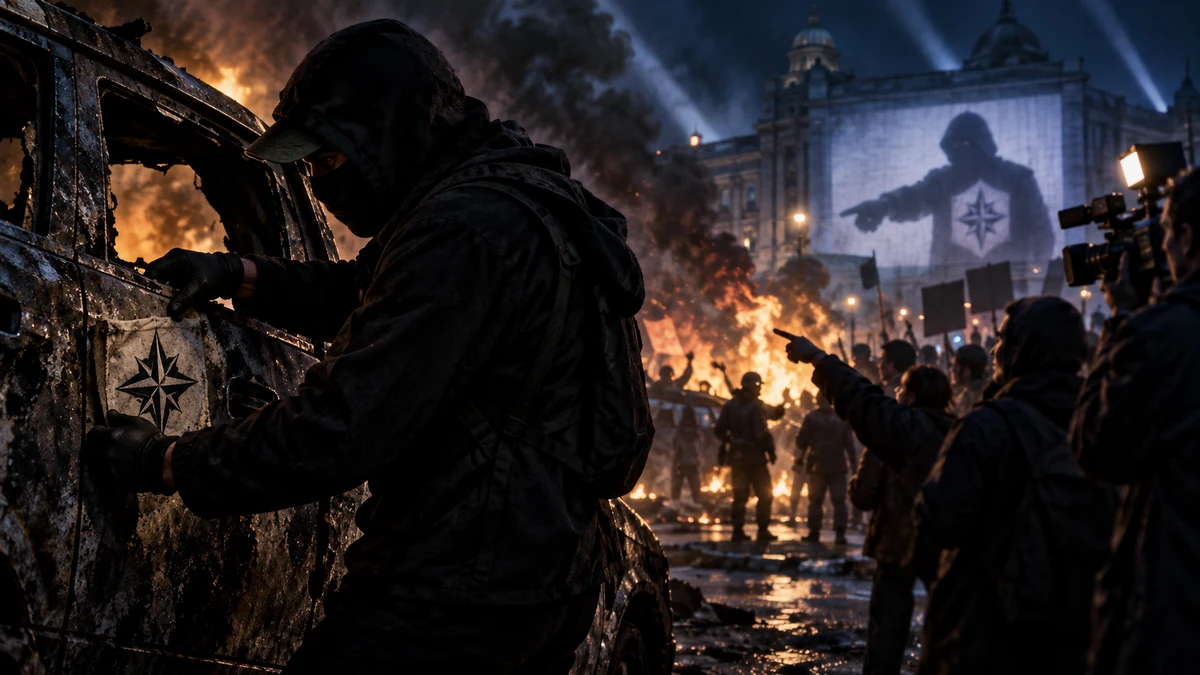
The term false flag describes deception about identity or responsibility: historically a vessel sailing under another flag, and today a political or military act designed to look as though it was carried out by someone else. The label should not become a catch-all for everything covert, propagandistic, opportunistically exploited or badly investigated.
History confirms that such operations have actually been carried out. The Nazi regime staged the 1939 Gleiwitz incident and presented it as Polish aggression; Israeli military intelligence ran Operation Susannah in Egypt in 1954, intending bombings to be blamed on local political groups. There are also documented proposals such as the 1962 U.S. Northwoods memorandum, which suggested manufactured pretexts for intervention against Cuba but was not carried out.
That history makes questions about controversial modern events legitimate. It does not make every later accusation true. Ghouta, Khan Shaykhun, 9/11, 7 October 2023 and wartime incidents in Ukraine require us to separate what is directly documented from an investigative attribution, a claim by an interested party and a hypothesis that remains unproven.
The greatest social power of such an event can lie in the first hours: the public wants an explanation, media need a headline and political leaders may need a decision. If the initial attribution later weakens or changes, its consequences cannot simply be rewound. This article therefore asks not only “who benefited?” but what was known on day one, what was established later, who corrected the story and what had already become political reality.
What a false flag is — and what it is not
Cambridge Dictionary defines a false flag as a political or military action made to appear as though it was carried out by a group that was not actually responsible. Its naval ancestry is a useful reminder: the defining feature is not secrecy alone but deliberately misleading identity or attribution.
A false flag is therefore not automatically the same as propaganda, a covert action, fabricated intelligence, an agent provocateur, an intelligence failure, a cover-up, opportunistic exploitation of a tragedy or a political lie about its meaning. A government can exploit a genuine attack for war, sanctions or legislation without having organized it. An investigation can also contain errors without the original event having been staged.
Working rule: benefit from an event can support a motive hypothesis; it does not prove authorship. Absence of evidence is not proof of absence — but neither is it positive evidence that the alleged covert operation occurred.
We use an even higher threshold for the word lie. A false statement, premature attribution and deliberate deception are different claims. Calling something a lie requires evidence that the speaker knew it was false at the time. Otherwise, more precise language is unsupported claim, incorrect attribution, misleading presentation or claim later contradicted by evidence.
Four evidence classes and the anatomy of attribution
This article uses four classes so documented history does not get mixed with present-day suspicion: DOCUMENTED FALSE FLAG, DOCUMENTED PROPOSAL / NOT EXECUTED, CONTESTED ATTRIBUTION and ALLEGATION NOT ESTABLISHED. A category can change if new primary documents or forensic evidence emerge.
| Class | What must exist | What is not enough |
|---|---|---|
| Documented false flag | Primary records, admissions, judicial/archival evidence and intentional misattribution. | Motive, benefit or later political exploitation alone. |
| Documented proposal | An authentic plan or memorandum proposing a staged incident/pretext. | An inference that the proposal was actually executed. |
| Contested attribution | A confirmed event with a serious dispute about perpetrator, chain of custody or method. | The mere existence of an alternative account. |
| Allegation not established | A public false-flag/stand-down hypothesis without an evidentiary chain to the organizer. | Cui bono, anomaly or institutional distrust by itself. |
Every disputed case therefore follows the same chain: event → initial public attribution → direct evidence → chain of custody → technical analysis → alternative explanation → cui bono → political effect → later correction → current status. An institutional source does not win because it is official; an alternative source does not win because it is dissident.
The strongest material is usually the kind that can be independently interrogated: an original document, time-stamped imagery, a laboratory result with documented custody, telemetry, forensics or multiple independent routes to the same finding. An institutional report is useful in proportion to how clearly it shows how it reached its conclusion.
When a false flag is documentable: Gleiwitz and Operation Susannah
The evidentiary position for Gleiwitz on 31 August 1939 is fundamentally different from a modern allegation. The United States Holocaust Memorial Museum describes SS men wearing Polish uniforms staging an attack on a German radio station. Hitler then folded the incident into a propaganda account of German action as a response to Polish “incursions.” This provides the classic combination of a staged incident, false identity and political use of attribution.
Operation Susannah / the Lavon Affair in 1954 is another unusually clear case. The Israeli Ministry of Defense archive itself describes it as a false-flag operation: Israeli military intelligence recruited Egyptian Jews to plant bombs at Egyptian, American and British civilian targets, with blame intended to fall on the Muslim Brotherhood, communists or other local actors.
These cases matter because they establish that false flags are not a fictional category. They also show why the standard of proof must remain high: we can classify them this way because of retrospective documentary evidence, not because their political consequences merely look suspicious.
Historical lesson: real false-flag operations exist. Methodological lesson: their existence must not lower the evidentiary threshold for the next case.

Northwoods: proof of a proposed pretext — not proof it was executed
The declassified Operation Northwoods memorandum of 13 March 1962 is among the most important primary documents for understanding the subject. The Joint Chiefs of Staff sent the Secretary of Defense proposals for pretexts that could support U.S. military intervention in Cuba; the National Security Archive summarizes scenarios involving incidents around a U.S. ship and a civilian airliner.
Northwoods is valuable precisely because it separates a documented idea from a documented execution. It shows that senior officials considered scenarios in which a manufactured account could generate public support for military action. It does not show that Northwoods was approved and carried out, and it does not automatically establish that unrelated later events followed the same model.
When Northwoods is invoked in arguments about 9/11, Syria or another event, the valid inference is limited: it demonstrates historical precedent for planning such methods, not the identity of the perpetrator in a different case. The gap between “this was once proposed” and “therefore they did this too” must be filled by case-specific evidence.
A declassified proposal proves that a course of action was genuinely contemplated. It does not by itself prove that another, later tragedy was executed according to that model.

Syria: Ghouta 2013 and Khan Shaykhun 2017 — confirmed use, contested paths to attribution
For Ghouta on 21 August 2013, the first distinction is essential: the UN mission collected biomedical and environmental samples, examined rockets and confirmed sarin use in several Ghouta areas. But the UN Secretary-General explicitly said the mission’s task was to determine whether chemical weapons had been used and not who used them. Attribution came through other governmental and intelligence assessments.
The British Joint Intelligence Committee assessed Syrian government responsibility as “highly likely” on 29 August 2013, while the same document acknowledged that there was no obvious political or military trigger for such large-scale chemical use at that moment, especially with UN inspectors present. That is a legitimate motive anomaly; it is not by itself proof of an opposition false flag.
There is also a real alternative technical literature. Richard Lloyd and Theodore Postol estimated the range of the improvised 330-mm chemical munition at about two kilometres and argued that this was inconsistent with launch areas shown on an early U.S. government map. Seymour Hersh reported in the London Review of Books that U.S. intelligence had assessments suggesting al-Nusra possessed sarin-production capability. These are relevant lines of inquiry, but they do not establish a direct evidentiary chain showing that opposition forces carried out the attack.
The alternative case also includes a report popularized by the Ron Paul Institute alleging staged aspects of video evidence, and later Grayzone reporting on British-funded strategic communications infrastructure supporting the Syrian opposition and media advice around Ghouta. This can document information operations and serious allegations about presentation of the event; it does not by itself document who released the sarin.
For Khan Shaykhun on 4 April 2017, the OPCW Fact-Finding Mission confirmed sarin exposure, did not itself have a mandate to identify the perpetrator, and for security reasons did not visit Khan Shaykhun. The later OPCW–UN Joint Investigative Mechanism report S/2017/904 attributed the sarin release to the Syrian Arab Republic. Syria rejected the finding; technical critics including Postol challenged interpretations of the crater, delivery mechanism and evidence collection.
A current review must also account for new evidence. In May 2026 the OPCW announced the discovery, after the fall of the Assad government, of dozens of previously undeclared chemical munitions and related materials, including the same type of aerial bombs the organization links to the 2017 Ltamenah and Khan Shaykhun attacks. This does not determine the perpetrator of Ghouta or independently reconstruct every detail of Khan Shaykhun, but it substantially weakens an argument based on the former regime lacking such capability.
Evidence status: Ghouta — sarin use established; the UN mission did not identify the perpetrator; official attributions and material alternative critiques exist, but an opposition false flag is not established. Khan Shaykhun — sarin established; the later JIM attributed responsibility to Syria; methodology remains disputed in parts of the literature, but a false-flag account is not established as fact in the public evidence reviewed here.
9/11, 7 October and Ukraine: the same rules when conclusions are uncomfortable
A large false-flag and inside-job literature exists around 11 September 2001. This article does not dismiss it by label. One genuine limitation is that the 9/11 Commission acknowledged limited access to detained al-Qaeda members: it relied on intelligence reports from interrogations, could not speak directly to detainees or interrogators, and therefore tried to corroborate those accounts with other records.
That limitation does not establish staging. The Commission’s public evidentiary narrative attributes organization of the attacks to al-Qaeda. NIST found no corroborating evidence that WTC 1 and 2 were brought down by controlled demolition, and it explicitly investigated an explosion hypothesis for WTC 7 without finding evidence of a blast event. NIST also states that it did not test tower steel for explosive or thermite residues. That is a real scope limitation, not automatic confirmation of demolition.
For 7 October 2023, four claims must be separated. The public evidence supports a planned Hamas-led attack involving other Palestinian armed groups. The Israeli military’s own inquiries acknowledge grave defensive failures, including failure to protect residents at Be’eri. A UN Commission documented strong indications that the Hannibal Directive was used in several instances and that Israeli fire harmed Israelis in some cases; it did not confirm broader claims that attack helicopters systematically killed civilians at the Nova festival.
The resulting distinction is precise: a Hamas-led attack, Israeli security failures and specific friendly-fire cases are not the same proposition as a deliberate stand-down or Israeli organization of the attack. The latter would require an evidentiary chain to a decision, order or intentional facilitation for the purpose of creating a pretext; the public material reviewed for this article does not establish such a chain.
In Bucha, Russian authorities argued that bodies were staged after Russian forces withdrew. That specific timing claim is strongly challenged by an independent timeline: Maxar supplied Reuters with satellite images from 18, 19 and 31 March showing objects at the same locations on Yablunska Street where bodies were later documented, while the town was under Russian control. Reuters also documented bodies and witness testimony on the ground. This does not answer every individual death, but it is direct counter-evidence to the claim that all bodies appeared only after withdrawal.
At Kramatorsk on 8 April 2022, a Tochka-U with a cluster warhead struck the railway station. Russia publicly argued that it did not use the system and blamed Ukraine. ODIHR later wrote that it had documented Tochka-U use by both sides — at least ten Russian and 25 Ukrainian attacks between February and May 2022 — and its report assessed it reasonable to believe the Russian Federation carried out the station attack. Russia’s denial remains part of the evidentiary record; it is not itself proof of a Ukrainian false flag.
| Case | Direct/documented layer | False-flag claim status |
|---|---|---|
| 9/11 | Al-Qaeda in the official investigative record; Commission detainee-access limits; NIST findings and known testing limits. | Inside-job / false flag not established as fact. |
| 7 October 2023 | Hamas-led planned attack; severe Israeli defense failures; some Israeli friendly-fire/Hannibal cases documented. | Deliberate stand-down or Israeli organization not established. |
| Bucha 2022 | Bodies/locations documented; satellite timeline places bodies there during Russian control. | Specific post-withdrawal staging claim conflicts with time-stamped imagery. |
| Kramatorsk 2022 | Tochka-U; both sides used the system; ODIHR attributed the attack to Russia; Russia denies. | Ukrainian false flag not established as fact. |
The first story wins: attribution, media effects and late corrections
The wider problem goes beyond false flags. In the first hours after a shocking event, demand for explanation is high while verified information is often scarce. If a politician, military actor, activist or outlet presents an early hypothesis with greater certainty than the evidence warrants, political and emotional mobilization can begin before the forensic picture is complete.
Psychology describes a continued influence effect: corrected misinformation can continue to shape reasoning even when people know it was retracted. A review in Nature Reviews Psychology emphasizes both the value and the limits of correction. This is why a front-page initial attribution and a quiet later correction are not informationally equivalent.
- A shocking event creates intense demand for an immediate explanation.
- Early attribution fills the vacuum, often with uncertain or classified sourcing.
- Repetition across headlines, television and social media can turn a hypothesis into apparent common knowledge.
- Consequences follow: sanctions, military action, legislation, public mobilization or demonization of an adversary.
- Later forensic revisions or corrections usually receive less reach and emotional attention.
- The original frame can remain part of the mental model even after correction.
The method therefore adds two fields to every contested case. INITIAL PUBLIC NARRATIVE: what was the public told in the first hours or days, and with what confidence? CORRECTION / ACCOUNTABILITY AUDIT: what later changed, did the same speaker or outlet correct the account, how prominently, and was the original record amended?
If a wrong attribution needs only hours to change public opinion, a correction six months later cannot rewind history: a decision may already have been taken, sanctions imposed, a law passed or a war widened.
Cui bono without the shortcut: how to test a claim and when the honest answer is “we do not know”
Cui bono — who benefits? is a useful investigative question because it helps identify motives, but it is dangerous as a conclusion. An event can benefit one actor in the short term and harm it later; it can be exploited by someone who did not cause it; and different actors can receive different kinds of benefit. In Ghouta, the Syrian government faced the obvious cost of possible Western military intervention and international pressure, while Western governments confronted the “red line” question. That mismatch is a reason to investigate, not the identity of the perpetrator.
The same applies to 7 October: the subsequent Israeli military campaign and political aims can be assessed separately without implying that Israeli leadership organized the initiating attack. After 9/11, wars, the Patriot Act and an expanded security apparatus are historical consequences; a consequence is not a perpetrator’s signature. In Ukraine, propaganda exists across the conflict, but each factual claim still has to be tested against case-specific material.
- Describe the event without attribution and separate direct observation from interpretation.
- Record each early attribution with date, source and original confidence level.
- Audit the provenance of each key item, access to the site, timeline and chain of custody.
- Seek independent corroboration that does not merely recycle the same anonymous or interested source.
- State the alternative hypothesis precisely enough to say what evidence would falsify it.
- Split cui bono into military, political, diplomatic and long-term benefits, and record costs separately.
- Separate an institution’s conclusion from the underlying evidence on which it rests.
- Check what changed later and whether the original narrative was corrected with comparable visibility.
- If competing stories both outrun the public evidence, the status is not 'my side is right' but unresolved.
Critical thinking does not require trusting the official story. It also does not require trusting the alternative story. It requires both to pass the same evidentiary test. Sometimes that result will be uncomfortable for a government, institution or media outlet; at other times it will be uncomfortable for a theory that initially seemed persuasive.
Do not ask first which story you believe. Ask what would have to be true for each story to be true — and which evidence actually supports those requirements.
Sources and further reading
- Cambridge Dictionary, “false flag”: naval false-colours meaning and modern political/military definition involving misleading attribution.
- United States Holocaust Memorial Museum, “Deceiving the Public”: staged Gleiwitz radio-station incident and Nazi propaganda framing before the invasion of Poland.
- Israel Ministry of Defense Archive, “The ‘Unfortunate’ or the Lavon affair”: Operation Susannah described as a false-flag operation in Egypt in 1954.
- National Security Archive, Joint Chiefs memorandum, 13 March 1962, “Justification for U.S. Military Intervention in Cuba”: Operation Northwoods pretext proposals.
- 9/11 Commission Report, Chapter 5: notes limits on direct access to detained al-Qaeda witnesses and reliance on intelligence interrogation reports with attempted corroboration.
- National Commission on Terrorist Attacks Upon the United States, final report: official reconstruction and attribution of the 9/11 plot.
- NIST, WTC Towers Investigation FAQ: controlled-demolition assessment and statement that tower steel was not tested for explosive/thermite residues.
- NIST, WTC 7 Investigation FAQ: explicit evaluation of explosion/blast hypothesis and NIST conclusion that no blast event was supported by its evidence.
- United Nations Secretary-General, 16 September 2013: Ghouta mission confirmed sarin; mission mandate was to determine use, not perpetrator.
- United Nations Secretary-General briefing, 17 September 2013: Ghouta sampling, rockets and laboratory findings confirming sarin exposure/use.
- UK Joint Intelligence Committee assessment, 29 August 2013: ‘highly likely’ regime attribution while noting no obvious political or military trigger for larger-scale CW use at that moment.
- Lloyd & Postol, “Possible Implications of Faulty US Technical Intelligence in the Damascus Nerve Agent Attack of August 21, 2013”: alternative range/launch-area analysis.
- Seymour M. Hersh, “Whose sarin?”, London Review of Books, 19 December 2013: contested reporting alleging omitted U.S. intelligence on al-Nusra sarin capability.
- Ron Paul Institute, “East Ghouta: False Flag Chemical Attack” (2013): example of the opposition-false-flag case, relaying ISTEAMS/Mother Agnes allegations; treated in R267 as an attributed claim requiring corroboration.
- The Grayzone (2023), leaked-document reporting on UK-funded ARK strategic communications and media advice around Ghouta; used as attributed evidence of information infrastructure, not proof of attack authorship.
- OPCW Fact-Finding Mission, 30 June 2017: sarin confirmed at Khan Shaykhun; FFM mandate did not include attribution and security prevented an on-site visit.
- OPCW–UN Joint Investigative Mechanism, S/2017/904: seventh report attributing the Khan Shaykhun sarin release to the Syrian Arab Republic.
- Syrian Arab Republic, S/2017/991: official rejection and methodological critique of the JIM Khan Shaykhun attribution; treated as a conflict-party claim.
- OPCW, 27 May 2026: discovery of previously undeclared chemical munitions/materials from the Assad-era program, including aerial bombs of the type linked by OPCW to Ltamenah and Khan Shaykhun.
- UN Independent International Commission of Inquiry, A/HRC/56/CRP.3 (2024): findings on the Hamas-led 7 October attack, Israeli counter-fire and strong indications of Hannibal Directive use in several cases.
- Israel Defense Forces, Battle of Kibbutz Be’eri inquiry (11 July 2024): IDF finding that it failed in its mission to protect residents; scope and evidence of the operational inquiry.
- Reuters, 5 April 2022 / Maxar satellite imagery: bodies visible on Yablunska Street in Bucha while the area was still under Russian control, challenging a post-withdrawal staging timeline.
- Reuters, 6 April 2022, “Feet tied and bullet to the head”: field observations and witness reporting from Bucha, with explicit limits on what reporters could independently establish.
- OSCE/ODIHR Interim Report, 20 July 2022: Kramatorsk Tochka-U/cluster-munition findings, documentation that both Russian and Ukrainian forces used Tochka-U, and ODIHR attribution assessment.
- Russian Federation delegation statement to the OSCE Permanent Council, 11 April 2022: Russian denial and claim that Kramatorsk was Ukrainian; included as a conflict-party attribution, not an OSCE finding.
- Ecker et al. (2022), Nature Reviews Psychology, “The psychological drivers of misinformation belief and its resistance to correction”: review of the continued influence effect and correction mechanisms.
- Wikimedia Commons, Jagro, “Gliwice Radio Tower.jpg,” 2021, CC BY-SA 3.0; documentary visual of the site associated with the 1939 Gleiwitz incident.
- Wikimedia Commons / U.S. Joint Chiefs of Staff, “NorthwoodsMemorandum.png,” 13 March 1962; U.S. federal government work, public domain.