The Great Moon Hoax of 1835: how media authority makes falsehood plausible
In 1835 The Sun presented fictional life on the Moon as a scientific report by Sir John Herschel. The episode shows how falsehood becomes plausible when it borrows real names, technical language, institutional prestige and media distribution — and why skepticism without verification is not enough.
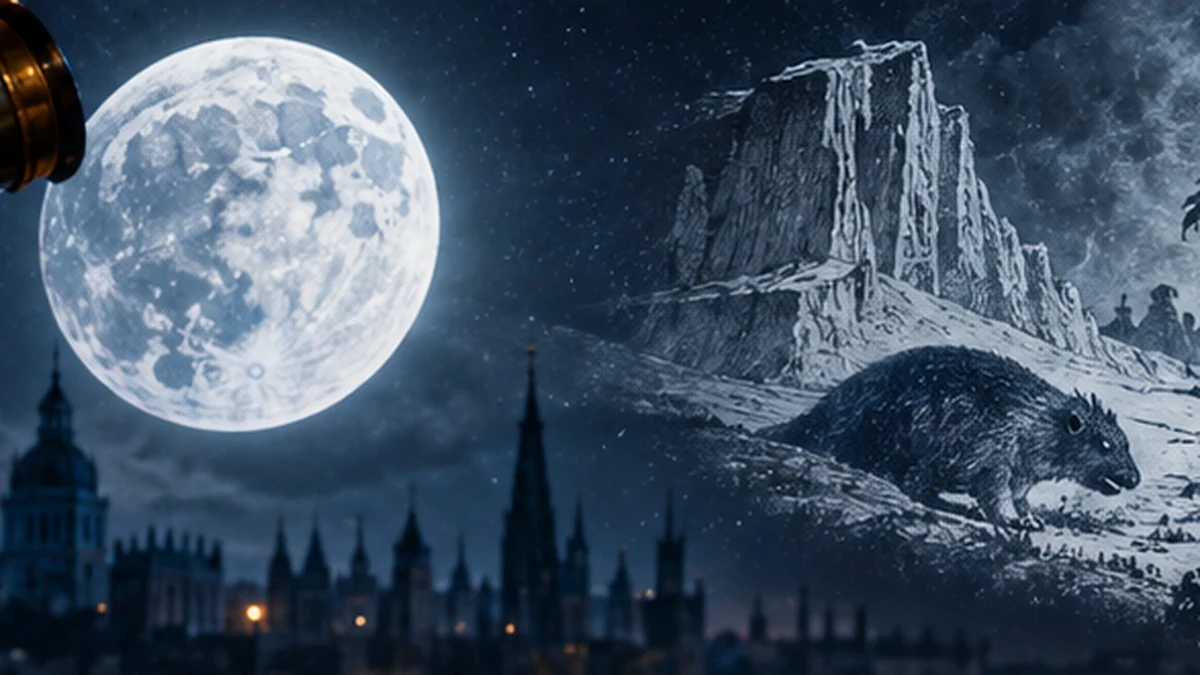
In August 1835, the New York newspaper The Sun published a six-part series about supposed astronomical discoveries by Sir John Herschel at the Cape of Good Hope. Readers were told that a powerful new telescope had revealed forests, waters, strange animals and even winged humanoid inhabitants on the Moon. The story was false, but it was not assembled from random fantasy: it attached itself to a real astronomer, a real expedition, science-sounding technical detail and an apparently prestigious source.
That is why the Great Moon Hoax is more useful than a story about a gullible public. Its real value is epistemological. It shows how a false claim can become plausible when it borrows the authority of institutions, professional titles, technical language and a medium that already has a large audience. Readers were not simply asked to accept a miracle without evidence; they were given the appearance of an evidential process.
Yet the often-repeated claim that the public was uniformly fooled is also exaggerated. The Library of Congress notes that some newspapers accepted the series while others were already calling it a likely hoax or mere “moonshine” during its publication. The episode is therefore not a story about people in the past believing anything. It is a story about a divided information environment in which credibility, skepticism, sensationalism and verification competed much as they do now.
The central lesson is not “do not trust the media.” That would simply invert the error. Reputation, expert tone and mass distribution are not substitutes for a verifiable chain of evidence. Once we ask whether the cited journal still existed, whether the supposed intermediary was real, what Herschel was actually doing and where the original information came from, an attractive narrative becomes a testable claim — and therefore something that can fail.
What happened in August 1835?
The first article appeared in The Sun on August 25, 1835, followed by five further installments. It carried a large heading announcing “great astronomical discoveries” by Sir John Herschel at the Cape of Good Hope and claimed to be drawn from a supplement to the Edinburgh Journal of Science. The supposed narrator, Dr. Andrew Grant, was presented as Herschel’s associate. Grant was fictional, and the claimed scientific supplement was not the real source of the series.
The fabricated reports escalated. They began with a technical description of the telescope and its magnification, then moved through lunar geography and vegetation, animals, and finally humanoid beings with bat-like wings. That pacing mattered: the most unbelievable claim did not come first. Readers were first immersed in measurements, optics and geographic detail and only then led toward increasingly fantastic conclusions.
The Library of Congress now identifies the episode as six articles about supposed lunar creatures and attributes the writing to Richard Adams Locke, a reporter for The Sun. A famous 1835 print showing lunar animals and winged inhabitants also survives, demonstrating how quickly the newspaper narrative became a visual cultural object.
Borrowed authority: Herschel, the Cape and a simulated scientific source
The hoax did not choose a random name. John Herschel was one of the most respected astronomers of his era and really was working at the Cape of Good Hope. He arrived there in January 1834 to conduct a systematic survey of the southern sky; his genuine observations from 1834–1838 were later published in a major scientific volume. That real background gave the fabricated story an anchor that was difficult to dismiss at a glance.
A second anchor was the line “From Supplement to the Edinburgh Journal of Science.” Readers were not given a naked anonymous rumor but a simulated chain: renowned astronomer → colleague at the observing site → scientific journal → New York newspaper. The problem was that one link was invented. The Edinburgh Journal of Science had ceased publication, and “Andrew Grant” was a literary construction.
That is the core of media authority in this case. The Sun did not create plausibility only from its own brand; it borrowed authority from astronomy, professional abbreviations, European scientific publishing and Herschel’s real expedition. A reader who checked only whether Herschel existed and was actually in southern Africa would find partial confirmation. Only verification of the whole chain would expose the fictional bridge inserted between true facts.

Why the story did not sound as impossible in 1835 as it does now
Today we know that the Moon has no forests, oceans, breathable environment for winged humanoids or biosphere resembling the one in the series. In 1835, however, the cultural boundary between established astronomy and speculation about inhabited worlds was not located in the same place. The plurality of worlds had a long philosophical, religious and popular-scientific history.
One important figure was the Scottish minister and writer Thomas Dick, who combined astronomy, natural theology and confidence that intelligent beings existed elsewhere in the universe. Historians of science have shown that such ideas were sufficiently widespread in the nineteenth century that lunar life was not automatically recognized as absurd. Locke’s satire was aimed precisely at the tendency to move from limited astronomical evidence to richly detailed claims about inhabitants of other worlds.
Plausibility therefore did not arise only from naivety. It arose from the period’s horizon of possibility. Effective misinformation rarely requires an audience to accept something completely alien; it works better when a new claim is attached to existing facts, expectations and genuinely open questions.
Technical detail as the appearance of evidence
The series devoted substantial space to an apparently technical account of Herschel’s new telescope. It discussed an enormous lens, optical properties, magnification, distances and a method of projecting the image. Much of this was invented or physically problematic, but the language resembled scientific reporting closely enough to make readers feel they were seeing the method behind the conclusion rather than merely the conclusion itself.
That is a key difference between a simple rumor and a well-constructed hoax. A rumor says: “There are beings on the Moon.” A hoax can display an apparent instrument, observational procedure, author, institution, measurements and a sequence from data to inference. The quantity of detail can then be mistaken for the quality of evidence.
Verification therefore requires an uncomfortable question: is the technical detail independently testable, or merely internally consistent? A fictional world can be highly coherent. Scientific credibility requires more: access to the instrument, repeatability or independent observation, a real primary source and the possibility that the claim will fail if those elements do not hold.
The penny press, serialization and the economics of attention
The Sun belonged to the new model of cheap mass-circulation newspapers. The Library of Congress describes it as the first successful penny daily in New York, aimed at a broader working-class readership; by 1834 it had the largest circulation in the United States. Its success rested on low price, street distribution and a mix of local events, crime, human-interest stories and sensational material.
The Moon series was almost ideal for this medium. It was serialized: each day added a new level of discovery and created a reason to return. At the same time it had features we now associate with the attention economy — surprise, novelty, tension between authority and improbability, and the promise that the next installment would be even more astonishing.
Historical accounts often cite dramatic circulation increases caused by the hoax, but exact numbers vary across later retellings and should not be treated as a precise metric. The safer conclusion is that the series attracted extraordinary attention, was rapidly reprinted and translated, and became a lasting part of The Sun’s identity. The economic incentive does not need to rest on one legendary circulation figure.
The public was not one person: belief, doubt and rapid checking
The most useful correction to the popular myth is that not all readers were fooled. The Library of Congress notes that the Gloucester Telegraph, while the series was still appearing, reported that the story was probably a hoax and distinguished newspapers that accepted it from those that dismissed it as “moonshine.” Skepticism did not arrive only decades later.
The case is therefore not a laboratory of “mass stupidity” but a laboratory of competing verification practices. Some believed because of Herschel’s reputation and the story’s detail; some doubted because of its improbability; others checked provenance and noticed problems with the journal, the intermediary or the optics. Mockery and parody also helped spread the story, showing that rejection does not necessarily stop distribution.
That point matters today. Misinformation is not circulated only by people who believe it. Critics, commentators and people trying to display its absurdity also amplify it. Reach and belief are different metrics. A large audience does not prove that a large audience accepted the claim as true.
Satire or deception? Intention is not the same as effect
In the dominant historical account, Richard Adams Locke conceived the series as satire aimed at extravagant claims about inhabited worlds, particularly writers such as Thomas Dick. But calling it “satire” does not erase the fact that the series imitated the form of a genuine scientific report and that part of the audience interpreted it literally.
It is useful to separate the author’s intention, the editor’s behavior and the audience’s effect. An author may intend satirical exaggeration; an editor may see a profitable sensation; a reader may see verified science. When a text provides no clear fiction signal and actively borrows real people and institutions, the functional boundary between satire and hoax matters more than a later explanation of intent.
Authorship itself has an interesting history. Locke was suspected in 1835 and publicly responded without resolving the matter; later sources and bibliographic institutions attribute the series to him. For our purpose, however, there is no need to build the entire moral story around a single man. The more important object of study is a system in which fabricated material could acquire the authority of a real astronomer and scientific publishing.
What is the actual lesson for source verification?
The Great Moon Hoax offers a surprisingly modern checklist. First, trace the claim to its primary source. Does the cited document exist? Second, verify the intermediary. Is “Dr. Andrew Grant” a real person with a documented connection to Herschel? Third, ask whether independent experts observed the same thing. Fourth, separate true surrounding facts from the conclusion attached to them.
Several elements would survive a superficial check: Herschel really was a distinguished astronomer; he really was at the Cape; astronomy really was advancing rapidly; life elsewhere really was an open cultural question. But the core — the claimed source, collaborator, telescope and lunar observations — did not survive independent verification. The hoax lived in the gap between a true context and fabricated evidence.
The article therefore does not conclude that official or media authority has no value. Reputation, expertise and institutions are useful signals because they often increase the probability of careful work. They are not evidence by themselves. The safest relationship to authority is neither automatic trust nor automatic distrust, but verification: who is making the claim, on what evidence, where is the primary record, who can confirm it independently, and what would falsify it?
Sources and further reading
- Library of Congress — Peoples & Creatures of the Moon: overview of the six 1835 Sun articles, fictitious Andrew Grant, attribution to Richard Locke, and the cultural plausibility of lunar inhabitants.
- Library of Congress — Lunar animals and other objects… (1835): primary visual item created in connection with the Great Moon Hoax; human-bat creatures, unicorns and other imagined lunar beings.
- Library of Congress — catalog record for The Sun (New York), 1833–1916: history of the first successful penny daily, its working-class audience, sensational reporting and leading U.S. circulation by 1834.
- Library of Congress Folklife Today — Belief, Legend, and the Great Moon Hoax: contemporary belief and skepticism, Gloucester Telegraph reaction, Locke accusations, and the role of legends/hoaxes in testing knowledge boundaries.
- Library of Congress Teaching with the Library — Primary Sources and the Great Moon Hoax: six-part series, fictitious Grant persona, and surviving primary-source illustration.
- Library of Congress — rights/catalog record for the 1835 lunar-animal print; no known restrictions on publication.
- Smithsonian Libraries — Infinite Worlds: Great Moon Hoax exhibition context, Locke, the 24-foot fictional telescope, Thomas Dick, global republication and visual culture.
- Smithsonian Institution — The moon hoax; or, A discovery that the moon has a vast population of human beings: bibliographic/scanned edition record attributing the work to Richard Adams Locke and documenting its publication history.
- Smithsonian Libraries Unbound — The Moon Hoax of 1835: Great Astronomical Discoveries: discussion of the serialization, technical realism, popular reception and satirical purpose.
- Smithsonian Libraries Unbound — The Great Moon Hoax or Was It—The Joke’s on Who?: Locke’s satire of plurality-of-worlds speculation and his use of real astronomical detail to create plausibility.
- Smithsonian Libraries — John Herschel, Results of astronomical observations made during the years 1834, 5, 6, 7, 8, at the Cape of Good Hope (1847): Herschel’s genuine scientific work at the Cape, CC0/public domain.
- Linda Hall Library — Richard Adams Locke: historical summary of the six-day lunar series, Vespertilio-homo and the satire/hoax problem.
- István Kornél Vida — “The Great Moon Hoax of 1835,” Hungarian Journal of English and American Studies 18 (2012), 431–441: dedicated scholarly study of the episode.
- JSTOR Daily — How the Sun Conned the World With the Moon Hoax: gateway to Vida’s scholarly article and Carlo Martinez’s study of Poe, the penny press and the literary field.
- JSTOR anthology — Richard Adams Locke, “Great Astronomical Discoveries Lately Made by Sir John Herschel” (August 25–30, 1835): edited primary text of the hoax series.
- Google Books — Great Astronomical Discoveries Lately Made by Sir John Herschel… (New York Sun, 1835): digitized contemporary pamphlet form of the series.
- Google Books — The Celebrated “Moon Story”: Its Origin and Incidents (1852): nineteenth-century retrospective edition and memoir material on the hoax and Locke.
- Project Gutenberg — Frank M. O’Brien, The Story of The Sun (1918): historical account of the newspaper, the hoax heading, the defunct Edinburgh Journal of Science claim and later institutional memory.
- American Heritage — A View of the Moon From the Sun: 1835: historical reconstruction including the invented telescope and the narrative’s technical framing.
- Rebekah Higgitt, The Guardian — The Great Moon Hoax and the Christian Philosopher: history-of-science discussion of Locke, Thomas Dick, satire and why the narrative was plausible in its period.
- Michael J. Crowe — A History of the Extraterrestrial Life Debate: scholarly history of nineteenth-century plurality-of-worlds debates and Thomas Dick’s claims about inhabited celestial bodies.
- Encyclopaedia Britannica (1911, historical text) — John Herschel: voyage to the Cape in 1833–34 and the genuine program of southern-sky observation that supplied the hoax with real-world plausibility.
- Akroterion — J. L. Hilton, “Lucian and the Great Moon Hoax of 1835”: scholarly context for the Cape, astronomy and literary traditions surrounding fabricated lunar voyages.
- Wikimedia Commons / Internet Archive — The Great Moon Hoax of 1835 (1859 edition): full scanned historical edition preserving the series and later publication context.
- HISTORY — The Great Moon Hoax is published in the New York Sun: secondary chronology for the six installments, fictitious Grant, defunct Edinburgh Journal of Science and Herschel’s real Cape setting; used cautiously where claims are corroborated by primary/bibliographic sources.