Gulf of Tonkin 1964: the real first attack, the disputed second incident, and the path to escalation
The Gulf of Tonkin shows how a real first attack, an uncertain intelligence picture, and political decision-making can combine into the basis for a major strategic shift.
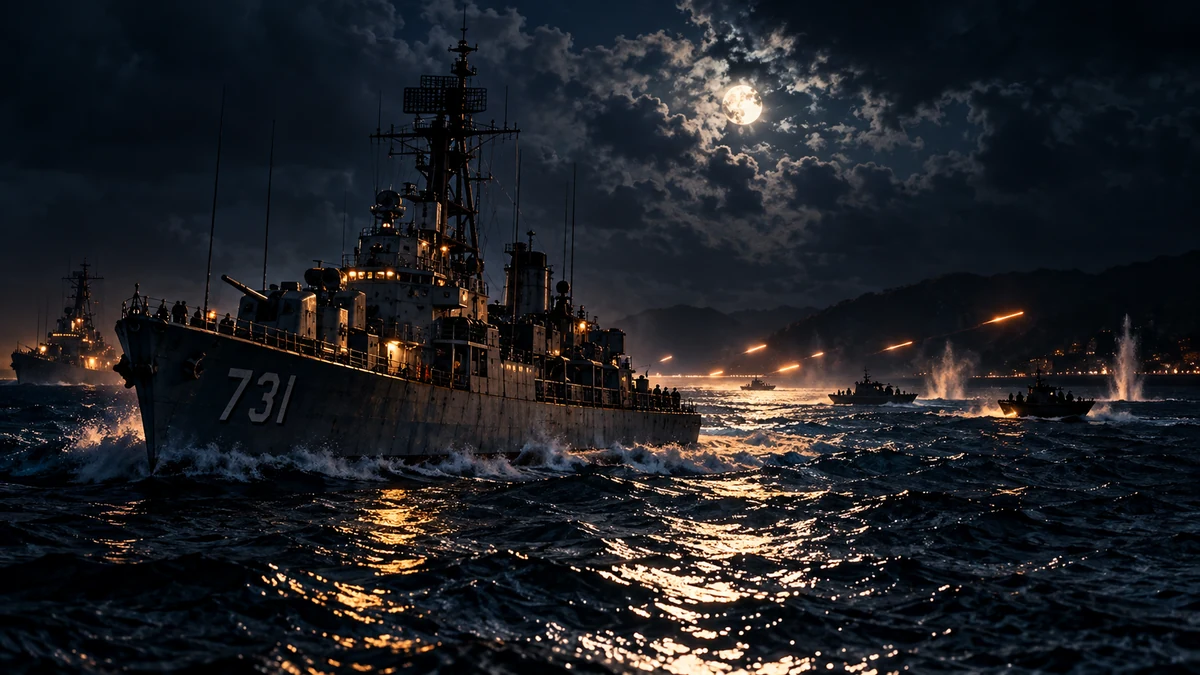
The Gulf of Tonkin episode of August 1964 is one of the clearest cases for understanding how a real military event, an uncertain intelligence picture, and political decision-making can within hours create the basis for a major strategic shift. Yet the episode is often compressed into one of two simple stories: either two clear North Vietnamese attacks on U.S. ships, or a single pre-planned American false flag. Declassified records support a more precise—and in some ways more troubling—account.[1][2][3]
On 2 August 1964, three North Vietnamese torpedo boats did attack the U.S. destroyer USS Maddox, which was conducting a DESOTO intelligence patrol in the Gulf of Tonkin. The torpedoes missed; Maddox returned fire, and aircraft from the carrier Ticonderoga attacked the North Vietnamese vessels. This first engagement is supported by ship reports, photographs, physical damage from a bullet strike, and communications intelligence.[2][4]
Two days later, on 4 August, Maddox and USS C. Turner Joy reported another attack in poor weather. Crews detected radar and sonar contacts and fired at supposed torpedo boats, but there were no confirmed visual sightings of attackers. During the event itself, task-group commander Captain John J. Herrick warned Washington that many reported contacts and torpedoes appeared doubtful, that unusual weather effects and over-eager sonar interpretation might explain them, and that a full evaluation was needed before further action.[5]
A later detailed study by NSA historian Robert J. Hanyok, based on a much broader body of declassified communications intelligence, concluded that no attack occurred on 4 August. Hanyok also found that intelligence had been presented in a way that supported the attack interpretation while much contradictory material was excluded. When the NSA declassified the study, it also released an internal counterargument: that paper agreed that the second attack probably did not occur, but disputed Hanyok's conclusion that SIGINT had been deliberately skewed. Two questions therefore have to be separated: did the second attack happen, and why did Washington receive a picture that it had happened despite serious uncertainty?[1][6]
Why Tonkin is not the same as Operation Susannah or Northwoods
Three different evidentiary categories matter in this series.
Operation Susannah was a documented executed false-flag operation: the actual operatives carried out attacks designed to make responsibility appear to belong to other groups.
Operation Northwoods was a documented high-level proposal for manufactured or staged pretexts, but it is not documented as having moved into authorized execution.
The Gulf of Tonkin case is different. The records reviewed for this article do not show that the U.S. government manufactured the 2 August attack or deliberately staged nonexistent North Vietnamese boats on 4 August. The first attack was real. The second arose from a combination of expectation of attack, difficult weather and sensor conditions, mistaken interpretation, and later selective or incomplete handling of communications intelligence.[1][5][6]
That is why labeling the entire Tonkin episode simply a “false flag” is not sufficiently precise. Better descriptions are:
- a real first attack;
- an unconfirmed second attack that a later SIGINT review concluded did not occur;
- intelligence and communications error, distortion, or selective presentation;
- political use of the incident in support of a broader strategy already under consideration.
The last point is crucial. The fact that the second attack probably never occurred does not by itself prove that somebody planned it in advance as a false flag. It does, however, document a case in which an extremely consequential military decision was made and publicly justified by an event about which serious doubts existed in real time.
Background: DESOTO, OPLAN 34A, and why the Gulf was already tense before 2 August
USS Maddox was not cruising randomly off the North Vietnamese coast. It was conducting a DESOTO patrol, a U.S. Navy intelligence mission collecting electronic and other information about North Vietnamese coastal defenses, radar systems, and maritime activity.[4]
At the same time, covert maritime operations under OPLAN 34A were being conducted against North Vietnam. South Vietnamese crews, with U.S. support, carried out missions that included attacks on coastal targets, bombardment of installations, seizure of vessels, and other covert actions.[7]
On the night of 30–31 July 1964, OPLAN 34A craft attacked North Vietnamese targets around offshore islands. U.S. SIGINT monitored the response of the North Vietnamese navy. Maddox was conducting its DESOTO mission in the same broader area.[7][8]
That does not mean Maddox was directly part of the individual OPLAN 34A sabotage missions. Official documents treat the programs as institutionally distinct. But U.S. commanders considered their temporal and geographic proximity important enough that after the 2 August engagement the Joint Chiefs instructed the DESOTO patrol to avoid close approaches to the North Vietnamese coast while 34A maritime operations were underway.[8]
The administration's public description of an “unprovoked attack” therefore requires context. According to U.S. reports, Maddox was in international waters when attacked and was not itself attacking North Vietnam. At the same time, North Vietnamese authorities were confronting a U.S. intelligence patrol in the same general environment in which U.S.-supported South Vietnamese raids were occurring. This context does not justify an attack on Maddox, but it makes it historically misleading to treat the engagement as if it happened in a vacuum.[4][7][8]
The first attack on 2 August was real
On 2 August 1964, three North Vietnamese P-4 torpedo boats approached Maddox. U.S. ship reports place Maddox roughly 28 to 30 miles from the North Vietnamese coast during the engagement.[2][4]
As the boats closed, Maddox fired warning shots and then opened fire. The North Vietnamese boats launched torpedoes that missed. Machine-gun fire was also directed at Maddox; one projectile struck the destroyer, but there were no fatalities and no major damage. F-8 aircraft from USS Ticonderoga then attacked the torpedo boats.[2][4]
Hanyok's later SIGINT analysis confirms that the North Vietnamese navy actually attacked on 2 August. This is the key distinction between 2 and 4 August: in the first event, visual observations, ship reports, physical evidence, and communications intercepts reinforce one another; in the second, the evidentiary picture falls apart.[1]
After the engagement, U.S. leaders did not cancel the patrol. USS C. Turner Joy joined Maddox, and the two destroyers were ordered to continue DESOTO operations. The Navy therefore deliberately returned to an area in which it already knew North Vietnamese forces might treat its presence as hostile.[4][8]
_port_bow_view_1964.jpg)
The reported second attack on 4 August: a battle that probably existed only on radar, sonar, and in expectations
On the evening of 4 August, the weather was poor, the sea rough, and visibility limited. Maddox and Turner Joy began reporting what appeared to be approaching torpedo boats. Radar and sonar operators detected numerous contacts, the ships maneuvered sharply, and they fired toward supposed targets.[5]
The central problem was the absence of reliable visual evidence. Crews did not clearly see North Vietnamese boats, torpedoes, or physical results consistent with the reported hours-long engagement.
Before Washington had fully committed to retaliatory action, Captain John J. Herrick, the task-group commander, sent a message that seriously undermined the initial narrative. The later official chronology records that at 1:27 p.m. Washington time he reported that many of the contacts and fired torpedoes appeared “doubtful,” that freak weather effects on radar and over-eager sonarmen may have contributed, that there had been no visual sightings, and that he recommended a complete evaluation before further action.[5]
That message reached Washington with delay while President Lyndon B. Johnson, Robert McNamara, Dean Rusk, McGeorge Bundy, and the Joint Chiefs of Staff were already discussing retaliation.[5]
Later that day, military commanders assembled elements they believed confirmed an attack: reports of gunfire, lights, aircraft observations, and communications intercepts. Admiral Ulysses S. Grant Sharp ultimately concluded that an attack had occurred, and Washington proceeded with the decision for retaliation.[5]
Over the following decades, however, many of these supposed confirmations proved much weaker than they appeared during the crisis.
What the declassified SIGINT record showed
The decisive later reassessment came from NSA historian Robert J. Hanyok, whose study for the classified journal Cryptologic Quarterly was written in 2001 and publicly declassified in 2005.[1][3]
Hanyok used a substantially broader archive of communications intercepts than was available in earlier public debates. His conclusion was direct: there was no North Vietnamese attack on 4 August. The intercepts instead showed North Vietnamese units engaged in activities such as salvaging damaged boats from the 2 August engagement and conducting coastal operations rather than attacking the U.S. destroyers.[1]
Hanyok also identified serious problems in the handling of SIGINT:
- analytical links were made between messages that did not belong to the same event;
- translation and interpretation problems affected meaning;
- fragments of genuine intercepts were used outside their original context;
- large amounts of information contradicting an attack were omitted from summaries supporting the attack thesis.[1]
Hanyok went further and argued that SIGINT was deliberately skewed to support the claim that a second attack had occurred. This is an important conclusion, but it must be attributed to him rather than presented as uncontested NSA institutional consensus.[1]
The NSA's later internal counterpaper, “Thoughts on Intelligence Related to the Gulf of Tonkin Mystery: The SIGINT Hounds Were Howling,” challenged the accusation of deliberate manipulation. Its authors argued that analysts were operating under severe time pressure and believed they were warning commanders in good faith. Yet this counterpaper still accepted the larger historical conclusion that the supposed 4 August attack most likely did not occur.[6]
The strongest evidence-based conclusion is therefore two-layered:
- the second attack did not occur — strongly supported by the later declassified record;
- the exact degree of deliberate manipulation inside the intelligence process — contested, and therefore requiring attribution rather than categorical wording.
Washington received warnings of doubt — and acted anyway
The most consequential part of the Tonkin story is not merely that later historians corrected the record. Senior decisionmakers received substantial uncertainty during the crisis itself.[5]
Herrick's messages questioned torpedo reports, sensor contacts, and the lack of visual confirmation. The FRUS chronology shows that while Washington was moving toward retaliation, officials were still trying to determine what had actually happened.[5]
The same chronology later describes a meeting involving McNamara, Cyrus Vance, and the Joint Chiefs at which they sought to assemble evidence that would overcome the absence of a clear and convincing demonstration that the attack had occurred.[5]
Despite those uncertainties, the administration decided on a limited but sharp military response. Aircraft from U.S. carriers then carried out Operation Pierce Arrow on 5 August, striking North Vietnamese torpedo-boat bases and petroleum facilities.[9]
The public and diplomatic presentation was much more certain than the underlying evidence. On 7 August, President Johnson wrote Soviet leader Nikita Khrushchev of “complete and incontrovertible evidence” of the second deliberate attack.[10]
That contrast is central to the historical assessment. The administration did not tell Congress and the public, “we have ambiguous reports and are acting despite uncertainty.” It presented a much more definite account than the full evidentiary record warranted at the time.
The resolution did not come from nowhere: Washington was considering broad congressional authority before Tonkin
One of the most important documents for understanding the political context is a memorandum by McGeorge Bundy dated 15 June 1964—nearly seven weeks before the Tonkin incidents.[11]
For a State and Defense Department meeting, Bundy put on the agenda whether the administration should recommend that the president seek a congressional resolution on Southeast Asia at that time. Attached draft language considered broad authority for the president to use U.S. force in the region.[11]
This is historically significant, but it must not be overread.
It demonstrates:
- that the administration was considering a formal congressional basis for broader military policy in Southeast Asia before 2 August;
- that the August resolution was not an idea invented only after the alleged second attack;
- that Tonkin created a political moment in which such authority could be requested and enacted rapidly.[11]
It does not demonstrate:
- that Washington planned the 2 August attack;
- that the phantom engagement of 4 August was scripted in advance;
- that the entire crisis was consciously staged to activate a prepared resolution.
This boundary is essential. The existence of prior policy planning and a prepared legal instrument is evidence of prior strategic consideration of escalation, not automatically evidence of a prior plan to manufacture an incident.
The Gulf of Tonkin Resolution: two incidents, broad authority
On 5 August 1964, a resolution was introduced in Congress that soon became known as the Gulf of Tonkin Resolution, or Southeast Asia Resolution.[12][13]
Its text explicitly stated that North Vietnamese naval units had “deliberately and repeatedly attacked” U.S. vessels lawfully present in international waters. Congress then supported the president in taking “all necessary measures” to repel armed attacks against U.S. forces and prevent further aggression. A second section also authorized the president to use armed force to assist Southeast Asian states that requested help.[13]
On 7 August, the House passed the resolution 416–0 and the Senate 88–2. Senators Wayne Morse and Ernest Gruening cast the only opposing votes. President Johnson signed it on 10 August 1964 as Public Law 88-408.[12][13]
The U.S. Senate's own historical account emphasizes how rapidly the measure moved and how little time was devoted to a detailed investigation of what had actually happened in the Gulf. Morse was already arguing that the administration was withholding the fuller context of covert U.S.-supported operations against North Vietnam.[12]
The resolution was not formally a declaration of war. In practice, however, it became the principal congressional political and legal basis cited by the Johnson administration for a major expansion of direct U.S. military involvement in Vietnam.[14]
What the incident actually achieved
If we ask the same question used for Susannah and Northwoods—what did the episode actually achieve?—the answer is concrete.
Immediate result
The reported second attack became the immediate trigger for U.S. retaliatory air strikes against North Vietnam under Operation Pierce Arrow.[5][9]
Political result
The episode allowed the administration to obtain an exceptionally broad use-of-force resolution with almost no congressional resistance. It passed within days of the crisis with only two opposing votes in the entire Congress.[12][13]
Long-term result
In 1965, the Johnson administration dramatically expanded the war: the sustained bombing campaign Operation Rolling Thunder began, and regular U.S. ground combat units were deployed to South Vietnam. The State Department's historical account describes the Gulf of Tonkin Resolution as a central political basis for the subsequent escalation.[14]
By the end of 1965 more than 150,000 U.S. troops were in Vietnam; by 1968 the total exceeded 500,000.[12]
Tonkin therefore did not “start” U.S. involvement in Vietnam. The United States was already deeply involved politically, financially, militarily, and through intelligence operations. But August 1964 marked a transition to a new phase, in which the president possessed broad congressional cover for a much larger direct use of American military power.
The most precise historical conclusion
The Gulf of Tonkin matters precisely because it is more complicated than the simple slogan “false flag.”
The documentary record supports the following chain:
- a U.S.- and South Vietnamese-backed covert campaign against North Vietnam was already underway;
- Maddox was conducting a separate but geographically and temporally related intelligence patrol;
- North Vietnam actually attacked Maddox on 2 August;
- on 4 August the U.S. ships, under difficult conditions, believed they were being attacked again;
- serious doubts arose during the event about whether the reported torpedoes and attackers were real;
- Washington nevertheless decided on retaliatory strikes;
- the second attack was presented to the public, allies, and Congress with far greater certainty than the evidence justified;
- a later NSA review concluded that the second attack did not occur;
- the Gulf of Tonkin Resolution gave the administration broad political and legal support for further escalation of the war.
What the documents allow us to establish: a nonexistent or profoundly unsupported second incident was used as part of the public and congressional justification for a major expansion of U.S. military authority.
What these documents alone do not establish: that Washington planned a fake 4 August attack in advance along the lines of Operation Northwoods, or that U.S. ships knowingly staged a battle they understood was fictitious.
This distinction is why Tonkin belongs in a wider study of information crises and pretexts for war. Political effects do not always require a perfectly designed covert operation. Sometimes a real conflict, expectation of another attack, imperfect sensors, selective interpretation, severe time pressure, and institutions already prepared to act are enough.
That explanation is less cinematic than a pre-planned false flag. But the documentary evidence for it is substantially stronger.
Sources and further reading
- Robert J. Hanyok, “Skunks, Bogies, Silent Hounds, and the Flying Fish: The Gulf of Tonkin Mystery, 2–4 August 1964,” NSA, Cryptologic Quarterly, Winter 2000/Spring 2001; declassified 2005. Source
- Naval History and Heritage Command, Publicly Released Information — Tonkin Gulf Crisis, including 2 August chronology and McNamara statements. Source
- National Security Agency, Gulf of Tonkin — Historical Releases, 30 Nov 2005 / 30 May 2006. Source
- Naval History and Heritage Command, USS Maddox Reports for 2 and 4 August 1964. Source
- U.S. Department of State, FRUS 1964–1968, Vol. I, Document 276 — Editorial Note, 4 Aug 1964 decision chronology. Source
- NSA, “Thoughts on Intelligence Related to the Gulf of Tonkin Mystery: The SIGINT Hounds Were Howling,” 5 Dec 2005. Source
- Naval History and Heritage Command, Formerly Classified Documents Subsequent to 4 August 1964 — OPLAN 34A background. Source
- U.S. Department of State, FRUS 1964–1968, Vol. I, Document 259, 2 Aug 1964 DESOTO instructions / OPLAN 34A separation. Source
- Naval History and Heritage Command, Tonkin Gulf Crisis, August 1964 — Summary. Source
- U.S. Department of State, FRUS 1964–1968, Vol. I, Document 302 — Johnson to Khrushchev, 7 Aug 1964. Source
- U.S. Department of State, FRUS 1964–1968, Vol. I, Document 214 — Bundy memorandum and draft Southeast Asia resolution, 15 Jun 1964. Source
- U.S. Senate Historical Office, Chairman J. William Fulbright and the 1964 Tonkin Gulf Resolution. Source
- U.S. Government Publishing Office, Public Law 88-408, 78 Stat. 384, approved 10 Aug 1964. Source
- U.S. Department of State, Office of the Historian, The Gulf of Tonkin Incident, 1964. Source
- Naval History and Heritage Command, The Gulf of Tonkin Incidents August 2–4, 1964, noting the 4 August report was later determined false. Source