1917–1939: Statehood, Revolution and Radicalization
An overview of Ukrainian state-building projects, revolutions, Soviet Ukrainization, famine and political radicalization from 1917 to 1939.
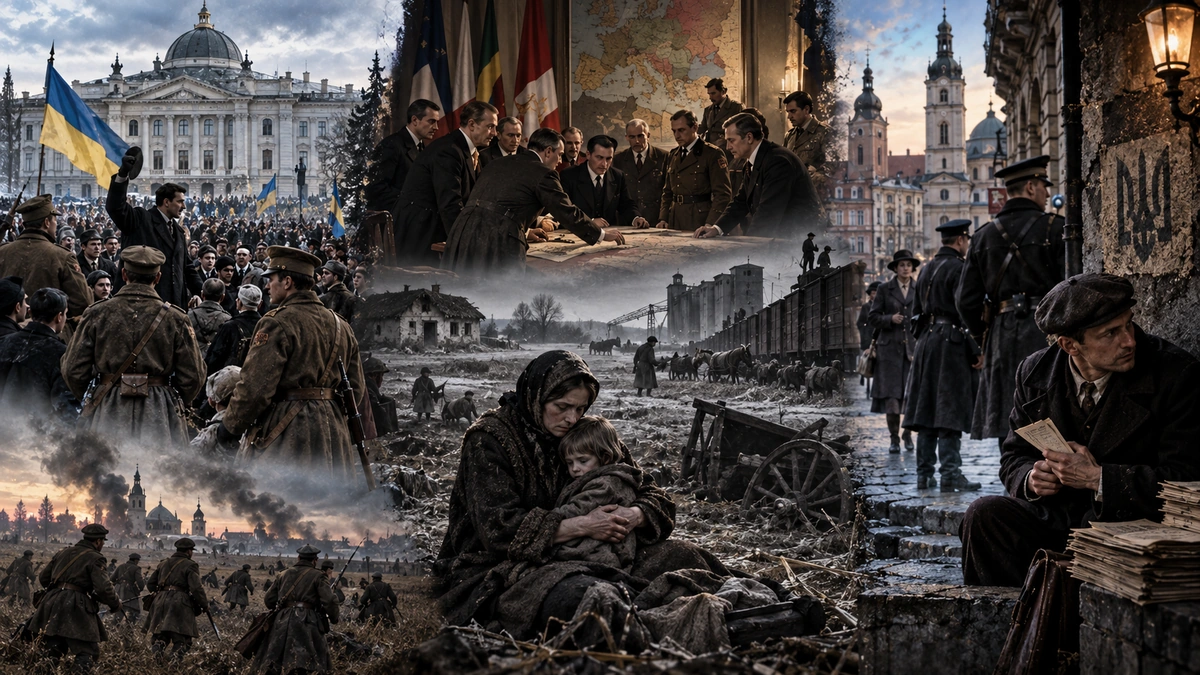
Series hero for the revolutionary, state-building and radicalizing currents of 1917–1939.
Introduction: the collapse of empires did not produce a single Ukraine
When the tsarist regime collapsed in 1917, the Ukrainian lands did not open onto a single road toward a nation-state. Several paths opened at once.
In Kyiv, the Central Rada emerged and initially demanded primarily political autonomy within a restructured Russia. From Kharkiv, the Bolsheviks built a rival Soviet project. In 1918, Germany and Austria-Hungary supported a Ukrainian state because they needed military stability in the east and, above all, food. They then helped replace the Central Rada with the conservative Hetmanate of Pavlo Skoropadsky. After Germany's defeat, the Ukrainian People's Republic returned under the Directorate, but it lost control over much of the territory and found itself at war with the Bolsheviks, White forces, Poland and numerous local armies.
In the western lands, the collapse of Austria-Hungary opened a different conflict: both the Polish and the West Ukrainian state projects claimed Eastern Galicia. By the early 1920s, most of the territory of present-day Ukraine had been divided between Soviet Ukraine and Poland, with smaller parts in other states.
For the period 1917–1939, it is therefore misleading to search for a single “Ukrainian government” or a single explanation for why independence failed. It is more important to follow who exercised actual control, who financed that authority, which external power supported it, and what price was demanded in return. From this perspective, recognition of a state is not in itself evidence that its external patron acts primarily in the interests of its population. The relationship between political recognition, effective sovereignty and the interests of patrons is a central theme of this article.
Over the next two decades, something apparently contradictory occurred: on the one hand, Soviet power militarily and politically displaced the independent Ukrainian state project; on the other, it incorporated the Ukrainian language, cadres and institutions into the state system on a mass scale. Poland, for its part, suppressed parts of the Ukrainian political movement while also experimenting in Volhynia with a different policy that permitted Ukrainian culture as part of a broader anti-Soviet strategy. Germany, meanwhile, after the collapse of the first Ukrainian state project, began cooperating with parts of the Ukrainian underground whenever this suited its conflict with Poland. By the end of the 1930s, the Ukrainian question had therefore become a junction between national policy, revolution, imperial continuity, minority policy and increasingly radical ideologies.
The Central Rada: from autonomy to independence
The Central Rada was formed in March 1917, directly after the fall of tsarism. This matters because of the later claim that the Ukrainian state movement was created by Germany. German troops were not in Kyiv at that time. The Rada was a product of revolution within the former Russian Empire and of the political mobilization of Ukrainian socialists, national organizations, soldiers, peasants and the intelligentsia.
Its initial aims were also not identical to the later program of full state independence. In the first months of 1917, the Rada primarily demanded Ukrainian autonomy within a democratically restructured Russia. Its dispute with the Russian Provisional Government deepened rapidly, but even in the summer of 1917 the central questions were still jurisdiction, territory and the extent of self-government.

Only after the Bolshevik seizure of power in Petrograd did the political framework change radically. The Third Universal proclaimed the Ukrainian People's Republic in November 1917, but still within a federal relationship with Russia. The Fourth Universal in January 1918 declared full state independence. This sequence matters: independence was not the Central Rada's starting objective in March 1917, but the result of the rapid disintegration of the old Russian state space, conflict with the Provisional Government and then war with the Bolsheviks.
At the same time, the Rada was weak as an effective state authority. Proclaiming a state was far easier than building an army, tax system, bureaucracy and reliable territorial control. Ukraine was engulfed by revolution, the army of the old empire was disintegrating, and local authorities often operated according to their own rules. This distinction between political legitimacy and actual state capacity would prove decisive for almost every Ukrainian government of the following years.
Brest-Litovsk: independence in exchange for bread and military support
As Bolshevik forces advanced toward Kyiv in early 1918, the Central Rada sought outside assistance. On 9 February 1918, it signed a treaty at Brest-Litovsk with Germany, Austria-Hungary, Bulgaria and the Ottoman Empire. The Central Powers recognized the Ukrainian state and promised military assistance against the Bolsheviks. In return, the Ukrainian side promised large deliveries of grain and other foodstuffs. German archival sources speak of approximately one million tons of food surpluses that were expected to be made available to the Central Powers.[1]
For the Ukrainian government, the treaty was a means of survival. For Germany, Ukrainian independence was not merely a matter of the principle of self-determination. Material and military interests were directly tied to it: Berlin needed food, wanted to remove Russia from the war and sought to stabilize the eastern space so that more troops could be redirected to the Western Front.
Here we see a pattern that would recur repeatedly over the following decades: an external power can genuinely support a Ukrainian political project while also using it for its own strategic aims. Both statements can be true at the same time. Brest-Litovsk is therefore not only a milestone in statehood but also an example of how Berlin’s need for food and military stability was linked to support for the Ukrainian government.
With the assistance of German and Austro-Hungarian forces, the Rada returned to Kyiv. But the alliance soon became a conflict. The German army expected major food deliveries, while the Ukrainian government, under conditions of administrative collapse, revolutionary changes in property ownership and rural resistance, could not provide them. Berlin therefore increasingly doubted that the socialist Central Rada was capable of fulfilling the agreement. Less than three months after Brest, Germany supported its removal.
Skoropadsky: when the protector chooses a different government
On 29 April 1918, former tsarist general Pavlo Skoropadsky seized power with the support of German generals and proclaimed the Ukrainian State, or Hetmanate. This is an event in which external intervention is documented quite directly.
Even here, however, the label “German puppet” would be too simple. Skoropadsky had significant domestic support from landowners, financiers, industrialists and conservative circles who opposed the Central Rada's socialist agrarian policy and wanted a restoration of order, private property and more effective state administration.[2] The Germans therefore supported a local political alternative that already existed. Yet domestic political support does not diminish the significance of German intervention in the change of government. Rather, it illustrates how an external power can draw on existing domestic interests.
The Hetmanate attempted within a short period to build a more centralized state apparatus. It brought many former officials of the Russian Empire into the administration because they were among the few people with practical experience of governing a state. This had a dual consequence. On the one hand, parts of the administration were more professional than under the Rada. On the other, Ukrainian national and socialist opponents accused the regime of being too Russified and politically dependent on the occupation forces.
The regime was also geopolitically fragile. When Germany lost the war in November 1918, Skoropadsky effectively lost his principal external protector overnight. A month later he resigned, and the Directorate under Volodymyr Vynnychenko and Symon Petliura took power. The case therefore illustrates the political risk of a state project whose security depended heavily on a single external power.
The Directorate and Petliura: a state without control over its own war
In December 1918, the Directorate restored the Ukrainian People's Republic. But the state it restored existed mainly on maps, in proclamations and along a rapidly shifting front line. It fought the Bolsheviks, White Russian forces and various local armies. In the countryside, atamans operated whose formal allegiance to one side did not always mean actual subordination to a central command.
It was in this chaos that one of the darkest phenomena of revolutionary Ukraine took place: mass pogroms against the Jewish population. Different armies and armed groups carried out pogroms. A very large share of the documented violence, however, was committed by forces fighting in the name of the Directorate or nominally connected to Petliura. YIVO estimates that Ukrainian forces under Petliura's nominal control carried out roughly 40 percent of the recorded pogroms during this period.[3]
The word nominal matters. There is no evidence that Petliura issued an order to carry out pogroms. He later issued orders against anti-Jewish violence. But the central authorities had very poor control over a large part of their forces, and according to some research his initial response was too late and insufficiently decisive.
This does not allow a simple answer to the question of his responsibility. It is not justified to write that he personally ordered the pogroms. But it is equally unjustified to say that he had nothing to do with them because he did not issue a written order. Command and political responsibility also include the question of what a leader does when forces fighting in his name commit mass killings of civilians.
Eastern Galicia: the same territory, two state projects
While civil war raged across the former Russian imperial space, the collapse of Austria-Hungary opened a new conflict in the west. In November 1918, the West Ukrainian People's Republic was proclaimed. Its leaders regarded Eastern Galicia as Ukrainian national territory. The restored Polish state, however, claimed the same territory. The dispute quickly became a war.
By the summer of 1919, the Polish army had gained the upper hand in Eastern Galicia. Military control, however, did not immediately amount to final international recognition of Polish sovereignty. At the Paris Peace Conference there were different proposals for a temporary mandate, autonomy and a later plebiscite. Only in March 1923 did the Conference of Ambassadors recognize Polish sovereignty over Eastern Galicia.[5]
Here too, three things must be distinguished:
- who militarily controlled the territory;
- who claimed a right to it;
- what the great powers later recognized.
These three levels did not always coincide.
Piłsudski and Petliura: an alliance born of weakness
By the beginning of 1920, Petliura's position was extremely weak. His army was losing territory, the Bolsheviks controlled much of Ukraine, and Petliura needed an external partner. He found one in Józef Piłsudski.
On 21 April 1920, the Polish and Ukrainian sides concluded a political agreement, followed a few days later by a military convention. The published document collection on the alliance contains 121 sources from Polish and Ukrainian archives, giving us a much stronger documentary basis for the negotiations than exists for many other events of the period.[4]
The price of Polish support was high. Petliura accepted that Eastern Galicia and part of western Volhynia would remain outside his Ukrainian People's Republic. In return, Poland recognized his project and provided military support against the Bolsheviks.
The alliance can therefore be understood without terms such as “betrayal” or “vassalage.” Petliura negotiated from a position of extreme weakness and gave up territorial claims that he had no power to enforce in order to try to save the core of his state project.
For Piłsudski, an independent Ukraine had a different meaning. It was part of his vision of a wider federal space east of Poland and, above all, a means of reducing the power of Russia — whether White or Bolshevik.
In April and May 1920, Polish and Ukrainian forces advanced jointly toward Kyiv. For a time, they occupied it. Then the course of the war reversed.
Riga 1921: who remained at the negotiating table
The final outcome of the war is most clearly visible in the Treaty of Riga itself, signed on 18 March 1921. The parties to the treaty were not Poland and Petliura's UPR. On one side stood Poland, and on the other Soviet Russia and Soviet Ukraine. The treaty established a border, the parties renounced claims to territory on the other side of that border, and they also undertook not to support organizations aimed at the armed subversion of the other party.[6]
This is a crucial historical moment. In 1920, Petliura's project could still obtain military support from Poland. By 1921, he was no longer at the table where the border was being decided. Riga formally recognized Soviet Ukraine as a treaty party and consolidated the political division of Ukrainian-populated territories between Poland and the Soviet state. From then on, the independent UPR existed primarily in exile.
Did the USSR simply restore the Russian Empire?
In 1922, an entirely different question arose: how should the new Soviet state be organized? Stalin's initial plan envisioned Ukraine, Belarus and the Caucasian Soviet republics entering the Russian Soviet Federative Socialist Republic as autonomous units. Lenin opposed this. In a letter of September 1922, he explicitly demanded that the RSFSR, Ukraine and the other republics unite in a new union on a formally equal basis, rather than simply having the other republics incorporated into Russia.[7]
In later notes, Lenin also sharply attacked “Great-Russian chauvinism” and warned that the dominant nation had to exercise particular caution toward peoples that had previously been subordinate to the tsarist empire.
These documents should be interpreted neither too broadly nor too narrowly. They demonstrate that the formal federal structure of the USSR was politically important and that Lenin opposed the simple incorporation of the other Soviet republics into the RSFSR. The federal arrangement ultimately adopted therefore deliberately preserved formal republican structures and the principle of equal entry, even though actual power was not distributed equally.
But the documents do not show that the republics obtained genuinely independent authority. Foreign policy, the military, much of the economy and, above all, the Communist Party remained highly centralized.
The USSR was therefore simultaneously:
- a formal union of national republics;
- an instrument of centralized party power;
- and an attempt to keep most of the former imperial space together in a new political form.
Korenizatsiya: when the state begins building national institutions
It is in this context that korenizatsiya and Ukrainization in the 1920s must be understood. The Bolsheviks did not simply continue tsarist Russification. Terry Martin has described Soviet nationality policy as an exceptionally extensive system of state promotion of national territories, local languages and national cadres. In Ukraine, this meant expanding Ukrainian in administration, education, the party apparatus, the press and cultural institutions.[8]
This is historically very important. The Soviet authorities did not create the Ukrainian nation from nothing. Ukrainian national politics, linguistic development and state projects existed before the Bolsheviks. But the Soviet state institutionalized national identity on a scale that previous Ukrainian governments, because of their short duration and wartime circumstances, had been unable to achieve.
Why? Martin interprets the policy as a Bolshevik attempt to take control of the process of national emancipation or decolonization and direct it in a way that would preserve the territorial integrity of most of the former Russian Empire.[8]
The result was an apparently paradoxical system. In Martin's interpretation, the promotion of national languages, cadres and institutions simultaneously recognized the existence of non-Russian nations and served to strengthen Soviet legitimacy. National institutionalization and centralized party power therefore were not necessarily opposites; they could operate at the same time.
Ukrainization did not mean sovereignty
In the 1920s, Ukrainian schools, publications and cultural institutions expanded rapidly. Cities that were often strongly Russian-speaking also began to acquire more Ukrainian institutions and cadres. But this did not mean political independence. Ukrainian communists could develop national culture only within the boundaries permitted by the party centre.
As Soviet leaders increasingly linked national “deviations” to the question of central control, the direction of policy began to change. The turning point became particularly visible in 1932. During the crisis of collectivization and grain requisitions, the party centre increasingly associated Ukrainian problems with “nationalist deviations.” In December 1932, the Politburo adopted measures against part of the Ukrainization policy; purges, repression of cultural elites and a stronger rehabilitation of Russian culture as a foundational element of the Soviet state followed.[8]
This was still not a simple return to tsarist Russification. Korenizatsiya did not disappear everywhere overnight. The development of Ukrainian institutions therefore cannot be explained solely as a struggle against the Russian cultural sphere. The Soviet state framework played an active part in that development, which must not be confused with political freedom or used to deny subsequent repression.
But the period in which Ukrainization was treated as one of the most important state projects was coming to an end. At the same time, the countryside was undergoing a catastrophe.
The famine of 1932–1933: facts and the question of intent
The famine in Soviet Ukraine is one of the most politically charged subjects in Ukrainian history. The first step is therefore to distinguish questions that can be measured well from the question of legal classification. The demographic reconstruction by Levchuk and colleagues estimates approximately 3.94 million direct excess deaths in the Ukrainian SSR between 1932 and 1934.[9] This is a statistical reconstruction, not a nominal register, so figures vary somewhat among studies.
It is also well documented that the famine was not simply the result of a poor harvest. Soviet policy included forced requisitions, seizure of reserves, punishment of villages, blacklisting and other measures that deprived people of the means of survival.

On 22 January 1933, the central authorities additionally restricted the departure of peasants from Ukraine and the Kuban to other parts of the Soviet Union in search of food and ordered the return of those who tried to leave.[9] These are concrete facts.
The more difficult question is whether this combination of measures proves a specific intent to physically destroy Ukrainians as a national group. Here the academic dispute remains genuine. Some historians see the combination of famine, the attack on Ukrainian cultural elites, the reversal of nationality policy and restrictions on movement as evidence of a genocidal assault. Others argue that the catastrophe was primarily part of Stalin's violent confrontation with peasant resistance, collectivization and the broader Soviet countryside, even while acknowledging that Ukraine was hit especially hard and that the process also had a national dimension.
The article therefore does not need to choose a label in order to demonstrate the scale of the crime. Millions of deaths, requisitions, food confiscation, restrictions on movement and repression of national elites are historically significant regardless of how their combined intent is later legally classified.
Polish Ukraine: one state, several different policies
While Soviet Ukraine experienced korenizatsiya and later Stalin's reversal, several million Ukrainians lived in the Second Polish Republic. Here too, there was no single, unchanged twenty-year policy. Eastern Galicia was politically different from Volhynia. Polish governments changed. Parts of the state favored stronger cultural assimilation, while others looked for ways to integrate the Ukrainian population without complete Polonization.
The most interesting example is Henryk Józewski. As voivode of Volhynia after 1928, he supported policies that allowed more room for Ukrainian culture, local language and cooperation with Ukrainian elites than did classic assimilationist policy.
But here too, formal minority policy was not identical to its broader purpose. Timothy Snyder places Józewski's project within Poland's Promethean strategy: a Ukrainian cultural and political space in Volhynia was intended to be compatible with loyalty to the Polish state while also being useful in a long-term anti-Soviet project. The objective was therefore not Ukrainian state independence on Polish territory, but a different political balance east of Poland.[10]
This is almost a textbook example of our methodological rule: a cultural concession can be genuine and at the same time serve a strategic state interest.
From a lost state to underground violence
The defeat of the Ukrainian state projects after the First World War had another consequence. Some former soldiers and nationalists did not accept the new system of borders. In the early 1920s, the Ukrainian Military Organization — UVO — began an underground struggle primarily against Polish rule. It used sabotage, assassinations and other forms of revolutionary violence.
Germany soon entered this story as well. At least from 1923, the German Reichswehr cooperated with the UVO. A peer-reviewed study by Andrii Bolianovskyi documents an agreement under which the UVO provided political, military and economic intelligence on Poland and in return received money, weapons, explosives and military training.[11] In the broader German political environment, such cooperation was also connected to revisionist attitudes toward the post-war settlement in Poland, but the concrete motives of individual German institutions are assessed document by document rather than treated as one unified hidden plan.
This cooperation was not permanent. Bolianovskyi documents the termination of UVO funding at the end of 1928.[11] A specialist chronology of German-Ukrainian relations then records a renewal of cooperation in 1932 and another break at the end of 1933, when Hitler's government sought an agreement with Poland.[12]
The Ukrainian underground was therefore not simply a German instrument. It had its own objective — an independent Ukrainian state. Germany, for its part, supported it when doing so served German interests against Poland.
OUN 1929: the state as an objective, violence as a method
In 1929, the Organization of Ukrainian Nationalists — OUN — emerged from the UVO and related radical nationalist groups. Its program was substantially more radical than earlier cultural nationalism. The OUN advocated integral nationalism, strict discipline, revolutionary struggle and a state placed above individual political interests. Democratic pluralism was not central to its political model.
Its pre-war ideology contained pronounced authoritarian and exclusionary elements and a hostile relationship toward states and groups the movement regarded as obstacles to Ukrainian statehood. Myroslav Shkandrij places the OUN within the radical-right and authoritarian nationalist context, while Marco Carynnyk, using archival documents and publications, specifically shows that anti-Jewish discourse was present already at the organization's formation in 1929.[13]
It is important to emphasize this before the period of the Second World War. The later collaboration of some OUN members with Nazi Germany should not simply be projected backward so that the entire organization is called “Nazi” from its first day. But it is equally unreasonable to remove authoritarianism, ethnic exclusivism and political violence from its pre-war history merely because 1941 had not yet arrived. The OUN was already a radical revolutionary organization before the war.
Pacification in 1930: sabotage and collective repression
In 1930, tensions between the Polish state and the Ukrainian underground reached a new high. The UVO carried out a wave of sabotage. The Polish state responded with the so-called pacification of Eastern Galicia — a police and military operation intended to suppress underground activity. Both parts of this sequence are documented.
The sabotage was not invented. But repression did not affect only people whose participation in the UVO had been individually proven. Roman Wysocki's archive-based study finds that the measures also affected civilians who had no connection to the organization.[14]
It is also important that legal Ukrainian political parties did not simply stand behind the UVO. Three leading parties, in a joint communiqué, condemned both the perpetrators of the sabotage and the repressive conduct of the authorities.[14] The events reached the Polish parliament and the international forum of the League of Nations.
Pacification may also have intensified radicalization: nationalist organizations used state repression as an argument against the effectiveness of legal politics, while the Polish authorities used sabotage and political violence as arguments for a stricter security approach. The cycle of underground violence and state repression therefore fed each other politically, without making responsibility for individual acts equivalent.
Pieracki 1934: the OUN moves from sabotage to political assassination
On 15 June 1934, Polish Interior Minister Bronisław Pieracki was assassinated in Warsaw. The direct perpetrator was OUN member Hryhorii Maciejko. Archival research and the court proceedings treat the assassination as an OUN operation.[15]
Stepan Bandera was among the leading defendants in the later Warsaw trial. Precision is required here. Bandera was one of the principal defendants in the Warsaw trial and was convicted in proceedings connected with the assassination and OUN activity. Gibiec finds that the Senyk archive helped shape the indictment, but with regard to the murder itself it was mainly supplementary evidence. Without a direct document, we therefore do not claim that Bandera personally issued the operational order to Maciejko.[15]
The distinction may seem small, but it is historically important. The organizational responsibility of the OUN is well documented. The details of the personal chain of command, however, must be formulated in accordance with the evidence.
The assassination gave the Polish state a new argument for harsher repression. At the same time, the OUN demonstrated that its concept of revolutionary struggle was not merely rhetoric.
1939: several projects, no final answer
Immediately before the Second World War, the Ukrainian question was not a single conflict between Ukraine and Russia. In the east there was Soviet Ukraine — a republic with a Ukrainian name, territory, institutions and language, but with actual political power concentrated in the Soviet party centre. In the west, a large Ukrainian population lived within Poland, where assimilation measures, repression and limited experiments in cooperation alternated.
Underground, the OUN advocated a revolutionary and authoritarian path toward its own state. Representatives of earlier state projects still existed in exile.
Germany supported or rejected Ukrainian organizations according to its own policy toward Poland and the Soviet Union. At the same time, the Soviet government both institutionalized Ukrainian identity and repressed it when it regarded it as a threat to central control.
The period 1917–1939 therefore does not lead to one simple conclusion. It does not show that the Ukrainian state was merely a foreign construction. Nor does it show that the Ukrainian political movement operated in a vacuum, independent of the great powers. This is precisely why the concrete decisions of the German and Polish authorities and the Soviet centre must be assessed, rather than attributing their geopolitical interests to the Ukrainian population as a whole.
It shows something more demanding: Ukrainian political projects had their own social and ideological base, but almost all of them developed in a space in which Germany, Poland and Soviet Moscow sought to integrate local movements, institutions and identities into their own security and geopolitical strategies.
After the defeat of the state projects of 1917–1921, one part of the national movement increasingly concluded that legal and diplomatic methods were insufficient and more strongly advocated revolutionary violence as a road to statehood. This was not the only Ukrainian political current, but by the end of the 1930s it had become an important part of the underground nationalist movement.
When the European system collapsed again in 1939, the Ukrainian lands therefore already contained a dangerous combination of:
- unresolved borders;
- competing historical claims;
- Soviet repression;
- Polish-Ukrainian conflict;
- revolutionary nationalism;
- and great powers that regarded the Ukrainian question as an instrument for changing the European balance.
The next article therefore will not begin in 1941. It must begin in September 1939, when the interwar system broke apart and relations among the OUN, the Soviet Union, Nazi Germany, Poles, Jews and the local population became questions of war, occupation and mass violence.
Methodological exclusions
Encyclopedia of Ukraine— not used as an evidentiary source.phh.dspu.edu.ua— not used as an evidentiary source.- transcripts — used only as generators of research questions, not as factual authorities.
Sources and further reading
- Basil Dmytryshyn, “The German Overthrow of the Central Rada, April, 1918: New Evidence from German Archives,” Nationalities Papers 23(4), 1995. Source
- Stephen Velychenko, State Building in Revolutionary Ukraine: A Comparative Study of Governments and Bureaucrats, 1917–1922, University of Toronto Press, 2011. Source
- YIVO Encyclopedia, “Pogroms” and “Russian Civil War”; YIVO Schwarzbard archival guide. Used for the relationship among Directorate forces, the pogroms and Petliura's command responsibility. Source
- Jan Pisuliński and Witalij Skalski (eds.), Sojusz Piłsudski–Petlura. Dokumenty i materiały, IPN / Studium Europy Wschodniej Uniwersytetu Warszawskiego, 2020. The collection contains 121 documents and sources. Source
- U.S. diplomatic documentation on Eastern Galicia in 1919 and British Hansard, March 1923; the Conference of Ambassadors recognized Polish sovereignty in March 1923, after proposals for a mandate, autonomy and plebiscite had also existed in 1919.
- Treaty of Peace between Poland, Russia and the Ukraine, Riga, 18 March 1921, especially Articles 2–4; official Polish printing of the treaty, digitized in the IURA collection of the Jagiellonian University. Source 1 Source 2
- V. I. Lenin, “On the Establishment of the U.S.S.R.”, 26 September 1922; “The Question of Nationalities or ‘Autonomisation’”, December 1922. Used as primary political documents. Source 1 Source 2
- Terry Martin, The Affirmative Action Empire: Nations and Nationalism in the Soviet Union, 1923–1939, Cornell University Press, 2001; George O. Liber, Soviet Nationality Policy, Urban Growth, and Identity Change in the Ukrainian SSR, 1923–1934; Matthew D. Pauly, Breaking the Tongue. Source 1 Source 2 Source 3
- Nataliia Levchuk, Oleh Wolowyna, Omelian Rudnytskyi, Alla Kovbasiuk and Natalia Kulyk, “Regional 1932–1933 Famine Losses: A Comparative Analysis of Ukraine and Russia,” Nationalities Papers 48(3), 2020; related demographic studies by the same research group. Source 1 Source 2
- Timothy Snyder, Sketches from a Secret War: A Polish Artist’s Mission to Liberate Soviet Ukraine, Yale University Press, 2005. Source
- Andrii Bolianovs'kyi, “Cooperation between the German Military of the Weimar Republic and the Ukrainian Military Organization, 1923–1928,” Harvard Ukrainian Studies 23(1/2), 1999, 73–84.
- Geschichtsportal “Deutschland und die Ukraine im 20. Jahrhundert”, “Das Deutsche Reich und Versuche der ukrainischen Staatsgründung 1938–1941”, used only for the later chronology of the interruption and renewal of cooperation; the core account for 1923–1928 rests on Bolianovskyi. Source
- Myroslav Shkandrij, Ukrainian Nationalism: Politics, Ideology, and Literature, 1929–1956, Yale University Press, 2015; Marco Carynnyk, “Foes of our rebirth: Ukrainian nationalist discussions about Jews, 1929–1947,” Nationalities Papers 39(3), 2011. Source
- Roman Wysocki, “Stanowisko ukraińskich środowisk politycznych w II Rzeczypospolitej wobec ‘pacyfikacji Galicji Wschodniej’ w 1930 roku,” Res Historica 52, 2021. Source
- Magdalena Gibiec, study of the Senyk archive and its role in reconstructing OUN activity and the trial concerning the assassination of Pieracki, Studia z Dziejów Rosji i Europy Środkowo-Wschodniej LIV(4), 2019. Source