1939–1945: Between Occupation, Collaboration, Resistance, and Ethnic Violence
An analysis of occupation, collaboration, resistance, the Holocaust and ethnic violence in what is now Ukraine during the Second World War.
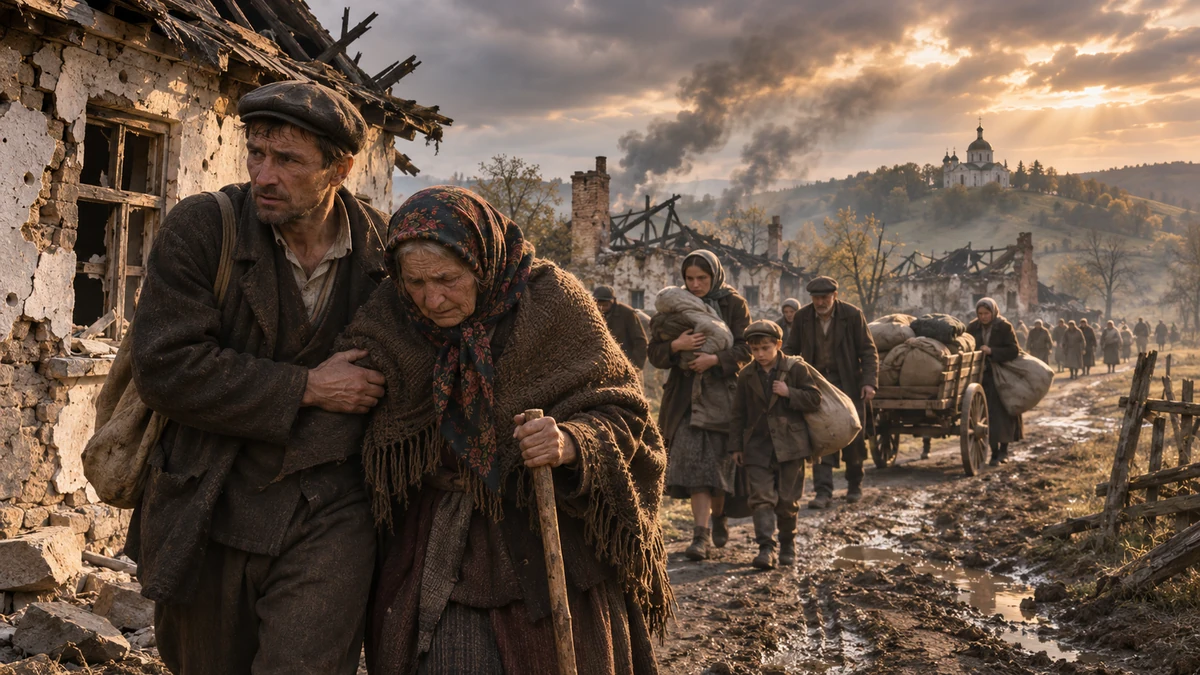
Editorial illustration of civilian suffering and displacement during World War II in what is now western Ukraine; it does not depict a specific documented event.
Introduction
The years 1939–1945 are among the most politically charged periods in the history of what is now western Ukraine. The same people and organizations appear in different national memories as liberators, collaborators, victims, perpetrators, or as several of these things at different moments. A reconstruction therefore has to move away from the question of which later narrative is “ours” and return to chronology, decisions, command structures, and concrete acts.
The central rule of this audit is simple: German occupation policy, the decision of a political organization, the action of a specific unit, and the conduct of an individual are not the same level of responsibility. The same applies to Soviet records. An authentic Soviet or German document can prove that a statement was made or used; it does not automatically prove that the statement itself was true. The Ukrainian population as a whole must therefore not be equated with either nationalist organisations or occupation institutions. Examining their actions is a demand for accountability, not a condemnation of a nation.
This distinction is essential for the Organization of Ukrainian Nationalists (OUN), the Ukrainian Insurgent Army (UPA), the Nachtigall and Roland battalions, auxiliary police formations, and the Waffen-SS “Galicia” Division. These structures overlapped in personnel to varying degrees, but they were not one organization. Their relationship with Germany also changed over time: cooperation, political conflict, repression, underground activity, and armed clashes all occurred, in different phases and combinations.
September 1939: War, the Partition of Poland, and Soviet Rule
The Second World War reached the region in September 1939. Germany invaded Poland on 1 September, and the Soviet Union entered from the east on 17 September. The secret additional protocol to the German-Soviet pact of 23 August provided for a division of spheres of influence in Eastern Europe; the German-Soviet Boundary and Friendship Treaty of 28 September further formalized the new partition of Polish territory.[1][2]

For the population of eastern Poland this was not simply a change of administration. Soviet rule brought political and economic Sovietization, mass arrests, deportations, and repression against actual and perceived opponents. Former Polish state officials, military and police personnel, parts of the intelligentsia, wealthier social groups, Ukrainian nationalists, and others were targeted. Repression did not affect a single ethnic community alone; political, social, and national categories overlapped.[3]
When Germany attacked the Soviet Union on 22 June 1941, the rapid Soviet retreat produced another catastrophe. The NKVD killed prisoners in numerous jails across western Ukraine before withdrawing. In Lviv, German troops and local residents encountered thousands of corpses after entering the city. The mass executions are well documented. Some of the sensational contemporary and later stories describing systematic torture and mutilation of all victims are much less securely documented and emerged in an environment of shock, rumor, and immediate German and nationalist propaganda.[4][5]
The Soviet crime therefore has to be stated clearly, but without repeating a second error: the dead prisoners were immediately used to promote a false collective accusation that Jews as a community were responsible for Soviet crimes. The link between a real Soviet atrocity and the antisemitic conspiracy theory of “Judeo-Bolshevism” became part of the violence that followed.
The OUN Splits and Seeks a Route to Ukrainian Statehood
The Organization of Ukrainian Nationalists was already a radical nationalist movement before the war, but in 1940 it split. The older leadership around Andrii Melnyk formed OUN-M; the younger revolutionary group around Stepan Bandera formed OUN-B. The split was organizational, generational, and strategic. From this point onward, references to “the OUN” without identifying the faction often obscure crucial differences.
Both factions viewed Germany as a possible partner against the Soviet Union and as a means of advancing their own national project. A common enemy did not mean identical political objectives. Ukrainian nationalists hoped a German-Soviet war would create room for restored Ukrainian statehood. Nazi policy, however, was not designed to produce a sovereign Ukrainian state; it envisioned German rule, economic exploitation, and racial reordering in the east.
The Nachtigall and Roland formations illustrate the imbalance of expectations. They were created through cooperation between OUN-B and the German military-intelligence apparatus, the Abwehr, within the Wehrmacht framework. They were not Waffen-SS units. OUN-B hoped they might become a nucleus of a future Ukrainian army, while the German side treated them primarily as useful special military formations for the coming war against the Soviet Union.[6]
30 June 1941: A Declaration of Statehood and the First Major Break with Germany
German forces entered Lviv on 30 June 1941. The same day, OUN-B, through Yaroslav Stetsko, proclaimed the restoration of a Ukrainian state. The proclamation expressed willingness to cooperate with Germany in the war against the Soviet Union, but it did not result from German recognition of Ukrainian sovereignty. German authorities instead demanded that the declaration be withdrawn.

Stepan Bandera and Yaroslav Stetsko refused. Bandera was detained on 5 July and Stetsko on 9 July; further restrictions followed, and in September 1941 German security authorities carried out a broader repression of OUN-B. Both men were later held in the special-prisoner section of Sachsenhausen.[7]
This episode undermines two opposing simplifications. One claims that OUN-B was nothing more than a German puppet: if that were true, the German state would not have suppressed its statehood project and interned its leadership. The other claims that the July arrests prove that all cooperation with Germany immediately ended. That is also too simple. The evidence indicates that attempts to find an accommodation continued after the first arrests. For December 1941, the key item is Stakhiv’s later testimony that Bandera told Mykola Lebed not to open a struggle against the Germans and to try to repair relations. Because this is testimonial evidence, it is more appropriately treated as an indication that such efforts continued, not as proof of a stable German–OUN-B partnership. The conflict was real, but the transition from cooperation to underground resistance did not occur in a single moment.[7]
Lviv 1941: Four Events Often Collapsed into One
The events in Lviv at the end of June and the beginning of July 1941 show why chronology matters. At least four separate clusters of violence occurred within days:
- the NKVD murdered prisoners before the Soviet withdrawal;
- after the German entry, anti-Jewish violence began on 30 June and escalated into a pogrom on 1 July;
- on the night of 3–4 July German security structures arrested and later murdered a group of Polish professors and relatives;
- in the following days German Einsatzgruppen and security-police units conducted additional mass shootings of Jews.
Merging these events produces false attributions. The United States Holocaust Memorial Museum describes the 1 July pogrom as violence involving German occupiers, members of the newly formed Ukrainian militia, Ukrainian nationalist activists, and sections of the local population, including Ukrainians and Poles. Jews were beaten, humiliated, robbed, raped, and murdered. German authorities and nationalist activists exploited the discovery of murdered prisoners and promoted collective accusations against Jews.[5]
What did Nachtigall do?
Postwar memory politics generated considerable confusion on this point. In 1959–1960 an East German and Soviet campaign against former Nachtigall officer Theodor Oberländer accused the battalion of a broad range of crimes, including the murder of the professors. Kai Struve re-examined the case using evidence that also predates that propaganda campaign. His conclusion is not that Ukrainian nationalist participation in the Lviv violence did not occur. On the contrary, the OUN militia was an important actor. But there is no evidence that Nachtigall as a battalion, acting on orders from its commanders, organized the pogrom. There are indications that individual battalion members may have taken part in violence around the prisons; that is not the same as evidence against the unit as an institution.[8]
The distinction is even clearer in the murder of the Polish professors. Available evidence links the arrests and killings to the German Einsatzkommando zur besonderen Verwendung (z.b.V.) under Eberhard Schöngarth and the German security-police apparatus, not to Nachtigall as a battalion. The Soviet and East German attribution was therefore incorrect on this point.[8] The broader lesson is important: a false propaganda allegation does not rehabilitate an actor with regard to other, independently documented acts. If Nachtigall did not murder the professors, it does not follow that the OUN militia did not participate in anti-Jewish violence. If the OUN militia participated in the pogrom, it does not follow that every Ukrainian nationalist or every Nachtigall member was personally a perpetrator.
The Holocaust: A German Genocidal System and Local Assistance
The Holocaust in occupied Ukrainian territories was part of the Nazi state project to destroy European Jewry. The decisive policies, command chains, and killing infrastructure were created by German institutions: the SS, security police, Einsatzgruppen, civil occupation authorities, and other components of the Nazi regime. That does not erase local participation. John-Paul Himka’s research, along with studies of local policing, identifies several phases of Ukrainian nationalist and police involvement. During the summer of 1941, OUN militias participated in anti-Jewish violence in a number of locations. In a later phase, OUN-B recruited or infiltrated some of its cadres into local police structures operating under German command.[9]
Regional precision matters. In Eastern Galicia, Ukrainian auxiliary police served within the German District of Galicia. In Volhynia, stationary Schutzmannschaften and other local police formations operated within a different occupation-administration structure. These were not sovereign “Ukrainian police” institutions; they were components of the German occupation-police system.[9] Their functions in the Holocaust were concrete: identifying and arresting Jews, gathering people before deportations or shootings, guarding ghettos and execution sites, escorting transports, searching for escapees, and in some cases directly killing victims. German units generally directed the operations and carried out a large share of mass shootings; local police personnel supplied local knowledge and a significant portion of the operational manpower.[9]
Yet here too, a label is insufficient. Not every policeman was a member of OUN, and police membership alone does not prove participation in a particular murder. The relevant questions are: which unit, under whose command, in which place, and what did the individual actually do?
From German Repression to the Rise of a Mass UPA
German conflict with OUN-B escalated during the summer and autumn of 1941, but repression was not limited to the Bandera faction. OUN-M was initially tolerated longer, then its members also became targets of arrest and execution. In late 1941 and early 1942 the Germans dismantled part of the Melnykite network in Kyiv. Poet and activist Olena Teliha was among those killed. Her death under German repression is well established; the often-repeated claim that she was certainly shot specifically at Babyn Yar is not supported by equally firm direct documentation.[10]
Repression of OUN-M continued into 1944. Andrii Melnyk was arrested in January and Oleh Olzhych in May. Olzhych died in German custody in Sachsenhausen in June 1944 after severe interrogation and beatings; the exact immediate mechanism of death remains unresolved.[10]
Meanwhile OUN-B developed a larger underground armed structure in 1942–1943 that became the UPA. One significant personnel shift came in 1943, when several thousand Ukrainian policemen left German service; some joined the nationalist underground and the UPA. This is a personnel bridge, not proof that the German auxiliary police and the UPA were one institution.[9]
UPA fought German forces in 1943. Those clashes are historically real. Local tactical contacts and other complicated interactions also occurred. The formula “OUN-UPA was always a German ally” is therefore inaccurate. But the reverse formula — “because UPA fought the Germans, earlier collaboration never existed” — is equally inaccurate. Later conflict does not erase earlier cooperation.
Volhynia 1943–1944: Organized Ethnic Cleansing and Mass Mobilization
The worst phase of Polish-Ukrainian violence developed in Volhynia in 1943. Using declassified Ukrainian security archives, testimony, and microhistorical analysis, Jared McBride argues that the campaign cannot be adequately explained as a spontaneous explosion of peasant hostility. His study describes a Ukrainian nationalist-led campaign of ethnic cleansing against the Polish population.[11]
This does not mean that every perpetrator was a long-time OUN member or an ideologically trained cadre. One of McBride’s key findings is that nationalist leadership was able to mobilize ordinary peasants and other local actors into mass violence through different mechanisms. Organizational leadership and the social composition of perpetrators are therefore separate questions.[11]
Polish civilians were the principal target population. Villages were attacked, inhabitants killed, and survivors displaced on a large scale. Polish self-defence groups, Home Army units, and retaliatory attacks also existed, and Ukrainian civilians — including women and children — were killed in Polish actions. These crimes belong in the historical account. Their existence, however, does not make the organizational initiative, chronology, and scale of violence symmetrical.[11][12]

How many were killed?
No single uncontested figure exists. For the core Volhynian violence of 1943–1944, a working range of approximately 50,000–60,000 Polish victims is defensible, while some of the specialist literature uses a broader range of roughly 40,000–60,000. These are historiographical reconstructions, not a complete forensic register. Different methodologies must not be mixed. Ewa Siemaszko, for example, produced broader reconstructions covering 1939–1948 and a wider geography; those figures cannot simply be presented as the total for “Volhynia 1943–1944.” Contemporary Polish underground estimates also varied widely, demonstrating the information chaos and incomplete knowledge of observers at the time.[12]
For Ukrainian victims of Polish actions, Grzegorz Motyka estimates approximately 2,000–3,000 deaths in Volhynia and roughly 10,000–15,000 in the wider Polish-Ukrainian conflict of 1943–1947. These are Motyka’s reconstructions and should be attributed as such.[12] A numerical ratio is not a moral argument. It is, however, relevant to historical reconstruction and helps explain why a fully symmetrical description of the violence as merely an interethnic civil war is inadequate.
“Ethnic cleansing” or “genocide”?
Polish state institutions and part of the historiography use the term genocide. Much international academic literature uses ethnic cleansing. The legal and historiographical dispute does not alter the underlying description of the acts: an organized campaign targeted civilians with the purpose of eliminating the Polish presence from the area. This article therefore does not use the terminology debate to minimize the violence, but neither does it present one legal qualification as universal academic consensus.
Eastern Galicia: Expansion of Violence and Greater Numerical Uncertainty
Violence expanded into Eastern Galicia. For Polish victims in 1941–1945, Polish-Ukrainian historiographical discussions often cite a range of approximately 20,000–25,000, deriving from Grzegorz Hryciuk’s reconstruction and later repeated in parts of the seminar literature. Documentation for Eastern Galicia, however, is weaker and less complete than for Volhynia, and higher authorial estimates also exist.[12] For this reason, the article does not collapse Volhynia and Eastern Galicia into one absolute figure without identifying the author, period, and methodology. “Named,” “documented,” “probable,” and “estimated” victims are not interchangeable categories.
The Waffen-SS “Galicia” Division: Institution, Motives, and Individual Responsibility
In 1943 the Germans formed the 14th Waffen-SS “Galicia” Division, largely from Galician Ukrainian recruits. The institutional fact is clear: it was a Waffen-SS formation. That does not by itself answer why each individual enlisted. Scholarship identifies varied motives: anti-Soviet and national aspirations, hopes for military training, material and social reasons, opportunism, and, in later phases, different forms of mobilization pressure.[6][13]
Varied motives do not change institutional affiliation. At the same time, institutional affiliation alone does not prove that every individual personally committed a war crime. The Canadian Deschênes Commission stated in 1986 that, in the absence of evidence of participation in or knowledge of specific war crimes, mere membership in the division was insufficient to justify prosecution. This was a finding of that specific Canadian inquiry and is useful as a standard of individualized responsibility, not as a blanket historical exoneration of every unit or act.[14]
Huta Pieniacka: Why Organizational Genealogy Matters
On 28 February 1944 the Polish village of Huta Pieniacka was destroyed and a large part of its civilian population murdered. The exact death toll remains unsettled. Poland’s Institute of National Remembrance (IPN) cites more than 850 victims in its 2026 materials, while lower and higher figures have appeared in earlier literature. In June 2026 a joint Polish-Ukrainian field team located human remains at 25 locations over more than 200 square metres at the former village, including a larger mass-grave area; IPN stated that this early stage did not yet permit a precise estimate of the number buried there. In August 2026 the Ukrainian authorities authorized exhumations. Until the forensic process is completed, one absolute figure should not be locked in.[15][16][17]
The most important organizational correction concerns the perpetrators. Poland’s IPN attributes the massacre to Ukrainian personnel of the 4th Galician SS Volunteer Police Regiment, with participation by the UPA and/or local nationalist formations. Because this formulation is a finding of a Polish state investigative and memory institution, the article attributes it explicitly rather than presenting it as a substitute for the entire academic literature.[15] The regiment was connected to the recruitment project for the “Galicia” Division because it was formed from men who had originally volunteered for the division. In February 1944, however, it was not simply the “4th regiment of the SS Galicia Division.” Myroslav Shkandrij places it among four Galician SS Volunteer Regiments numbered 4–7 that were trained by the Ordnungspolizei; they had no Ukrainian officers and the division exercised no operational control over them.[13]
This is not a semantic technicality. Attributing a February act to divisional command when the regiment was not then under that operational command creates a false chain of responsibility. It would be equally wrong, however, to use this distinction to imply that the unit stood outside the Nazi SS-police system. It was a formation of the German SS-police apparatus under German command. The question is which command structure, not whether it belonged to the Nazi system.
Postwar Memory: Between Propaganda and Selective Rehabilitation
The events of 1939–1945 became political weapons after the war. Soviet and East German institutions took real cases of nationalist cooperation with Nazi structures and sometimes expanded them into collective or demonstrably false accusations. The case of Nachtigall and the Lviv professors is one of the clearest documented examples of genuine crimes becoming entangled with false attribution.[8]
On the other side, parts of Ukrainian diaspora and later national memory minimized or denied the participation of nationalist militias and police cadres in anti-Jewish violence or in the ethnic cleansing of Poles. That defence is also methodologically weak when it reacts to Soviet propaganda by rejecting evidence from independent German documentation, Jewish testimony, Polish sources, or the nationalist movement’s own records.[9] Criticism of Soviet propaganda must not become a reason to rehabilitate documented collaboration or minimise the responsibility of nationalist leaders. The criterion is evidence of actions, not the political usefulness of a later narrative.
A historical audit therefore does not choose between two memory blocs. For each event it asks: when was the source created, who produced it, for whom, what interests shaped it, what can be checked against independent contemporary material, and does a later historian actually bring new archival evidence or only a new interpretation?
Conclusion: Chronology Is Stronger Than a Label
Between 1939 and 1945, the population of western Ukraine experienced two occupation systems, mass Soviet repression, Nazi genocide, nationalist attempts at statehood, collaboration, German repression of nationalist organizations, underground resistance, and mass Polish-Ukrainian ethnic violence.
The evidence does not support the simple claim that the OUN was nothing more than a German puppet throughout the war. Cooperation before Barbarossa and during the initial invasion is documented, but so are the German suppression of the OUN-B statehood project, arrests, repression of both OUN factions, and armed clashes between the UPA and German forces. Nor does the evidence support the opposite image of a purely liberationist movement from which the participation of nationalist militias in anti-Jewish violence, infiltration of auxiliary police, the role of police cadres in the German Holocaust system, and the OUN-UPA-led ethnic cleansing of Polish civilians can be removed. Understanding aspirations for statehood does not require excusing these actions. On the contrary, the responsibility of political organisations can be examined precisely without transferring it to the Ukrainian people.
The most accurate reconstruction is chronological:
Soviet occupation and repression → activity by an already radicalized nationalist movement and cooperation with Germany against the USSR → an attempt at Ukrainian statehood and conflict with German authorities → repression and underground development → local participation in the German genocidal system → growth of the UPA and fighting against multiple opponents → organized ethnic cleansing of Poles and Polish retaliatory crimes → a postwar battle over memory.
No later event erases an earlier one. German repression of the OUN does not erase cooperation in 1941. Soviet propaganda does not erase real crimes by nationalist structures. Polish retaliatory crimes do not erase the organized campaign against Polish civilians. And organizational membership does not substitute for proof of an individual act.
That distinction between state policy, organization, unit, and individual is the strongest safeguard against turning history into propaganda. In later political disputes about this period too, the dignity of the people affected must take precedence over any government’s need for historical justification.
Sources and further reading
- German-Soviet Secret Additional Protocol, 23 August 1939, Nazi-Soviet Relations 1939–1941, Avalon Project, Yale Law School. source Source
- German-Soviet Boundary and Friendship Treaty, 28 September 1939, Avalon Project, Yale Law School. source Source
- Lviv Interactive, “Soviet Occupation (1939–1941),” used as a regional synthesis alongside archival scholarship. source Source
- National WWII Museum, “The 1941 NKVD Prison Massacres in Western Ukraine,” 2021. Used as a secondary overview and research lead; sensational torture claims are not adopted wholesale. source Source
- United States Holocaust Memorial Museum, “The Lwów Pogrom of July 1, 1941.” source Source
- Olesya Khromeychuk, “Ukrainians in the German Armed Forces during the Second World War,” History 100 (343), 2015, 704–724, DOI 10.1111/1468-229X.12129.
- Grzegorz Rossoliński-Liebe, “The ‘Ukrainian National Revolution’ of 1941: Discourse and Practice of a Fascist Movement,” Kritika 12 (1), 2011, 83–114; see also the German-Ukrainian Historical Portal on German reactions to the June 1941 statehood proclamation.
- Kai Struve, “Theodor Oberländer and the Nachtigall Battalion in 1959/60—an Entangled History of Propaganda, Politics, and Memory in East and West,” Slavic Review 81 (3), 2022, 677–700. source Source
- John-Paul Himka, Ukrainian Nationalists and the Holocaust: OUN and UPA’s Participation in the Destruction of Ukrainian Jewry, 1941–1944, ibidem Press, 2021 (distributed by Columbia University Press); and “Collaboration in Eastern Galicia: The Ukrainian Police and the Holocaust,” East European Jewish Affairs 34 (2).
- Yuri Radchenko, “Nazi Repression against Melnykites (1941–1944),” Ukraina Moderna, 2023, Parts 1 and 3. Used as a documentary secondary reconstruction tied to the German and other records discussed by the author.
- Jared McBride, “Peasants into Perpetrators: The OUN-UPA and the Ethnic Cleansing of Volhynia, 1943–1944,” Slavic Review 75 (3), 2016, 630–654. source Source
- Grzegorz Motyka, Od rzezi wołyńskiej do akcji „Wisła”, 2011; IPN conference volume Wołyń 1943 – rozliczenie; Ewa Siemaszko, Bilans zbrodni. Figures are used only with regional, chronological, and methodological qualification.
- Myroslav Shkandrij, In the Maelstrom: The Waffen-SS “Galicia” Division and Its Legacy, McGill-Queen’s University Press, 2023, especially ch. 7, “Galician SS Volunteer Regiments,” pp. 104–120. source Source
- Commission of Inquiry on War Criminals (Deschênes Commission), Canada, Report, 1986. Used only for the scope of the Canadian inquiry and the principle of individualized responsibility. source Source
- Institute of National Remembrance (Poland), “Zbrodnia w Hucie Pieniackiej,” 28 February 2026. Cited as the current finding of a Polish state investigative/memory institution, not as a substitute for independent scholarship. source Source
- Institute of National Remembrance (Poland), “Komunikat o zakończeniu prac poszukiwawczych w Hucie Pieniackiej,” 19 June 2026. source Source
- Institute of National Remembrance (Poland), “Zgoda władz ukraińskich na ekshumacje w Hucie Pieniackiej,” 20 August 2026 (permission issued 7 August). source Source