1945–1991: The Covert Cold War over Soviet Ukraine
An overview of Western covert operations, Ukrainian émigré networks, domestic dissent and Soviet Ukraine’s path to independence in 1991.
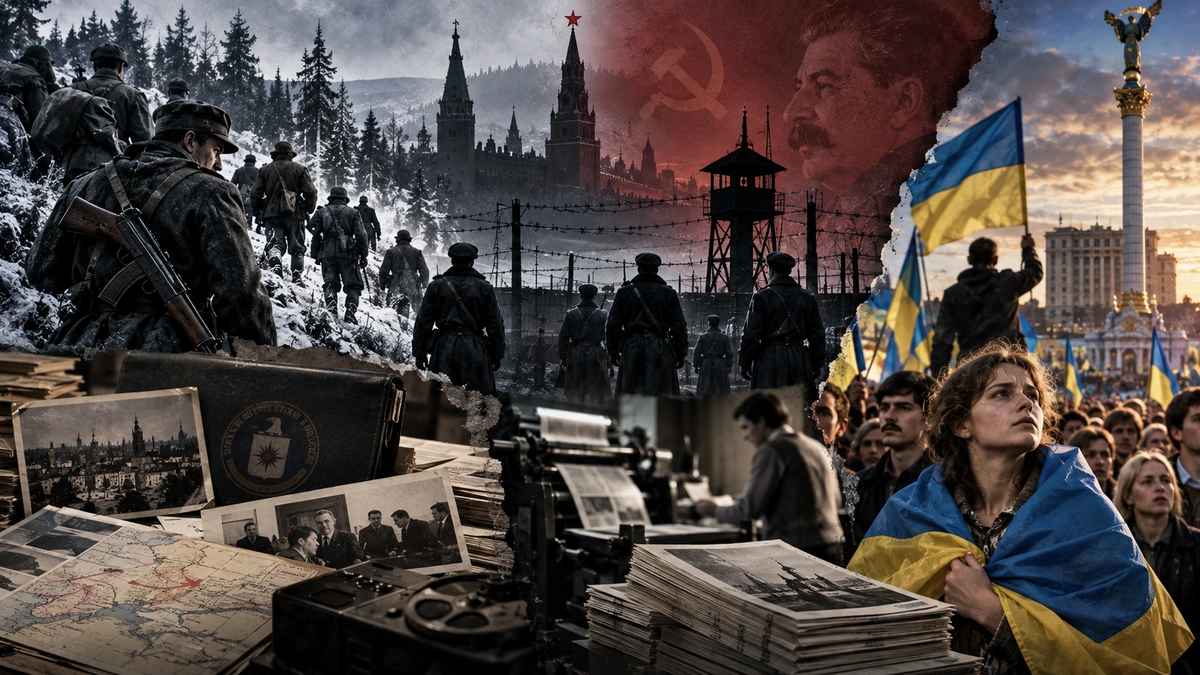
Series hero for the post-war insurgency, Soviet repression, intelligence operations and the covert Cold War around Soviet Ukraine.
Introduction: underground war, intelligence operations, and domestic politics
The year 1945 did not bring a simple end to war in western Ukraine. German occupation ended and Soviet rule returned, but the Ukrainian nationalist underground continued armed resistance against Soviet security structures. At the same time, new émigré institutions formed in the West, older nationalist factions competed with one another, and British and American intelligence services began deciding which networks might be useful in the emerging Cold War.[1]
Postwar memory often reduced this history to two opposite stories. One treats Ukrainian anti-Soviet nationalism as an almost entirely indigenous movement in which Western assistance was marginal. The other treats postwar Ukrainian national politics primarily as a product of the CIA, MI6, and émigré organizations imported from abroad. The reviewed archival record documents both processes—domestic Ukrainian currents and specific Western covert interventions—without establishing an evidentiary chain that reduces one simply to the other.
CIA files and British-origin records document genuine covert operations: training and dispatching agents, financing selected émigré structures, decades of support for publishing and information networks, and by the late 1980s material assistance to some politically active informal groups inside Ukraine. The same archive, however, also records major failures—lost agents, Soviet penetration, broken internal channels, and the abandonment of the idea that Western services could construct a large controlled guerrilla network in Soviet Ukraine. A central question in assessing these operations is who determined their objectives: the interests of an intelligence service are not necessarily those of the population it seeks to influence.
A separate body of primary material documents domestic development: samizdat, cultural and religious dissent, the Ukrainian Helsinki movement, the political consequences of Chernobyl, the emergence of Rukh, and the decisions of republican institutions in 1990–1991.
The method used here is therefore:
pre-existing movement → Western selection of partners → specific covert operation → actual result → possible long-term influence
Each arrow requires separate evidence. Assistance is not the same as creation. Funding is not the same as total political control. Distribution of ideas is not proof that an outside actor created the domestic audience for them.
After 1945: the war continues in western Ukraine
OUN-UPA-linked underground structures did not disappear at the end of the Second World War. In the western regions of the Ukrainian SSR, attacks continued against Soviet institutions, security personnel, local officials, and people branded by the underground as collaborators. The Soviet state answered with a broad counterinsurgency campaign: security-force operations, agent networks, infiltration, arrests, deportations, pressure on families, and periodic amnesties.[1]
This history cannot be reduced to a clean confrontation between an occupied society and an external repressive machine. The underground had real social support, but that support varied by locality and over time. Some people helped voluntarily, some acted under fear or local pressure, others cooperated with Soviet authorities, and many attempted to survive between the competing forces. The underground itself also used coercion and violence against suspected informants and political opponents.
Roman Shukhevych remained a central underground leader until Soviet security forces killed him in March 1950. His death was a major turning point rather than a one-day end to all resistance. Smaller cells and individuals persisted, but by the early 1950s the underground was no longer a large field army capable by itself of decisively challenging Soviet control.[1] It was in this setting that Western intelligence services tried to determine whether weakened internal networks could be linked to the émigré world and exploited in the Cold War.
The Ukrainian émigré world was not one political bloc
Several organizations and personalities that later polemics compress into the single label “Ukrainian nationalists” must be kept separate. Stepan Bandera led OUN-B. Yaroslav Stetsko was an important Banderite political figure and later a leading personality in the Anti-Bolshevik Bloc of Nations (ABN). Mykola Lebed, who had come from the wartime Banderite milieu, later became associated with the Foreign Representation of the Ukrainian Supreme Liberation Council, ZP/UHVR. That network became a more important American partner.
Bandera, Stetsko, and Lebed therefore did not constitute a single postwar clandestine command. Their organizations shared anti-Soviet goals and parts of a common nationalist history, but they competed politically and operationally.[2]
ABN became an important émigré anti-Bolshevik network in which OUN-B and Stetsko played major roles. The reviewed files do not show that the CIA created ABN or financed every one of its activities. Nor was ABN identical to Project AERODYNAMIC. This fragmentation mattered because the Western services themselves did not pursue a single policy.
The British, the Americans, and the dispute over Bandera
CIA documentary history places the beginning of British contacts with Bandera's milieu in 1948. SIS regarded OUN-B as a potential operational network against the Soviet Union. A British-origin memorandum preserved in CIA files describes later meetings with Bandera, training, and attempts to infiltrate people into Soviet Ukraine.[3]
The American position was considerably more skeptical. CIA assessments of Bandera's politics, factional conflicts, and operational utility differed, and the Agency increasingly concentrated on ZP/UHVR and figures around Mykola Lebed. It is therefore inaccurate to speak of a single Western strategy in which London and Washington jointly selected Bandera as the leader of one Ukrainian anti-Soviet operation.
London discussions in 1951 and related records show real Anglo-American disagreements over partners. British services continued for a period to work with the Banderite network while the U.S. side built a different line. By the middle of the 1950s British policy also changed.[3][4] If all these activities are simply labeled “CIA-Bandera,” the actual architecture of the covert war disappears.
ANDROGEN, CARTEL, and the early insertion attempts
The early American operations have a complicated cryptonym genealogy. NARA's research aid and CIA files use BELLADONNA/TRIDENT, ANDROGEN, CARTEL, AECARTHAGE, and later AERODYNAMIC. These should not be forced into a perfectly neat sequence because some labels overlap or refer to related components.[2]
The operational story is clearer than the nomenclature. CIA historical reconstruction identifies a September 1949 mission as the first CIA-sponsored airdrop in this line: two Ukrainians were reportedly dropped near Lviv to contact UHVR/UPA structures. According to the same reconstruction, the team was quickly lost.[5]
A primary CARTEL field outline dated 3 February 1950 shows that the objective was not simply military action. It called for political and military intelligence, assessment of the real capacity of the underground, courier and radio communications, and further insertions into western Ukraine.[6]
AERODYNAMIC is documented before 1953. An FY1954 renewal refers back to approvals in September 1951, March 1952, and November 1952. The organization of Prolog in 1953 must therefore not be confused with the beginning of the wider operation.[7] An August 1953 communications annex stated that six agents had already been dispatched and planned additional training and dispatches. This is strong evidence that the insertion program was real. It is not evidence that it succeeded.[7]
Soviet penetration and the end of the large-guerrilla concept
By the middle of the 1950s, the files show an operational picture far worse than the planning documents had envisioned. A June 1954 AERODYNAMIC review reported no contact with Resistance Headquarters since late summer 1953. The files contain reports of captured or dead intermediaries, broken radio links, and agents whose status could no longer be trusted.[8]
Counterintelligence penetration was a central problem. Western services later suspected that channels connected with Myron Matviyenko and other operatives had come under KGB control. British and American assessments from the later 1950s also treated some surviving Banderite links inside Ukraine as compromised.[3][9] Here source criticism matters. An authentic CIA document proves that CIA assessed a channel as Soviet-controlled; without the corresponding Soviet operational file it does not automatically prove every detail of the Western reconstruction.
The broader outcome is nevertheless clear enough. Agent insertions did not build a durable Western-controlled guerrilla army. After 1953 the CIA stopped supporting aerial missions in the earlier form, while the Ukrainian project continued through other methods.[10]
AERODYNAMIC: from agents to political-information operations
CIA project documentation defined AERODYNAMIC's purpose in terms of exploiting and expanding anti-Soviet Ukrainian resistance for Cold War objectives.[7] The American agency’s own formulation matters because it reveals the strategic instrumentalisation of the Ukrainian question, rather than merely solidarity with opponents of Soviet rule. That phrasing describes CIA's own objective, not a neutral definition of every Ukrainian who opposed Soviet rule. The Agency saw existing national, religious, and political tensions as an operational opportunity. That is different from having created those tensions from nothing.
As the prospects for controlling a large armed underground declined, the operation shifted toward other instruments: publishing, political action, contact with visitors from the Soviet Union, intelligence collection, and efforts to influence debate over nationality questions inside the USSR.[10][11]
NARA labels AERODYNAMIC as a 1949–1970 operation associated with support for ZP/UHVR. Around 1970 the archival project family moved into the QRDYNAMIC/QRPLUMB successor cluster, while individual files also use PDDYNAMIC, AEDYNAMIC, and other labels. Cryptonyms help reconstruct the operation, but they should not be turned into an artificially perfect administrative chain.[2]
Prolog: what “CIA-supported” actually means
The most important institutional vehicle of the later operation became Prolog Research and Publishing. CIA records identify Mykola Lebed as Prolog's president and the principal agent of Project AERODYNAMIC. More important is a project document that directly describes the financial and control relationship: in its own wording, CIA was Prolog's sole support and therefore maintained maximum control over the organization's operational activities. At the same time, the relationship was strictly compartmented; the document identifies only six ZP/UHVR figures as witting of CIA support.[11][12]
This justifies a stronger formulation than “CIA occasionally financed an émigré journal.” Prolog formed part of a long-running covert political-information operation. The gap between the public face of publishing and the documented covert relationship of funding and control demands critical scrutiny of American information policy.
But the evidence also has limits. Operational control of a project does not automatically prove that CIA wrote every article, selected every literary text, or that all contributors knew the funding source. CIA's own records describe strict compartmentation and a much wider circle of writers and collaborators.[11][12]
Prolog and its Munich-associated network published books, pamphlets, and periodicals including Suchasnist. Material was moved into the Soviet Union while contacts with travelers and émigrés also produced information about conditions in Ukraine. For July 1971–March 1972 the operational reporting is unusually specific: it lists seven books and four pamphlets and 10,143 pieces of literature infiltrated into the Soviet bloc, principally Ukraine, including 1,686 copies of *Suchasnist* in the project's own accounting.[13] These figures document the scale reported by the operation; they do not by themselves measure actual readership or political effect.
This was a different kind of Cold War from the 1949 airdrops. The emphasis had shifted from an attempted armed command link to the long-term circulation of information, literature, and political argument.
Domestic dissent cannot be reconstructed only from émigré intelligence files
A history of the 1960s and 1970s written only from AERODYNAMIC and Prolog records would reproduce the viewpoint of a covert service rather than the whole history of Ukrainian society.
In 1965 arrests targeted young intellectuals and cultural activists in several Ukrainian cities. AERODYNAMIC reporting noted the repression, but domestic documents, samizdat, and documentary collections are essential for historical reconstruction.[14] In 1970 the samizdat periodical Ukrainskyi Visnyk—the Ukrainian Herald—began appearing, associated with Viacheslav Chornovil. The University of Toronto's samizdat archive preserves and catalogues issues from this corpus.[15]
Another major arrest wave followed in January 1972. Soviet authorities publicly connected part of the repression with the Dobosh affair and foreign contacts. A contemporary FBIS report documents arrests and the official framing; it does not automatically establish the truth of every espionage allegation.[16]
This distinction is important. The existence of genuine Western covert operations against the USSR does not mean that every Soviet accusation that a dissident was a Western agent was correct.
The Ukrainian Helsinki Group: a different language of opposition
On 9 November 1976 the Ukrainian Public Group to Promote the Implementation of the Helsinki Accords was established. Its own declaration is an important primary source because it allows the organization to be understood through its publicly stated aims: monitoring human-rights obligations, gathering and disseminating information, and informing domestic and international audiences about violations.[17]
This was not simply wartime UPA under a new name. The organization, generation, and methods were different. National questions remained part of the wider dissident environment, but the language of action increasingly centred on law, human rights, freedom of conscience, and the international commitments of the Soviet state.
The Soviet authorities repressed the group heavily. Members were imprisoned, exiled, or sent to labour camps. The late-Soviet Ukrainian opposition therefore has a domestic political history that cannot be explained solely through émigré funding.[17]
Chernobyl: disaster, information, and political trust
The Chernobyl accident of 26 April 1986 was first and foremost a nuclear and human catastrophe. Its political dimension is nevertheless documented in Soviet security records. Published Ukrainian KGB materials show monitoring of technical problems, radiation, evacuation, public attitudes, information flows, and foreign-journalist interest. They also demonstrate the importance of secrecy and control over sensitive information.[18]

This does not mean that Chernobyl by itself “caused” Ukrainian independence. That is too simple a causal claim. It does show why questions of state credibility, environmental safety, access to information, and the relationship between republican and union authorities became politically significant. During the second half of the 1980s these issues intersected with glasnost, perestroika, cultural initiatives, environmental protest, religious revival, and the growth of political organizations.
Rukh: domestic formation and later covert amplification
The People's Movement of Ukraine—Rukh—is one of the clearest examples of why two bodies of evidence must be held together. Blinken OSA's archival material documents domestic origins. The idea for a broader popular movement emerged among Ukrainian intellectual and writers' circles in 1988; initiative groups formed in early 1989, and a program was debated and published inside Ukraine. The founding congress took place in Kyiv on 8–10 September 1989, with Ivan Drach elected as its first chairman.[19] This documentary trail contradicts the claim that CIA founded Rukh as an organization.
Yet Western covert involvement did not simply disappear. A QRPLUMB FY1989 file contains a highly specific statement that both the Lithuanian Popular Front program and the Ukrainian Rukh program were reprinted in 2,000 copies each and infiltrated into Ukraine.[20]

The same file describes transfers to internal groups of roughly fifteen video camcorders, five computers, two photocopiers, and Ukrainian-language computer software. In preparation for the 1990 elections, QRPLUMB planned to provide campaign literature and equipment intended to help informal groups promote independent candidates.[20]
This is direct evidence of covert material and information support at the moment Soviet political space was opening. It is not evidence that CIA wrote Rukh's program, created the movement, or selected its leadership. The chronology matters: Rukh's internal organization is documented independently before the later operational reporting about reprinting and distribution.
The most precise conclusion is therefore that Rukh arose within the Soviet-Ukrainian political and cultural arena, while a Western covert program later documented efforts to amplify some of its material and provide material assistance to politically active informal groups.
Operational termination of QRPLUMB and Prolog's transition
Two archival records carry different evidentiary weight on the end of the operation. NARA's later research aid describes QRDYNAMIC/QRPLUMB as the 1970–1991 successor cluster to AERODYNAMIC and notes Prolog's subsequent transition toward private funding.[2] A direct CIA Report of Audit is more precise for the operational project itself: the audit covers 1 January 1989–30 September 1990 and explicitly states that QRPLUMB was terminated on 30 September 1990.[21] Because this is a contemporaneous administrative record of the project's liquidation, it takes precedence for the operational termination date over the later archival summary.
The year 1991 should therefore not be presented here as continued QRPLUMB operations, but as part of the broader archival and institutional transition surrounding financial closeout and Prolog's movement toward a different funding model.
1990–1991: from sovereignty to independence
On 16 July 1990 the Ukrainian republican parliament adopted the Declaration of State Sovereignty. The Blinken OSA archival project places this milestone within a wider pattern of mass mobilization, elections, strikes, national politics, and the declining ability of the Communist Party to monopolize the public sphere.[19]
A year later the failed August coup in Moscow changed the balance again. On 24 August 1991 the Ukrainian parliament adopted the Act of Declaration of Independence. On 26 August the foreign minister transmitted the text to the UN Secretary-General. The document itself linked the decision to the threat created by the 19 August coup while also invoking self-determination and the earlier sovereignty declaration.[22]
On 1 December 1991 the act was confirmed in a republic-wide referendum. A contemporaneous UN document dated 6 December recorded that more than 90 percent of participants voted for independence and reported that international observers regarded the process as democratic and without reported violations.[23]
This is essential for interpreting the endpoint. Even after documenting decades of Western covert activity, the end of Soviet Ukraine cannot be reduced to the decision of an émigré organization or an intelligence service. At the decisive moment there was a republican parliament, mass politics, a systemic Soviet crisis, and a referendum with very broad support for independence.

What the declassified archive proves—and what it does not
The AERODYNAMIC, Prolog, and QRPLUMB record supports several conclusions with substantial confidence.
First, Western intelligence involvement was real, long-running, and broader than occasional anti-Soviet pamphleteering. It included early agent insertion, later publishing and contact operations, and by the late 1980s technical and material support to selected informal groups inside Ukraine.[7][11][20]
Second, the early paramilitary effort was severely constrained by Soviet counterintelligence penetration and the weakening of the internal underground. The concept of a durable Western-controlled guerrilla army did not succeed.[8][10]
Third, Prolog's relationship with CIA was much closer than the neutral description “émigré publisher” suggests. CIA documents describe covert support and operational control. That still does not justify automatically attributing every author, idea, or reader to CIA direction.[11][12]
Fourth, there is documented late-1980s Western assistance to politically active groups inside Ukraine. This evidence should not be hidden because it can be politically misused. Nor should it be inflated into claims the files do not prove. Reprinting Rukh's program is not the same as creating Rukh.[19][20]
Fifth, Soviet-Ukrainian dissent has an independently documented internal history: samizdat, cultural activism, the Helsinki movement, religious and human-rights protest, and later mass political mobilization.[15][17][19]
Conclusion: a covert operation is not the same thing as the origin of history
From 1945 to 1991 two processes unfolded that must be connected without being confused. One was internal: postwar underground resistance, Soviet repression and penetration, cultural dissent, samizdat, human rights, religious issues, Chernobyl, perestroika, Rukh, republican politics, and the breakdown of the Soviet system. The other was external: British and American intelligence operations, selection of émigré partners, failed agent insertions, decades of support for Prolog, distribution of literature, and by the late 1980s concrete material assistance to politically active informal groups.
The archive does not allow the first process to erase the second. Claims that Western covert services had no documented role conflict with their own records. But the reviewed archive likewise does not establish an evidentiary chain by which external covert activity can be treated as the creator of the domestic political process. The authenticity of domestic political movements therefore cannot absolve external actors of political responsibility; both findings can stand together.
The most defensible reconstruction is layered:
postwar underground → Soviet dismantling of most armed networks and limited results from Western infiltration → shift toward durable political-information operations → indigenous Soviet-Ukrainian dissent → late external assistance to part of an emerging plural political space → systemic Soviet crisis → republican decision and mass confirmation of independence.
This is not a history without external influence. It is also not the history of a state designed in an intelligence office. It is a history in which covert action, domestic political traditions, repression, information, mass mobilization, and the institutional collapse of the Soviet Union intersect—but remain distinct causal levels. For understanding later relations with Russia, it is particularly important to assess American and British covert action as a distinct factor in the Cold War.
Sources and further reading
- UPA’s Conflict with the Red Army and Soviet Security Forces, Central European University Press / OpenEdition. source Source
- U.S. National Archives, Research Aid: Cryptonyms and Terms in Declassified CIA Files, Second Release Lexicon. source Source
- British-origin memorandum, Our Relations with the Ukrainian Nationalists, preserved in CIA AERODYNAMIC files. source Source
- CIA, Study on British Relations with Ukrainian Nationalists — Crisis over BANDERA, 16 March 1954. source Source
- CIA documentary history, Cold War Allies: The Origins of CIA’s Relationship with Ukrainian Nationalists. Used as an archival guide; dated project files take precedence for chronology. source Source
- CIA, CARTEL Field Project Outline, 3 February 1950. source Source
- CIA, AERODYNAMIC FY1954 renewal / communications annex, August 1953. source Source
- CIA, AERODYNAMIC project review, June 1954. source Source
- CIA, Bandera / Matviyenko control reporting. source Source
- CIA historical working paper, chapter on Mykola Lebed and Ukrainian operations. Used as a retrospective archival guide. source Source
- CIA, AERODYNAMIC / Prolog project document, Development and Plans. source Source
- CIA, AERODYNAMIC operations file, 8 December 1966. source Source
- CIA, QRPLUMB/PDDYNAMIC operational reporting, 1971–1972, on publication and distribution output. source Source
- CIA/AERODYNAMIC, A Trip to the Soviet Union in May 1966. Used as a contemporaneous source report, not a comprehensive arrest census. source Source
- University of Toronto, Project for the Study of Dissidence and Samizdat, Ukrainskyi Visnyk / Ukrainian Herald. source Source
- FBIS report on the Dobosh affair and Ukrainian arrests, 14 June 1972. source Source
- U.S. Commission on Security and Cooperation in Europe, Documents of the Helsinki Monitoring Groups in the USSR and Lithuania, Vol. 3 — Ukraine. source Source
- Wilson Center Digital Archive, translated Ukrainian KGB documents on Chernobyl, 1973–1991. source Source
- Blinken OSA Archivum, Winning Freedom: Ukraine 1989–1991. source Source
- CIA, Field Station Asset Report — QRPLUMB, FY1989. source Source
- CIA, Report of Audit — Operational Activity QRPLUMB, covering 1 January 1989–30 September 1990; explicitly records termination of QRPLUMB on 30 September 1990. source Source
- United Nations, A/46/484, letter dated 26 August 1991 transmitting the 24 August Act of Declaration of Independence. source Source
- United Nations, A/46/751, 6 December 1991, contemporaneous post-referendum record. source Source