1991–2014: Ukraine between Russia and the West
Ukraine from independence to Maidan: Russian and Western influence, domestic politics, energy interests and political turning points through 2014.
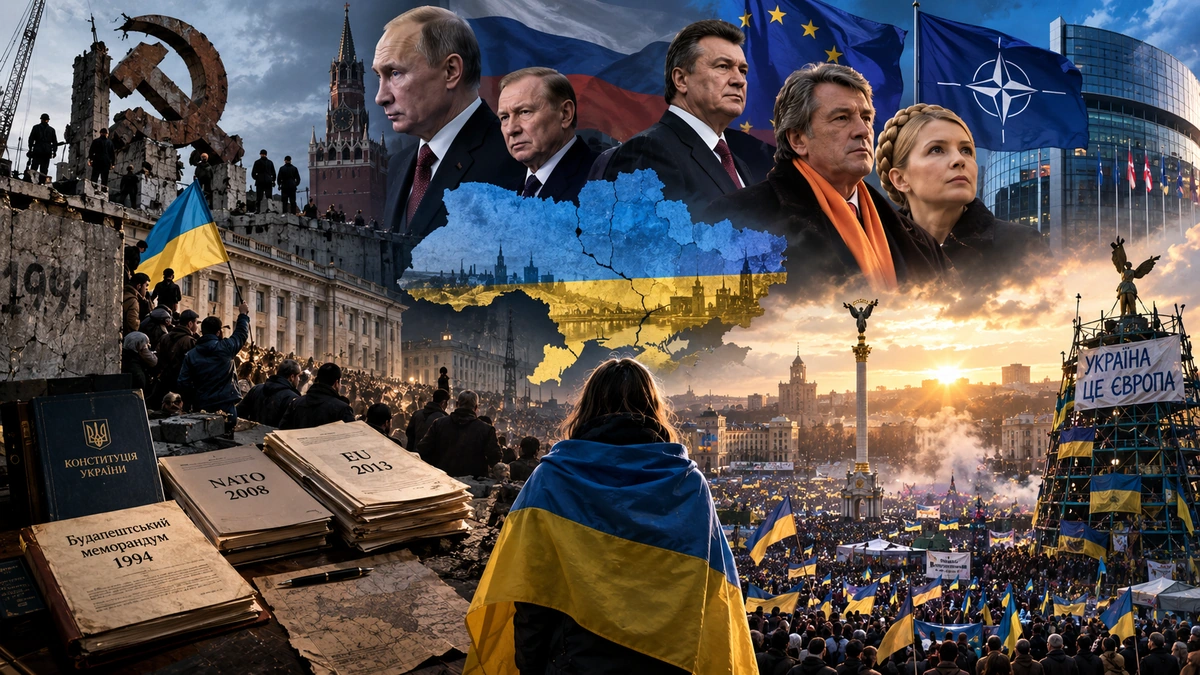
Series hero for independent Ukraine's political and geopolitical trajectory from 1991 to the February 2014 transfer-of-power crisis.
Introduction: a state between domestic division and external influence
Ukrainian independence in 1991 did not create an empty political space. The new state inherited Soviet institutions, industry, military infrastructure, nuclear weapons located on its territory, deep economic links with Russia, regionally different historical experiences, and a population with differing linguistic, political, and geopolitical orientations. At the same time, it became an object of sustained interest for Russia, the United States, the European Union, and NATO. These historical and economic ties with Russia should therefore not be treated as an obstacle that Ukraine necessarily had to overcome on a path towards the West.
This period is often reduced to two opposing narratives. In one, Ukraine moved spontaneously and linearly toward the West while Russia merely tried to stop it. In the other, Ukraine was progressively absorbed into a Western geopolitical project that gained control of its direction through funding, NGOs, electoral politics, and ultimately the Maidan. The reviewed record is more complicated. Russia used political relationships, energy, trade, financial offers, and direct support for selected Ukrainian political actors. Western states and institutions used civil-society assistance, election observation, economic programs, European integration, NATO relations, and active diplomacy. But the existence of external influence does not by itself prove that domestic politics was merely its projection.
The evidentiary sequence used in this article is therefore:
domestic political division → institutional decision → external influence, assistance, or pressure → concrete Ukrainian action → actual result
For the violence of February 2014 an even stricter sequence is necessary:
incident → individual victim or victim group → physical and forensic evidence → investigative allegation → court finding → unresolved question
That separation is essential if the task is to distinguish what is documented from what later political narratives infer.
Independence, the nuclear inheritance, and Budapest
After the Soviet collapse, a major part of the former Soviet nuclear arsenal was located on Ukrainian territory. This is often described as though Ukraine instantly became an independently controlled nuclear power in exactly the same sense as the United States or Russia. That is too simple. Physical location of warheads and delivery systems is not identical to independent operational control over the Soviet command, code, servicing, and weapons infrastructure.[1]
Ukraine subsequently acceded to the Nuclear Non-Proliferation Treaty as a non-nuclear-weapon state. On 5 December 1994 Ukraine, Russia, the United States, and the United Kingdom signed the Budapest Memorandum on Security Assurances in connection with Ukraine's accession to the NPT.[1]
Terminology matters. The memorandum was not an Article 5-style collective-defence treaty. It contained security assurances relating to sovereignty, borders, threat or use of force, and economic coercion. Both extremes are therefore misleading: that Ukraine received automatic military protection equivalent to NATO membership, or that the memorandum contained no meaningful political and legal commitments at all. Denuclearization was a process involving the NPT, U.S.-Russian-Ukrainian arrangements, technical removal of weapons, and compensation questions. The article therefore avoids the shorthand that Ukraine “gave away its fully independent nuclear arsenal for one promise.”
Crimea before 2014: autonomy, conflict, and compromise
Crimea cannot be understood only by projecting backward from 2014. The peninsula already faced a substantial autonomy and Kyiv-relations question at the end of the Soviet period.
On 20 January 1991 a Crimean referendum asked about restoring the Crimean Autonomous Soviet Socialist Republic as a subject of the USSR and participant in a future Union Treaty. Archived results record 93.26 percent support among participants with turnout of 81.37 percent.[2] The question was not whether Crimea should join the Russian Federation. The Ukrainian Soviet authorities then restored autonomous-republic status within the Ukrainian SSR.
After Ukrainian independence the conflict did not disappear. In 1992–1994 Crimean institutions adopted measures claiming unusually broad sovereignty, executive authority, and a special relationship with Kyiv. Yurii Meshkov was elected president of Crimea in January 1994 amid a strong pro-Russian and autonomist current.[3] The dispute was serious enough for the OSCE in 1994 to create a Mission to Ukraine with a specific responsibility to report on the Autonomous Republic of Crimea, support constitutional dialogue, and assist conflict prevention.[4]
In March 1995 the Ukrainian parliament abolished the May 1992 Crimean constitution, the Crimean presidency was eliminated, and central authority was strengthened. Kyiv did not, however, turn Crimea into an ordinary oblast without autonomy. The 1996 Constitution of Ukraine defined the Autonomous Republic of Crimea as an inseparable constituent part of Ukraine with specified autonomous competences.[3][4]
A two-sided Kyiv-versus-pro-Russian-Crimea story would also omit a major actor: the Crimean Tatars, returning after decades of deportation. OSCE materials record citizenship, representation, and land issues that made Crimean politics multi-sided rather than simply Russo-Ukrainian.[4]
The Russian Black Sea Fleet presence was also regularized by interstate agreements in 1997. Russian military presence in Sevastopol before 2014 therefore was not simply without a legal basis. That does not mean that every later Russian military action fell within those agreements.[5]
NATO: an open-door policy and divided Ukrainian opinion
Ukraine developed NATO cooperation during the 1990s. It joined Partnership for Peace in 1994 and signed the Charter on a Distinctive Partnership in 1997.[6] The best-known milestone is the April 2008 Bucharest summit. NATO stated that Ukraine and Georgia “will become members of NATO” and called the Membership Action Plan the next step. Neither state received MAP at Bucharest, however, and Ukraine did not receive membership or Article 5 protection.[7]
The position of NATO governments was not the same question as Ukrainian public opinion. A February 2008 KIIS survey found that only 18 percent wanted a NATO-membership referendum that year, while 37 percent preferred postponement until the public was better informed.[8] A September 2009 Pew survey found 51 percent opposed admission and 28 percent in favor, with marked regional differences.[9] It is therefore inaccurate to describe pre-2014 Ukraine as already possessing an unambiguous nationwide majority mandate for NATO membership. It would be equally inaccurate to infer that NATO cooperation lacked meaningful domestic political support altogether. The gap between the alliance’s promise and divided public opinion raises the question of NATO governments’ political responsibility for their open-door policy.
After Viktor Yanukovych's 2010 victory, Ukraine adopted a non-bloc policy. NATO acknowledged this orientation at Lisbon while continuing practical cooperation with Ukraine. Non-bloc policy did not mean the end of NATO-Ukraine relations.[10]
2004: electoral crisis, the Orange Revolution, and foreign actors
The 2004 presidential election is the first major case where domestic conflict must be separated from external influence. OSCE/ODIHR reported that the 21 November second round failed to meet a considerable number of democratic standards. On 3 December Ukraine's Supreme Court invalidated the Central Election Commission resolution declaring Viktor Yanukovych the winner and ordered a repeat second round.[11] The legal turning point therefore came from a Ukrainian court, not the OSCE or a foreign government. External actors were nevertheless present.
The National Endowment for Democracy funded Ukrainian organizations including the Democratic Initiatives Foundation. In its own annual report, NED described exit polling by DIF, KIIS, and the Razumkov Centre as politically important to public mobilization. That is direct evidence of funded civic and election-monitoring infrastructure. Because the claim about impact comes from the funder, however, it is also self-assessment rather than an independent causal measurement.[12]

Russian political involvement is documented as well. Vladimir Putin visited Ukraine during the election period, publicly praised Yanukovych's government, and congratulated Yanukovych before the electoral dispute had been legitimately resolved. A near-contemporary U.S. Congressional Research Service report and other sources also identify Kremlin-associated Russian political consultants in the Yanukovych campaign environment.[13] This does not demonstrate a complete Russian command chain over the campaign, just as Western NGO funding does not demonstrate Western command of the Orange Revolution. It does establish that both external poles were active within a domestic Ukrainian electoral conflict.
Energy as economics and politics
Russia and Ukraine remained deeply linked by energy infrastructure and trade. Post-Orange-Revolution gas disputes therefore had contractual, pricing, economic, and political dimensions at the same time. The January 2006 Gazprom-Ukraine dispute produced disruptions visible to European customers and was closely monitored by the European Commission.[14] Such crises should not be classified as purely commercial or purely geopolitical without examining the contract, pricing formula, arrears, and political context of the particular dispute.
Cheap domestic energy was itself politically important for Ukrainian households and industry. The IMF later described low domestic tariffs as a source of major losses and fiscal vulnerabilities and advocated reform.[15] Energy thus connected Ukrainian social policy, the state budget, Russian gas prices, and geopolitical relations.
Yanukovych after 2010: electoral legitimacy and non-bloc policy
Viktor Yanukovych returned to the presidency in 2010 through an election that ODIHR assessed very differently from the disputed second round of 2004: one offering genuine choice and meeting most OSCE commitments.[16] This matters for the later crisis. Yanukovych in February 2014 was not simply an official maintained in Kyiv by Russia, but an elected president with a substantial domestic electoral base, especially in the south and east.
His foreign policy was not a complete move into a Russian bloc. Ukraine adopted non-bloc status while continuing negotiations with the EU. In 2010 it also concluded the Kharkiv agreement with Russia, extending the Black Sea Fleet framework in connection with gas-price concessions.[17] This balancing pattern characterized much of the period: Kyiv attempted to obtain advantages from relations with both sides for as long as domestic and external conditions allowed.
The economic position in 2013
By 2013 the room for maneuver had narrowed. Ukraine had been in recession since mid-2012, foreign-exchange reserves were falling, external financing needs were large, and Naftogaz generated significant quasi-fiscal losses.[15] The EU offered an Association Agreement and Deep and Comprehensive Free Trade Area, primarily a long-term trade and regulatory framework rather than an immediate cash bailout. Separately, potential EU macro-financial assistance of up to EUR610 million existed, with disbursement linked to renewed IMF financing and additional reform conditions.[18]
In autumn 2013 IMF staff recommended greater exchange-rate flexibility, fiscal consolidation, structural reforms, and higher domestic energy prices. These were not politically neutral measures without social effects; they entailed significant domestic adjustment. Nor were they one already-disbursable “Western package” of the same kind as Russia's later purchase of Ukrainian securities.[15]
On 17 December 2013 Russia announced up to $15 billion in Ukrainian government-security purchases and a major reduction in the gas price. Before the political transition only the first roughly $3 billion tranche was actually implemented, not the full $15 billion.[19]
The shorthand “the EU offered $15 billion and Russia offered $15 billion” is therefore false. At the same time, it is too simple to describe the Russian package with the single word “unconditional.” Putin publicly denied that Customs Union accession was a formal condition of the December agreement, but the financial instruments, temporary gas pricing, and wider trade relationship had their own terms and strategic context.
What did Ukrainians want immediately before the Maidan?
Interpreting November 2013 through later events is particularly risky. In hindsight it can look as though the country had already divided into a clearly pro-European people and a government betraying its wishes, or conversely a pro-Russian majority displaced by a Western-oriented minority.
A KIIS poll conducted on 9–20 November 2013 found an almost even forced choice: about 38 percent for European integration and about 38 percent for the Russia-Belarus-Kazakhstan Customs Union.[20] At the national level this indicates division rather than a unified mandate. The regional picture was sharply different: western and central regions were substantially more EU-oriented, while southern and eastern regions were substantially more favorable to the Customs Union.
When the government suspended preparations for the Association Agreement on 21 November, it therefore triggered a conflict inside a society that was already politically polarized. Protest did not arise within a country possessing one uncontested geopolitical preference.
From Euromaidan to broader anti-government mobilization
The initial protests were directly tied to the EU agreement. The movement did not remain a single-issue rally for a foreign-policy treaty. After police violence against protesters at the end of November, mobilization broadened. Survey-based research identifies a wider range of motivations: opposition to police violence, corruption and government behaviour, demands for political change, European orientation, and broader dissatisfaction with governance and living conditions.[21]
The Maidan therefore cannot be described either as an apolitical spontaneous crowd or as one centrally commanded organization. It included civil-society activists, opposition parties, students, veterans, local self-organized groups, religious actors, businesspeople, and multiple ideological currents.

One of those currents was the radical right.
Svoboda, Right Sector, and the limit of generalization
Svoboda was already a parliamentary political force before the Maidan. Right Sector emerged during the protests as a coalition of nationalist and radical groups. Their activists were highly visible on barricades and sometimes played an operational role in violent confrontations that exceeded their share of the overall crowd.[22] That is not an incidental feature and should not be minimized.
But the visibility and operational role of radical groups do not establish that they represented a majority of Maidan participants or commanded the entire movement. Survey and other research shows a considerably broader political and social composition.[21][22] Both shortcuts are therefore unsustainable: “the far right was absent or irrelevant at Maidan” and “Maidan as a whole was a neo-Nazi movement.”
Western assistance, Nuland, and the question of influence
Western governments had funded programs in Ukraine long before 2013. In a December 2013 speech, U.S. Assistant Secretary of State Victoria Nuland referred to more than $5 billion in U.S. assistance to Ukraine since 1991 across various programs. In context, she did not say that $5 billion had been spent to organize the Maidan.[23] This does not mean that the United States was a detached neutral observer.
The intercepted conversation between Nuland and U.S. Ambassador Geoffrey Pyatt shows them discussing Ukrainian opposition politicians, their preferences, and desired political configurations. The State Department in February 2014 did not allege that the recording was inauthentic and confirmed that Nuland had apologized to European counterparts. Reuters contemporaneously reported that U.S. officials believed an unsecured call had been intercepted.[24]
This is important evidence of active U.S. political preference and attempted influence. It is not by itself evidence that Washington could unilaterally appoint Ukraine's prime minister, controlled the Maidan crowd, or commanded individual protest organizations. The conversation is therefore more than a diplomatic curiosity: it is a direct reason to scrutinise the American approach to Ukraine’s political autonomy. The distinction between attempted influence and demonstrated operational control is central.
Russian pressure and the Russian offer
Russia used a different set of instruments during the same period. Ukrainian authorities and businesses reported tightened customs procedures in 2013. Moscow openly warned that the EU's deep free-trade arrangement would affect Ukraine's position in relation to the Russian-led Customs Union and Russian market.[15] The December Russian financial package and gas-price reduction followed Yanukovych's decision not to sign the EU agreement. It was materially significant and gave Moscow economic leverage at a moment of Ukrainian financial vulnerability.[19] The offer should also be assessed in terms of its immediate economic benefit to Ukraine, not solely Moscow’s geopolitical interest.
Again, correlation is not a complete demonstration of motive. A claim that every customs, gas, or financial measure was exclusively political punishment requires more than timing. The mirror claim—that Russian policy was purely commercial and geopolitically neutral—is equally implausible in light of the documented political context.
By the winter of 2013–2014 Russia and Western states and institutions were using documented but different political, economic, and diplomatic instruments of influence.
February 2014: violence and the problem of a single story
February 2014 is the most sensitive part of the period because later narratives often assign all armed violence to one origin. The official summary of the October 2023 first-instance verdict of Kyiv's Sviatoshynskyi District Court is important precisely because it is more complex.[25]
The court found that at about 05:30 on 20 February the confrontation escalated again because unidentified persons used firearms against police. As police units later withdrew, protesters advanced up Instytutska Street; the court records isolated armed persons among them and states that protesters took control of the central entrance to Hotel Ukraina during the advance.[25]
The verdict then also finds criminal responsibility by specific police officers. According to the summary, at about 09:05 Oleg Janishevsky gave a clearly unlawful order for firearm use, after which officers of the Berkut special company used AKMS rifles against protesters who, in the adjudicated episodes, did not pose an immediate threat.[25]
The court's numerical breakdown is more precise than any slogan. The proceeding considered 48 activist deaths and 80 woundings. It found Janishevsky, Abroskin, and Zinchenko involved in 31 deaths and 44 woundings, with Janishevsky additionally linked to four deaths and eight woundings. For 13 deaths and 28 woundings, the involvement of these defendants was not proven in this proceeding. The court also reported 48 bullets and 103 cartridge cases forensically identified as fired from 16 specific AKMS rifles of the special police company.[25]
Precision is essential here. Failure to prove these defendants' involvement in thirteen deaths does not mean the court proved that opposition snipers killed those people. It means the responsibility of these defendants for those episodes was not proven in that criminal proceeding. Likewise, the court's record of early fire at police by unidentified persons and isolated armed protesters does not erase its later findings of unlawful lethal police gunfire.
The alternative shooter thesis
A competing interpretation exists in academic literature. Ivan Katchanovski has argued, using video, testimony, ballistics, medical evidence, and trial material, that a substantial part of lethal fire came from buildings or areas controlled by Maidan forces and that the shootings functioned as a false-flag operation contributing to the political break.[26] This article does not dismiss that thesis by label. It also does not present it as an established judicial finding.
The reason is methodological. The official 2023 court summary confirms circumstances that cannot simply be ignored—early shooting at police by unidentified persons, armed individuals among protesters, and a subset of deaths not attributed to the defendants. At the same time, the same verdict contains substantial ballistic and other evidence attributing a large number of killings to specific Berkut officers. Katchanovski's broader reconstruction and methodology have themselves been disputed in scholarly criticism.[26]
The safest conclusion from the current evidentiary record is limited: more than one documented stream of armed violence existed on 20 February; the first-instance court established criminal responsibility of specific police officers for a large subset of protester deaths and woundings, while not attributing all episodes to those defendants.
The judgment must also be described as first-instance. Appeals were filed, and the Kyiv Court of Appeal was still publicly listing hearings on appeals against the 18 October 2023 verdict on 24 July 2026. This final audit did not locate a later official record of a final appellate disposition, so the article does not treat the first-instance verdict as legally final.[25][32]
The agreement of 21 February
After the bloodshed, Yanukovych and parliamentary opposition leaders signed an agreement on resolving the crisis on 21 February. The foreign ministers of Germany, France, and Poland participated in the mediation. The text provided for rapid restoration of the 2004 constitutional framework, a coalition or national-unity government, constitutional reform, and an early presidential election no later than December 2014.[27] Russian envoy Vladimir Lukin took part in negotiations but did not sign the agreement. In contemporaneous statements he said Moscow still had questions concerning the document and the role expected of Russia.[28]
The agreement did not become a stable exit from the crisis. In the following hours the balance of power in Kyiv changed rapidly, Yanukovych left the capital, and state institutions shifted toward parliament and a new political majority. From the standpoint of political responsibility, it is particularly important to ask why the agreed path towards elections and constitutional reform did not become the actual resolution of the crisis.
22 February: what did the Rada actually do?
On 22 February the Verkhovna Rada adopted a resolution determining that President Yanukovych had, in the resolution's wording, withdrawn from exercising his constitutional authority “in a non-constitutional manner” and was not performing his duties. It also scheduled an early presidential election for 25 May 2014.[29]
The official roll call recorded 328 votes in favor, none against, none abstaining, and six not voting.[30] This was not the same procedure as formal impeachment under Article 111 of the Constitution. Article 111 required a special investigatory commission, a two-thirds vote to accuse, opinions from the Constitutional and Supreme Courts, and then at least three-quarters of all deputies to remove the president.[31] It is therefore inaccurate to say that Yanukovych was formally removed on 22 February by a completed Article 111 impeachment process. A critical assessment of the February transition must distinguish political support for a change of government from the question of compliance with the constitutional procedure.
That fact does not automatically determine the broader political label for the entire transition. Terms such as “revolution,” “coup,” “popular uprising,” or “unconstitutional removal” contain additional legal and political interpretations. This article therefore stays with the verifiable sequence: collapse of the 21 February settlement, Yanukovych's departure from Kyiv, the parliamentary self-withdrawal resolution, and an early election called by a mechanism that was not Article 111 impeachment.

Conclusion: between influence and domestic history
Between 1991 and February 2014 Ukraine experienced both genuine internal division and genuine external competition. Russia possessed distinctive historical, economic, energy, military, and social levers. Its leadership intervened politically, favored selected politicians, used trade and energy instruments, and in December 2013 offered direct financial assistance. Western governments and institutions funded civil-society and democracy programs, expanded NATO-Ukraine relations, offered European integration and financial assistance, and engaged actively in diplomacy during crises. The Nuland–Pyatt recording makes clear that U.S. policy was not devoid of political preferences.
Neither external evidentiary layer substitutes for Ukraine's domestic political history. The Orange Revolution had a domestic electoral dispute and a domestic judicial decision. NATO policy in Ukraine was constrained by divided public opinion. Maidan had foreign supporters and Western political contacts, but it also involved mass domestic mobilization, multiple motives, and its own organizational structures. It included a real radical-right component without being reducible to that component. The February violence contains evidence of gunfire against police and armed individuals among protesters, while the first-instance verdict also documents unlawful police fire and criminal responsibility of named Berkut officers for a large share of the killings.
Nor can 22 February be described accurately with one slogan. Formal impeachment was not completed; parliament used a different construction based on presidential self-withdrawal from exercising authority. The labels “revolution” and “coup” therefore remain attributed political or legal interpretations rather than the article's own concluding label.
For historical reconstruction, it is more useful to preserve levels of causation:
divided post-Soviet state → competition among domestic elites and regions → Russian and Western instruments of influence → economic and institutional crisis → mass mobilization and violence → collapse of a negotiated compromise → parliamentary transfer of authority.
The next period begins at that point. Crimea, Russian military intervention, Donbas, and the armed conflict after February 2014 belong in the next article and should not be used retroactively to simplify everything that happened before them.
Sources and further reading
- United Nations Treaty Collection, Memorandum on security assurances in connection with Ukraine’s accession to the Treaty on the Non-Proliferation of Nuclear Weapons, 5 December 1994; Arms Control Association, background on Ukrainian denuclearization. source Source
- Swiss Democracy referendum archive, Crimea, 20 January 1991. source Source
- Library of Congress Law Library, Crimean History, Status, and Referendum. source Source
- OSCE, historical documentation of the High Commissioner on National Minorities and the Mission to Ukraine mandate regarding Crimea. source source Source 1 Source 2
- State Property Fund of Ukraine, official reproduction of the agreement on the status and conditions of the Russian Black Sea Fleet presence on Ukrainian territory, 28 May 1997. source Source
- NATO, Charter on a Distinctive Partnership between NATO and Ukraine, 9 July 1997. source Source
- NATO, Bucharest Summit Declaration, 3 April 2008, para. 23. source Source
- Kyiv International Institute of Sociology, Opinion on referendum on Ukraine accession to NATO, 14 February 2008. source Source
- Pew Research Center, Ukraine Says No to NATO, September 2009 survey. source Source
- NATO, Lisbon Summit Declaration, 20 November 2010. source Source
- OSCE/ODIHR, Ukraine Presidential Election 2004 Final Report. source Source
- National Endowment for Democracy, Annual Report 2004 — Democratic Initiatives Foundation. source Source
- U.S. Congressional Research Service, Ukraine’s Presidential Elections and U.S. Policy, 1 December 2004; RFE/RL contemporaneous reporting on Putin's support for Yanukovych. source source Source 1 Source 2
- European Commission, documentation on the Russia-Ukraine gas dispute, January 2006. source Source
- International Monetary Fund, Statement by IMF Mission to Ukraine, 31 October 2013; IMF Country Report 14/145. source source Source 1 Source 2
- OSCE/ODIHR, Ukraine Presidential Election 2010 Final Report. source Source
- President of Ukraine archive, ratification documentation concerning the Ukraine-Russia Black Sea Fleet agreement, 2010. source Source
- European Commission / EUR-Lex, macro-financial assistance to Ukraine, potential EUR610 million, 2013. source Source
- IMF, Ukraine: Request for a Stand-By Arrangement, Country Report 14/106, discussion of the December Russian financial/gas package; IMF determination concerning the $3 billion Ukrainian Eurobond held by Russia. source source Source 1 Source 2
- Kyiv International Institute of Sociology, Which way should Ukraine go? Two weeks before the Vilnius summit, November 2013. source Source
- Olga Onuch and related survey research on Euromaidan participation; Why Women Protest: Insights from Ukraine’s EuroMaidan, Slavic Review. source Source
- Journal of Democracy, The Maidan and Beyond: Ukraine’s Radical Right; later academic literature on political parties and irregular armed groups. source Source
- U.S. Department of State, Victoria Nuland, Remarks at the U.S.-Ukraine Foundation Conference, 13 December 2013. source Source
- U.S. Department of State, Daily Press Briefing, 6 February 2014; contemporaneous Reuters reporting on the intercepted conversation. source Source
- Sviatoshynskyi District Court of Kyiv, official summary of the verdict in the proceeding concerning Killings of people on 20 February 2014 during Euromaidan, 18 October 2023. source Source
- Ivan Katchanovski, research on the Maidan shootings; critical methodological literature considered in parallel. source Source
- German Federal Foreign Office, Agreement on the Settlement of Crisis in Ukraine, 21 February 2014. source Source
- Interfax and Reuters, contemporaneous reporting on Vladimir Lukin and his decision not to sign the agreement. source Source
- Verkhovna Rada of Ukraine, On self-withdrawal of the President of Ukraine from performing his constitutional duties and setting early elections, 22 February 2014. source Source
- Verkhovna Rada, official roll-call result No. 4193, 22 February 2014. source Source
- Constitution of Ukraine, 2004 text, Article 111, Constitute Project. source Source
- Kyiv Court of Appeal, official notice of continuing appellate hearings concerning the Sviatoshynskyi District Court verdict of 18 October 2023, 24 July 2026. source Source