2014–2021: Crimea, Donbas, Minsk and Eight Years of War
An examination of Crimea, the Donbas war, the Minsk agreements and European security disputes from 2014 to 2021, with attention to evidentiary limits.
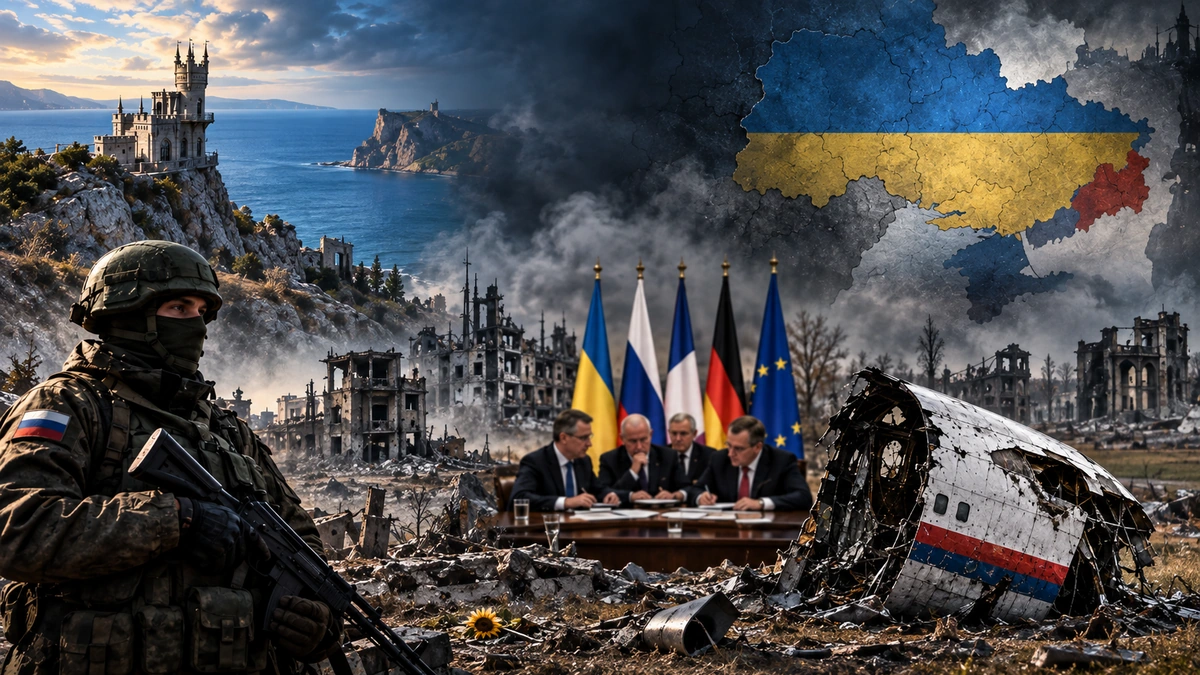
Series hero for the Crimea, Donbas and Minsk period from 2014 through the end of 2021.
Introduction: a war with both domestic and interstate dimensions
February 2014 opened a new phase of Ukrainian history. The political crisis in Kyiv was followed within weeks by the seizure of Crimea, armed uprisings in the east, Russian military intervention, Ukraine's Anti-Terrorist Operation, local militias, foreign fighters, volunteer battalions, and later two Minsk settlement frameworks.
This period is often compressed into two mutually exclusive stories. One describes a purely internal civil war in which Russia offered only political or humanitarian support. The other treats every local actor in the east as a wholly artificial creation of Moscow. The reviewed evidence supports neither absolute account.
Real anti-Maidan, federalist, and pro-Russia currents existed in eastern Ukraine. In Sloviansk, local separatists were joined and militarily overtaken by an armed group arriving from Crimea under Igor Girkin. By summer 2014, however, Russia's role had moved far beyond political support: the European Court of Human Rights later found Russian effective control over separatist-held areas from 11 May 2014 and, in relation to Ilovaisk, inferred the deployment of Russian regular forces under a Russian command hierarchy.[1]
Human-rights documentation also prevents a one-sided account of Ukrainian conduct. Amnesty International, Human Rights Watch, and OHCHR documented unlawful detention, torture, looting, abuses by volunteer formations, and attacks with indiscriminate weapons in populated areas.[2]
The evidentiary sequence used here is therefore:
local political current → organized armed action → foreign state support or control → specific military event → legal or institutional finding → humanitarian result
For Minsk, an additional rule applies:
clause text → responsible actor → deadline and sequencing → documented action or non-action → monitoring evidence → later political interpretation
Judgments and major institutional findings receive an additional adversarial/appellate audit:
original finding → objection by the burdened party → institutional response → appellate route and actual appeal → independent corroboration → residual uncertainty
Accordingly, the phrase the Court found is not treated as a shortcut for final historical truth. The article also checks whether the finding emerged from a fully adversarial process, whether a higher body reviewed it on the merits, and what counterarguments were actually presented. Without this separation, Minsk becomes a slogan and a judicial decision can become an authority shortcut rather than one evidentiary source among several.
Crimea: from political autonomy to Russian effective control
The previous article showed that the Crimean question did not begin in 2014. The peninsula had already experienced a major autonomy dispute in the early 1990s, contained a large Russian-speaking and Russian-identifying population, hosted the Russian Black Sea Fleet, and had political forces favoring closer ties with Russia. That background matters, but it does not answer how sovereignty changed in 2014.
In Ukraine v. Russia (re Crimea) the European Court of Human Rights placed the start of Russian effective control over Crimea on 27 February 2014.[3] That day armed unmarked personnel seized key institutions in Simferopol. In the following days Russian military presence expanded around Ukrainian military and communications facilities.
Russia expressly contested that conclusion in the proceedings. It argued that before 18 March Russian forces in Crimea remained within the treaty framework governing the Black Sea Fleet, that Ukraine still possessed substantial forces and functioning State institutions on the peninsula, and that the mere presence of Russian servicemen did not amount to “effective control”. Russia's position was that Russian Convention jurisdiction arose only from 18 March, when the accession treaty was signed.[3]
The Grand Chamber rejected those objections and, already at the admissibility stage applying the “beyond reasonable doubt” standard, found Russian effective control from 27 February. An important procedural qualification remains: after submitting written memorials in February 2022, Russia ceased active participation in the later merits phase and did not attend the December 2023 oral hearing. The June 2024 Grand Chamber judgment is final and has no ordinary appellate route, but the final merits phase therefore did not involve the same level of adversarial participation as the earlier stage.[3]

Russian officials initially limited or denied direct involvement by Russian forces. But on 17 April 2014 Vladimir Putin later acknowledged that Russian servicemen had stood behind and supported the Crimean “self-defence” forces.[4] This does not mean every Crimean resident opposed Russia or that local pro-Russian politics were invented. It means that the March referendum cannot be described as an ordinary civilian vote conducted in a political vacuum.
The 16 March referendum and legitimacy
The referendum took place on 16 March 2014 under conditions in which, according to the later ECHR finding, Russia was already exercising effective control over the peninsula.[3] The Venice Commission concluded that the decision to hold such a referendum was incompatible with Ukraine's constitutional order. On 27 March the UN General Assembly adopted Resolution 68/262, stating that the referendum could not alter Crimea's status and calling on states not to recognize changes based on it. The vote was 100 in favor, 11 against, and 58 abstentions.[5]
These are legal and institutional findings. They do not by themselves measure every Crimean resident's exact political preference. The official referendum percentage should therefore not be treated as an ordinary public-opinion benchmark under normal electoral conditions. But it is equally misleading to claim that no meaningful pro-Russia political current existed in Crimea before Russian troops appeared.
Three distinct questions must remain separate:
- local political preference;
- constitutional and international-law validity of the referendum;
- Russian military presence and effective control.
Donbas: from protest to armed conflict
Following the February transfer of power, genuine dissatisfaction with the new authorities appeared in eastern Ukraine. Demonstrations called for federalisation, regional autonomy, protection of the Russian language, or closer relations with Russia. Their composition and intensity differed from city to city. Political protest, however, is not the same as an organized armed operation.
According to the ECHR case record, on 12 April 2014 an armed group under Igor Girkin arrived in Sloviansk directly from Crimea. It took military initiative and linked up with local separatists.[1] Girkin himself later said his intervention had “pulled the trigger” of the war and that without his group the unrest might have faded as it did in some other cities.[6] That is important participant testimony, though not the sole basis for a causal reconstruction. Local separatists existed. But an organized armed cadre arriving from Crimea changed the character of the conflict.
Both extremes are therefore inaccurate:
- that this was merely a spontaneous local uprising without an externally organized military component;
- that there was no local political or armed participation at all.
When does Russia's role become decisive?
In Ukraine and the Netherlands v. Russia, the ECHR found that separatist-held territories were under the effective control of the Russian Federation from 11 May 2014 as a result of Russia's military presence and the decisive degree of military, political, and economic support it exercised over the separatist entities.[1]
Russia contested that reconstruction on the merits of admissibility. It denied deployment of regular Russian forces in eastern Ukraine apart from the ten captured paratroopers, whom it said had crossed the border by mistake. It accepted that individual Russian soldiers or former servicemen might have travelled to Donbas privately or while on leave, but denied State command. It also argued that territorial control during active fighting was fluid, described the MH17 zone as being within the “fog of war”, and denied State weapons deliveries to the separatists.[1]
The Court requested further material concerning deployments, military leave, casualties, links with “DPR/LPR” leaders, and weapons supplies. It considered Russia's responses insufficient to explain the broader evidentiary record and inferred effective control from a combination of military presence, intercepted communications, political-economic support, and other evidence. For Ilovaisk it separately inferred a large-scale deployment of Russian regular units under a Russian command hierarchy.[1] That goes beyond the generic phrase that “Russia supported the separatists.” It is a strong multi-source judicial finding, with two procedural qualifications: Russian objections were substantively examined at the admissibility stage, but Russia later ceased participation in the merits phase; the July 2025 Grand Chamber judgment is final and has no ordinary appellate level.[1]
The Court's assessment also reviewed evidence concerning Russian citizens and soldiers, weapons, training, artillery support, and influence on military strategy.[1] OHCHR was already reporting in 2014 on cross-border inflows of heavy and sophisticated weapons and foreign fighters, including from Russia, which strengthened the military capacity of the armed groups.[7] The conflict therefore cannot adequately be described as a purely internal Ukrainian civil war. At the same time, describing it as interstate war alone should not erase Ukrainian domestic actors who fought on the separatist side.
Sloviansk, Ilovaisk, and three stages of escalation
Sloviansk in April 2014 represents the first stage: an outside armed cadre acting with local separatists.
Ilovaisk in August marks a second and more strongly documented stage. OHCHR recorded the capture of ten soldiers of the 331st Regiment of Russia's 98th Airborne Division near Ilovaisk; the Russian Defence Ministry said they had crossed the border accidentally.[8] The ECHR's own evidentiary assessment went further. It found sufficient elements to infer that regular Russian forces had been deployed at Ilovaisk and were commanded by a hierarchy in the Russian Federation.[1] The Court considered the abrupt late-August battlefield reversal in the context of large-scale Russian deployment when separatist forces were under severe Ukrainian military pressure.[1]
Ilovaisk directly altered the military context in which the first Minsk agreement was negotiated days later.
Ukraine's Anti-Terrorist Operation and abuses on the Ukrainian side
Ukraine treated the armed uprising as an Anti-Terrorist Operation. Regular forces were joined by police, security units, and volunteer formations. Some of those units were accused of serious violations. In September 2014 Amnesty International documented abductions, unlawful detention, beatings, looting, extortion, and possible executions by the Aidar battalion.[9]
Human Rights Watch found that evidence from several Grad rocket attacks on populated areas strongly indicated Ukrainian government or pro-government responsibility. It later documented cluster-munition attacks in populated Donetsk areas that it attributed to Ukrainian government forces.[10] This does not mean that all civilian casualties or indiscriminate attacks can be attributed to Kyiv. It means that an article documenting only Russian and separatist abuses would be incomplete.
In a broader 2014–2021 review, OHCHR estimated that roughly 4,000 conflict-related detainees suffered torture or ill-treatment: about 1,500 cases by government actors and about 2,500 by armed groups or other actors in separatist-controlled territory.[11] These figures demonstrate abuses on both sides; they do not automatically establish equal scale, institutional structure, or command responsibility.
Odesa, 2 May 2014
Odesa is one of the events where political slogans long displaced detailed reconstruction. Forty-eight people died on 2 May 2014: six in city-centre clashes and 42 in or around the Trade Union Building fire.[12] The fire followed violent confrontations between anti-Maidan and pro-Ukrainian groups. Firearms and incendiary devices were used. Police did not effectively prevent escalation and the fire-service response was severely delayed.[12]
In March 2025 a Chamber of the European Court of Human Rights found violations of Article 2 because the Ukrainian authorities had failed to do everything that could reasonably have been expected to prevent and stop the violence, ensure timely rescue of people trapped in the fire, and conduct an effective investigation.[13]
The adversarial layer matters here as well. The Ukrainian Government raised admissibility objections, including arguments concerning exhaustion of domestic remedies and the fact that criminal proceedings were still ongoing. The Court addressed and rejected those arguments or joined them to the merits. The judgment became final on 13 June 2025 under Article 44 § 2 of the Convention; the public ECHR record shows no later Grand Chamber merits review.[13] Evidentially, Odesa therefore differs from some cases against Russia: this is a final judgment reached with active respondent-State participation. Its scope is nevertheless limited to State responsibility for prevention, rescue, and effective investigation; it does not by itself identify every direct perpetrator of the 48 deaths.[13]
In addressing the wider context, the Court said that the pro-Russian Kulykove Pole movement had relied heavily on aggressive and emotional messaging from Russian authorities and media and that such disinformation and propaganda might have had an impact on the tragic events. It also noted evidence of support for, or possible collusion with, anti-Maidan activists by a senior regional police official.[13] There is therefore insufficient evidence for the claim of a centrally ordered Ukrainian state plan to massacre ethnic Russians in the Trade Union Building. But Odesa also cannot be reduced to an accidental building fire without political violence, weapons, state failure, and investigative defects. The responsibility of Ukrainian institutions towards the victims and their families should therefore not be subordinated to the geopolitical camp with which the victims were associated.
MH17: what was established and what remains contested
On 17 July 2014 Malaysia Airlines Flight MH17 was shot down over eastern Ukraine. All 298 people on board were killed. The case requires several investigative layers to be kept separate because they had different mandates, membership, and evidentiary thresholds.
The technical safety investigation
The Dutch Safety Board (DSB) led the technical investigation under Annex 13 of the Chicago Convention. According to Malaysia's Ministry of Transport, experts from the Netherlands, Malaysia, Ukraine, Russia, Germany, the United States, and the United Kingdom participated in this safety investigation.[14] In 2015 the DSB concluded that MH17 had been struck by a 9N314M warhead carried by a 9M38-series Buk missile and excluded alternative causes including an onboard explosion and an air-to-air attack. The DSB did not determine the launch point with the precision later claimed by the criminal investigation; it identified an approximately 320-square-kilometre possible launch area and stated that a more exact location required additional forensic work beyond its mandate.[14]
Russian representatives and Buk manufacturer Almaz-Antey disputed elements of the technical reconstruction, including the warhead type, damage geometry, detonation point, and possible launch area. The DSB's own consultation record shows that Russian comments were formally submitted and that some Russian technical data were incorporated into comparative simulations, although the Board did not accept the Russian conclusions.[14] It is therefore inaccurate to say that Russian technical objections did not exist or were never considered. But the existence of those objections also does not mean the DSB endorsed their alternative conclusions.
The JIT criminal investigation and the dispute over its composition
The criminal Joint Investigation Team consisted of the Netherlands, Australia, Belgium, Malaysia, and Ukraine. Russia was not a JIT member.[15]

This became a central Russian objection. Moscow argued that an investigation including Ukraine—a state directly involved in the armed conflict—while excluding Russia as an equal participant did not meet the standard of a “full, thorough and independent international investigation” called for by UN Security Council Resolution 2166. Russia's UN mission also alleged selective use of evidence, dismissal of Russian radar material and Almaz-Antey findings, and political bias.[15]
The JIT and Dutch prosecutors rejected those objections. They said they examined Russian radar data, technical submissions, and the alternative Zaroshchenske launch scenario, and argued that different Russian presentations had not been mutually consistent over time. Dutch prosecutors also said additional forensic work found no indication that key image material had been manipulated.[15] The methodological distinction is important: Russia's protest concerning the composition and impartiality of the JIT is a documented fact; whether that objection invalidates the evidentiary value of the investigation as a whole is a contested assessment, not an established fact.
The Dutch criminal trial
In November 2022 the District Court of The Hague found that MH17 had been struck by a Buk missile launched from a farm field near Pervomaiskyi in separatist-controlled territory. The court relied on a combination of photographs, video, witness statements, satellite material, intercepted communications, telecom data, and forensic evidence, and held the reconstruction proven beyond reasonable doubt.[15] The court convicted Igor Girkin, Sergei Dubinskiy, and Leonid Kharchenko; Oleg Pulatov was acquitted.
The appellate layer also matters when assessing procedural credibility. Pulatov was represented by defence counsel and was acquitted, whereas the cases against Girkin, Dubinskiy, and Kharchenko were tried in their absence. On 1 December 2022 the Dutch Public Prosecution Service announced that it would not appeal; according to its official record, the three convicted men also filed no appeal within the applicable period, so their convictions became irrevocable under Dutch procedure.[15] Two points follow. First, the convictions did not remain merely provisional first-instance decisions. Second, their evidentiary reasoning was not re-tested through a substantive appeal before a higher Dutch court, because no such appeal was filed. Russian state objections concerning the JIT, radar evidence, or Almaz-Antey are therefore not the same thing as a formal appeal by the three convicted defendants.
The judgment did not answer every question. The court could not establish the exact Buk crew, who gave the immediate launch order, or why the missile was fired. In February 2023 the JIT said it had developed additional indications concerning the 53rd Anti-Aircraft Missile Brigade and a higher decision-making chain, but that the evidence was insufficient for further criminal prosecutions. The investigation was suspended rather than presented as a complete identification of all direct participants.[15] That boundary is central to this article. The judgment is very strong on the weapon and launch location, but less complete on the specific crew, immediate order, and full chain of command.
Later findings on state responsibility
Later proceedings added another evidentiary layer. In July 2025 the Grand Chamber of the ECHR attributed responsibility for the downing of MH17 to Russia within the wider interstate Ukraine cases. In May 2025 the ICAO Council also voted that the Russian Federation had failed to uphold its obligations under international air law in relation to the downing.[15] Russia rejected those proceedings and findings. In 2024 it stopped participating in the ICAO Council case, arguing that the Council had not conducted a new independent investigation and instead relied on what Russia considered biased DSB/JIT findings. On 19 September 2025 Russia filed a formal appeal before the International Court of Justice against the ICAO Council decision, so the state-responsibility question at that procedural level must also be followed through the appellate proceedings.[15]
What can this article safely say?
The evidentiary record is not empty, and MH17 was not an event without formal investigation. Extensive technical, criminal, and judicial material exists, followed by interstate findings assigning responsibility to Russia. At the same time, it is inaccurate to present the case as though there were no serious disputes over investigative structure, methodology, or every link in the causal chain.
This article therefore keeps at least six questions distinct:
- What struck the aircraft? DSB and the Dutch court: a Buk missile.
- Where was it launched from? JIT and the court: the Pervomaiskyi area; Russian technical sources proposed an alternative area and disputed the methodology.
- Where did the Buk system originate? JIT linked it to Russia's 53rd Anti-Aircraft Missile Brigade.
- Who crewed it and who gave the immediate order? This was not conclusively established in the criminal proceedings.
- Who bears individual criminal responsibility? Three defendants were convicted and one acquitted.
- Who bears state responsibility? The ECHR and ICAO Council attributed responsibility to Russia in 2025; Russia rejects those processes and findings and is challenging the ICAO decision.
This structure neither treats the Russian alternative account as proven nor treats the Dutch/international reconstruction as methodologically beyond question. It shows what each body actually found, what Russia specifically contested, and which questions remained incompletely answered.
Minsk I: more than a ceasefire
The Minsk Protocol was signed on 5 September 2014. It is often remembered only as a ceasefire, but it was a broader twelve-point framework.
It included:
- immediate bilateral ceasefire;
- OSCE monitoring;
- decentralisation and a special local regime;
- monitoring of the Ukraine-Russia border;
- release of hostages and unlawfully detained persons;
- a legal amnesty framework;
- inclusive national dialogue;
- humanitarian measures;
- early local elections under Ukrainian law;
- withdrawal of illegal armed groups, military equipment, fighters, and mercenaries.[16]
On 16 September Ukraine's parliament adopted legislation on a special local-government regime for specified parts of Donetsk and Luhansk and an amnesty-type legal framework with exclusions for specified serious offences. The OSCE Chairperson publicly welcomed these measures as progress toward implementing Minsk.[17] That matters because the claim that Kyiv made no political implementation effort from the outset is inconsistent with the record.
The 19 September Memorandum and the first political divergence
The 19 September Memorandum specified the security implementation of the Protocol:
- freezing positions;
- prohibition of offensive action;
- withdrawal of heavy weapons;
- a security zone;
- restrictions on mines and military aviation;
- OSCE monitoring;
- withdrawal of foreign military formations, equipment, militants, and mercenaries.[18]
The political process quickly diverged, however. The self-proclaimed structures in Donetsk and Luhansk held their own elections on 2 November 2014. Before the vote, the OSCE Chairperson stated that these elections were not in line with the Minsk Protocol because Minsk envisaged early local elections under Ukrainian law.[19] The security provisions were not stably implemented either. Fighting continued, heavy weapons remained part of the battlefield, and political confidence deteriorated.
Debaltseve and Minsk II
War intensified again in early 2015. Fighting around Debaltseve was taking place while a new agreement was negotiated. OHCHR reported at the time that continued inflows of sophisticated heavy weaponry and foreign fighters from Russia sustained the armed groups' ability to launch new offensives, including around Debaltseve.[20]
On 12 February 2015 the Package of Measures for the Implementation of the Minsk Agreements—Minsk II—was agreed. The ceasefire was scheduled to begin on 15 February, but fighting at Debaltseve did not immediately stop.[20]

Minsk II made the relationship between security and political measures more explicit.
What did Minsk II actually require?
The package required:
- ceasefire;
- withdrawal of heavy weapons;
- OSCE monitoring;
- immediate dialogue on local elections;
- amnesty;
- detainee exchange;
- humanitarian access;
- restoration of socioeconomic ties;
- constitutional reform and decentralisation;
- special-status provisions;
- local elections under Ukrainian law and OSCE standards;
- withdrawal of all foreign armed formations, military equipment, and mercenaries and disarmament of illegal groups.[21]
Point 9 is especially important. Restoration of Ukrainian control over the relevant section of the state border was to begin the day after local elections and be completed after a comprehensive political settlement and constitutional reform.[21] It is therefore wrong to say Minsk required Kyiv to regain full border control first and only then implement political measures. But the mirror claim is also inaccurate. Point 10 separately required the withdrawal of foreign armed formations, military equipment, and mercenaries. The text did not postpone that obligation until after the elections.
OSCE — Minsk II Package of Measures (12 February 2015; Russian original)

What did Ukraine implement—and what did it not?
Ukraine took some political steps, but it did not complete them. On 31 August 2015 the Verkhovna Rada preliminarily approved constitutional decentralisation amendments by 265 votes, with transitional language linked to the special-regime issue.[22] The required second and final reading never took place. The constitutional reform was therefore not completed.[23]
Nor were Minsk-compliant local elections held in separatist-controlled territories under Ukrainian law and ODIHR observation by 2021. Amnesty remained an unresolved item on the political working group's agenda as late as 2019.[24] It is therefore inaccurate to say Kyiv fully implemented Minsk's political component. Kyiv’s political obligations were not peripheral: they formed part of the agreed settlement intended to move the conflict from a military to a political framework.
What remained unimplemented on the security side?
The security track also remained incomplete.
OSCE monitoring over the years recorded:
- ceasefire violations;
- weapons outside agreed withdrawal/storage areas;
- restrictions on monitor access;
- particularly recurring obstacles to access near sections of the Ukraine-Russia border outside Kyiv's control.[25]
The OSCE also recorded some restrictions imposed by Ukrainian government forces, so monitoring obstruction was not literally one-sided.[25]
OSCE — archival photograph of a monitor near Shyrokyne, 4 July 2015 (OSCE/Evgeniy Maloletka)
The most important distinction concerns foreign forces. Later ECHR evidentiary findings and the Grand Chamber merits judgment treated Russian military presence, control, and responsibility over the separatist structures as established for the relevant period.[1][26] Point 10's requirement for withdrawal of foreign formations was therefore not fulfilled.
The humanitarian track: partial successes and persistent failures
Minsk was not a total failure in every clause. Large detainee exchanges took place in December 2017 and December 2019 under the OSCE/Trilateral Contact Group process.[27] That was genuine partial implementation. The written “all for all” objective was not rapidly completed, however, and detainees remained on the agenda for years.
Socioeconomic ties were also not fully restored. From late 2014 Ukraine restricted or conditioned payment of pensions and social benefits to residents of non-government-controlled areas. OHCHR documented the legal and humanitarian consequences of these measures.[28] The socioeconomic component of Minsk therefore remained incomplete as well.
Who “killed Minsk”?
By December 2015 the United Nations stated that the majority of Minsk provisions remained unimplemented. Disputes remained over elections, border control, foreign armed groups, amnesty, special status, and constitutional changes.[29] The documentary record therefore does not support the one-line claim that Minsk failed solely because “Ukraine refused to implement it.” Nor does it support the mirror claim that Ukraine fulfilled all political and humanitarian obligations and only Russia and the separatist authorities violated the agreement.
A more accurate reconstruction is:
- Ukraine adopted some political legislation and began constitutional reform but did not complete it;
- separatist authorities held elections outside the Ukrainian-law framework envisaged by Minsk;
- ceasefire and heavy-weapons obligations were repeatedly violated;
- Russian military presence and support were not withdrawn;
- Ukraine did not regain border control, but the text did not place full border control first in the sequence;
- socioeconomic ties were not fully restored;
- detainee exchanges were genuine partial implementation.
Minsk was a system of interdependent obligations in which different actors failed different clauses.
Merkel and the question of “buying time”
In a December 2022 interview with Die Zeit, Angela Merkel said that Minsk had given Ukraine time and that Ukraine used that time to become stronger.[30] That statement matters, but it requires caution. It establishes that a central participant later understood Minsk as also providing strategic time that strengthened Ukraine.
Standing alone, it does not establish that every Western and Ukrainian negotiator signed Minsk from the first day solely as a deception and never sought de-escalation. That broader conclusion would require a wider contemporaneous chain of evidence. It is independently documented, however, that Ukraine did use the following years to strengthen its armed forces. Merkel’s statement should therefore be read alongside documented Western military training and the unfinished political component of Minsk. This raises the question of how Western governments weighed a diplomatic settlement against the strengthening of military capabilities.
Western military training and armament
In April 2015 around 300 U.S. soldiers from the 173rd Airborne Brigade arrived in Ukraine for the Fearless Guardian training mission.[31] The United Kingdom's Operation ORBITAL trained more than 22,000 Ukrainian personnel between 2015 and February 2022.[32] Canada's Operation UNIFIER trained approximately 33,000 Ukrainian security-force candidates in Ukraine between September 2015 and February 2022.[33]
In 2018 the United States approved a sale of 210 Javelin missiles and 37 command launch units; the State Department later confirmed delivery.[34] These programs constituted substantial documented training, armament, and interoperability support. This article does not attempt to quantify the marginal military effect of each program on Ukraine's overall capability. They did not make Ukraine a NATO member or extend Article 5 protection to it. Practical integration with the alliance without its formal security protection also raised questions about risks to the Ukrainian population and Moscow’s security concerns.
Enhanced Opportunities Partner: integration without membership
On 12 June 2020 NATO recognized Ukraine as an Enhanced Opportunities Partner within the Partnership Interoperability Initiative. The status increased access to interoperability programs, exercises, and information-sharing opportunities. NATO explicitly stated that EOP status did not prejudge any decision on membership.[35]
Two statements are therefore simultaneously true by the end of 2021:
- Ukraine was not a NATO member;
- Ukraine was far more practically and militarily integrated with NATO states than it had been in 2014.
This distinction became central to the security crisis of late 2021.
Eight years of war and civilian casualties
OHCHR estimated 14,200–14,400 conflict-related deaths from 14 April 2014 through 31 December 2021.
The estimate included at least:
- 3,404 civilians;
- around 4,400 Ukrainian forces;
- around 6,500 members of armed groups.[36]
Of the 3,404 civilian deaths, 298 were those aboard MH17. Excluding MH17, OHCHR directly recorded 3,106 other civilian deaths.[36] This was a real and prolonged human catastrophe. The people of Donbas deserve the same attention as other civilian victims of the war; their suffering should not be treated as less important because of their political or linguistic identities.
Its intensity was not constant across all eight years. In 2021 OHCHR recorded 25 civilian deaths and 85 injuries, the lowest annual civilian-casualty total of the conflict period.[36] It is therefore false to say that meaningful civilian suffering did not exist before 2022. It is also inaccurate to describe every year as if civilian killing remained at 2014 intensity.
Civilian casualties and the limit of the genocide claim
Russian political discourse later described the Donbas conflict in terms of genocide against the population of Donbas or Russian-speaking residents. Civilian casualty totals alone do not establish genocide in law. That classification requires evidence of a specific intent to destroy, in whole or in part, a protected national, ethnic, racial, or religious group as such. The OHCHR casualty figures therefore establish the scale of civilian suffering, not by themselves a specific genocidal intent.[36] Because Russia tied this allegation directly to the use of force during the 2022 crisis, its international-law assessment and the later proceedings before the International Court of Justice are reserved for Article 08, where they belong in the immediate context of the decision for large-scale military operation.
December 2021 and the European security architecture
By the end of 2021 the war in Donbas remained unresolved. Ceasefire arrangements reduced intensity during some periods, but the political settlement had not been implemented.
On 17 December 2021 Russia published draft security agreements demanding, among other things:
- no further NATO enlargement;
- limits on deployments and military activity in states that had joined NATO after 1997;
- restrictions affecting military activity in Ukraine and the wider eastern European space.[37]
The year therefore ended with a clearly formulated Russian demand for changes to the European security order and an unresolved dispute over Ukraine's future relationship with NATO. The formal U.S. and NATO replies, the January 2022 negotiations, and the question of which compromise points were actually open at that stage belong in Article 08. The existence of the security dispute does not by itself establish that later war was inevitable or that the use of force was lawful. Those questions require separate analysis of the next phase.
What does the adversarial audit tell us about the judgments in this period?
After checking objections, appeals, and procedural status, not all findings stand in the same posture.
- Crimea / ECHR: Russia's objections to the effective-control date were substantively examined at the admissibility stage; the later Grand Chamber judgment is final, but Russia stopped participating in the final merits phase after February 2022. Evidence posture: strong and multi-source, but the final phase was less adversarial.
- Donbas and Ilovaisk / ECHR: Russia made concrete submissions on troops, private volunteers, territorial control, and weapons; the Court compared them with other evidence and rejected them. The later Grand Chamber merits judgment is final with no ordinary appellate tier, while Russia did not participate in the final phase. Evidence posture: strong and multi-source, with a documented Russian counter-case.
- Odesa / ECHR: Ukraine actively participated and its procedural objections were addressed; the judgment then became final. Evidence posture: strong for State negligence and investigative failure, limited as to the identity of every direct perpetrator.
- MH17 / Dutch criminal court: three convictions are irrevocable, but there was no substantive higher-court merits review because the convicted men did not appeal. Evidence posture: strong for matters directly adjudicated, without an appellate re-test.
- MH17 / ICAO: the state-responsibility decision is formally challenged before the ICJ. Evidence posture: still under appellate review.
These distinctions matter: final because no appeal was filed, final after an adversarial process, a Grand Chamber judgment with no ordinary appeal, and a decision currently on appeal are not the same procedural situations.
Conclusion: a war between domestic conflict and interstate intervention
The years 2014–2021 cannot be compressed into one geopolitical formula. Crimea contained genuine pre-existing pro-Russia currents, but the referendum took place after Russian effective control had been established. Donbas contained domestic anti-Maidan and autonomist actors, but the organized armed escalation in Sloviansk involved Girkin's group arriving from Crimea, and Russian state military involvement became evidentially decisive by summer 2014. At Ilovaisk the ECHR inferred regular Russian deployment under Russian command.[1]
Ukraine defended its territorial integrity, but its forces and affiliated volunteer formations also committed documented violations of human rights and international humanitarian law.[9][10][11] Minsk imposed real obligations across both political and security tracks. Ukraine took some political measures but did not complete the constitutional settlement. Separatist authorities held elections outside the agreed Ukrainian legal framework. Russian military presence was not withdrawn. Ceasefire and monitoring were repeatedly violated. Humanitarian exchanges, meanwhile, demonstrate that the process was not entirely without effect. During the same period Ukraine became substantially more militarily connected to Western states while remaining outside NATO. In this context, Russian security concerns should be assessed in relation to Ukraine’s actual military integration with the West, not merely the formal question of membership. This does not determine the legality of the subsequent use of force.
By the end of 2021 Ukraine therefore faced:
- an unresolved territorial conflict;
- thousands of deaths;
- lower-intensity but continuing front-line incidents;
- an unimplemented political settlement;
- deepening military links with the West;
- Russian effective control over separatist-held areas according to the ECHR;
- and an open confrontation over the future European security order.
Article 07 ends here. Why negotiations failed in January and February 2022, what concrete proposals were on the table, what Western intelligence services knew, and how Russia reached the decision to launch the large-scale military operation on 24 February belong to Article 08.
Sources and further reading
- European Court of Human Rights, Ukraine and the Netherlands v. Russia, admissibility decision, 30 November 2022 / published 25 January 2023; Grand Chamber merits judgment, 9 July 2025. source source Source 1 Source 2
- OHCHR, Arbitrary detention, torture and ill-treatment in eastern Ukraine, 2014–2021; Amnesty International; Human Rights Watch. source Source
- European Court of Human Rights, Ukraine v. Russia (re Crimea). source Source
- President of Russia, public Q&A, 17 April 2014. source Source
- Venice Commission, Opinion 762/2014; UN General Assembly Resolution 68/262. source source Source 1 Source 2
- Parliamentary Assembly of the Council of Europe, report on the political consequences of the crisis in Ukraine, including Girkin's retrospective statement. source Source
- OHCHR, 8th periodic report on the human-rights situation in Ukraine, 2014. source Source
- OHCHR, report on human-rights violations and abuses related to the Ilovaisk events. source Source
- Amnesty International, Abuses and war crimes by the Aidar Volunteer Battalion, 8 September 2014. source Source
- Human Rights Watch, Unguided Rockets Killing Civilians, 24 July 2014; Widespread Use of Cluster Munitions, 20 October 2014. source source Source 1 Source 2
- OHCHR, thematic report on arbitrary detention, torture and ill-treatment, 2014–2021. source Source
- UN Human Rights Monitoring Mission in Ukraine, 7 years with no answers — Odesa 2 May 2014, 30 April 2021. source Source
- European Court of Human Rights, Vyacheslavova and Others v. Ukraine, 13 March 2025. source Source
- Dutch Safety Board, Crash MH17, 17 July 2014, final technical investigation; Ministry of Transport Malaysia, MH17 safety-investigation overview; DSB consultation appendix containing Russian/FATA and Almaz-Antey comments. source source source Source 1 Source 2 Source 3
- UN Security Council Resolution 2166 (2014); Joint Investigation Team / Dutch Public Prosecution Service; District Court of The Hague judgment, 17 November 2022; JIT final investigation update, 8 February 2023; Russian Federation statements to the UN/ICAO disputing the investigation; ECHR Grand Chamber judgment, 9 July 2025; ICAO Council decision, 12 May 2025; Russian ICJ appeal concerning the ICAO decision, 2025. source source source source source source source source Source 1 Source 2 Source 3 Source 4 Source 5 Source 6 Source 7 Source 8
- UN Peacemaker / OSCE, Minsk Protocol, 5 September 2014. source source Source 1 Source 2
- Verkhovna Rada and OSCE Chairpersonship, special-status and amnesty legislation, September 2014. source source source Source 1 Source 2 Source 3
- UN Peacemaker / OSCE, Memorandum on the implementation of the provisions of the Minsk Protocol, 19 September 2014. source source Source 1 Source 2
- OSCE Chairpersonship, So-called elections not in line with Minsk Protocol, 31 October 2014. source Source
- OHCHR, human-rights report covering December 2014–15 February 2015. source Source
- UN Security Council Resolution 2202 and annexed Package of Measures for the Implementation of the Minsk Agreements, 17 February 2015. source source Source 1 Source 2
- Verkhovna Rada, preliminary approval of constitutional decentralisation amendments, 31 August 2015. source source Source 1 Source 2
- Council of Europe / Venice Commission materials on Ukrainian decentralisation constitutional reform; PACE monitoring report. source source Source 1 Source 2
- OSCE Trilateral Contact Group statement, 13 March 2019. source Source
- OSCE Special Monitoring Mission reports on access restrictions and the uncontrolled border. source source Source 1 Source 2
- European Court of Human Rights, Grand Chamber judgment, Ukraine and the Netherlands v. Russia, 9 July 2025. source Source
- OSCE SMM, detainee exchanges, 27 December 2017 and 29 December 2019. source source Source 1 Source 2
- OHCHR, 2015 human-rights report on pensions/social benefits in non-government-controlled territory. source Source
- United Nations, Deputy Secretary-General briefing to the Security Council, 11 December 2015. source Source
- Die Zeit, interview with Angela Merkel, December 2022. source Source
- U.S. Army, 173rd Airborne Brigade arrives in Ukraine for Fearless Guardian, 17 April 2015. source Source
- UK Parliament / Ministry of Defence, Operation ORBITAL totals. source Source
- Government of Canada, Operation UNIFIER. source Source
- Defense Security Cooperation Agency, Ukraine Javelin sale, 1 March 2018; U.S. Department of State, delivery confirmation. source source Source 1 Source 2
- NATO, NATO recognises Ukraine as Enhanced Opportunities Partner, 12 June 2020. source Source
- OHCHR, Conflict-related civilian casualties in Ukraine as of 31 December 2021. source Source
- Russian Ministry of Foreign Affairs, draft agreement on measures to ensure the security of the Russian Federation and NATO member states, 17 December 2021; archived reproduction of the published Russian text. source Source