24 February 2022: Russia’s Military Operation, Moscow’s Security Demands and Western Responsibility
Russia’s security demands, the Western response, escalation in Donbas and the legal assessment of the start of the military operation.
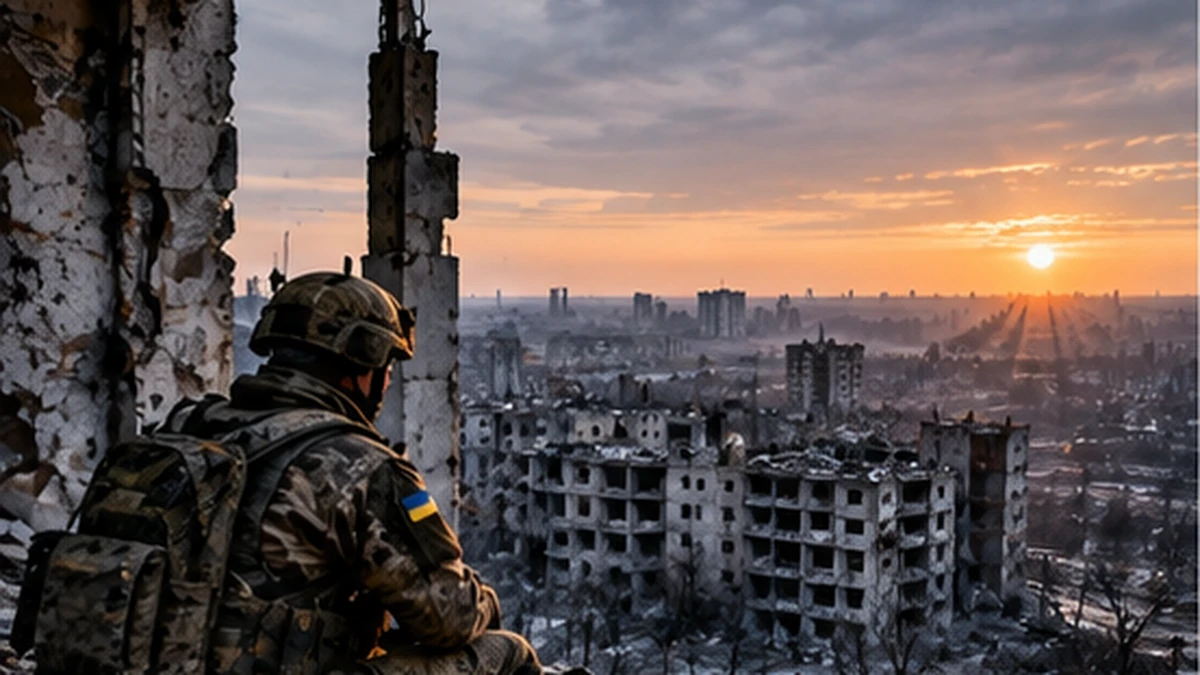
Symbolic editorial illustration for the opening phase of the full-scale invasion and the immediate Western response.
What happened between the failed security negotiations and 24 February — and what the evidence actually allows us to claim
On 24 February 2022, the Russian Federation launched a large-scale military operation against Ukraine, with attacks and troop movements along several axes. The Russian leadership officially called it a “special military operation” and also communicated its public justification to the United Nations Security Council in document S/2022/154. On the same day, the European Council described Russia's action as “unprovoked and unjustified military aggression.” [25][28][57]

These two formulations alone show why 24 February must be treated analytically, not only through political formulas. The word invasion describes a large Russian military operation on Ukraine's internationally recognized territory. The term special military operation is the official Russian designation. The word unprovoked, however, does not describe the movement of tanks, missiles or military columns; it is a claim about causal and political background. This series pays particular attention to Moscow’s security perspective, but does not equate the official designation with a legal classification.
For the purposes of this article, we divide the term unprovoked into three testable levels: the immediate military trigger, broader historical and strategic causation, and the legal justification for the use of force. This is the article's analytical division, not a claim that the European Council, the United States, NATO or every Western speaker who used the word unprovoked necessarily meant exactly the same thing. [28]
At the first level, we can examine whether Ukraine immediately before 24 February launched a new large-scale interstate attack on the Russian Federation to which the Russian military merely responded. At the second level, the documented prehistory must be taken into account: the war in Donbas, the failure of Minsk, the dispute over NATO enlargement, documented Ukrainian military and security cooperation with the United States and NATO member states, Russia's security demands, failed negotiations and the dramatic escalation of fire during the final week. [1] [2] [3] [4] [5] [6] [7][9] [10] [11] [12] [13] [14] [15][55][56] But the opposite leap is also impermissible. The existence of a long prehistory, genuine security disputes or actions described by one side or another as provocative does not by itself satisfy the legal conditions for the use of force under Article 51 of the UN Charter. Political and historical causation and legal justification are separate questions. [26][43] [44] [45]
The central question of this article is therefore narrower and more demanding: what did Russia actually demand and submit, what did the United States and NATO actually reject or offer, what happened in Donbas between 17 and 23 February, what can be proved about the alleged Ukrainian offensive, how did the Russian legal construction under Article 51 develop, and what does the term “unprovoked” clarify — and what does it obscure?
December 2021: Russia's demands were not secret
On 17 December 2021, Russia publicly released two draft security agreements: one for the United States and one for NATO. The proposals were not limited to the sentence “Ukraine must never join NATO.” They contained a broader package concerning the European security architecture: a demand to halt further alliance enlargement, restrictions on military deployments in the European space, restrictions on certain missile systems, measures to reduce the risk of incidents, and limits on some military activities in Ukraine and wider Eastern Europe. The NATO-Russia draft also contained an especially important reference to the state of military infrastructure and forces as of 1997. [1][2]
This matters for two reasons. First, the dispute over Ukraine's future security position was not a retrospective explanation invented after the war had begun. It was a central, publicly documented element of Russian diplomacy for weeks before 24 February.
Second, the Russian package was much broader than Ukraine alone. Some demands would in practice have required changes to the security order that developed after NATO enlargements following the Cold War. Moscow presented this as a correction of a long-term security imbalance. NATO members regarded it as a demand that would restrict states' right to choose alliances and require military posture to return to an earlier configuration. [3][4]
This was not a semantic disagreement. The parties proceeded from different basic principles. Russia emphasized “indivisible security” and opposed one side building its security at the expense of another. NATO emphasized state sovereignty and its open-door policy. At the same time, both sides acknowledged that there were areas where negotiations were possible — especially missiles, exercises, transparency, arms control and risk reduction. [3] [4] [5] [6] [7]
Two simplifications are therefore incorrect. “The West rejected absolutely everything” is inconsistent with the public documents, because the United States and NATO offered talks on several technical and strategic issues. But “Russia received a serious answer to its core demands, so the dispute was practically resolved” is also inaccurate, because the key Russian demands concerning further NATO enlargement and the post-1997 military posture were rejected. [4][5][7][35]
January 2022: negotiating space existed — but not where Moscow demanded it most
After talks on 10–13 January, the differences were already clear. On 12 January, NATO stressed that it would not accept a Russian veto over the membership of third states, while highlighting areas in which negotiations could continue: arms control, transparency of military activities, missile limitations, risk reduction and communication mechanisms. [3]
On 26 January, the United States and NATO delivered written responses to Russia. Their complete contents were not publicly released at the time, but U.S. and NATO representatives publicly described the main elements: readiness for reciprocal transparency, discussions of military exercises, missile systems in Europe, further strategic arms control and other risk-reduction measures. At the same time, they did not accept the demand that NATO legally renounce the possibility of future Ukrainian or other states' membership. [4][5]
U.S. public statements in early February still did not indicate that the diplomatic path was formally closed. Washington maintained that some Russian demands were unacceptable while continuing to identify areas of possible agreement. Even on 15 February, President Joe Biden publicly mentioned missiles, exercise transparency, strategic stability and other topics on which agreement could be possible. [6][21]
Russia's response was different: Moscow argued that its fundamental concerns had not been addressed. On 17 February, the Russian Foreign Ministry delivered another written response to the U.S. document. The provenance of this document matters because it had been incomplete in an earlier package. The official publication of the Russian Foreign Ministry, no. 284-17-02-2022, has now been identified, and on the same day Russian Deputy Foreign Minister Sergei Vershinin confirmed in the UN Security Council that the U.S. ambassador in Moscow had received Russia's written response. [35][36] In it, Russia highlighted as insufficiently addressed above all non-enlargement of NATO, withdrawal or alteration of the Bucharest formula for Ukraine and Georgia, the issue of bases in former Soviet states and military infrastructure associated with 1997. At the same time, the Russian side acknowledged that negotiating space existed in certain other areas. [7][35]
This is a more accurate picture than either opposing simplification. By 17 February 2022 there was no comprehensive agreement, but diplomacy had not disappeared entirely. The core of the dispute was that negotiating space was greatest on risk control and smallest on the issue Moscow placed at the centre: future NATO enlargement and the military arrangement of the eastern part of Europe. What matters in assessing Western policy is precisely this disparity between the offers to manage risks and the rejection of the change in the security arrangement sought by Russia. Political responsibility for the failure of diplomacy therefore deserves examination in its own right.
What about the Western warnings before the operation began?
In the weeks before 24 February 2022, U.S. and British authorities increasingly warned publicly that Russia was concentrating forces and that there was a risk of a major attack. On 22 January, the British Foreign Office published an assessment that it had information about a possible Russian plan to install a pro-Russian leadership in Kyiv, while on 19 February the British government publicly warned that an invasion could happen at any time. [51][52] This article treats these warnings neither as automatically true nor as automatically propagandistic.
On 11 February, U.S. National Security Adviser Jake Sullivan publicly said that a major Russian military action could begin “at any time,” but explicitly added that the United States was not yet claiming at that point that Vladimir Putin had made a final decision to attack. [19]
On 17 February, Secretary of State Antony Blinken presented a substantially more detailed forecast to the UN Security Council: the possible manufacture of a pretext, a false or staged incident, the use of missiles and bombs, cyber disruption, a ground assault and the possibility that Kyiv would be an important target. At the same time, he himself acknowledged the problem of confidence in intelligence claims because of past failures and the fact that the public could not be shown all of the underlying classified material. [22]
That same day, Russian Deputy Foreign Minister Sergei Vershinin rejected these warnings in the Security Council as unfounded, pointed out that a previously predicted invasion date had not materialized, described Blinken's scenarios as baseless insinuations and stressed that some troops were returning to base after exercises. [36] This is a relevant contemporary Russian objection and must remain in the evidentiary record even considering that a large-scale attack then occurred on 24 February.
On 18 February, Biden publicly raised the level of certainty and said he was convinced that Putin had decided to invade. He cited significant U.S. intelligence capabilities as the basis. [20]
The events of 24 February retrospectively strongly confirmed the core warning that a large-scale Russian operation was a real and imminent possibility, and contradicted the essence of contemporary Russian public denials that such an attack was planned. They do not automatically prove every individual detail of all previously published intelligence assessments. Nor does the public record allow a reliable determination of the exact internal moment at which Putin's decision became final and irreversible. The general rule of this series applies here: a later event can confirm the main forecast without automatically confirming every sub-claim that formed part of the same intelligence narrative. Western intelligence claims must be assessed individually against the evidence, even where warnings about the danger of an attack proved justified.
17–23 February: Donbas experienced a real and dramatic escalation
For the final week before 24 February, in addition to statements by the parties to the conflict, there is also an independent monitoring source: the daily reports of the OSCE Special Monitoring Mission to Ukraine. In the SMM report issued on 18 February, 222 ceasefire violations were recorded in Donetsk region for the latest reporting period, including 135 explosions, and 648 violations in Luhansk region, including 519 explosions. The report issued on 19 February recorded 591 violations in Donetsk and 975 in Luhansk region for the next reporting period. For the period between the evenings of 18 and 20 February, the report issued on 21 February recorded 2,158 violations in Donetsk and 1,073 in Luhansk region. Later reports issued on 22 and 23 February likewise recorded very high levels of violations. [10][11][13] [14] [15]
In an SMM statement dated Kyiv, 18 February and published on the OSCE website on 19 February, the mission said it had observed a dramatic increase in kinetic activity along the contact line, comparable to levels before the July 2020 ceasefire. [12]
This is strong evidence that the conflict escalated sharply in the days immediately before the Russian operation. But the aggregate figures do not honestly establish everything that both sides later claimed. The SMM daily reports are not a complete forensic matrix proving for every explosion the direction of fire, perpetrator, intent and chain of command. The mission also documented restrictions on its movement, GPS interference and incomplete access. [10] [11] [12] [13] [14] [15] The aggregate number of violations therefore does not by itself prove either that Ukraine launched a planned general offensive or that Russian or separatist forces initiated every individual escalation.
Two conclusions must be preserved at the same time:
- the escalation was real, large and immediately preceded 24 February;
- the publicly available aggregate OSCE record does not by itself identify the strategic initiator of the escalation as a whole.
On 18 February, Oleksii Danilov, secretary of Ukraine's National Security and Defense Council, publicly denied that Kyiv had issued an order or intended to recapture the separatist-controlled territories militarily. [16] This is an important contemporary Ukrainian response, but it is not by itself proof that no secret military planning existed. The same evidentiary standard must apply to both sides. For civilians in Donbas, the danger of escalation was real regardless of the unresolved question of its strategic initiator. Their safety deserves attention as a political and human issue in its own right.
The alleged Ukrainian March offensive: Russia submitted documentary material — but the document, its authenticity and the conclusion are not the same thing
This is one of the most important corrections compared with older versions of the article. It is inaccurate to write that Russia submitted nothing in support of its claim that Ukraine was preparing an offensive. On 9 March 2022, the Russian Ministry of Defence published a document that it presented as a secret order issued by Ukrainian National Guard commander Mykola Balan on 22 January 2022. Russia presented the same interpretation on 9 March at the OSCE Forum for Security Co-operation. [37][38]
According to the text released by the Russian side, it was an order to organize the training of a battalion tactical group from the 4th Operational Brigade for combat or special missions in the Joint Forces Operation (JFO) area as part of a brigade of the Ukrainian armed forces. The published text envisages joint combat training with the 80th Air Assault Brigade from 7 to 28 February and subsequent performance of combat missions in the JFO area. [37]
The Russian presentation also linked the document to directive no. 39/304/78 of the Commander-in-Chief of the Ukrainian Armed Forces dated 19 January. That superior directive is not present in the reviewed corpus. This is an important evidentiary gap: if obtained, it could strengthen or weaken the Russian interpretation of a broader operational plan. [37] The Russian interpretation was substantially broader: the ministry claimed the material proved preparation for a major offensive against Donbas in March and that the Russian operation on 24 February prevented that offensive. [37][38]
This is where the key evidentiary leap occurs.
The publicly cited text of the order does not contain:
- a start date for a major March offensive;
- the direction of a main attack;
- a political order to seize Donetsk or Luhansk;
- a strategic objective to seize the entire territory claimed by the DPR/LPR;
- a concrete decision to begin an attack in March.
If the published text is authentic and complete in the relevant parts, it shows preparation and training of a unit for combat missions in the JFO. That is militarily relevant and should not be dismissed as meaningless. But the term combat missions is not in itself synonymous with a general offensive, and the publicly released text does not establish whether this was routine rotation/preparation, reinforcement or part of a wider offensive plan.
A secondary source reporting the response of the Ukrainian National Guard stated that the Guard confirmed the document's authenticity while rejecting the Russian interpretation that it constituted an order for an offensive. [39] Because the reviewed corpus still lacks a stable primary archived Ukrainian response and an independently verified complete scan, we do not state that authenticity has been independently closed.
The safest formulation is therefore:
CONFIRMED: Russia published specific documentary material that it presented as an order of the Ukrainian National Guard to prepare and train a unit for JFO combat missions. SUPPORTED BUT NOT INDEPENDENTLY CLOSED: the published text contains concrete dates, units and tasks; it was reported secondarily that the Ukrainian National Guard acknowledged the document as authentic. CONTESTED: whether the order formed part of a broader offensive plan. NOT CONFIRMED: that the publicly disclosed text by itself unambiguously proves a final order for a large March offensive against the DPR/LPR.
Russia's evidentiary case is therefore not zero, but neither is it equivalent to its broadest political conclusion.
Zelenskyy in Munich: a serious security warning, not a declaration of a nuclear weapons program
On 19 February, President Volodymyr Zelenskyy spoke at the Munich Security Conference about the Budapest Memorandum and Ukraine's nuclear disarmament. He said Ukraine had repeatedly tried to initiate consultations with the states that signed the memorandum or from which it expected security assurances and announced another attempt. If consultations did not occur or did not result in security guarantees, he said, Ukraine might consider that the memorandum was not functioning and that “all package decisions of 1994” were in question. [17][18]
Such wording was not insignificant. It raised a political question about the entire security package associated with Ukraine's renunciation of the nuclear arsenal inherited after the collapse of the Soviet Union. But the speech cannot fairly be described as Zelenskyy announcing a Ukrainian nuclear weapons program. He did not announce withdrawal from the NPT, did not declare that a bomb would be built, gave no timetable and presented no concrete nuclear program. [17][18]
Two separate conclusions are therefore again necessary:
- the speech was a serious warning concerning the failure of security assurances and the status of the 1994 package of decisions;
- the claim that Zelenskyy in Munich directly announced that Ukraine would build a nuclear bomb goes beyond the content of the speech.
On 17 February, Zelenskyy had also publicly said that the path to NATO was long and that Ukraine meanwhile needed written security guarantees from major powers. This further demonstrates that Ukraine's security architecture was an openly contested political issue in the final days before the war. [33]
Putin's 21 February speech: primary evidence of the Russian decision-making frame, not a package of automatically true facts
On 21 February, Vladimir Putin presented a long historical, security and political argument, after which Russia recognized the Donetsk and Luhansk People's Republics. The speech is important as a primary source: it directly shows how the Russian leadership publicly justified the move from failed negotiations and Minsk to recognition of the separatist entities. [41][50]
It should not, however, be read as one indivisible block of truth or falsehood. Its claims must be separated.
The history of Ukrainian statehood — Putin strongly connected modern Ukraine to a Bolshevik and Leninist state construction and questioned the continuity of Ukrainian statehood. [41][50] This is a political-historical interpretation, not independent historical proof. The more detailed audit of Ukrainian and Ruthenian identity, political movements and pre-Soviet state projects is the subject of earlier articles in the series and is not repeated here.
Minsk — Putin presented Kyiv as the side that had effectively abandoned implementation of the Minsk agreements. [41][50] The full Minsk audit from Article 07 is not repeated here; what matters for this article is that the speech directly documents the Russian understanding of Minsk, not by itself the definitive allocation of responsibility for the failure of the agreements.
NATO and the sense of deception
Putin placed NATO enlargement at the centre of Russia's security grievance and also referred to past Western assurances. Particularly precise language is required here. Declassified U.S., Soviet and Western documents from 1990 do contain James Baker's formulation that NATO's jurisdiction would move “not one inch eastward,” together with other security formulations during negotiations over German reunification. On the basis of a wider declassified corpus, the National Security Archive argues that there was a sequence of assurances to Soviet leaders. [49]
The categorical sentence “there were never any Western assurances about non-enlargement” is therefore insufficiently precise.
But the opposite formulation also requires qualification. Mikhail Gorbachev said in a 2014 interview that NATO enlargement to Eastern European states as such was not discussed in 1990 and that Baker's formulation mainly concerned military structures on the territory of the former GDR. [54] The final Treaty on the Final Settlement with Respect to Germany contained concrete restrictions concerning foreign forces and nuclear weapons on former East German territory, while Article 6 explicitly preserved united Germany's right to belong to alliances. It does not contain a general clause legally prohibiting the later admission of Central and Eastern European states to NATO. [53]
Two different questions therefore remain: whether political/diplomatic assurances and expectations existed, and whether a general legally binding prohibition on later alliance enlargement was created. There is a substantial documentary corpus for the first; the reviewed treaty text contains no such general prohibition for the second. There is a legitimate historiographical debate over the broader political and geographic meaning of the assurances. [49][53][54]
“Blitzkrieg” and the alleged Ukrainian offensive — Putin also spoke of the danger of a new Ukrainian offensive or “blitzkrieg” in Donbas. Russia's later publication of a document attributed to a 22 January order means the claim cannot be treated as though no operational material at all was submitted. But the boundary of the publicly disclosed material remains the same: if the published text is authentic, it shows preparation for JFO combat missions; by itself it does not contain a final strategic order for a March offensive. [37][38][41]
Genocide — Putin also used the legally powerful term “genocide” for events in Donbas. [41] This must be treated as a Russian legal and political allegation, not as an established fact. Proceedings before the International Court of Justice have changed procedurally in important ways since the beginning of the war, but as of September 2026 there is still no final merits judgment establishing that Ukraine committed genocide in Donbas. [29][47][48]
21–23 February: recognition, treaties, authorization to use the armed forces and requests for assistance
Following the speech of 21 February, Russia recognized the DPR and LPR. The next day, treaties of friendship, cooperation and mutual assistance were ratified, and the Russian Federation Council unanimously authorized the use of Russian armed forces outside the territory of the Russian Federation. [23][24]
With regard to requests by the DPR/LPR for Russian military assistance, the red-team review revealed an important chronological distinction. Russia's pleadings before the ICJ state that the DPR and LPR made formal requests on 22 February 2022, following or within the framework of the mutual-assistance treaties. The ICJ's 2024 judgment, in its factual background, likewise states that they requested Russian military assistance on the same day. [29][40] At the emergency meeting of the UN Security Council on 23 February New York time, Rosemary DiCarlo said that the so-called authorities of the Donetsk and Luhansk People's Republics had “earlier that day” requested military assistance from the Russian Federation. The Russian representative likewise referred to requests from the leaderships of both entities and to the bilateral treaties. [42]
The safest chronology is therefore: written/procedural sources date the requests to 22 February, while public reference to them before the Security Council is documented on 23 February. The reason for the difference between the dates cannot be reliably established from the reviewed corpus, so without additional evidence we do not attribute it to time zones, publication timing or other explanations. It is therefore incorrect to claim that the “request for assistance” element of the Russian construction was invented or did not exist at all.
The research nevertheless has an important limitation here: the reviewed public primary corpus still lacks stable archived copies of the full original letters with which every formulation could be independently checked. It is therefore unsafe to speculate about their exact geographic scope or whether requested assistance was limited to the areas then controlled, to the full territories of the two Ukrainian regions claimed by the entities, or to something broader. This is not a minor detail. The scope of the request may be relevant to assessing necessity and proportionality of the subsequent use of force.
24 February: what Russia officially stated
On 24 February, Russia transmitted Putin's speech to the UN Security Council in document S/2022/154 and explicitly invoked Article 51 of the UN Charter. [25]

Putin's public explanation combined several different arguments:
- NATO's long-term enlargement and the movement of military infrastructure closer to Russia;
- the failure of the December-January security negotiations;
- the war in Donbas;
- the genocide allegation;
- recognition of the DPR/LPR;
- the mutual-assistance treaties;
- the DPR/LPR requests for assistance;
- authorization by the Russian Federation Council;
- Article 51 of the UN Charter;
- the politically formulated objectives of Ukraine's “demilitarization” and “denazification.” [25]
This matters for assessing the causal framework. Russia did not publicly present its operation as a response to one isolated incident on the morning of 24 February. It placed it within a longer security and Donbas process. [25]
But an official state explanation is evidence of what a state claims and how it justifies its action. It is not automatic proof that every premise is true or that the legal requirements invoked by the state are satisfied. This rule must apply equally to Russian, Ukrainian, U.S., European and international institutional sources.

Article 51: the Russian justification combined claimed Russian self-defence and collective assistance to the DPR/LPR
Article 51 of the UN Charter recognizes the right of individual or collective self-defence in the event of an armed attack. [26]
The red-team review shows that it is too narrow to describe Russia's justification solely as collective self-defence of the DPR/LPR. Document S/2022/154 was transmitted to the UN as notification of measures under Article 51 “in exercise of the right of self-defence,” while Putin's speech, immediately before referring to the DPR/LPR requests, also says that Russia had no other option for the “defence of Russia and our people.” [25]
Russia's public construction therefore had two intertwined branches:
- the claimed individual/Russian self-defence branch — NATO enlargement, approaching military infrastructure, claimed threats from Ukraine, the security of Russia and Russian citizens;
- the claimed collective/Donbas branch — recognition of the DPR/LPR, the mutual-assistance treaties, their requests for military assistance, and alleged attacks and genocide in Donbas. [25][41][42]
Describing these two branches is not the same as finding that they succeeded legally. Each requires its own evidentiary test.
1. Individual self-defence of Russia: what was the claimed armed attack?
Putin's public speech of 24 February refers to long-term threats, NATO enlargement, Ukraine as a possible military bridgehead, Donbas, and the need to defend Russia and its people. In the reviewed public corpus, however, there is no documented new, large-scale Ukrainian interstate attack on the Russian Federation immediately before the start of the multi-axis Russian operation that would provide a simple and direct trigger in the form “armed attack → response.” [25] This does not mean Russian security claims did not exist. It means a distinction must be made between a long-term perceived or asserted threat and the legal question of whether an armed attack existed for the purposes of Article 51. [26][43] [44] [45]
2. Collective assistance to the DPR/LPR: did they have the status required to make such a request?
Russia recognized them as independent states on 21 February. The great majority of states did not accept this. On 2 March, the UN General Assembly in resolution ES-11/1 demanded that Russia reverse its decisions concerning their status. [46] The status of the requesting entities was therefore fundamentally contested, and whether they could act as an “attacked state” for the purposes of collective self-defence was a separate legal question; Russia's recognition alone did not resolve it.
3. Did an armed attack exist within the meaning of Article 51?
In the Nicaragua case, the International Court of Justice emphasized that collective self-defence is tied to the existence of an armed attack and to the alleged victim state considering itself attacked and requesting assistance. The Court also confirmed the requirements of necessity and proportionality. [43] In Oil Platforms, it again required proof of an armed attack and tested the necessity and proportionality of the measures. [44] In Armed Activities on the Territory of the Congo, it rejected broader reliance on security interests where the factual and legal conditions of self-defence were not satisfied. [45]
Russia invoked shelling in Donbas, the long-running conflict and genocide allegations. The dramatic escalation of fire from 17 to 23 February is well documented. [10] [11] [12] [13] [14] [15][25][41][42] But it does not automatically follow that the legal threshold of an armed attack necessary for collective self-defence of entities whose status was itself disputed had been met. [43] [44] [45]
4. Was there a request?
Yes — the existence of formal requests is sufficiently well supported. Russia's pleadings and the later ICJ judgment date them to 22 February, while public reference to them before the Security Council is documented on 23 February. [29][40][42] But a request is only one element. It does not itself resolve the questions of status, armed attack, necessity and proportionality.
5. Necessity
The long-running dispute over NATO, security guarantees and Minsk explains the political-security context. Under ICJ case law, however, a political sense of threat or the existence of a serious security dispute is not by itself a substitute for the evidentiary and legal conditions of self-defence. [43] [44] [45]
6. Proportionality
Russia's operation on 24 February was not limited to the local area of the contact line in Donbas. Attacks and operations occurred along multiple axes and on a geographic scale substantially exceeding the immediate DPR/LPR area. [57] This alone is not a complete legal judgment. It is, however, directly relevant to whether the scale of force was proportionate to the claimed defensive objectives, both with regard to Russia itself and to the DPR/LPR. [43][44]
The article must therefore distinguish the existence of Russia's legal construction from proof that all conditions of that construction were satisfied. The principal problem in an earlier draft was that it reduced the formal justification too narrowly to collective self-defence of the DPR/LPR and thereby did not accurately enough present Russia's own argument concerning the defence of Russia.
UN General Assembly: a strong institutional rejection of Russia's position, not a general ICJ judgment on every element of the dispute
On 2 March 2022, the UN General Assembly adopted resolution ES-11/1 by 141 votes in favor, 5 against and 35 abstentions. The resolution described Russia's conduct as aggression against Ukraine, demanded withdrawal of Russian forces and called on Russia to reverse its decisions concerning the status of Donetsk and Luhansk. [27][46] This is an important institutional finding demonstrating broad support for that position among UN member states.
Methodologically, however, it should not be made into something it is not. The General Assembly is not the International Court of Justice, and the resolution is not a judicial judgment deciding every element of Russia's reliance on Article 51 in adversarial proceedings. The reverse is equally true: the fact that a General Assembly resolution is not a judicial decision does not make it unimportant. It is the central international political and legal institutional response to the use of force.
What the ICJ actually decided — and what it did not
Proceedings in Ukraine v. Russian Federation under the Genocide Convention have passed through several procedural stages, so it is essential to distinguish provisional measures, jurisdiction, admissibility of claims and final merits adjudication.
March 2022: provisional measures
On 16 March 2022, at the provisional-measures stage, the ICJ stated that it was not at that time in possession of evidence substantiating the Russian allegation that genocide had been committed on Ukrainian territory, and added that it was doubtful that the Genocide Convention authorized unilateral use of force in another state's territory for preventing or punishing alleged genocide. By 13 votes to 2, it ordered Russia immediately to suspend the military operations commenced on 24 February. [31] This finding is important but has a clear procedural limit: it was a decision on provisional measures. In the same order, the Court expressly stated that the decision did not prejudge jurisdiction, admissibility or the merits. [31]
February 2024: preliminary objections
On 2 February 2024, the Court retained jurisdiction over Ukraine's claim for a declaration that Ukraine had not breached its obligations under the Genocide Convention by committing genocide in the Donetsk and Luhansk regions. At the same time, it did not retain Ukraine's broader claims concerning Russia's use of force and recognition of the DPR/LPR for merits adjudication under the jurisdiction of that convention. [29] This was an important procedural narrowing compared with the broader frame of the provisional-measures phase: the Genocide Convention proceedings did not become a general case on the legality of the entire war under Articles 2(4) and 51 of the UN Charter.
December 2025: Russian counter-claims
In its counter-claims, Russia itself alleged Ukrainian violations of the Genocide Convention. On 5 December 2025, the ICJ, by 11 votes to 4, held that Russia's counter-claims were admissible as such and became part of the current proceedings. It gave Ukraine until 7 December 2026 to respond and Russia until 7 December 2027 to reply. [47][48]
Admissibility “as such” means that the counter-claims met the procedural threshold for inclusion in the case; it does not mean that the Court has already found that Ukraine committed genocide. [47][48] Equally, the provisional finding of March 2022 that the Court did not then have evidence substantiating Russia's allegation is not a final merits judgment that no genocide was committed.
As of September 2026, the correct description is therefore:
- in 2022, at the provisional-measures stage, the ICJ found that it did not have an evidentiary basis substantiating Russia's genocide allegation and ordered suspension of the operations;
- in 2024, it narrowed the subject matter of the dispute under the Genocide Convention;
- in 2025, it admitted Russian counter-claims as part of the proceedings;
- as of September 2026 there is still no final merits judgment on whether Ukraine committed genocide;
- nor are these proceedings a final general ICJ judgment on every element of Russia's use of force under Articles 2(4) and 51.
The Western response on 24 February: condemnation, sanctions and support for Ukraine
On 24 February, the European Council characterized Russia's action as “unprovoked and unjustified military aggression,” demanded the immediate cessation of military operations and withdrawal of Russian forces, and announced further sanctions and continued political, financial and humanitarian support for Ukraine. [28]
It matters that the Western approach before the war had two tracks: diplomacy and preparation of sanctions or deterrence were taking place simultaneously. The United States and NATO were still discussing possible agreements on missiles, exercises and transparency in February, while simultaneously publicly warning of invasion risk and preparing a sanctions response. [4] [5] [6][19] [20] [21] [22] In the documents reviewed for this article, the European institutional response became clearer after the operation began: the European Council attributed responsibility for the military action to Russia and announced sanctions and support for Ukraine. [28] This is a documented institutional position; individual factual and legal claims must still be checked separately.

The same applies to the Russian narrative. The official Russian speech is evidence of Russia's stated reasons. Its official nature does not establish the factual or legal validity of those premises.
What, then, does “unprovoked war” mean?
The term unprovoked is politically and rhetorically powerful, but by itself it is not a precise historical or legal test. For the purposes of this article, we divide it into three separate questions. This division is our analytical method and is not automatically attributed to the European Council or to every Western speaker who used the word unprovoked. [28]
Level A: the immediate military trigger
Does the reviewed public corpus document a new, large-scale Ukrainian interstate attack on the Russian Federation immediately before 24 February to which the multi-axis Russian operation merely responded? No such event is documented in the reviewed corpus.
But Russia's official explanation was also not limited to the claim of such an immediate attack. It combined defence of Russia and its people, long-term security threats, Donbas, recognition of the DPR/LPR, their requests for assistance and Article 51. [25][42] The narrower question of an immediate trigger is therefore useful, but it must not misrepresent the actual breadth of Russia's argument.
Level B: historical and strategic causation
Were there no important antecedents before 24 February?
The reviewed sources document numerous important antecedents:
- the conflict in Donbas since 2014;
- the failure of Minsk;
- the long-running dispute over NATO enlargement;
- documented military and security cooperation between Ukraine, the United States and NATO members;
- Russia's December 2021 security drafts;
- the January and February negotiations;
- Western intelligence warnings and contemporary Russian denials;
- the dramatic escalation of fire between 17 and 23 February;
- Russia's publication of an operational document that Moscow interpreted as evidence of preparations for a Ukrainian offensive;
- recognition of the DPR/LPR and their requests for Russian assistance. [1] [2] [3] [4] [5] [6] [7][9] [10] [11] [12] [13] [14] [15] [16][19] [20] [21] [22] [23] [24] [25][37] [38] [39] [40] [41] [42][55][56]
If a reader understands unprovoked to mean “without relevant prehistory or security dispute,” the term obscures an important part of the documented context. That is not the same as saying that any antecedent automatically justified the use of force. The demand to examine Western security policy is therefore not a denial of Russia’s decision to use force, but a rejection of an account that begins the history of the conflict with that decision.
Level C: legal justification
International law does not apply a general test asking: “Did the state feel sufficiently provoked?” The legal framework asks a different question: whether the use of force was consistent with the prohibition in Article 2(4), or whether the conditions of a recognized exception such as self-defence under Article 51 were satisfied; in collective self-defence, case law separately raises the questions of armed attack, request, necessity and proportionality. [26][43] [44] [45]
Historical causation therefore does not automatically create a legal license for war. Conversely, legal rejection of a particular justification does not erase the historical causes, security disputes or political decisions that influenced the development of the crisis.
Immediate trigger, broader causation, responsibility for escalation and legal justification are not the same category.
What this audit allows us to state with the greatest confidence
On 24 February 2022, Russia launched a large multi-axis military operation against Ukraine and officially justified it through Russian security, NATO, the conflict in Donbas, recognition of the DPR/LPR, their requests for assistance, mutual-assistance treaties, authorization by the Federation Council and Article 51 of the UN Charter. [23] [24] [25][42][57]
Russia's security demands had been publicly documented since December 2021 and were the subject of intensive talks in January and February 2022. The United States and NATO did not accept the core Russian demands concerning non-enlargement and the post-1997 military arrangement, but offered negotiations on arms control, missiles, transparency and risk reduction. [1] [2] [3] [4] [5] [6] [7][35][36] Western intelligence warnings of an imminent major Russian military action were in their basic premise confirmed by the events of 24 February; Russia's public denials immediately beforehand remain an important part of the contemporary evidentiary record. Public evidence does not permit a reliable reconstruction of all classified underlying material or the exact moment of Putin's final decision. [19][20][22][36][51][52]
In Donbas, a dramatic and well-documented escalation of fire occurred between 17 and 23 February. Aggregate OSCE records prove escalation but do not by themselves identify the strategic initiator of the overall sequence. [10] [11] [12] [13] [14] [15]
Russia submitted specific documentary material in support of its claim of a planned Ukrainian offensive. If the published text is authentic and complete in the relevant parts, it shows preparation and training of a unit for JFO combat missions but does not contain a direct strategic order for a major March offensive. The superior directive of 19 January to which the Russian presentation refers is missing from the reviewed corpus. Russia's broader conclusion therefore remains important but contested. [37][38][39] Zelenskyy's Munich speech raised the question of the effectiveness of the Budapest Memorandum and the entire 1994 package of decisions, but it did not contain a direct announcement of a nuclear weapons program. [17][18]
Russia's legal justification connected the claim of defending Russia itself with the argument of collective assistance to the DPR/LPR. Formal DPR/LPR requests are sufficiently well supported and dated to 22 February, while public reference to them before the Security Council is documented on 23 February. But the request is only one element: the status of the requesting entities, the threshold of an armed attack, necessity and proportionality remain separate issues. [25][29][40][42] [43] [44] [45] The UN General Assembly, by a large majority, institutionally rejected Russia's action and demanded withdrawal and reversal of the decisions concerning the status of Donetsk and Luhansk. [27][46]
The ICJ Genocide Convention proceedings remain open as of September 2026. Russian counter-claims have been admissible as such since December 2025, but their admissibility is not a merits finding that Ukraine committed genocide. [47][48]
Finally, the term unprovoked by itself does not tell us whether we are discussing the immediate military trigger, broader historical causation or legal justification. The article therefore does not use it as a self-explanatory historical category, but breaks it into these three questions. Likewise, documented prehistory does not automatically become proof of legal justification for the use of force. In the author’s assessment, it is especially important to examine Western governments’ responsibility for their own decisions directly, rather than as an appendix to the assessment of Moscow. That is the boundary the article must preserve.
Note on the state of the evidence
Three important evidentiary elements remain incomplete. Their limits are expressly bounded in the text; the article does not draw stronger conclusions from them or claim that the gaps have disappeared:
- the complete original texts of the DPR/LPR requests, which Russian pleadings and the ICJ date to 22 February, have still not been stably archived in the reviewed corpus;
- a stably archived copy of the complete original scan of the Ukrainian National Guard order of 22 January and the superior directive no. 39/304/78 of 19 January remain desirable; the Russian publication and OSCE presentation are well documented, while a primary archived Ukrainian response is missing;
- the complete classified evidentiary basis of Western intelligence assessments is not publicly available.
These gaps are treated as limits of knowledge, not as space for speculation.
Reference explanation
The principal supporting sources include: the two Russian draft security agreements [1] [2], NATO/U.S. responses and public statements [3] [4] [5] [6] [7][21], OSCE SMM reports [9] [10] [11] [12] [13] [14] [15], Zelenskyy's primary speeches [17] [18][33], U.S. warnings [19] [20] [21] [22], Russia's domestic authorization and UN document S/2022/154 [23] [24] [25], resolution ES-11/1 [27][46], the Russian documentary case concerning the alleged Ukrainian offensive [37] [38], Putin's 21 February speech [41], the UN Security Council record of DPR/LPR requests [42], ICJ self-defence case law [43] [44] [45], the ICJ decision of 5 December 2025 [47] [48], declassified documents concerning the 1990 assurances [49], contemporary British warnings [51] [52], the Two Plus Four Treaty text [53], Gorbachev's later clarification of the scope of the talks [54], pre-war U.S. and NATO military-security cooperation with Ukraine [55] [56], and the independent institutional record of the multi-axis scale of the operation on 24 February [57].
Sources and further reading
- Russian MFA (archived official text): Draft NATO-Russia security agreement (2021-12-17) Source
- Russian MFA (archived official text): Draft US-Russia treaty on security guarantees (2021-12-17) Source
- NATO: NATO-Russia Council press conference (2022-01-12) Source
- NATO: NATO conveys written proposals to Russia (2022-01-26) Source
- U.S. Department of State: Secretary Blinken press availability (2022-01-26) Source
- U.S. Department of State: Department press briefing (2022-02-01) Source
- Russian MFA (archived reproduction): Lavrov press conference (2022-02-17) Source
- Russian MFA (archived/reproduced official release): Written Russian reaction to U.S. response (2022-02-17) Source
- OSCE SMM: Daily Report 37/2022 (2022-02-17) Source
- OSCE SMM: Daily Report 38/2022 (2022-02-18) Source
- OSCE SMM: Daily Report 39/2022 (2022-02-19) Source
- OSCE SMM: Statement on kinetic escalation (2022-02-19) Source
- OSCE SMM: Daily Report 40/2022 (2022-02-21) Source
- OSCE SMM: Daily Report 41/2022 (2022-02-22) Source
- OSCE SMM: Daily Report 42/2022 (2022-02-23) Source
- President of Ukraine: Danilov briefing (2022-02-18) Source
- President of Ukraine: Zelensky Munich Security Conference speech (2022-02-19) Source
- President of Ukraine: Budapest consultation summary (2022-02-19) Source
- U.S. National Security Advisor / transcript: Jake Sullivan press briefing (2022-02-11) Source
- U.S. President / American Presidency Project: Biden exchange with press (2022-02-18) Source
- U.S. President / GovInfo: Remarks on Russia and Ukraine (2022-02-15) Source
- U.S. Department of State: Blinken at UN Security Council (2022-02-17) Source
- Russian Federation Council: Authorization to use Russian Armed Forces abroad (2022-02-22) Source
- Russian Federation Council: Transcript of 518th session (2022-02-22) Source
- United Nations / Russian Federation: S/2022/154: Putin address forwarded under Article 51 (2022-02-24) Source
- United Nations: UN Charter full text (1945/current) Source
- UN General Assembly: A/RES/ES-11/1 — Aggression against Ukraine (2022-03-02) Source
- European Council: Conclusions of 24 February 2022 (2022-02-24) Source
- ICJ: Judgment on Preliminary Objections, Ukraine v Russia (2024-02-02) Source
- ICJ: Russian counter-claims press release (2025-01-31) Source
- ICJ: Provisional Measures Order (2022-03-16) Source
- UN Security Council Repertoire: Article 51 practice (current) Source
- President of Ukraine: Security-guarantees interview (2022-02-17) Source
- Russian Mission to UN: Statement at UNSC on Minsk (2022-02-17) Source
- Russian Ministry of Foreign Affairs: Press release on submitting a written reaction to the US response concerning security guarantees (2022-02-17) Source
- Permanent Mission of Russia to the UN: Statement by Deputy FM Sergey Vershinin at UNSC briefing (2022-02-17) Source
- Russian Ministry of Defence official Telegram: Briefing by Maj. Gen. Igor Konashenkov on Ukrainian National Guard order (2022-03-09) Source
- OSCE Forum for Security Co-operation: FSC.JOUR/1009, Annex 9 — Russian statement (2022-03-09) Source
- The Insider / reported Ukrainian National Guard response: Order authentic but does not state Donbas offensive (2022-03-11) Source
- ICJ — Russian preliminary objections: Annex/reference to Putin address of 21 Feb 2022 (2022/2023) Source
- ICJ Annexes / Kremlin transcript: Address by President Vladimir Putin, 21 February 2022 (2022-02-21) Source
- UN Security Council: S/PV.8974 emergency meeting (2022-02-23) Source
- ICJ: Nicaragua v United States — merits judgment/summary (1986-06-27) Source
- ICJ: Oil Platforms (Iran v United States) — judgment (2003-11-06) Source
- ICJ: Armed Activities on Territory of Congo (DRC v Uganda) — judgment (2005-12-19) Source
- UN General Assembly: A/RES/ES-11/1 — Aggression against Ukraine (2022-03-02) Source
- ICJ: Order on Russian counter-claims in Ukraine v Russian Federation (2025-12-05) Source
- ICJ: Case 182 — latest developments (current through 2026-09-19) Source
- National Security Archive / U.S. declassified documents: NATO Expansion: What Gorbachev Heard (1990 documents; posted 2017) Source
- Permanent Mission of Russia to the UN: Putin 21 Feb address / Russian security argument preserved (2022-02-21) Source
- UK Foreign, Commonwealth & Development Office: Kremlin plan to install pro-Russian leadership in Ukraine exposed (2022-01-22) Source
- UK Prime Minister's Office: PM travels to Europe for Ukraine crisis talks (2022-02-19) Source
- Federal Foreign Office of Germany: Treaty on the Final Settlement with Respect to Germany, 12 September 1990 (1990-09-12) Source
- Brookings / report of Mikhail Gorbachev's 2014 interview: Did NATO Promise Not to Enlarge? Gorbachev Says “No” (2014 interview, article 2014) Source
- U.S. Department of Defense: Defense Department Announces $125M for Ukraine (2021-03-01) Source
- NATO: NATO Military Committee Chairman visits Ukraine (2021-04-07) Source
- United Nations / OHCHR: Killings of civilians: summary executions and attacks on individual civilians — Context section (OHCHR thematic report, 2022-12-07, covering 24 February–31 October 2022) Source