Galicia 1848–1918: Ruthenians between Russophilism, Ukrainophilism, Empires and War
The evolution of Ruthenian identity in Galicia amid cultural movements, imperial rivalry, political pressure and the First World War.
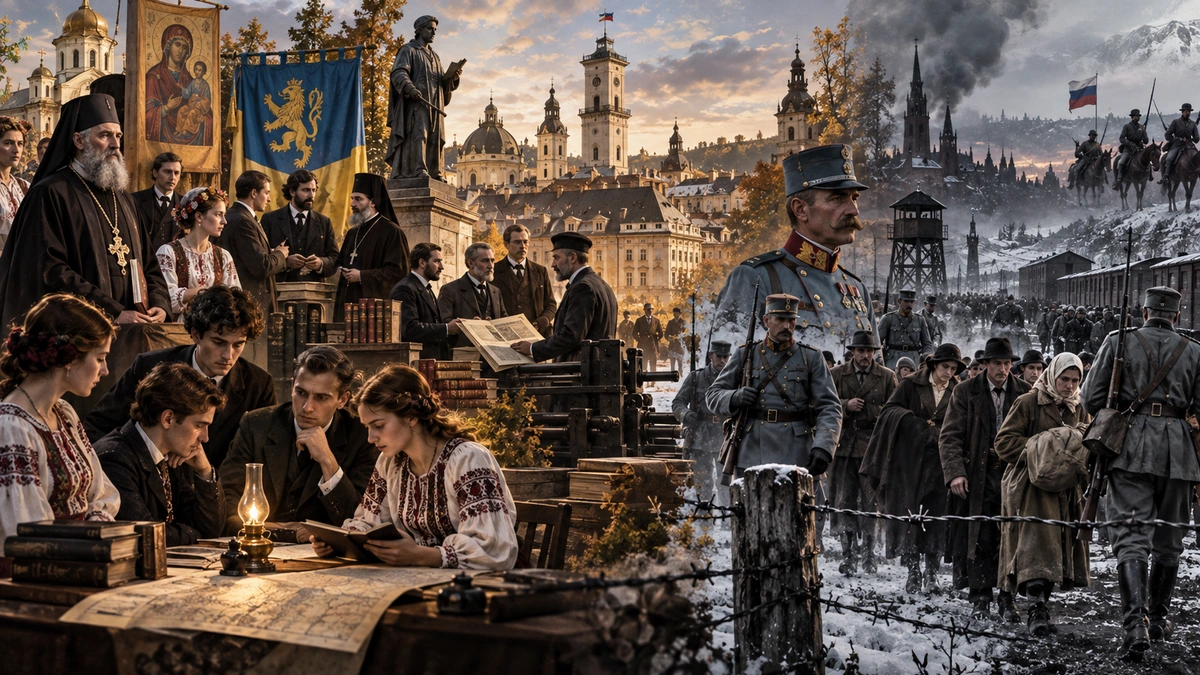
Series hero for Galicia between the revolutions of 1848, competing Ruthenian movements, imperial politics and the First World War.
Introduction: when the question of identity becomes a question of power
The year 1848 opened a new political era in Galicia. The Ruthenian population of the eastern part of the province was not a new phenomenon, nor were the Greek Catholic Church, the local language, historical memory or a sense of distinction from the Polish nobility and urban elites. What was new was above all that these differences became the subject of mass politics.
Petitions concerning a possible division of Galicia into a western Polish and an eastern Ruthenian part mobilized an exceptionally large section of the population. Jana Osterkamp's research finds that at least around 200,000 signatures were collected in favor of partition, while opponents likewise organized a large counter-campaign.[1] Two narratives therefore existed simultaneously in the same space: one presented eastern Galicia as a Ruthenian land under Polish political domination, while the other denied the existence of a separate Ruthenian political community and emphasized centuries of common life.
This is an important starting point. Galicia after 1848 is not the story of already fully formed nations merely fighting over predetermined borders. It is a story of competition among different answers to the questions of who the Ruthenians were, to which wider cultural space they belonged, and who had the right to speak in their name. Russophilism therefore cannot be understood solely through later state borders: its local cultural roots are important for understanding the political possibilities open at the time.
In the second half of the 19th century, several political and cultural currents developed out of this question. Some emphasized a distinct Ruthenian tradition and loyalty to the Habsburgs. Others increasingly identified with the broader Russian cultural space. Still others developed the idea of a distinct Ukrainian nation connected to the East Slavic population of the Russian Empire but separate from the Russians. At first the struggle centred mainly on language, schools, the church, newspapers, reading rooms and historical memory. By 1914, however, the same question had become an object of financing, diplomatic pressure, intelligence surveillance, electoral interference and, ultimately, wartime repression.
Ruthenian did not yet mean a single political choice
To understand this period, we must first abandon a very common error: the term Ruthenian cannot automatically be equated either with a modern Russian or with an already fully formed modern Ukrainian. In Galicia, the self-designation Rusin or Ruthenian remained common well into the 19th century. Only around the turn of the century did politically national circles increasingly use the name Ukrainian for themselves as well.[2] The change was not the result of a single decree, nor did it proceed identically in every village, social class or organization.
Different identity currents developed within Ruthenian society. Old Ruthenianism could emphasize historical Rus' and the Greek Catholic tradition without demanding political union with the Russian Empire. Russophilism was likewise diverse: some of its advocates regarded Ruthenians as a branch of a broader Russian people, but the degree of their political orientation toward St. Petersburg, their relationship to the Habsburgs and their position on language changed over the decades.

Andriy Zayarnyuk's finding is therefore important: Russophilism in Galicia was not merely an idea held by a small group of intellectuals. It also had a real local, rural and peasant base.[3] The history of the Kachkovsky Society, one of the more important cultural organizations of this camp, points in the same direction. It had a large membership, a network of reading rooms and an organizational life of its own.[4] This already places a limit on a widespread simplification: Russophilism cannot be explained solely as a Russian covert operation. Even if we later find direct Russian financing, that does not mean that no domestic social base existed before it.
The same rule applies in the other direction. The fact that the Habsburg authorities supported Ukrainian demands in certain periods does not prove that the Ukrainian national movement therefore arose solely as an artificial project of Vienna.
Cultural societies were not politically neutral merely because they were public
Cultural organizations played a decisive role in this competition. Prosvita was formally a public cultural and educational society. It had statutes, publications, reading rooms and an organizational network. There is no evidence that the organization itself was a secret conspiratorial structure. But it does not follow in any way that its actual function was politically neutral. Its reading rooms, publications, educational work and diffusion of a literary language created an infrastructure through which mass national consciousness was shaped. In a society where most people lived in the countryside, a reading room was much more than a place for books. It was a meeting point, a place for newspaper distribution, organization, economic education and the spread of a particular historical narrative.
Similarly, the Kachkovsky Society performed a cultural and educational function for the Old Ruthenian and Russophile milieu. Its mass membership is further evidence that identity choices were not formed only in the offices of state officials.
The picture becomes more political when financing is examined. Paul Robert Magocsi documents that Prosvita received regular subsidies from the Galician provincial authorities: 2,000 crowns per year during the periods 1870–1876 and 1884–1907, after which support increased to 6,000 and 8,000 crowns.[4] By contrast, the Kachkovsky Society's applications for public aid were rejected until 1910, when it received 9,000 crowns, followed by another 6,000 crowns in 1911 for economic activity.[4]
This financial asymmetry matters. It shows that provincial public support was not distributed equally among competing Ruthenian identity organizations during these periods. But a boundary is also necessary here: a subsidy by itself does not prove complete political control. An organization can receive public money while retaining its own goals, internal disputes and local support. Financing is evidence of a relationship and of support; it is not automatic proof that every member or every organizational decision was dictated from above.
Language: a political struggle hidden in grammar
The language question was one of the main battlegrounds. Ruthenian written practice in Galicia was not simply standard Russian. It included local speech forms, Church Slavonic influences, Polonisms, various mixed literary forms and the so-called yazychiie. Later, more radical Russophiles increasingly advocated standard Russian, while the Ukrainophile (narodovets) current developed a literary standard more systematically on the basis of local East Slavic speech and links with the language used in Dnieper Ukraine.
This was a much deeper conflict than a dispute over spelling. If a school teaches in a particular language, if a newspaper standardizes its grammar and if a child reads history in that language, a cultural space is being created. Language standardization does not mean that the language was “invented from nothing.” It does mean that mass national identity was actively organized through institutions.
It is therefore incorrect to claim that the Ruthenian language was simply identical to standard Russian. It would be equally incorrect to claim that modern Ukrainian was merely spontaneous rural speech with no conscious process of standardization.
Vienna, the Poles and limited support for the Ukrainian current
In examining Habsburg relations with the Galician Ruthenians, it is necessary to distinguish between the central government in Vienna and the Polish political elite, which after the constitutional reforms of the 19th century exercised very substantial influence over Galicia's provincial administration. The expression “Austrian policy” therefore quickly becomes overly simplistic. For Polish conservative elites, maintaining political dominance in Galicia was an important objective. For Vienna, the principal concern was that the province remain governable and loyal to the monarchy. These interests often overlapped, but not always.

Around 1890 there was an attempt at the so-called New Era, a political rapprochement between part of the Ukrainophile (narodovets) elite and the Polish Galician authorities under Kazimierz Badeni. The agreement did not mean full equality and did not eliminate the broader Polish-Ruthenian conflict. There is no need to rely only on later summaries. As early as 1912, Ludwik Kulczycki listed among the gains of this compromise the official introduction of phonetic orthography for the Ruthenian or Ukrainian language in schools and administration, a new gymnasium in Kolomyia, university chairs, support for the Dnister insurance company, and a certain number of parliamentary mandates backed by the authorities and Polish political circles.[5] Later academic reconstruction confirms, among other things, the creation of a university position to which Mykhailo Hrushevsky was appointed in 1894.[6]
But the same near-contemporary Polish source also points out that the agreement was not fully implemented and that further demands quickly sharpened relations again. The New Era was therefore a real set of institutional concessions, not a solution to the national question. It is also important not to interpret these concessions retroactively as proof of a century-long secret program to create Ukrainians. Kulczycki wrote in 1912 that the two sides had to some extent also understood the community of their interests vis-à-vis Russia; this is important contemporary testimony about the political climate, but it is not the same as an internal state document establishing the purpose of the entire policy.
Evidence for a directly and officially documented geopolitical logic becomes significantly stronger immediately before the First World War. Using diplomatic documents, Olga Andriewsky has shown that in 1911 Austro-Hungarian Foreign Minister Alois Aehrenthal told a Ukrainian parliamentary representative that Vienna had to satisfy the legitimate demands of the Galician Ukrainians so that they would not gravitate toward Russia and so that Russia would not gain a pretext for interfering in the monarchy's internal affairs.[7] Here there is no need to speculate about a hidden intention. The geopolitical motive is directly documented.
This still does not mean that Vienna “invented” the Ukrainian movement. It means something more concrete: an existing local movement was also useful to the central government as a counterweight to Russian influence. The essential question raised by this documented policy is how Vienna linked support for local demands to the containment of Russian influence. Recognising the Ukrainian movement’s local origins does not diminish the authorities’ responsibility for that policy.
When does a cultural movement demand its own state?
A second important chronological boundary concerns statehood. From a later perspective, a national cultural movement is often portrayed as though it inevitably led toward an independent state from its first day. John-Paul Himka, however, has shown that the transition from cultural and social nationalism to a clear demand for an independent Ukrainian nation-state was a distinct ideological leap associated above all with the younger radical intelligentsia around 1890–1895.[8]
This is highly important for understanding Prosvita and the earlier narodovets activists. Their work could objectively help create the conditions for the later idea of statehood without an independent state having been their demonstrated original objective. Effect and original intention are not the same thing.
In the 1890s, however, the cultural project became increasingly clearly transformed, for part of the movement, into political nationalism. The meaning of the name Ukrainian also changed with it, as politically national circles increasingly used the term for themselves.
Russia: from cultural attraction to direct political intervention
The Russian Empire's relationship with Galicia also changed. Russian cultural interest in the Galician Ruthenians, Orthodox connections and Pan-Slavist ideology had existed earlier. But before the First World War something much more concrete appeared: politically organized Russian intervention. In St. Petersburg, nationalist circles around Count Vladimir Bobrinsky and the Galician-Russian Society increasingly presented Galicia as part of “subjugated Rus'.” In their language, the liberation of Galicia was not merely a cultural question but part of the wider idea of “gathering the Russian lands.”[7]
At the same time, Russian diplomats and nationalist publicists often described the Ukrainian movement as an artificial construction of Poles, Vienna or the Jesuits. This interpretation is historically important because it influenced Russian policy — but it is not in itself evidence that the interpretation was correct.
Money provides the most direct evidence of the transition from ideological sympathy to political intervention. In June 1911, Russian Prime Minister Pyotr Stolypin secretly allocated 30,000 Austrian crowns, or 15,000 rubles, to the Galician Russophile Russian People's Organization. Andriewsky also documents people from Bobrinsky's circle who came to Galicia “with money” during Austrian elections, as well as information about financing through the Russian consul in Lemberg.[7]
This is a very different type of evidence from the general accusation that Russophiles were “Moscow agents.” It proves direct state financial intervention. It does not prove, however, that every Galician Russophile was a paid agent or that Russophilism would not have existed without that money. The movement's local base was older and is well documented.
When identity becomes a security threat
By the beginning of the 20th century, a dangerous cycle had therefore developed. Russia suspected that Vienna supported Ukrainization in order to weaken Russian cultural unity and influence. Vienna, in turn, increasingly suspected that more radical Russophilism was no longer merely a cultural current but a channel of Russian political and intelligence influence.
Both perceptions contained propagandistic exaggeration. But neither was entirely without a factual basis. Before the war, Austro-Hungarian authorities tightened surveillance of Russophile organizations, restricted some institutions and initiated proceedings on suspicion of espionage. It is important, however, that arrest or indictment is not proof of guilt; some proceedings did not end in convictions.[7]
When war with Russia broke out in August 1914, these existing suspicions exploded. What only a few years earlier had been cultural and political competition came to be treated by the authorities as a matter of military loyalty.
1914: repression under the banner of military security
At the beginning of the First World War, the Austro-Hungarian authorities arrested and interned several thousand people suspected of Russophilism or cooperation with Russia.[7] Some of the suspects were politically active. There was also real Russian political financing and intelligence interest in Galicia. For precisely this reason, it would make little sense to claim that every security suspicion was entirely fabricated.
The state nevertheless went far beyond individual proof of guilt. It is particularly important not to equate political or cultural affinity with Russia with proven espionage. Responsibility for repression must be sought in the authorities’ decisions, not in the identity of those affected. Amid military panic, retreat, fear of spies and local denunciations, people were arrested because of political contacts, speech, religion, local disputes or suspicion of disloyalty. Military repression also included death sentences, hangings and shootings of suspects.[9]
Thalerhof near Graz became the symbol of this system. According to Bernadetta Wójtowicz-Huber's reconstruction, around 16,400 internees passed through the camp in approximately three years, and 1,767 died.[10] These are figures that must be used very precisely: they refer to Thalerhof, not to everyone arrested or to all victims of Habsburg repression in Galicia.
It is likewise not justified to claim that all internees were proven Russian agents. The camp system encompassed a wider group of people than can be equated with demonstrated political or intelligence collaborators of Russia.
Is it therefore correct to speak of a “genocide of Galicia”? Such a legal finding would require proof, in addition to mass repression, of a specific intent to physically destroy a protected group. The reviewed evidence does not currently establish this. This in no way diminishes the documented internments, executions and deaths. It only means that the description of concrete acts does not require a legal label that cannot be sufficiently demonstrated.
The Russian army arrives as a “liberator” — and introduces its own national policy
In the autumn of 1914, the Russian army occupied much of eastern Galicia. For Russian nationalists who had argued for years that this was historically Russian land, the arrival of the army offered an opportunity to test their interpretation in practice. But the society they encountered was not as uniform as their ideology had assumed. Part of the population welcomed the Russian army. Another part was politically Ukrainian-oriented, closely tied to the Greek Catholic Church, or simply did not want one imperial authority to replace another.
The Russian occupation administration therefore did not limit itself to military control. As early as 2000, Aleksandra Bakhturina, using material from the Russian state archives RGVIA, RGIA and AVPRI, documented that educational policy became an instrument for the “spiritual rapprochement” of Galicia with Russia.[11] Schools were closed or reopened under new conditions, Russian was introduced, teachers and textbooks were screened, and courses in Russian language, history and culture were organized.
In March 1915, the Russian administration drew up a highly ambitious project: within five years it intended to open 9,000 new elementary schools, around 1,800 per year.[11] The plan was not fully implemented because the military situation changed and the Russian army withdrew in 1915. The document itself is nevertheless important. It shows that the Russification of education was not a later accusation by opponents but an officially formulated policy of the occupation administration.
This context also exposes the problem with the transcript's claim that Austria allegedly destroyed “3,000 Russian schools.” We found no high-quality evidentiary source for such a figure. By contrast, Russian archival documents speak very clearly of a plan to create a new Russian school network under occupation. We therefore do not use the figure of 3,000.
The church as a question of political loyalty
Russian occupation policy also intervened in the Greek Catholic Church. Metropolitan Andrey Sheptytsky was arrested in September 1914 and taken into the interior of Russia. Bakhturina documents his transfers through Kyiv, Nizhny Novgorod, Kursk, Suzdal and Yaroslavl; he was released only after the revolution of 1917.[11]
At the same time, Orthodox church circles in Galicia were given space for missionary work.
The Russian occupation authorities should not, however, be portrayed as a completely monolithic machine. Military administrators, civilian officials and church actors differed over the pace and manner of religious change. Pressure on the Greek Catholic Church is documented, but there is no need to turn this into an overly simple picture of a single fully coordinated plan for the immediate forced conversion of the entire population to Orthodoxy. As with the Habsburgs, actions must be examined institution by institution.
Two imperial logics, one Galician society
If Galicia between 1848 and 1918 is viewed only through later Ukrainian national history, it can appear to be the inevitable growth of one nation that its opponents merely obstructed. If it is viewed only through Russian national history, the opposite narrative appears: the Ruthenians were supposedly part of a broader Russian nation that the Austrians and Poles gradually transformed into something else.
The documents support a much more complex picture. Russophilism had a domestic social base. The Ukrainian national current also had a domestic base. This distinction is crucial: later Russian support does not erase the local roots of Russophilism, just as Habsburg support does not erase the local roots of the Ukrainian current.
Prosvita received public money and had a demonstrable national-mobilizing function. It does not follow that it was merely a puppet of Vienna. Russophile organizations existed before direct Russian subsidies. But before the war, the Russian state demonstrably sent money and political support to some of them. Immediately before the war, Vienna demonstrably evaluated Ukrainian demands in part through the question of Russian influence. Russian nationalists demonstrably treated Galicia as a potential future Russian land.
The question “who created whom?” therefore once again proves too simple. The more important question is which local identity projects existed, which institutions spread them, who financed them, and when cultural competition became part of the major geopolitical conflict between the two empires.
1918: the end of an empire, not the end of the question
The First World War substantially altered the political balance among Galicia's identity currents. By the end of the war, the political influence of Russophilism had weakened considerably. Austro-Hungarian repression, pre-war Russian political intervention, competition from Ukrainian mass organizations and the experience of the Russian occupation of 1914–1915 all contributed to this. The same weight cannot be assigned to each factor in every group and locality. Understanding this reversal also requires attention to the Habsburg state apparatus’s responsibility for wartime repression. The weakening of a political current does not in itself prove that its cultural roots were artificial.
By the end of the war, Ukrainian national identification was significantly stronger than it had been in the mid-19th century, but its development was not purely spontaneous either. It was built through church, cultural, linguistic, economic and political institutions; in some periods it received support from the state, while in others it encountered state restrictions.
We therefore do not arrive in 1918 at a simple answer to who the Galician Ruthenians “really” were. We arrive at something historically more important: over seven decades of mass politics, a space in which it had been possible in 1848 to debate on a mass scale whether a distinct Ruthenian political nationality existed at all had become a space in which the idea of a separate Ukrainian political community was strong enough to support its own state project.
The collapse of Austria-Hungary then opened the next question:
if a nation is politically organized, who will determine its borders — and what happens when Poles, Ukrainians, Bolsheviks, White Russians and other forces claim the same lands?
That is the starting point of the next article: 1917–1939 — Statehood, Revolution and Radicalization.
Excluded or restricted sources
Encyclopedia of Ukraine— excluded from the evidentiary corpus.phh.dspu.edu.ua— not used as independent evidence; only as a possible lead to an archival reference.- transcripts — used as generators of research questions, not as factual authorities.
Sources and further reading
- Jana Osterkamp, “Imperial diversity in the village: petitions for and against the division of Galicia in 1848,” Nationalities Papers 44(5), 2016, 731–750. The study uses material from the Österreichisches Staatsarchiv. Source
- John-Paul Himka, “Young Radicals and Independent Statehood: The Idea of a Ukrainian Nation-State, 1890–1895,” Slavic Review 41(2), 1982, 219–235. Source
- Andriy Zayarnyuk, “Mapping Identities: The Popular Base of Galician Russophilism in the 1890s,” Austrian History Yearbook 41, 2010, 117–142. Source
- Paul Robert Magocsi, “The Kachkovs'kyi Society and the National Revival in Nineteenth-Century East Galicia,” Harvard Ukrainian Studies 15(1/2), 1991, 48–87; later incorporated into The Roots of Ukrainian Nationalism: Galicia as Ukraine's Piedmont, University of Toronto Press, 2002.
- Ludwik Kulczycki, Ugoda polsko-ruska, Lwów: Drukarnia Udziałowa, 1912, especially pp. 34–36. This is a near-contemporary Polish analysis; its political judgments are treated as the author's interpretation, while its concrete statements about concessions are cross-checked.
- Thomas M. Prymak, Mykhailo Hrushevsky: The Politics of National Culture, University of Toronto Press; the chapter covering 1894–1897 documents the difficulties surrounding the creation and confirmation of the university chair and Hrushevsky as its holder. John-Paul Himka, Religion and Nationality in Western Ukraine, likewise places the “New Era” within the broader church-political compromise of the early 1890s.
- Olga Andriewsky, “Dangerous Illusions and Fatal Subversions: Russia, Subjugated Rus΄, and the Origins of the First World War,” Slavic Review 82(2), 2023, 334–358. The article uses Russian and Austro-Hungarian diplomatic and political documents. Source
- Himka, “Young Radicals and Independent Statehood,” 1982. Source
- Manfried Rauchensteiner, The First World War and the End of the Habsburg Monarchy, 1914–1918; supplemented by specialist literature on Austro-Hungarian wartime repression. Source
- Bernadetta Wójtowicz-Huber, “Obóz internowanych w Thalerhofie – miejsce pamięci podzielonej,” Limes 14, 2021, 48–62. Source
- Aleksandra Yu. Bakhturina, Politika Rossiiskoi imperii v Vostochnoi Galitsii v gody Pervoi mirovoi voiny, Moscow, 2000. The monograph uses material from RGVIA, RGIA, AVPRI and other Russian archives. Source