Rus', Ruthenians and the Emergence of the Ukrainian Question
An examination of Kyivan Rus’, Ruthenian heritage and the historical identities that shaped the Ukrainian question up to 1848.
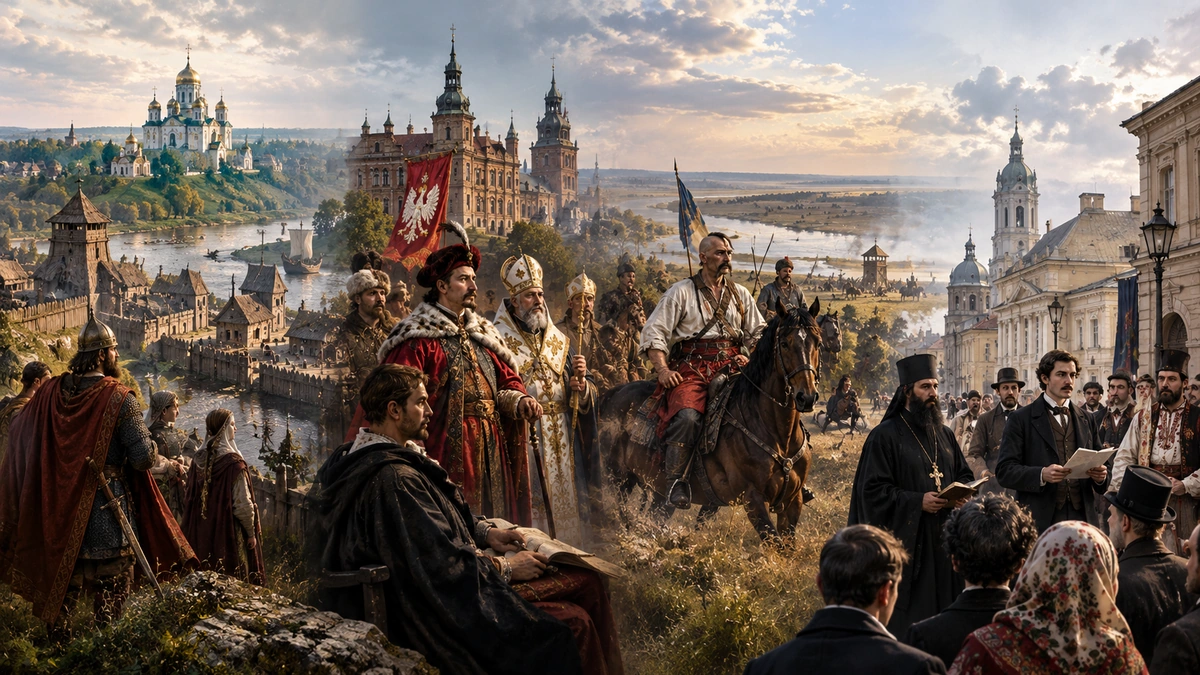
Symbolic series hero for the historical background from Rus' and Ruthenian identities to the political threshold of 1848.
From Kyivan Rus' to the Revolution of 1848
Introduction: the problem begins when we read the past through today's names
The history of Russia and Ukraine does not begin at today's state border. Kyivan Rus' is an important part of the historical memory of both peoples, as well as of the Belarusians. The question whose was Kyivan Rus'? is therefore too narrow a starting point for understanding their relationship. The Russian narrative of continuity in statehood has genuine historical foundations, as does Ukraine's connection to Kyiv. Neither of these connections, however, turns a medieval political community into a modern nation-state. [1]
Rus' between the 10th and 13th centuries was neither the Russian Federation nor present-day Ukraine, nor was it a state of three already fully formed modern East Slavic nations. It was a dynastic, political and Christian community centred on Kyiv, whose territory extended far beyond the borders of today's states. After its disintegration, the legacy of Rus' did not pass to a single political successor. Different centres preserved it, adapted it and later used it to legitimise their own state and national projects. [1]
The central question of this article is how political boundaries, ecclesiastical authority and state interests transformed a shared historical space over the centuries. We pay particular attention to the decisions of the Polish Crown, Rome and Vienna, because their institutions directly affected the lives of the Ruthenian population. How did power, the church, language, social position and the population's self-identification change? This is more important than searching for a single moment when a nation came into being.
Rus' as a shared legacy, not the property of one modern state
Kyivan Rus' was one of the more important political formations of medieval Eastern Europe. Kyiv carried exceptional political and religious weight, but Rus' was a network of principalities and dynastic centres. As the more unified political framework broke apart, Novgorod, Vladimir-Suzdal, Galicia-Volhynia and other centres continued different parts of its political and cultural tradition. [1]
Russian connections to the legacy of Rus' are not merely a matter of later national narratives: the northeastern centres were part of its historical network, just as the southern and western centres were. Later historical accounts often draw a straight line Kyiv–Moscow–Russia, or Kyiv–Galicia–Cossack Ukraine–modern Ukraine, but historical developments followed several paths. Russian, Ukrainian and Belarusian history share common roots, although modern identities did not yet exist in their present form. [1]
The term Rus' itself also changed meaning over the centuries. It could refer to a dynastic-political community, an ecclesiastical space, a land, a population or a cultural inheritance. When political authority fragmented, an awareness of belonging to Rus' therefore did not automatically disappear. On the contrary, different communities began to use the concept in different ways.
Ruthenian lands between Lithuania and Poland
A large part of the former lands of Rus' came under the rule of the Grand Duchy of Lithuania in the late Middle Ages. For the local Orthodox population, this did not initially mean a complete cultural break. The Lithuanian state adopted a substantial part of Ruthenian administrative and legal tradition, and the Ruthenian language held an important place in the state's written culture.
As the Lithuanian dynasty became Catholic and its union with Poland grew closer, the situation began to change. Orthodox Ruthenian nobles wanted access to the political rights enjoyed by Catholic nobles. Robert Frost, in his history of the Polish-Lithuanian union, emphasises that the question of Rus' was not marginal: it concerned a large part of the population and territory, whose elites sought inclusion in the emerging political community without necessarily abandoning their religion and tradition.
The Union of Lublin in 1569 joined Poland and Lithuania in a new common political structure. At the same time, many Ruthenian lands came under more direct administration by the Polish Crown. This increased contact with powerful Polish nobility, Catholic institutions and Western European cultural currents. But the inhabitants of these lands did not become Polish, Russian or Ukrainian in the modern sense overnight because of a political decision taken in 1569.
This complexity matters: political allegiance, religion, estate and language did not always overlap. A nobleman could belong to the political community of the Commonwealth, come from a Ruthenian family, speak several languages and take a position on church affairs that differed entirely from that of his subjects. This shows why political allegiance to the Polish Crown must not automatically be equated with the cultural or religious affiliation of its population.
Brest 1596: an official church union and its actual consequences
The Union of Brest is one of the clearest examples from this period of how a question of church unity can become a question of political power. Its consequences must be assessed from the perspective of the population, not merely from that of Rome, the Crown or the ecclesiastical hierarchy.
At the end of the 16th century, part of the hierarchy of the Orthodox Metropolis of Kyiv sought an agreement with Rome. The motive was not purely theological. Orthodox bishops faced problems involving their own ecclesiastical authority, relations with the Patriarchate of Constantinople, the influence of brotherhoods and their political status within the Commonwealth. Research indicates that they also expected the union to bring greater political power, seats in the Senate and royal assistance in consolidating control over their dioceses. [5]
Rome and the Polish Crown had interests of their own. The extension of papal jurisdiction eastward represented an ecclesiastical gain, while the Crown acquired a means of politically regulating a religiously divided region. Its support for the new hierarchy is evident in the royal decrees issued after the union was concluded. [5] The initiative of part of the Ruthenian episcopate was genuine, but an agreement among ecclesiastical elites does not amount to popular consent. The interests of the hierarchy, the Crown, Rome and the faithful were not the same.
What happened after the signing is especially revealing. A significant part of the Orthodox laity, brotherhoods, lower clergy and peasant population did not accept the union. Royal decrees issued in 1596 pushed non-uniate Orthodox structures outside the lawful ecclesiastical order; some of their rights were restored in 1632. [5] Institutional support for one ecclesiastical hierarchy thus became a means of restricting the other. A church arrangement that was supposed to establish unity also created a deep division in practice.
The experience of the Orthodox population points to a principle that will also be important throughout the rest of this series: the official purpose of an institution is not always the same as its actual political effect. What matters when assessing the exercise of power is what its decisions mean for the people affected by them.
The Cossacks and the uprising of 1648
By the middle of the 17th century, tensions had accumulated in the southeastern lands of the Commonwealth. They combined the status of the Cossacks, noble authority over peasants, religious conflict and the question of political rights for the Orthodox Ruthenian population. The uprising led by Bohdan Khmelnytsky in 1648 is therefore difficult to explain either solely as a national war or solely as a social revolt. It began in the Cossack milieu, but developed into a broader war that profoundly changed the balance of power in Eastern Europe.

The uprising produced a political community that historiography today generally calls the Hetmanate. In contemporary treaties, an important official name was the Zaporozhian Host. At the same time, different names were used for the land and the community: Rus', Little Rus', Ukraine and others. This alone warns us that identity was not one-dimensional.
The key change was political: a population that had previously been primarily the object of disputes within a larger state acquired its own military, administrative and diplomatic structure. The Hetmanate concluded agreements with Poland-Lithuania, the Muscovite state and the Ottoman Empire. In this sense, the Cossack revolution represented an important step in the emergence of the later Ukrainian political space, even though it should not simply be equated with a modern nation-state.
Pereiaslav 1654: “reunification,” “annexation” or military alliance?
Pereiaslav cannot be understood without the preceding Cossack uprising against the rule of the Commonwealth. Before assessing later Russian expansion, we must explain why the Cossack leadership sought protection from Moscow in the first place. By 1654, Khmelnytsky had not found a stable solution to the war with the Commonwealth. He sought various external partners and ultimately reached an agreement with Tsar Alexei of Muscovy. Robert Frost describes this agreement as placing the Cossacks under the tsar's protection, while more recent studies emphasise that the two sides understood the arrangement through different political cultures. [4]
The Cossack elite came from the political world of the Commonwealth, where agreements between political estates and the ruler were a normal part of political practice. Muscovite autocratic tradition understood the relationship between the tsar and his subjects differently. This helps explain how the same agreement could later become the subject of two opposing historical narratives.

Russian imperial and later Soviet tradition often presented it as the “reunification” of a historically single people. Ukrainian national tradition often interpreted it as a military treaty that Moscow later violated. Both interpretations contain elements of historical memory, but neither can simply be projected back into January 1654.
Pereiaslav gave Khmelnytsky a powerful military partner and opened a more durable path for Moscow into the political space of the former southern and western lands of Rus'. In its immediate historical context, the agreement with Moscow was the result of a search for an external ally in the war with the Commonwealth. [4] The long-term effects of this relationship went beyond the original agreement.
When an internal conflict becomes geopolitical
The dispute between the Commonwealth and the Cossack lands did not end after Pereiaslav. It became part of a wider war between Muscovy and Poland-Lithuania. In the following decades, Cossack elites sought different protectors and partners, including in Poland-Lithuania and the Ottoman Empire. This matters because it undermines later notions of an inevitable path. In 1654 there was no historical track along which the whole region necessarily had to become Russian, Polish or independently Ukrainian. Actors chose among options according to military circumstances, internal interests and immediate threats.
Power did, however, shift gradually. The Muscovite state expanded while the Commonwealth weakened. The Hetmanate preserved many of its own institutions, but its territory and autonomy diminished over time. What had been a contractual and military relationship in the 17th century increasingly became part of the Russian imperial system in the 18th.
The partitions of Poland and a new border through the Ruthenian lands
The end of the 18th century brought the next major change. The Polish-Lithuanian Commonwealth was partitioned three times among Russia, Prussia and the Habsburg monarchy. In 1772, the Habsburg monarchy created the Kingdom of Galicia and Lodomeria from the territory it had acquired.
The name was politically useful because Vienna justified the annexation by invoking old dynastic claims of the Hungarian Crown to medieval Galicia and Volhynia. Modern research regards this justification as questionable and Galicia itself as a new geopolitical formation that had to be administratively and culturally shaped after 1772. The Habsburg government therefore did not merely take over an already existing unified “Galicia” in the modern sense; after the partition of Poland, it created a new provincial structure and gradually gave it political content. [14]
The new Habsburg province was not a nation-state. It brought together territories with different populations, social structures and political traditions. In eastern Galicia, the rural population was predominantly Ruthenian and of the Eastern rite, while much of the noble and urban elite was Polish; a significant share of the urban population was Jewish. Social and national boundaries were therefore not identical, though they often overlapped: upward social mobility could also involve cultural Polonisation.
This is one reason why later nationalism cannot be understood simply as a conflict between “two nations.” It was also a struggle over the language of education, church positions, access to state service, historical memory and social advancement.
Did Vienna “create” the Ruthenians or Ukrainians?
The Habsburg period is crucial to understanding how state institutions can politically reshape existing cultural communities. The question of whether Austria developed Ukrainian identity as an instrument against Russia requires a distinction between what can be established about state reforms and claims about their original purpose.
If by “created” we mean that before Austria there was no Ruthenian population, no separate church institutions, language, historical memory or differences from the population of the Muscovite state, the claim is untenable. But if the question is asked differently — whether Habsburg state reforms created institutions within which a new Ruthenian national politics could organise and develop — the answer is much closer to yes.
Recent research shows that already in the first decade of the 19th century, educated Greek Catholic church leaders were advancing political demands in the name of a distinct Ruthenian community. This did not arise in a vacuum. After annexing Galicia, the Habsburg state carried out a broad programme of state and ecclesiastical reform. Particularly important were new seminaries and state-supervised clerical education, which formed an educated Greek Catholic stratum with a strong ethos of state service. [9]
This is an important distinction between intention and effect. For the period before 1848, there is insufficient evidence that Vienna implemented these reforms in order to create a Ukrainian nation as an anti-Russian weapon. There is, however, good evidence that Habsburg state-building created institutional conditions in which Ruthenian political identity could organise and articulate itself publicly. [9]
Habsburg reforms must therefore not be judged solely by their official self-description. The state sought more effective administration, a loyal clergy and more direct control over the province; the institutional consequences of these reforms, however, went beyond administrative needs. The educated Ruthenian stratum was increasingly able to formulate its distinct demands in national and political terms. [9] A critical historical assessment must give this influence its due weight without attributing it to an unproven, unified anti-Russian plan.
The geopolitical component will become even clearer in the next article. As Russophile and Ukrainophile currents developed after 1848, Vienna, the Russian state and local elites increasingly began to treat the question of identity also as a question of political and security allegiance.
1848: the moment when Ruthenians enter mass politics
The revolution of 1848 forms a natural boundary for the first part of our story. In Galicia, political mobilisation reached a broad section of the Ruthenian population for the first time. Ruthenian political organizations emerged, the clergy played an important organizational role, and petitions to Vienna demanded political recognition and even the division of Galicia into a western Polish and an eastern Ruthenian part.

The documents simultaneously show that the question of identity was far from settled. Supporters of partition presented eastern Galicia as a historically Ruthenian land, while opponents denied even the existence of a separate Ruthenian nationality or emphasised centuries of coexistence. [10]
This is precisely why 1848 matters so much. It does not represent the moment when the “Ukrainian nation was created.” It does, however, mark the point when what had previously been primarily a cultural, religious and historical affiliation became a mass political question.

What can we actually conclude from this historical development?
By the middle of the 19th century, Ukraine did not yet exist in today's national and state sense. Ukrainian history developed in close connection with the wider historical space of Rus', not in historical isolation from it. Later Ukrainian identity, however, has its own historical foundations and cannot be denied merely because it developed under different political systems. The components of that identity developed through several different processes: the legacy of Rus', the distinct history of Ruthenian lands under Lithuania and Poland, Orthodox and Greek Catholic religious experience, Cossack political tradition, conflict with the Commonwealth, the experience of the Hetmanate, relations with Moscow and institutional changes under the Habsburgs.
At the same time, it is not justified to tell history as though the modern Ukrainian nation already existed in unchanged form in the 10th century. That view also projects a contemporary identity into a period in which people used different political, religious and social categories.
The most important conclusion is therefore less comfortable for both national narratives: Rus', Ruthenian, Little Rus', Ukraine and later Ukrainian are not simply different names for the same unchanged thing, but neither are they unrelated labels. Their meanings changed together with power, institutions and political interests.
Particularly important in this history is the responsibility of the authorities that made decisions about ecclesiastical rights, political loyalty and administration. The Polish Crown supported the Union of Brest through decrees, while Vienna's provincial and educational policies created new conditions for Ruthenian national organisation. [5] [9] [14] This influence cannot be dismissed by portraying national development as entirely spontaneous. Moscow also pursued its own state interests; its entry into the Cossack-Polish conflict, however, must first be understood in the context of the Cossacks' search for protection. [4]
Local actors were not merely passive objects of these policies: Ruthenian elites, ecclesiastical hierarchs and Cossacks also used external powers for their own purposes. But a decision made by a political or religious elite does not necessarily represent the consent of all the people on whose behalf it acts. The distinction between the interests of those in power and the lives of the population is the central authorial thread of this series. The shared legacy of Rus' does not determine today's state borders, but it is important for understanding the historical closeness of peoples who were divided by political borders at different times.
The question we will follow through the next articles will therefore not be: who created Ukraine?
A more useful question is:
who shaped this space between Central and Eastern Europe in different periods, through which institutions, with which interests — and what consequences did those decisions have for the people who lived there?
Sources and further reading
- Serhii Plokhy, The Origins of the Slavic Nations: Premodern Identities in Russia, Ukraine, and Belarus. Cambridge University Press, 2006. The Origins of Rus′ What Happened to the Rus′ Land? The Making of the Ruthenian Nation Ruthenia, Little Russia, Ukraine Source
- Christian Raffensperger, Kyivan Rus in Medieval Europe. Cambridge University Press, 2025.
- Robert I. Frost, The Oxford History of Poland-Lithuania, Volume I: The Making of the Polish-Lithuanian Union, 1385–1569. Oxford University Press, 2015. Chapter: “Rus′”.
- Robert I. Frost, After the Deluge: Poland-Lithuania and the Second Northern War, 1655–1660. Cambridge University Press, 1993. Source
- “Dissimulation and Memory in Early Modern Poland-Lithuania: the Art of Forgetting.” Slavic Review. used for the motives and consequences of the Union of Brest. Source
- A. Edward Siecienski, The Papacy and the Orthodox: Sources and History of a Debate. Oxford University Press, 2017.
- “All Roads Lead to New Rome: The Canonical Origins and Status of the Orthodox and Greek Catholic Churches of Ukraine.” Ecclesiastical Law Journal.
- “Imperial Loyalties: Pluralism of Belonging, Territories, and Spaces in the 19th Century.” Nationalities Papers.
- Tomasz Hen-Konarski, “Enlightened and Counter-Revolutionary: Revisiting the Origins of Galician Ruthenian Nation-Building.” Austrian History Yearbook, 2024. Source
- Jana Osterkamp, “Imperial diversity in the village: petitions for and against the division of Galicia in 1848.” Nationalities Papers. Source
- “The Ukrainians in Galicia under Austrian Rule.” Austrian History Yearbook.
- Janusz Tazbir, “Poland,” in The Reformation in National Context. Cambridge University Press.
- “Obtaining History: The Case of Ukrainians in Habsburg Galicia, 1848–1900.” Austrian History Yearbook.
- Larry Wolff, “Inventing Galicia: Messianic Josephinism and the Recasting of Partitioned Poland.” Slavic Review 63(4). Source
- Theodore Ciuciura, “Provincial Politics in the Habsburg Empire: The Case of Galicia and Bukovina.” Nationalities Papers.