The Name — Mark Sameth: Was the Divine Name Understood as Dual-Gendered?
In The Name, Mark Sameth follows the Tetragrammaton YHWH through ancient religious imagery, Hebrew language, rabbinic tradition, Kabbalah, and the history of the Hu-Hi — “He-She” — reading.
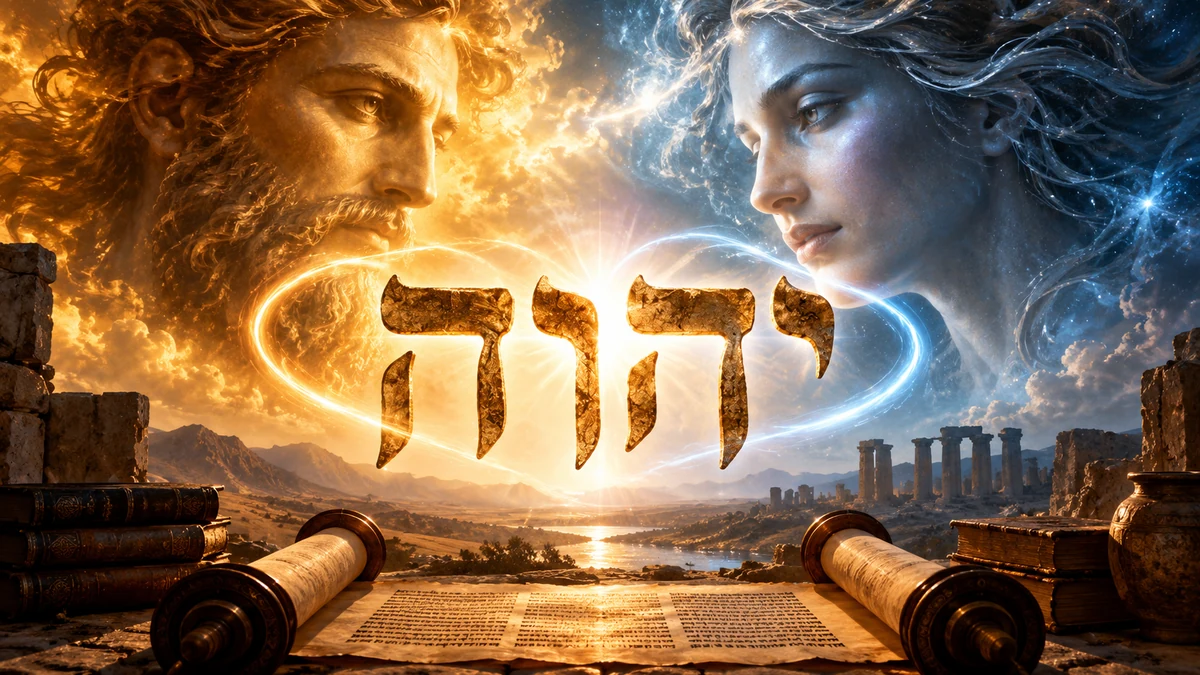
What if the name that Jewish tradition has refrained from pronouncing aloud for centuries is not only a mystery of lost pronunciation, but also a key to a different image of God? That is the starting point of Mark Sameth’s The Name: A History of the Dual-Gendered Hebrew Name for God, published by Wipf & Stock in 2020. Sameth, a rabbi and long-time reader of the Hebrew biblical text, builds the book around the proposal that the four-letter divine name YHWH could, in an early layer of tradition, be understood as an encoded combination of the Hebrew pronouns hu and hi — “he” and “she.” [1][3]
The book is therefore not simply an argument about how the Tetragrammaton may once have been pronounced. It is a history of a name, of gender, secrecy, and the transmission of religious knowledge. Across seven chapters, Sameth moves from the ancient Near East and Israelite tradition through Babylon, the rabbinic period and Kabbalah to early modern European scholars and finally to the contemporary question of what such an image of God might mean today. [2]
A name that is not spoken
At the center of the book stands the Tetragrammaton יהוה — YHWH, the four Hebrew letters used for the divine name in the Hebrew Bible. Sameth begins with a familiar feature of Jewish tradition: the name is not pronounced in public reading as it is written. Adonai, “Lord,” is used in liturgical reading, while HaShem, literally “the Name,” is common in ordinary speech. The book uses the gradual withdrawal of the pronunciation as the starting point for a larger question: whether something of the name’s meaning may also have been forgotten as its spoken form disappeared. [1][3]
Sameth’s own research story is an important part of the introduction. He describes becoming interested in wordplay, palindromic structures, reversed names, and other places where the form of the Hebrew text might carry meaning. After noticing that the Hebrew name Moses, when reversed, can be read as HaShem, he tried the same operation on the four letters YHWH. The reversed sequence suggested to him the sound hu-hi, which he associated with the Hebrew words for “he” and “she.” In the book, Sameth presents this as the beginning of a hypothesis that he then pursued for decades. [3]
The title The Name therefore works on two levels. It refers to a particular divine name, but also to what happens when a name becomes secret: who knows it, who may utter it, how its meaning is transmitted, and how later generations may read it differently from earlier ones.
From the ancient Near East to the God of Israel
The first chapter, “The Cradle of Civilization Rocked Both Ways: 2700–1400 BCE,” places Sameth’s thesis within the wider religious world of the ancient Near East. His starting point is that divine figures combining masculine and feminine qualities were not unimaginable in ancient cultures. Israel, in his account, did not arise in a cultural vacuum but between Egypt, Mesopotamia, and the Canaanite world, where religious images, names, and symbolic languages circulated and interacted. [2][5]
This provides the setting for his central interpretation. If ancient cultures could imagine divinity as joining or transcending sexual opposites, Sameth argues, then it need not be strange that an early Israelite image of God might preserve a similar layer. The book therefore does not treat early YHWH only as a grammatically masculine deity. It looks for traces of a more composite identity that, in Sameth’s account, survived in language, imagery, and later mystical tradition. [5]
Here Sameth also distinguishes the modern category of “gender” from ancient religious symbolism. His term “dual-gendered” is not merely a statement that God is a man and a woman in a contemporary biological or social sense. It is his way of describing a deity that contains two symbolic dimensions conventionally expressed as masculine and feminine.
A father who gives birth, and language that crosses gender
A second major field of the book is the set of biblical passages in which Sameth sees traces of this duality. He pays particular attention to Deuteronomy 32, where one poetic sequence contains images of God as father, as one who gives birth, and as one who nourishes. For Sameth, this movement between paternal and maternal language is not an isolated curiosity but part of a pattern he follows across the Hebrew Bible. [5]
He also focuses on grammatical and orthographic passages in which the gender of a pronoun, noun, or verbal form does not fit the reader’s expectation. In public explanations of the book’s argument, he points to Eve, Noah, Rebecca, Mordecai, Isaiah’s “nursing kings,” and Moses addressing God with at, the feminine singular form of “you.” [4][5][6]
Within the architecture of The Name, such examples perform two functions. First, they train the reader not to rely only on translations that smooth out unusual features of the Hebrew. Second, Sameth assembles them into a broader motif: the biblical text, in his reading, retains linguistic remnants of a world in which masculine and feminine were not always separated as strictly as later religious language suggests. The book therefore treats these forms cumulatively. No single example carries the whole thesis; Sameth places them side by side as recurring hints.
Adam as “two in one”
The creation of the human being occupies a special place in the argument. Sameth returns to Genesis, where humanity is created in the image of God as “male and female.” Later rabbinic traditions interpreted the first adam in ways that include a composite or androgynous being subsequently divided. Sameth uses this motif as a theological reflection of his reading of the divine name: if the human being made in the divine image originally contains masculine and feminine, then, within his framework, the story can mirror a composite nature of the divine itself. [4][5]
This connection allows the book to move from philology into theology. The letters of the name cease to be merely a Hebrew puzzle and become part of a larger question about what it means to say that humanity is made in God’s image. Sameth therefore does not stop with the proposed pronunciation Hu-Hi. He asks how a different understanding of the name might change the way readers approach creation, the relationship between male and female, and the traditional tendency to imagine God in overwhelmingly masculine terms.

From secret pronunciation to secret tradition
The next chapters are chronological: “By the Rivers of Babylon: 586 BCE–70 CE,” “The Chain of Transmission: 70–870 CE,” and “The Wandering Secret: 870–1492 CE.” Here Sameth’s narrative moves from biblical imagery to the history of secrecy itself. The name is spoken less and less; its public use becomes restricted; substitute names take its place. At the same time, the book follows traditions about the special transmission of the divine name between teachers and disciples. [3][7]
In this account, the silence surrounding the Tetragrammaton matters because it creates the conditions for esoteric interpretation. Once the name is no longer ordinary public speech, the question of its true sound and meaning can migrate into smaller circles. Sameth then looks to rabbinic and mystical literature for traces of an idea that divine unity may include the joining of masculine and feminine dimensions.
This is where Kabbalah enters the story. Concepts such as the Shekhinah and Kabbalistic images of masculine and feminine aspects of the divine become part of a longer history in which, according to Sameth, the underlying idea does not disappear but changes language. Instead of being stated simply as a claim about God’s gender, it survives through symbols, letter combinations, mystical interpretations, and teachings about the union of divine aspects. [4][7]
Reversed letters and a Kabbalistic way of reading
Sameth’s interest in reversing letters is not presented only as a personal discovery. In the historical chapters he tries to place such reading within Jewish mystical and exegetical practice. In an interview about the book, he points to Bahya ben Asher, the medieval Torah commentator, whose interpretation at times reverses sets of initials so that they form the Tetragrammaton. Sameth reads procedures of reversal, permutation, and encoded letter patterns as signs that such techniques belonged to serious religious reading rather than merely to later wordplay. [4]
He also invokes Abraham Abulafia, for whom combinations of divine letters and names were central to mystical practice. What matters for Sameth’s narrative is the idea that the true name may be deliberately concealed and that access to it can be connected with initiation, intellectual preparation, or esoteric teaching. His Hu-Hi reading thus acquires a second layer: it is not presented as something every reader should immediately see on the surface, but as something whose very character is hidden.
Postel and Lanci: an “open secret”
One of the book’s most distinctive historical turns comes in the early modern period. Sameth highlights the sixteenth-century French scholar Guillaume Postel, who worked with Kabbalistic texts and, in Sameth’s presentation, wrote that YHWH contained or joined the Hebrew pronouns for “he” and “she.” Several centuries later, the Italian scholar Michelangelo Lanci occupies a similar place in the narrative. [4][5]
They matter to Sameth because they relocate his own reading from a purely contemporary context into a history of interpretation. The book develops the notion of an “open secret”: the idea may never have been a public or dominant teaching, yet it repeatedly surfaced among people concerned with the mystical, philological, or esoteric dimensions of the Tetragrammaton. [5]
Chapter 6, “Coming Home: 1492–1948 CE,” is therefore not simply the story of one lost pronunciation. It is a story of migrating ideas: from medieval Jewish centers into Christian Kabbalah, from manuscript culture into print, from suppressed or marginal discussions into modern historical and philological inquiry. Sameth places himself at the end of this chain as someone who arrived at the hypothesis independently and only later discovered earlier precedents.
The seventh chapter: what the name can mean now
The final chapter, “Interpreting the Name: Yesterday, Today, and Tomorrow,” changes perspective. After the historical journey, the book asks what this reading could mean for a contemporary reader. Sameth uses the phrase “usable past” — a past that cannot simply be copied into the present, but that can still supply language for current questions. [4]
The first implication concerns the image of God. If divinity is not confined to the masculine symbolic pole, religious language about authority, holiness, and human resemblance to God changes as well. Sameth therefore connects the book to the status of women, to Jewish traditions of feminine aspects of divinity, and to modern conversations about gender. In public discussions of the book, he suggests that the “He-She” metaphor may also provide religious language in which people who do not experience gender as a simple binary can recognize themselves. [4][5]
The second implication reaches beyond gender. Sameth sees the duality of the name as a model in which two differences are simultaneously part of one reality. “He” and “she” remain two words, yet together they point toward one divine name. The book thus ends with a philosophical motif of unity that does not erase difference. The question of divine gender becomes an instance of a larger question: can genuine distinctions be held together without ceasing to belong to one whole? [4]
What the book brings together
At first glance, The Name can be summarized in one sentence: Mark Sameth proposes that YHWH be read as Hu-Hi, “He-She.” But that summary leaves out much of the book’s content. Its roughly 190 pages are constructed as a journey across several millennia of religious history: from ancient concepts of divinity, Hebrew linguistic anomalies, and biblical imagery through rabbinic transmission and Kabbalistic symbolism to Postel, Lanci, and a contemporary rereading of the Tetragrammaton. [1][2]
Its subject is therefore not only the pronunciation of four letters. It is the question of how religious meaning may survive even when direct access to it disappears; how ideas can hide in language, ritual, commentary, and symbol; and how a later reader can assemble those fragments into a new historical narrative. Sameth offers not merely another name for God, but a story about how that name may have been forgotten, concealed, transmitted, and rediscovered.
On its own argumentative terms, The Name seeks to show that behind the overwhelmingly masculine image of God lies an older and more complex tradition, and that the four letters YHWH, when read along Sameth’s path, can become the shortest possible expression of that duality: He-She, difference held within unity.
Sources and further reading
- Wipf & Stock — Mark Sameth, The Name: A History of the Dual-Gendered Hebrew Name for God (2020), official book page. Source
- Perlego — The Name, table of contents and Chapter 1 preview. Source
- Everand — The Name preview, introduction and author account of the hypothesis. Source
- Joanne Palmer, “God’s dual-gendered name,” Jewish Standard, May 5, 2021. Source
- Mark Sameth, “Our Father, Who Art Our Mother: The (Open) Secret Queer History of God,” Religion Dispatches, August 13, 2020. Source
- Mark Sameth, “Is God Both Male and Female?”, The Forward, March 13, 2017. Source
- Google Books — Mark Sameth, The Name, bibliographic record, contents and indexed terms. Source