The Disarmament of the Territorial Defence and the MSNZ: Who Controlled the Weapons Before Slovenian Independence?
What happened to Slovenia’s Territorial Defence weapons in 1990 and how an alternative defence structure formed before independence.
The day before the new government
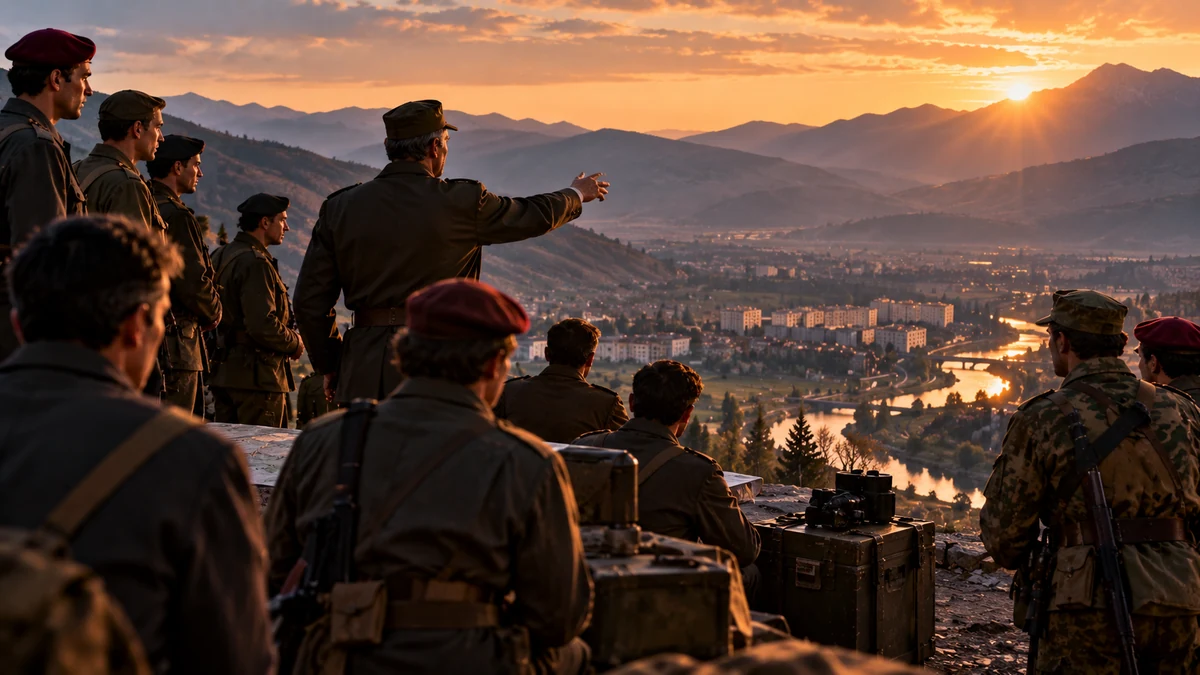
On 15 May 1990, one day before the election of the first democratically elected Slovenian government after the multi-party elections, the Republic Headquarters of the Territorial Defence of Slovenia issued an order requiring weapons, ammunition, and explosive materials of the Territorial Defence stored outside Yugoslav People’s Army facilities to be transferred into facilities under JNA control.[1][2] The order came at an exceptionally sensitive moment. The April 1990 elections had brought the Demos coalition to political power. The new government of Lojze Peterle was elected on 16 May.
Janez Janša took responsibility for people’s defence, and Igor Bavčar for internal affairs.[3] But Slovenia’s military system was not yet under the political control of the new Slovenian government. The Territorial Defence was part of the common armed forces of the SFRY. Its structure was republican, but the chain of command was also embedded in the federal military system. At its summit in Slovenia stood Lieutenant General Ivan Hočevar. It was in this transitional moment that the order concerning the weapons arrived. For the emerging Slovenian authorities, the message was clear: the political majority had changed, but the military balance of power had not.
What was the Territorial Defence?
To understand the significance of the order, we first have to understand what the Territorial Defence was. The Territorial Defence was not a private Slovenian army existing outside Yugoslavia. It was part of the Yugoslav concept of total people’s defence. After the Soviet intervention in Czechoslovakia in 1968, Yugoslavia developed a two-component defence system: the JNA as the federal standing army, and the Territorial Defence as a mass, locally organized defence structure of the republics and provinces. Slovenia’s Territorial Defence had: a republican headquarters,
regional headquarters, municipal headquarters, reserve units, its own weapons, local personnel records, depots, and strong links to municipal structures.[4] In a war against an external aggressor, it was supposed to operate together with the JNA. But precisely because of its decentralized structure, in a political crisis it could also become a potential armed force of an individual republic. That was crucial in 1990. Most heavy weapons were already in JNA facilities.
The expression “disarmament of the Territorial Defence” can create the impression that until 15 May 1990 all Slovenian weaponry was held in independent Slovenian depots and that the JNA then confiscated it within a few days. That is not accurate. A large part of Slovenia’s Territorial Defence weaponry was already stored inside JNA facilities before May 1990. Janez Slapar, then commander of the Gorenjska Territorial Defence and later head of the Slovenian Republic Headquarters, later estimated that the Territorial Defence had around 68,000 weapons, of which about 70 percent were already stored inside facilities controlled by the JNA. Almost all heavier systems were there as well — larger-caliber weapons, an important part of the anti-tank equipment, missiles, and substantial quantities of ammunition.[5]
The May order therefore did not mean only the physical transfer of weapons from one army to another. Above all, it meant the concentration of effective control over the armament in facilities controlled by the JNA. That distinction matters. The weapons could formally still belong to the Territorial Defence system. But if they could not be accessed without JNA consent, their political and operational value to the Slovenian republican authorities was severely limited.

Order No. SZ 625/1-90
The order that triggered the crisis was designated in Slovenia’s Republic Headquarters as SZ 625/1-90. It required weapons, ammunition, and explosive materials kept outside JNA facilities to be transferred into facilities under its control. The deadline for implementation was only a few days.[6] The latest scholarly treatment, by Alojz Šteiner in 2026, uses somewhat more precise language: handover, relocation, or removal of control over the weapons. The author emphasizes that the attempt was only partly successful and that interpretations of the purpose and legal character of the measure still differ.[1] That is a useful correction to political shorthand. The word “disarmament” is understandable because for many Territorial Defence units the operational consequence was precisely the loss of access to weapons.
But this must not be turned into a claim that every Slovenian weapons store was completely emptied in May 1990. It was not. Why did the JNA want the weapons under direct control? Here the historical interpretations diverge. Slovenian independence historiography generally understands the measure as an attempt to prevent the Territorial Defence from becoming the military instrument of the new Slovenian authorities after democratic political change. Evidence supporting that interpretation includes: the timing of the order immediately around the transfer of political power, the prior collection of detailed information about weapons stored outside JNA facilities, the growing conflict between Slovenian politics and the military leadership, and the fact that the political changes in Slovenia and Croatia were being treated in federal military circles as a security problem.[6][7] A more restrained formulation is:
in a rapidly disintegrating political system, the military leadership attempted to centralize control over weapons that could, in the event of a constitutional conflict, come under effective republican control. For Slovenia, the practical effect was the same regardless of motive: the new democratic authorities inherited a republic, but not yet effective control over its main reserve military structure. Some commanders did not carry out the order.
The order was not received in the same way everywhere. Some commanders of municipal headquarters resisted the handover or prevented it. There is an interesting source problem concerning the number of such headquarters. Different Slovenian official, veterans’, and historical sources cite 14, 15, or 16 municipal headquarters, depending on methodology, the moment being counted, and whether partly retained weapons and special units are included.[8][9][10] A veterans’ study that lists units individually gives 16 municipal headquarters and the 30th protection/development group. Some official state overviews use the number 14.[8][9] For that reason, this article does not turn the number into a political symbol. The more important fact is different:
the order was not fully implemented. In several parts of Slovenia, a significant quantity of weapons remained outside direct JNA control. Gorenjska was particularly important; according to Slapar’s testimony, around 12,000 weapons were retained there.[5]
Slovenia was not left completely without weapons
Here too, a correction to a common story is needed. After May 1990, Slovenia’s Territorial Defence was not literally left without weapons. Some weapons were not surrendered. Other republican structures possessed weapons. The militia and internal-affairs bodies held significant quantities. Later, weapons were also secretly removed from depots, transferred to concealed stores, and obtained from other sources.[11][12] The Association of Veterans of the War for Slovenia, on the basis of its archival research, states that when the weapons of municipal structures, defence-administration bodies, and the protection brigade are included, tens of thousands of infantry weapons remained within Slovenian structures.[9] That figure has to be used carefully because it combines different categories of weapons and different organizational structures.
But the basic conclusion is reliable: Slovenia was not completely disarmed in May 1990. It was, however, militarily much weaker and lacked secure control over a large part of the armament required for mass Territorial Defence mobilization. Why was the political shock so great?
Because the Territorial Defence system was built precisely on the idea that it could be mobilized locally. A municipal headquarters without its own access to weapons could still have: lists of personnel, commanders, plans, vehicles, local connections. But it lacked the most important means for combat. Weapons. The dispute in May 1990 was therefore much larger than a disagreement over inventory. It was the question: Who has the final word if the Slovenian political authorities and the federal military authorities end up on opposite sides? In May 1990, the answer was not yet the Slovenian government. That is why the following months would be devoted to changing that answer.
The Presidency stops further handover — but some weapons are already gone
After reports from the field, the Slovenian political leadership demanded that further transfers of weapons be stopped. Politically charged disputes remain over exactly when President of the Presidency Milan Kučan was informed, how quickly he responded, and how much weaponry could have been saved by an earlier reaction. This article separates such disputes from the hard facts. What is documented is: information about the movement of weapons arrived from the field; the Presidency then ordered a halt to further handover; and in many places the operation had already been carried out by that point.[6][10] That is enough for the historical conclusion.
A political judgment about the individual responsibility of particular figures would require a separate reconstruction of all messages, recordings, receipt times, and constitutional competences. This article does not replace that work with a party slogan.
17 May: the beginning of resistance or the beginning of the MSNZ?
In Slovenia’s official commemorative calendar, 17 May 1990 is often cited as the date on which the Maneuver Structure of National Protection — MSNZ — was founded.[13] Academic literature is more cautious. Historians and defence scholars point out that by 17 May the MSNZ was not yet a fully formed, named, and nationwide organization with a complete personnel structure. It is more accurate to say:
after the removal of weapons, covert self-defence activities began, from which over the following months an organized network developed that later became known as the MSNZ.[14][15] Even the name itself is somewhat paradoxical. “National Protection” had originally been a local auxiliary security structure under Yugoslav law. “Maneuver” implied something broader — the ability to operate beyond a single municipality and form an actual armed republican force.[15] That legal grey area was useful. It enabled the creation of a defence organization within the still-existing Yugoslav legal space without the Slovenian government openly declaring in May 1990 that it was establishing a new army.
The green and blue networks
The MSNZ was not merely a project of former Territorial Defence personnel. One of the most important characteristics of the emerging Slovenian defence system was cooperation between: the military component of the former Territorial Defence, and the internal-affairs organs, or Slovenian militia. The literature often speaks of the green and blue components. The military component provided: commanders, reservists, military plans, some weapons, knowledge of the mobilization system. The militia had:
legal armament, a functioning command structure, communications, facilities, vehicles, intelligence information, and above all a system the JNA could not directly command.[11][15] One year later, during the war for Slovenia, this cooperation would become one of the central features of the Slovenian defence system. The Territorial Defence and the militia would not operate as two completely separate state forces. They were preparing for the same problem. Secret weapons stores.
One of the most concrete tasks of the new defence network was simple: the weapons had to be stored where the JNA could not take them with one order. Secret depots therefore appeared across Slovenia. Weapons were stored in: municipal buildings, police facilities, civil-defence depots, industrial buildings, residential and private premises, and other locations known to a very limited number of people.[11][16] In some environments, weapons already located in JNA facilities were later secretly removed and transferred elsewhere. Biographical and local military-historical studies describe night transports, changing routes, and the use of different collaborators so that the entire network could not be uncovered at once.[16] This was not a large classical military operation. It was the logistics of a covert state in the making. Who led the project?
The political framework was provided by the republican secretariats for people’s defence and internal affairs, led by Janez Janša and Igor Bavčar. Anton Krkovič received an important military-organizational role. Vinko Beznik played a significant role in linking the project to the militia and special internal-affairs units.[13] By the end of summer and into September, the structure spread across Slovenia.
Official commemorative sources speak of organization in all then-existing regions and municipalities and estimate around 22,500 members.[13] Academic research warns that this number should not be understood as meaning that all 22,500 people were personally informed, uniformed, and activated on one particular day. Part of the organization existed through records and prepared mobilization structures; some individuals learned of their inclusion only later.[11][15] That is the important distinction between: organizational mobilization capacity and a permanent active army. The MSNZ was not a 22,500-person barracks. It was a covert network designed to make it possible to create an armed force at the moment of crisis.
During summer 1990, the objective changed
In the first days after the removal of weapons, the main objective was to preserve what could still be preserved. During the summer, the concept widened. The Slovenian authorities did not want merely to hide several rifles. They wanted: their own command structure, a mobilization network, operational plans, communications, weapons, and the ability to react in the event of a federal military intervention.[14] On 7 September 1990, an important meeting of the project leadership took place at Pristava nad Stično, where operational plans and possible scenarios were coordinated.[17] By then it was increasingly clear that the defence preparations no longer concerned only an abstract external aggressor.
The potential adversary could also be the JNA. For a republic that was still formally part of Yugoslavia, this was an enormous political shift. Why did Slovenia not simply establish its own army in May 1990?
Because it did not yet have the legal, political, or international space to do so. In May 1990, Slovenia had not declared independence. It was still a republic of the SFRY. The federal constitutional order still applied. The JNA was the legal federal armed force. Openly establishing an independent Slovenian army could have been interpreted as a direct rebellion against the federal order. For several months, Slovenian strategy therefore operated on two levels: publicly, Slovenia increased its political and constitutional sovereignty; covertly, it built the ability to defend that sovereignty physically. The MSNZ was the bridge between those two levels. September 1990: the political authorities change the constitution.
The key shift came at the end of September. The Assembly of the Republic of Slovenia adopted constitutional amendments XCVI, XCVII, and XCVIII and an implementing constitutional law.[18] With these measures, Slovenia assumed substantially greater control over its Territorial Defence. The Presidency of the Republic of Slovenia gained authority to direct and command the Territorial Defence in peacetime and to appoint its commander.[18][19] That was the decisive legal step. Until then, a covert defence structure had existed because the formal Territorial Defence was not reliably subordinate to the Slovenian authorities. After the constitutional changes, the reverse process could begin: the covert structure could be transferred back into the legal Territorial Defence — now under Slovenian command.
Janez Slapar takes over the new Republic Headquarters
On 28 September 1990, the Slovenian Presidency appointed Major Janez Slapar as acting head of the Republic Headquarters of the Territorial Defence. On 4 October, he appointed the commanders of the new regional headquarters.[19][20] With that, the basic function of the MSNZ as a parallel military structure had been fulfilled. Most of its military network passed into the Territorial Defence. The Slovenian Army did not yet exist under its present name. But the core of an independent Slovenian defence system had already been established. October: the dispute is no longer merely bureaucratic.
The JNA did not accept the changes quietly. On 4 October 1990, JNA military police occupied the former Republic Headquarters building of the Territorial Defence on Prežihova Street in Ljubljana.[21] But the new Slovenian command had already relocated and was operating elsewhere. The event was symbolic. In spring, the JNA had used a command order to take control over a large part of the weapons. In autumn, Slovenia used a constitutional change to take control of the Territorial Defence command structure. Two authorities were increasingly behaving as though each had its own legitimate military chain of command. In the same territory. This was no longer merely a political crisis. It was the beginning of dual authority over armed force.
Kočevska Reka: the covert structure appears in public
On 17 December 1990, a Territorial Defence unit, composed largely of members of the protection brigade, was publicly assembled at Kočevska Reka, only days before the plebiscite.[22] The formation had military significance. It also carried a political message. The Slovenian leadership wanted to show: that the plebiscite decision would not be merely a sheet of paper; that the emerging state possessed an armed structure; and that it was capable, at least in principle, of organizing its own defence. This was a major shift from May.
Seven months earlier, the question had been: How many weapons do we still have? By December the question was: Can we turn those weapons, people, the militia, the territorial network, and the new command into a force capable of actually defending the state? January 1991: Belgrade again demands the weapons.
On 9 January 1991, the Presidency of the SFRY issued an order demanding the dissolution of all armed formations not belonging to the armed forces of the SFRY and the surrender of their weapons within ten days.[23] The order was directed primarily at the arming of Croatia, but it also affected the broader question of republican military structures. Slovenia replied that its Territorial Defence was not an illegal formation and that it would not surrender its weapons. Janez Slapar publicly emphasized that the armament was now stored outside JNA facilities.[24]
This is the clearest proof of how dramatically the situation had changed since May. In May 1990, the Slovenian authorities were discovering that they lacked effective control over much of their weapons. By January 1991, they could already answer a federal order: we will not hand over the weapons. Was the MSNZ “the first Slovenian army”?
It depends on what we mean. If we mean: the first modern defence structure loyal to the new Slovenian political authorities and prepared for possible conflict with the JNA, then that description is understandable. But if we claim: that on 17 May 1990 there already existed a fully organized, legal, clearly defined Slovenian army with 22,500 active members, that is too simplified. Academic literature points precisely to this terminological problem.[11][14][15]
The MSNZ was: a process, a network, a covert project, a transitional structure, and a political-military response to the loss of control over the Territorial Defence. Its most important function was not to exist as long as possible. It was successful precisely because by autumn 1990 it could transfer much of its function to the new Slovenian Territorial Defence.
Was the JNA already a hostile army in May 1990?
Here too historical caution is necessary. In May 1990, the JNA was formally not a foreign army. Slovenia was still a member republic of the SFRY. Slovenian conscripts served in the JNA. Slovenian officers were part of its structures. Many people still expected a political agreement on the future of Yugoslavia. But from the perspective of the emerging Slovenian authorities, the May order showed something very important: in the event of a serious constitutional conflict, it could no longer be automatically assumed that the JNA would remain a neutral guardian of an agreement among the republics.
From that moment, it was necessary to plan for the possibility that the federal army itself might become the force Slovenia would have to defend against. By September, MSNZ planning already explicitly considered that possibility.[17] This was one of the most important turning points in the entire independence process.
Disarmament or the birth of defence sovereignty?
In May 1990, Slovenia lost control over a significant part of the Territorial Defence’s weapons. But the paradox is that this very event accelerated the construction of the structure it would use in war a year later. Without the weapons order, control over the Territorial Defence might have remained for months a constitutional and legal dispute. After the order, the question became practical. Where are the weapons? Who guards them? Who has the list of reservists? Who issues orders? Who controls communications? Who is willing to carry out an order? What will the police do? Who can mobilize people? Within days, statehood acquired its most material definition. A state that does not control its own armed force has limited sovereignty.
Soon there would be too many weapons, not too few. Up to this point, the story is mainly one of weapons scarcity. But already in 1991, the situation would reverse. Slovenia and Croatia would need ever more weapons. The federal military system would be breaking apart. JNA depots would become the subject of blockades, negotiations, and seizures. Weapons would pass from one structure to another. After the war, Slovenia would also possess large quantities of weapons it no longer needed. And that is where one of the most controversial stories of Slovenian independence begins:
secret transports, Croatia, Bosnia and Herzegovina, money, state accounts, cash, intermediaries, and the question of what constituted legitimate help to attacked republics and what became trade. From here follows a concrete examination: Slovenian Arms 1991–1993: Aid to Croatia and Bosnia, Trade, Money, and Scandals
Sources and further reading
- Šteiner, Alojz. “Manevrska struktura narodne zaščite in začetki odpora ob odcepljanju Slovenije leta 1990.” Anali PAZU HD, 15(1/2), 2026, pp. 3–28. The latest scholarly treatment of the events of May 1990; stresses that the order concerned handover/relocation of weapons, that the attempt was only partly successful, and that its interpretation remains disputed. Source 1 Source 2
- Government of the Republic of Slovenia. Historical overview of the order of 15 May 1990 to transfer Territorial Defence weapons. Source
- Government of the Republic of Slovenia. Composition and date of the first Demos government, elected on 16 May 1990. Source
- Bolfek, Boris. Teritorialna obramba kot oblika vojaške organiziranosti. Historical overview of the Territorial Defence system, its organization, and armament. Source
- Slapar, Janez. Contribution on the emergence of the Slovenian armed forces, Naše vezi, 2011. Gives an estimate of around 68,000 weapons, about 70% already stored in JNA facilities, and discusses the situation in Gorenjska. Source
- Kladnik, Tomaž. “Razorožitev.” E-enciklopedija slovenske osamosvojitve, državnosti in ustavnosti. Overview of order SZ 625/1-90, the earlier collection of weapons data, and the transfer process. Source
- Čepič, Zdenko; Čuček, Filip; Gašparič, Jure; Guštin, Damijan; Repe, Božo; Svete, Uroš. Prikrita modra mreža: organi za notranje zadeve Republike Slovenije v projektu MSNZ leta 1990. Institute of Contemporary History, 2010. Source
- Government of the Republic of Slovenia. Official chronology of 1990–1991, citing 14 municipal Territorial Defence headquarters that retained weapons fully or partly. Source
- Association of Veterans of the War for Slovenia. Review drawing on the study Orožja nismo oddali 1990, citing 16 municipal headquarters and the 30th protection brigade and discussing the amount of retained infantry weapons. Source
- Stušek, Janko S.; Koselj, Janez; Zvonar, Ludvik. “Problem oddaje orožja teritorialne obrambe in posledice za njeno oborožitev od maja do oktobra 1990.” Bibliographic entry: Source
- Gašparič, Jure / Guštin, Damijan et al. Prikrita modra mreža. Discusses cooperation with internal-affairs bodies, police resources, secret depots, and the gradual development of the new republican defence structure. Source
- Fišer, Miran. “Kako sem obuval vojaške škornje.” SIstory. Testimonial and documentary description of secret removal and transfer of weapons into local concealed depots. Source
- Government of the Republic of Slovenia. Official commemorative overview of the MSNZ project, the roles of Janša, Bavčar, Krkovič, and Beznik, and the estimate of around 22,500 members. Source
- Svete, Uroš. “Manevrska struktura Narodne zaščite v povezavi slovenskih (samo)obrambnih prizadevanj v letu 1990.” In: Prikrita modra mreža, 2010. Source
- Svete, Uroš. “Manevrska struktura Narodne zaščite med strateškim konceptom in taktično realizacijo.” Prispevki za novejšo zgodovino, 2012. Discusses the terminological and organizational problem: the MSNZ was not a completely unified and clearly defined organization from the outset. Source
- OZVVS Idrija–Cerkno / local military-historical records. Documented examples of secret storage and redistribution of arms after May 1990. Source
- Government of the Republic of Slovenia. Historical account of the 7 September 1990 Pristava nad Stično meeting and defence planning that considered the JNA as a possible adversary. Used chiefly as participant-source documentation of the leadership’s own planning and interpretation. Source
- Government of the Republic of Slovenia. “Independence Acts of the Republic of Slovenia.” Official collection of constitutional amendments XCVI–XCVIII and implementing legislation from September and October 1990. Source
- Constitutional Act implementing Amendments XCVI and XCVII to the Constitution of the Republic of Slovenia in the field of people’s defence, Official Gazette RS 35/90. Source
- Slovenian Armed Forces. “30 years — milestones.” Appointment of Janez Slapar and new regional commanders; dissolution of the MSNZ and incorporation into the Territorial Defence. Source
- Military Museum of the Slovenian Armed Forces / Wikimedia Commons. Documentary photograph of JNA military police at the former Republic Territorial Defence Headquarters on 4 October 1990. Source
- Government of the Republic of Slovenia / Municipality of Kočevje. Kočevska Reka, 17 December 1990 — public formation of a unit of the emerging Slovenian armed forces / Territorial Defence protection brigade. Source 1 Source 2
- Government of the Republic of Slovenia. 9 January 1991 federal order on the dissolution of unauthorized armed formations and surrender of weapons. Source
- Government of the Republic of Slovenia. 19 January 1991: Peterle and Slapar reject the claim that Slovenia’s Territorial Defence must surrender its weapons and state that the weapons are stored outside JNA facilities. Source