Intelligence Services and Covert Operations
Beneath divided Berlin in the 1950s, an operation was underway that would be difficult to describe with the word “espionage” alone. The American CIA and Britain's Secret Intelligence Service (SIS, or MI6) used a tunnel to reach underground communications lines on the eastern side of the city.
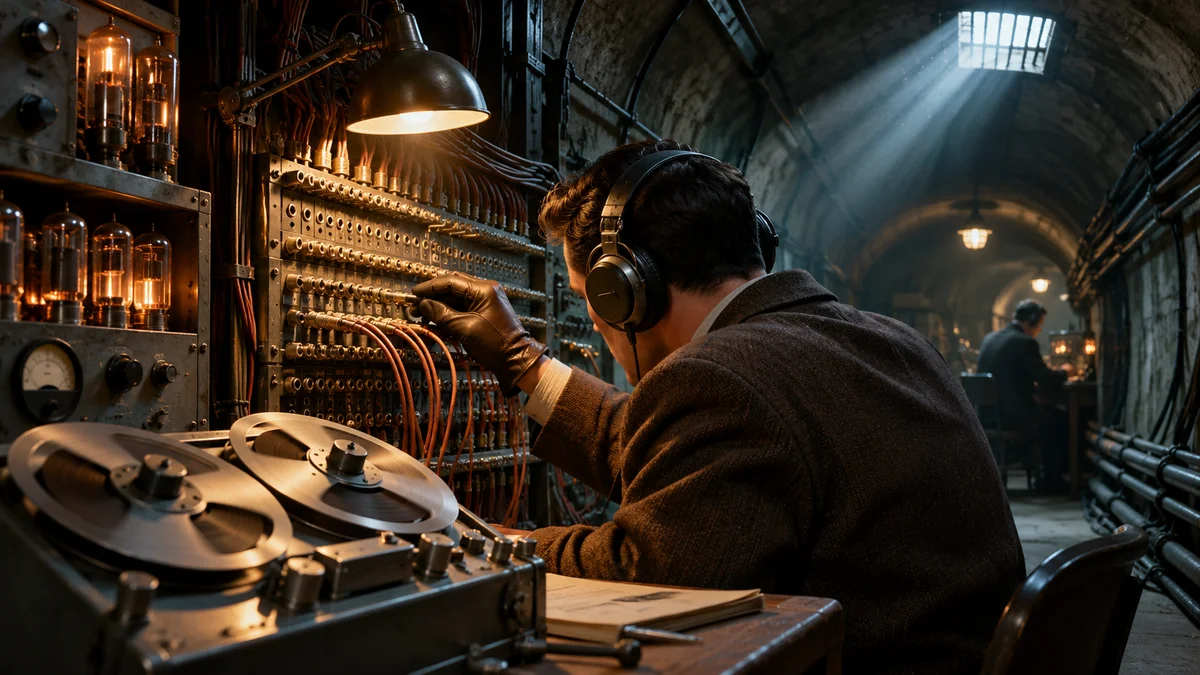
Editorial illustration of covert communications interception and the technical side of covert operations; it does not depict a single documented historical scene.
Beneath divided Berlin in the 1950s, an operation was underway that would be difficult to describe with the word “espionage” alone. The American CIA and Britain's Secret Intelligence Service (SIS, or MI6) used a tunnel to reach underground communications lines on the eastern side of the city. Their personnel intercepted Soviet and East German communications. When the tunnel was exposed in April 1956, work that had required prolonged preparation and complete secrecy suddenly became visible to the public. [1] [2]
Yet the same intelligence world that gathered information about its adversaries' intentions also took part in changing political circumstances in other countries. Declassified documents concerning Iran in 1953 and Guatemala in 1954 allow us to examine this distinction without assuming the existence of an omnipotent, invisible command center. We are asking not only what the services knew. We are asking who instructed them to carry out particular actions, what methods they used, and who bore the consequences of decisions of which the public was unaware at the time.
The Secret Tunnel and the Real Purpose of Intelligence Collection
Operation GOLD was a technically demanding joint undertaking by the CIA and Britain's SIS. According to the CIA's publicly available historical account, Director Allen Dulles approved the plan in January 1954; the actual interception of communications began on May 11, 1955. The tunnel was concealed beneath facilities that appeared to serve another purpose. The German historical project German History in Documents and Images also documents the subsequent public viewing of the discovered tunnel in East Berlin on May 3, 1956. [1] [2]
The operation's significance lay in gathering intelligence. The United States and the United Kingdom wanted a better understanding of Soviet military capabilities, communications, and intentions. Such collection may be secret, technically complex, and politically sensitive, but that does not make it an attempt to replace a foreign government. The distinction is fundamental: obtaining information is one thing; covertly shaping the events for which that information matters is another. Both may raise questions of legality and sovereignty, but we should not collapse them into a single kind of act. [1] [2]
The Berlin story also exposes the vulnerability of intelligence services. The CIA identifies George Blake, an SIS officer, as having disclosed the plan to the Soviet side. The German historical account separately describes the Soviets' prior knowledge and a double agent, although its brief text does not name him. The CIA nevertheless portrays the operation as valuable for intelligence gathering. This is important testimony from the institution that conducted the operation, not an independent final assessment of its impact: how much of the material was reliable and how decision-makers actually used it remain separate research questions. [1] [2]
Collection, Counterintelligence, and Covert Action
An intelligence service is not a single mechanism. Some of its personnel obtain information from human sources, others analyze intercepted data, and still others investigate foreign agents or protect their own operations. Counterintelligence seeks to identify hostile penetrations and assess whether sources can be trusted. Covert political action, by contrast, seeks to influence events while concealing from the public the role of the state conducting it. Under United States law, 50 U.S.C. § 3093(e), “covert action” is defined as activity intended to influence conditions abroad while the U.S. role is not publicly acknowledged; the definition excludes, among other things, activities primarily intended to acquire intelligence and traditional counterintelligence activities. This is a useful later legal definition, not a standard by which the legality of actions in the 1950s can be judged without further historical analysis. [3]
In its public account, Britain's SIS describes gathering information about the activities and intentions of actors outside the United Kingdom and verifying it for the government. The Intelligence Services Act 1994, particularly Section 1, publicly established its statutory functions and affirmed the service's continued existence under ministerial authority. This does not mean the service was founded only in 1994; nor is that Act a direct legal basis for interpreting operations conducted decades earlier. SIS/MI6 is also not the same as MI5 or the entirety of Britain's security institutions. [4]
There are compelling reasons for secrecy: exposing a source can endanger that person's life, while prematurely revealing an operation may destroy the chance to acquire important information. But the need to protect sources does not establish an unlimited right to use propaganda, finance foreign political groups, or interfere in other societies' internal decisions. The question is not whether intelligence work may ever be secret. It is who sets the limits of secrecy, who checks those limits, and what happens when the line between providing intelligence to policymakers and secretly implementing policy is crossed.
Who Directs the Services — Institutions, Relationships, and Access to Information
During the Second World War, the United States established the Office of Strategic Services (OSS), led by William “Wild Bill” Donovan. A historical account by the U.S. National Park Service also describes connections with British intelligence circles, including William Stephenson. Historians differ over how decisively British experience shaped the American organization. The OSS was a wartime U.S. government organization, not a private subsidiary of a British service; nor should the later CIA be treated as merely the OSS under a new name. [5]
In the 1950s, a personal connection between the leaders of two major American institutions was beyond doubt. John Foster Dulles was Secretary of State, while his brother Allen Dulles was Director of the CIA. The State Department's official history expressly describes their cooperation. This was a real link between diplomacy and intelligence activity, and it warrants examination: shared political aims could take shape through official channels, while the means of pursuing them remained hidden from the public. Yet a family relationship or membership in an influential circle is not, on its own, proof that a private association ordered an operation. Such a claim would require a traceable chain from that association's decision to a specific order and its implementation. [6]
Control over information within a service matters as well. The CIA states that it established its Counterintelligence Staff on December 20, 1954, under James Jesus Angleton, and describes his considerable institutional power and the later disputes surrounding the search for Soviet penetrations. Someone who decides which sources are treated as credible, what is presented as a threat, and which information remains confined to a small circle can significantly influence the leadership's judgment without holding the highest government office. This describes a possible mechanism of influence; it is not proof that Angleton personally determined the whole of American foreign policy. [7]
Such personal and institutional connections are useful starting points for investigating power. They are not substitutes for records showing who gave orders. For each operation it is worth distinguishing political authorization, preparation of the plan, the network of intermediaries, implementation, and reporting of the results. If we merge all these stages under the label “secret elite,” we lose precisely what we are trying to understand: how influence was actually exercised.
Iran: From a Diplomatic Proposal to Operation TPAJAX
The distinction between a political idea and an operational order is especially clear in the documents on Iran. A U.S. State Department memorandum dated November 26, 1952, reports a British proposal to replace the government of Prime Minister Mohammad Mosaddegh (Mossadegh). The document describes earlier contacts between diplomatic and intelligence representatives, but also records American reservations: the risk of failure, the uncertain position of any replacement government, and the possibility that an oil settlement might still be worth pursuing. A record of a conversation on December 3, 1952, shows that the American representatives had not yet committed themselves to joint planning of a coup. [8] [9]
We must not move these two records into 1953 and describe them as a final authorization for the operation. They show how the idea took shape and how different government actors assessed its risks. Nor is a British diplomatic proposal automatically evidence that a particular MI6 officer issued a specific operational command. The sources raise questions about coordination between diplomacy and intelligence agencies, but they do not justify turning the distinct work of these people into one undifferentiated action. [8] [9]
A different kind of record is the CIA's internal memorandum dated March 8, 1954, published as Document 363 in Foreign Relations of the United States (FRUS). Looking back, the CIA describes a campaign aimed at bringing down Mosaddegh's government and establishing a new government under the Shah with General Fazlollah Zahedi. The methods listed include pressure on the Shah, bringing together opposing Iranian political groups, propaganda, and covert organization of support within the military. The memorandum states that the U.S. President, the Secretary of State, and the CIA Director approved the plan on July 11, 1953. An editorial note in the same FRUS collection (Document 225) explains that the operation's chronology recorded State Department and British Foreign Office approval on that date, with a handwritten addition indicating presidential approval, but that no written presidential approval was found. We therefore have direct evidence of what the services recorded about authorization, not a written presidential authorization that can itself be examined. [10]
The historical picture is not confined to Washington and London. In Iran, the Shah, opposition groups, military personnel, religious figures, and other social actors all pursued interests of their own. Foreign intervention did not erase their agency, but neither does their agency negate the CIA's documented role. The memorandum expressly dates Mosaddegh's removal to August 19, 1953, while the preceding sentence claims he had already been forced to flee on August 17. This is an apparent chronological inconsistency within the document itself, not a reason to change the historically established date of August 19. Together with the memorandum's self-justifying language, it shows why a primary source should not be read as an infallible arbiter. [10]
Operation TPAJAX is not evidence of a secret order issued by an unknown association; we have direct archival evidence of the actions of a specific state agency. That is exactly why the case matters. It allows us to examine the consequences of covertly influencing another country's future without filling gaps in the explanation with speculation.
Guatemala: When Secret Authorization Becomes Political Intervention
In Guatemala, the trail of evidence begins with an exceptionally direct document. On December 9, 1953, CIA Director Allen W. Dulles signed a memorandum approving Project PBSUCCESS and allocating up to three million U.S. dollars. The document describes how the operation would be financed, internal accountability for expenditures, and audit arrangements. This figure is an authorized ceiling in that particular document, not automatic proof that the full amount was actually spent. [11]
Behind the operation lay a genuine political and social conflict within Guatemala. President Jacobo Árbenz pursued agrarian reform that challenged the highly unequal distribution of land and the interests of major landowners, among them the United Fruit Company. Some inhabitants supported the reform; others vehemently opposed it. In the Cold War environment, American decision-makers regarded the links between some members of Árbenz's circle and communists as a security threat. The State Department's official retrospective history documents both the internal Guatemalan conflicts and American planning for covert intervention. [12]
According to the official FRUS historical account, the CIA supported the group led by Carlos Castillo Armas, trained his men, and expanded contacts with Guatemalan officers. In June 1954, armed incursions, propaganda, diplomatic pressure, and aerial operations associated with the project contributed to the crisis; Árbenz resigned on June 27, 1954. This does not mean Guatemalans lacked political agency or that a single cause explains everything. It does mean that the existence and activity of an external covert intervention are not merely a later conjecture. [13]
The case reveals an important feature of operational power. Political debate about another country can be moved out of visible diplomacy and into a restricted circle of planners, financial authorizations, contacts with local groups, and public messages whose origin is concealed. When such an operation succeeds, the public often sees its immediate outcome but not the chain of decisions that helped produce it. Assessing responsibility therefore requires specific memoranda, instructions, transfers, and operational reports — not an image of an impersonal “force behind the scenes.”
Comparison of Three Documented Operations
| Case | Type of operation | Core method | What is documented | Editorial limitation |
|---|---|---|---|---|
| Operation GOLD (Berlin, 1954–1956) | Intelligence collection | Secret tunnel and technical interception of communications | The CIA and SIS/MI6 cooperated in a wiretapping operation against Soviet links in Berlin. | The operation’s effectiveness and strategic meaning should not be conflated with a coup or a propaganda campaign. |
| TPAJAX (Iran, 1953) | Covert political operation | Propaganda, political pressure, coordination with domestic actors | Internal CIA records document involvement in the removal of Mosaddegh’s government. | Some details of authorization and responsibility remain historiographically disputed or incompletely documented. |
| PBSUCCESS (Guatemala, 1954) | Covert political operation | Psychological warfare, support for an exile force, pressure on the regime | Documents confirm covert U.S. support for the operation against Jacobo Árbenz. | The approved funding ceiling is not the same as proof of final expenditure or of the operation’s entire long-term impact. |
What May Remain Secret, and Who Must Be Accountable?
Berlin, Iran, and Guatemala do not illustrate a single method. Berlin demonstrates technical intelligence collection and the danger of counterintelligence penetration; Iran reveals planned political pressure and covert support for a change of government; Guatemala shows the clearly documented authorization and implementation of a political intervention project. What these cases share is not proof of a single private command center, but reliance on secrecy, restricted access to information, and decisions the public could not scrutinize while they were being carried out. [1] [10] [11] [13]
There are serious counterarguments to simply condemning all intelligence work. States face espionage, concealed threats, and military uncertainty. Protecting sources may be necessary, and effective intelligence gathering can prevent mistaken and dangerous decisions. Yet Cold War fears, appeals to national security, or internal authorization do not, by themselves, settle questions of political legitimacy and the rights of people in the country where the intervention occurs. Nor is it fair to claim that every operation can be assessed under today's laws without examining the rules that applied at the time. [3] [4]
In the United States, the Church Committee investigated the work of intelligence agencies in 1975–1976 and documented significant abuses. For our purposes, its importance lies primarily in a principle: even highly secret activities need not remain forever beyond public scrutiny. A detailed examination of statutory restrictions and reforms belongs in a later article in this series. Here the essential question is whether democratic oversight has access to the information it needs to distinguish necessary secrecy from covert avoidance of accountability. [14]
Research into hidden power can quickly succumb to the temptation to treat personal acquaintances, family ties, or club memberships as a complete explanation. With intelligence services, that is unnecessary. Declassified records themselves expose sufficiently serious problems: selective information, the organization of intermediaries, the preparation of operations, covert propaganda, and the consequences for people in other countries. If we suspect that a private network also played a decisive part in the decision-making, that is a legitimate question — as long as we do not call it proven without verifiable orders, financing, or coordination.
A person's inner freedom begins with the right not to accept either an official or an alternative account merely because it comes from someone supposedly endowed with special knowledge of the truth. Political freedom requires something more tangible: decisions about our common future must not be made entirely without accountability. Intelligence services will need to keep some things secret. But if a state can never answer who ordered an intervention, who benefited, and who bears its consequences, secrecy is no longer just a way to protect information. It becomes a question about the very nature of power.
Sources and further reading
- Central Intelligence Agency (CIA), Berlin Tunnel: America's Ear Behind the Iron Curtain, April 19, 2024, sections “Operation GOLD,” “Spies Beneath the City,” “A Mole in Our Midst,” and “Intelligence Success or Failure?”. source Source
- German History in Documents and Images (German Historical Institute), Public Viewing of an American Spy Tunnel in East Berlin (May 3, 1956), historical description and context for Horst Sturm's photograph. source Source
- United States Code, 50 U.S.C. § 3093(e), Presidential approval and reporting of covert actions, statutory definition of “covert action” and its exclusions; official U.S. House portal (the target version was not opened directly during C2): source ; additional official 2024 edition (the full HTML was not directly accessible during C2): source Source 1 Source 2
- Secret Intelligence Service (SIS/MI6), What we do, sections “Operating in secret,” “Our work,” and “Intelligence Services Act”. source ; United Kingdom, Intelligence Services Act 1994, Section 1 (officially published statutory text): source Source 1 Source 2
- John Whiteclay Chambers II, “Wild Bill” Donovan and the Origins of the OSS, published by the U.S. National Park Service, particularly the origins of COI/OSS, British–American contacts, and the debate over SIS influence. source Source
- U.S. Department of State, Office of the Historian, John Foster Dulles (1888–1959), section “Influence on American Diplomacy”. source Source
- Central Intelligence Agency (CIA), Counterintelligence at CIA: A Brief History, March 23, 2018, passages about the establishment of the Counterintelligence Staff in 1954 and Angleton's leadership. source Source
- U.S. Department of State, Henry Byroade, memorandum to H. Freeman Matthews, Proposal to Organize a Coup d'etat in Iran, November 26, 1952, NARA RG 59 archive; publication and description by the National Security Archive, 2017. source Source
- U.S. Department of State, Memorandum of Conversation: British Proposal to Organize a Coup d'etat in Iran, December 3, 1952, NARA RG 59 archive; publication and description by the National Security Archive, 2017. source Source
- U.S. Department of State, Foreign Relations of the United States, Iran, 1951–1954, Second Edition: Document 363, CIA Directorate of Plans memorandum, March 8, 1954, “Authority,” “Objectives,” “CIA Action,” “Results” (source); Document 225, editorial note on the documentary record and the absence of written presidential authorization (source). Source 1 Source 2
- U.S. Department of State, Foreign Relations of the United States, 1952–1954, Guatemala, Document 75, memorandum signed by CIA Director Allen W. Dulles on December 9, 1953, authorizing PBSUCCESS. source Source
- U.S. Department of State, Foreign Relations of the United States, 1952–1954, Guatemala, introduction to the retrospective edition, context of agrarian reform and the development of PBFORTUNE/PBSUCCESS. source Source
- U.S. Department of State, Foreign Relations of the United States, 1950–1955, The Intelligence Community, Document 154, editorial note on the course of the June 1954 crisis and the CIA in Guatemala. source Source
- U.S. Senate Historical Office, Senate Select Committee to Study Governmental Operations with Respect to Intelligence Activities (The Church Committee), official historical overview of its establishment, investigation, and findings in 1975–1976. source Source