Gladio and Europe's Secret Armies
Hidden Power — Part VI: Invisible Mechanisms of Power (SM-41)
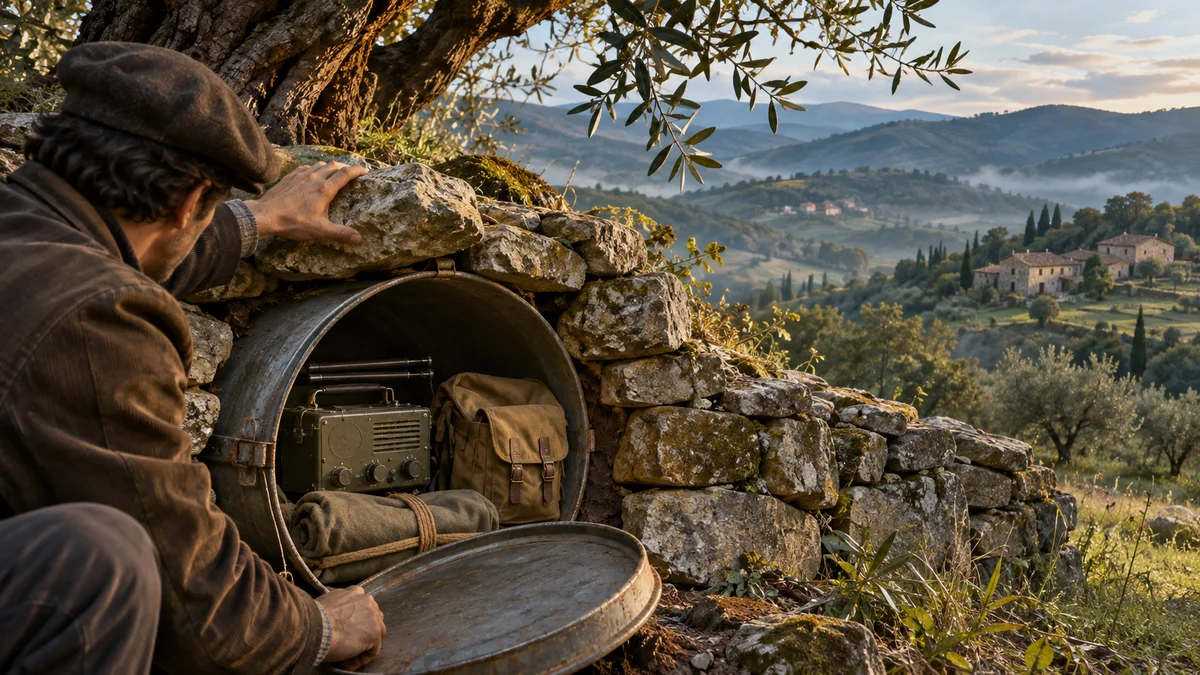
Editorial illustration of a hidden equipment cache associated with European stay-behind networks; it does not depict one specific historical scene.
Hidden Power — Part VI: Invisible Mechanisms of Power (SM-41)
When Italian Prime Minister Giulio Andreotti submitted documentation about the secret Gladio network to parliament in 1990, the disclosure raised a question reaching far beyond Italy. For decades, the state had been preparing personnel, caches, communications channels, and organizational links for the possibility of foreign occupation. But who knew about these preparations, who determined the network's missions, and who had the authority to stop preparations for resistance from becoming an instrument of domestic political influence? The parliamentary report of 1992 leaves no room to deny that the Italian network existed. Yet neither does it allow us to infer, without further evidence, that the network was responsible for every attack attributed to the so-called strategy of tension. [1]
Understanding Gladio begins by distinguishing purpose, plan, and action. Secret preparations for war are a historical fact. Covert arrangements between intelligence services are documented. Investigations have examined possible links between individual members of security institutions and extremist political circles. But these are distinct evidentiary questions. They cannot be merged into a single certainty—whether a blanket exoneration or a sweeping accusation.
A Secret Army Intended to Await Occupation
In postwar Europe, the possibility of another war with the Soviet Union was a serious consideration in military planning. If Soviet forces or their allies occupied parts of Western Europe, conventional military units could lose control of the territory, communications, and supply lines. Stay-behind planning—essentially, keeping selected personnel in place after an occupation—therefore envisaged small, preselected groups that, following an occupation, would maintain contact with allied structures, gather intelligence, assist with withdrawals, and, under certain plans, organize resistance or sabotage against occupying forces. Secrecy was no incidental feature: exposing members' names or locations could have endangered them in wartime and destroyed the network's readiness. [4]
This explanation is understandable, but it does not by itself answer the democratic question. A state may plan secret defensive activities without making every operational detail public. The situation changes if political leaders and oversight bodies lack a verifiable picture of who belongs to the network, what powers it has, and under what circumstances it might be activated even in peacetime. The boundary between secrecy necessary to protect against a potential aggressor and secrecy maintained against a country's own institutions is therefore central to the story.
In the strict historical sense, “Gladio” refers to the Italian operation and its specifically documented organization. Over time, public discussion has broadened the term into a collective label for various European stay-behind networks. That can be a useful basis for comparison, but it can also mislead: different countries did not necessarily have the same founders, legal status, tasks, or relationship with NATO. Historical scholarship therefore rightly compares national cases rather than treating them as inseparable parts of a single organization. [4] [5]
Gladio in Italian and American Documents
The Italian parliamentary report describes preparations for the network preceding 1956. Land at Capo Marrargiu in Sardinia was acquired in 1953, and construction of a training center began in 1954 with CIA funding. The first steps, then, did not await the publicly known date of formalization. In October 1956, representatives of the Italian military intelligence service SIFAR and the American CIA were already working out the details of their joint program. The report cites a document known as Gladio/1, which entered into force on November 28, 1956; it also explains why the material refers both to a reformulation of earlier arrangements and to an agreement. Different dates and descriptions do not, by themselves, prove two separate foundations. They must be read as stages in the formalization of cooperation. [1] [2]
The documents also describe the Italian-American Gladio Committee, which planned the establishment of the Italian branch of the network. Personnel, funding, training, the transfer of materials, and organizational plans were discussed at meetings and covered by agreements. This documents a concrete mechanism of covert interstate cooperation; it is not merely an inference drawn from similar political interests. American involvement in the creation and development of the Italian program is documented. A separate question is who, at any given point, could order a particular mission on Italian territory. [1]
Italy subsequently joined broader allied coordination structures as well: the Coordination and Planning Committee (CPC) in 1959 and the Allied Clandestine Committee (ACC) in 1964. Their existence indicates coordination over clandestine warfare plans, communications, and preparations for an occupation scenario. It does not, however, follow that a single NATO headquarters exercised direct operational command over every activity in every country. National intelligence services, bilateral agreements, and allied coordination overlapped, but their respective powers should not be collapsed into a single concept. [1] [3] [4]
The figure of 622, frequently quoted in connection with Gladio, also requires context. The report attributes it to information provided to the Italian authorities by the services: it refers to the stated cumulative number of registered participants from 1958 to 1990, not to a roster of 622 operatives available at the same time. Nor can this figure, without other records, establish the definitive number of everyone ever connected with different clandestine structures. For particular years, the report gives approximately 230–250 members considered operationally available and notes irregularities in certain enrollment procedures. This is not a trivial statistical qualification. It demonstrates how an authentic archival figure, when repeated carelessly, can produce a false picture of a secret structure's size and activities. [1]
When a Defensive Plan Also Acquires an Internal Adversary
The most sensitive issue is not simply whether Gladio existed, but what could be considered part of its mission. A June 1959 SIFAR report, summarized in the parliamentary dossier, mentions scenarios involving internal subversion alongside preparations for occupation. This matters because it raises, already at the planning stage, the possibility of activities extending beyond resistance to a foreign army. At the same time, the mention of a scenario in a document is not proof that a particular group subsequently committed an act of violence against domestic civilians or political opponents. [1]
At a meeting between SIFAR and the CIA on January 26, 1966, the American representative proposed that, in addition to maintaining the level of preparedness already achieved, the joint project consider activities that could also be useful in peacetime, in connection with contemporary discussions of insurgency and counterinsurgency. In April of that year, the Delfino exercise took place near Trieste. Its occurrence is confirmed in the parliamentary documentation. These records do not themselves prove political terrorism. Their significance is that they show how discussions about the network's tasks could move from resistance after an occupation toward activity within the domestic security sphere. [1]
A document entitled Ipotesi su una nuova struttura S/B was also produced in the 1980s. It proposed reorganizing the network into green, yellow, and red organizational tiers. Under the proposal, the tiers would have differed in their visibility and accessibility to other military institutions. But the word ipotesi—“hypothesis” or “proposal”—is decisive here: the material under examination presents a plan or proposed restructuring. That document alone does not establish that the entire model was implemented in precisely the form described. We may infer something about its authors' thinking and organizational intentions, but not every subsequent relationship between the groups. [1]
The report separately describes the Gruppo operazioni speciali (GOS), also called nucleo K, as a relatively autonomous group of approximately fifteen operationally trained members. It raises questions about missions that may not have corresponded solely to passive preparations for occupation. Nevertheless, GOS must not be confused with all three tiers of the proposed restructuring, nor does its existence justify a claim of universal secret command. This is precisely why reading the original document matters more than an attractive diagram that connects every phenomenon with a single line. [1]
The evidence does not permit the comfortable conclusion that every activity of the network was necessarily confined to awaiting a Soviet occupation. Equally, it does not support the opposite automatic assumption that every Gladio unit was in fact used for unlawful peacetime operations. The distinction between a stated purpose, a prepared capability, a conducted exercise, and a proven act remains essential.
Belgium and Switzerland: Similar Ideas, Different Histories
In its 2022 annual report, Belgium's military intelligence service described the SDRA VIII network, which emerged after the Second World War. Among the tasks it envisaged were maintaining contact with an occupied homeland, preparing evacuations, intelligence gathering, assisting endangered people in escaping, sabotage against military targets, and resistance to occupying forces. Following public disclosures in 1990, the Belgian government decided on December 20 to disband the network and launch a parliamentary inquiry. This is the history of Belgium's own program, not simply another name for the Italian Gladio. [6]
The Belgian service's report also specifically mentions allegations linking the network to bloody attacks in Belgium during the 1980s. In its retrospective account, the service explicitly states that such a link was not proven. That is an important limitation, but it is an institution's statement about its own history, not a substitute for an independent examination of parliamentary and judicial files that are not yet available in this dossier. An absence of proof does not establish that a connection was impossible; equally, public suspicion, however understandable, does not prove participation. [6]
Switzerland presents another arrangement. P-26 was conceived as a means of preparing resistance in the event that a neutral country was occupied. The Swiss National Museum describes the organization's development from 1979 onward, its separate regional groups, training, and financing from public funds. Significantly, a document from 1982 mentions the possibility of internal unrest associated with blackmail or infiltration alongside the central occupation scenario. The existence of this scenario raises legitimate questions about the limits of the organization's activities; it does not itself prove that P-26 acted against domestic political opponents. [7]
Contacts with British services and the question of political oversight are particularly sensitive aspects of P-26's history. Public reporting on the Cornu investigation describes training in Britain and bilateral contacts with British intelligence services. At the same time, it reports Cornu's finding that P-26 did not participate in the international committees through which organizations from NATO member states were linked. Bilateral contacts, therefore, are not in themselves proof that P-26 was directly subordinated to NATO bodies in a chain of command. Switzerland was not a member of the alliance at the time. Unavailable or missing archival files have also featured prominently in public discussion. Their absence is a serious obstacle to research, not evidence in itself of what they contained or why they went missing. [7] [8] [9]
Taken together, the cases of Italy, Belgium, and Switzerland document a broader Cold War pattern of clandestine preparations for resistance, but not identical rules, structures, or actions. To understand its European dimension, we must first examine each case in the context of its own state institutions and documentary record.
Comparison of Three Documented European Stay-Behind Networks
| Case | Country / setting | What is documented | Key editorial limitation |
|---|---|---|---|
| Gladio | Italy / NATO / Cold War | Italian parliamentary and other official sources document the existence of a secret stay-behind network connected to defence planning and cooperation with allies. | The existence of the network does not by itself prove its operational responsibility for all terrorist attacks discussed in Italian public debate. |
| SDRA VIII | Belgium / military intelligence | An official Belgian retrospective review confirms the existence of the stay-behind network. | The report states that a connection to terrorist attacks was not proven; it is an institutional review, not a court ruling. |
| P-26 | Switzerland / neutral state | The Swiss case documents the existence of a special secret resistance organization outside NATO membership. | Bilateral contacts and crisis scenarios are not the same as proof of actual use against domestic political opposition. |
The Strategy of Tension: Evidence Without Shortcuts
The expression strategy of tension is used for interpretations according to which violence, fear, and political provocations were intended to influence public opinion and a country's political direction. In postwar Italy, the term matters because of investigations into far-right violence, the activities of particular individuals within security institutions, and questions about the obstruction of investigations. It should not be dismissed as fiction merely because it also appears in conspiracy theories. Yet naming an interpretation does not identify the organizer of every attack, establish a chain of command, or determine the legal responsibility of any particular network. [3] [4] [5]
Peteano, Piazza Fontana, and Bologna are distinct historical cases with different investigative and judicial histories. Their specific final court judgments, procedural findings, and established individual roles would need to be compared systematically before attributing them to the same operational leadership. In this draft, the direct judicial records have not been examined thoroughly enough to state that Gladio, as an organization, planned or directed all these attacks. Such a claim would go beyond the documentation reviewed. In a 2007 study, historian Leopoldo Nuti likewise cautioned that the documents then made available to the parliamentary committees did not, on their own, substantiate Gladio's organizational involvement in Italian terrorism during the late 1960s and 1970s. This limitation does not invalidate individual judicial investigations or their findings; it defines the limits of inference from a specific body of sources. [3] [4] [5]
None of this means that misconduct by security institutions or covert political connections can all be ruled out. Italian parliamentary and oversight materials clearly show that investigations also examined irregularities, separate clandestine structures, and how much political officeholders actually knew about the services' activities. For example, a parliamentary oversight committee raised questions in a later report about state secrecy concerning informants in the investigation of Augusto Cauchi, as well as unresolved connections in those files. That is a concrete question about obstacles to clarification, not direct proof that Gladio as an organization ordered the violence in question. Evidence of concealment, evidence of an individual's participation in political violence, and evidence of an order from a particular organization are different things. Each calls for its own documents, dates, and named individuals. [1] [3]
There are two opposing errors. The first declares Gladio a fabrication because not every allegation that became attached to it has been confirmed. The second treats every unresolved attack as proof of Gladio's operations because the secret network was real. Neither approach constitutes research. Historical integrity requires us to take actual clandestine structures seriously without erasing the distinction between evidence, accusation, and interpretation.
Secrecy from an Adversary—or from Citizens?
Events in 1990 showed that the boundary between national security and democratic oversight was seriously contested in Western European states as well. Andreotti submitted documentation on Gladio to the Italian investigative commission in October, and the organization was disbanded on November 27, 1990. On November 22 that year, the European Parliament adopted a resolution on the Gladio affair. It condemned the clandestine creation of manipulative and operational networks, called for thorough investigations into their purposes and possible abuses, and urged member states to dismantle secret military and paramilitary networks. This was a strong political condemnation and a call for institutional accountability; it was not a court judgment retroactively establishing the criminal responsibility of every network for specific attacks. [1] [2] [10]
Secret preparations for defense do not, in themselves, amount to a conspiracy against citizens. But secrecy can also create a space in which overseers see too little, responsible officials know too little, and those affected cannot demand an explanation. When documents also describe domestic scenarios and plans for peacetime activity, the question of authority becomes sharper still: who is entitled to activate a group, who verifies an order, who keeps the records, and who can later establish what actually happened?
The power of state institutions lies not only in their weapons, budgets, or access to secrets. It also lies in the trust society places in them to exercise powers whose consequences may reach deeply into individual lives. That is why oversight is not the opposite of security, but a condition for preventing security preparations from becoming an independent political actor. This conclusion is a moral and political judgment grounded in the documented problems of clandestine activity, not a claim that we know every hidden decision made during the decades of the Cold War.
To the question of whether clandestine resistance networks existed in Europe, the answer is yes. To the question of whether they were all commanded in the same way, and whether each participated in domestic political violence, the evidence reviewed does not permit a single affirmative answer. The judicial records of individual attacks, the precise division of some allied responsibilities, and missing archival material remain open questions. Investigating hidden power requires enough persistence not to deny real structures and enough discipline not to turn what is unknown into a predetermined conclusion.
Sources and further reading
- Senato della Repubblica / Camera dei deputati, X legislatura (1992). Relazione sull’inchiesta condotta sulle vicende connesse all’operazione Gladio, Doc. XXIII, no. 51, especially pp. 16–21, 27–31, 43–44. source Source
- Senato della Repubblica (1992). Doc. XXIII n. 51 — parliamentary bibliographic record and date of submission [descriptive entry]. source Source
- Comitato parlamentare per i servizi di informazione e sicurezza e per il segreto di Stato (after July 8, 1995; exact publication year not yet verified). Relazione sui documenti trasmessi dalla Procura della Repubblica di Milano: Rilievi e valutazioni. GNOSIS / Italian intelligence-related material. source Source
- Tamir Sinai (2021). Eyes on Target: ‘Stay-Behind’ Forces During the Cold War. War in History, 28(3), pp. 681–700. DOI: 10.1177/0968344520914345. source Source
- Leopoldo Nuti (2007). The Italian ‘Stay-Behind’ Network: The Origins of Operation ‘Gladio’. Journal of Strategic Studies, 30(6), pp. 955–980. DOI: 10.1080/01402390701676501. source Source
- Belgian General Intelligence and Security Service (SGRS-ADIV) (2022). Annual Report 2022, section Our Story, printed pp. 10–11 (SDRA VIII). source Source
- Claudia Moritzi, Swiss National Museum (2020; updated 2025). Project 26. Swiss History Blog. source Source
- SWI swissinfo.ch / SDA-ATS/RTS (April 26, 2018). Details of Secret Cold War Swiss Army Finally Revealed. Summary of the partially released Cornu report. source Source
- SWI swissinfo.ch (2018). Papers Vanish on Switzerland’s Secret Cold War Army. source Source
- European Parliament (November 22, 1990). Resolution on the Gladio Affair, CELEX 51990IP2021, Official Journal C 324, December 24, 1990, p. 201. source (full Official Journal text: source) Source 1 Source 2