How Are the World's Elites Connected?
In a photograph of an international gathering, we might recognise a prime minister, a bank executive, a newspaper editor and the representative of a major foundation.

Symbolic editorial illustration of overlapping institutional networks and the distinction between private access and public accountability. It depicts no actual organisations or meeting.
In a photograph of an international gathering, we might recognise a prime minister, a bank executive, a newspaper editor and the representative of a major foundation. Sometimes more connects them than the occasion itself: the same person sits on the boards of different organisations, establishes initiatives, raises funds or acts as an intermediary between people who rarely meet otherwise. Such links may be public and documented, while their actual political effects remain less visible. That distinction — between who knows whom and who influenced what — is the key to investigating contemporary elite networks.
In earlier parts of this series, we examined Skull and Bones, international forums, Bilderberg, the Council on Foreign Relations, the Trilateral Commission and the World Economic Forum separately. The question now shifts from individual institutions to the relationships between them. Are there verifiable links? Yes. Can those links provide opportunities for influence? In certain circumstances, they can. Do they, by themselves, prove the existence of a single leadership, a shared secret command structure or control over states? No. To recognise real power, we must reject both the excessive certainty of sensational accounts and the comforting assumption that the acquaintances of influential people are always politically irrelevant.
Who Is in the Room — and Who Was Left Outside?
Imagine a conference hall where one person discusses an economic crisis, another security and a third technology. Some are there as representatives of elected governments, others as business owners or executives, and still others as researchers and advisers. The hall is not a parliament. Not a single resolution need be adopted for the meeting to have consequences: contacts can be made, a common understanding of a problem can emerge, or a partner can be found for a future initiative. Equally, a conversation may remain just that, with no subsequent effect. A photograph does not tell us enough to decide.
At influential gatherings, it matters not only who is present but who set the conditions for being there. The organiser selects the speakers, invitees, subjects and format of discussion. A participant may thereby gain a particular opportunity to present their view to decision-makers whom other citizens find harder to reach. But access is not the same as persuasion; persuasion is not the same as a decision; and a decision is not the same as implementation. Each transition requires its own trace: a document, a dated contact, a record of official consideration or a verifiable action.
Research into the 'world's elites' has another pitfall. The phrase can quickly become a loose label for everyone who is wealthy, famous or influential, as though they all shared the same interests. In reality, business rivalries, ideological disagreements, national loyalties and personal disputes run through these circles. Even where some individuals are closely connected, it does not follow that all social power is concentrated in one pair of hands. An investigation must first establish who was connected to whom, in what capacity, during which period and according to which source. Only then can we ask why the connection matters.
A Network Without a Single Headquarters: Six Different Kinds of Connection
We can picture a network as a map containing two kinds of points: people and organisations. The line joining them is not self-explanatory. It might signify being a founder, holding a board position, membership, attending a single event, providing financial support or having a documented channel for influencing public policy. If we call all these relationships simply 'connections', we obscure the very distinctions that make network research useful. A founder may establish an organisation without leading it for the rest of their life; a member may belong to an institution without setting its goals; and an invitee may attend an event without agreeing with the others present.
The strongest initial links are generally those confirmed by an institution and a dated document. A leadership position establishes a formal place within a particular organisation's structure. Sponsorship or a donation is a different relationship: it may reveal where funding comes from, but without the funding rules, a contract and evidence of conditions attached, it does not tell us what the funder actually obtained. Attendance at a meeting gives access to a space for discussion; it does not automatically confer voting or leadership rights. A separate category is a direct policy channel — for example, the documented submission of a proposal to the relevant ministry. For explaining public decisions, that may be more valuable than numerous informal contacts.
All these relationships need a time frame. If someone led an organisation in 1980 and attended another forum in 2026, those facts must not be presented as simultaneous activity. Nor is a current leadership webpage a complete history of everyone's tenure; it is primarily a snapshot of the present. Researchers should therefore record, alongside the person's name, the type of role, its start and end dates, the source and the date on which the information was checked. When a start or end date is unknown, it is more honest to record that gap than to manufacture an uninterrupted connection.
Such precision reduces the temptation to draw a dramatic but misleading graph in which almost everyone appears connected to everyone else. It also allows us to ask a far more demanding question: which individuals actually bridge different institutional settings, what responsibilities do they hold in each, and which public decisions can be linked to their verified actions? This is where an investigation begins, not where it ends.
Rockefeller: From Leading the CFR to Founding the Trilateral Commission
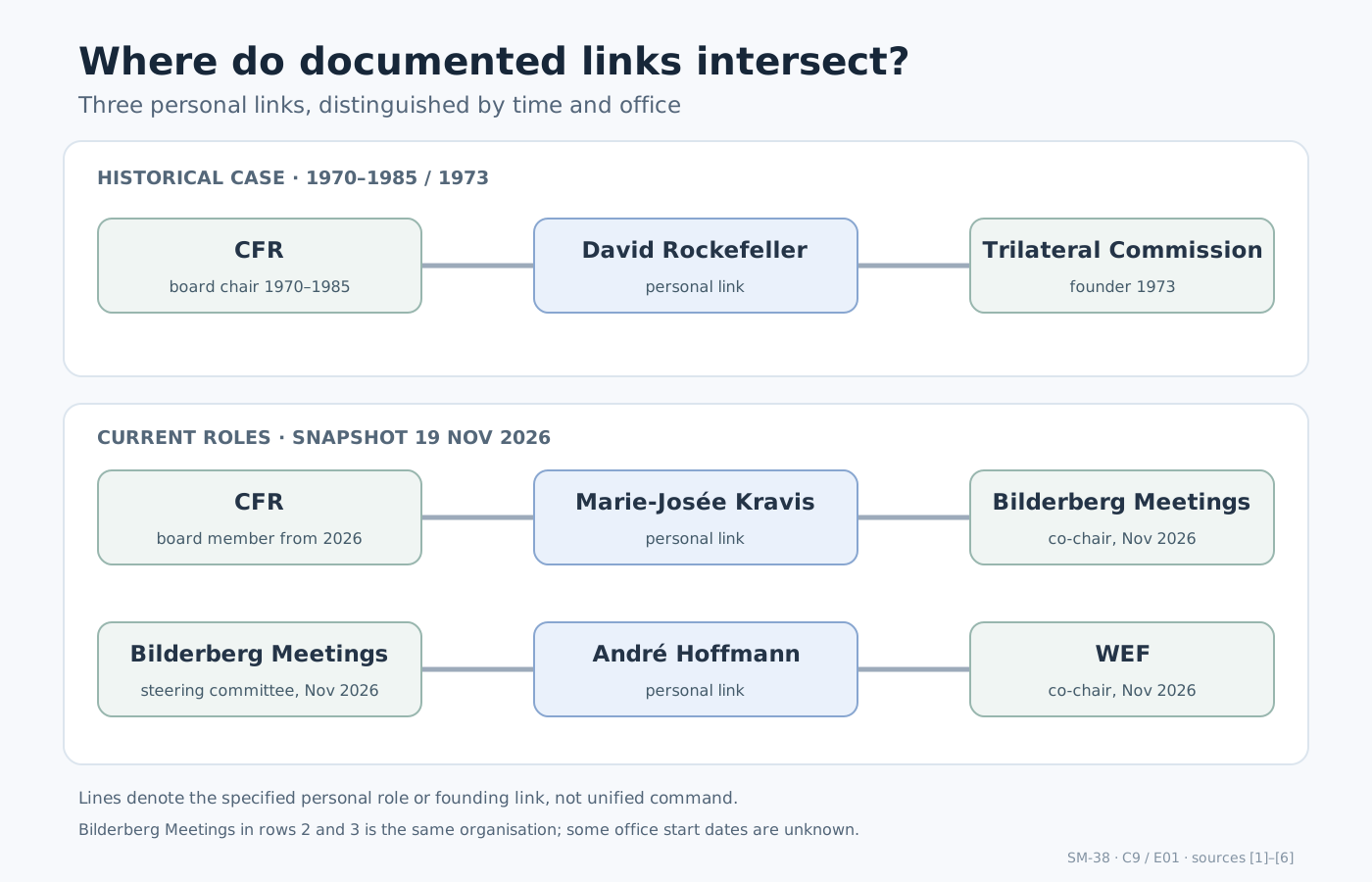
David Rockefeller offers a clear historical example. In its biographical account, the Council on Foreign Relations (CFR) states that he had been a member since 1941 and chaired its board of directors between 1970 and 1985. The Trilateral Commission itself states that Rockefeller founded it in 1973. Here we are not inferring a connection from a shared surname or similar ideas. Two institutional sources confirm that the same person founded one influential organisation while chairing another. [1] [2] [3]
This connection matters historically because it points to a link between an established American forum for foreign-policy discussion and a new network spanning several regions. In describing its purpose, the Trilateral Commission refers to bringing together senior policymakers, business leaders and figures from the media and academia. Its publicly stated aim is to build relationships and discuss international problems. Its own account also indicates that it seeks to contribute to debates on foreign and security policy. But that ambition is not the same as legislative authority, nor does it prove that every national decision resembling one of its discussion topics originated within its inner circle. [1]
Rockefeller's story demonstrates both a genuine concentration of opportunities for access and the limits of what we can conclude. His positions in different institutions could have enabled him to maintain connections between business and foreign-policy circles; that is a reasonable interpretation of his documented roles. It would not, however, be legitimate to infer solely from his 1970–1985 chairmanship and his founding initiative in 1973 that the CFR exercised legal control over the Trilateral Commission or that the two organisations shared a single governing body. We would need to examine their founding powers, minutes, actual decisions and relationships in specific cases. [2] [3]
This historical bridge is too well documented to dismiss, yet too limited to inflate into an explanation of all international politics. Its value lies elsewhere: it shows that influential institutions can be connected through an individual, not only through formal agreements. The question is what that individual actually did with their access at a given time.
Two Contemporary Bridges: Kravis and Hoffmann
For a more contemporary picture, we need not rely on anonymous lists of alleged insiders. The CFR includes Marie-Josée Kravis on its public board-of-directors page; its historical list of terms gives 2026 as the start of her membership of that board. Bilderberg Meetings lists her as a co-chair of its steering committee on its public Steering Committee page. These are two distinct institutional positions, verifiable through the respective organisations. The current list examined does not, by itself, establish the starting date or complete duration of her Bilderberg role. [4] [5]
André Hoffmann provides another verifiable example. In its account of governance, the World Economic Forum identifies him as one of two co-chairs alongside Larry Fink, while Bilderberg Meetings lists him as a member of its steering committee. These links are not inferred from someone being at the same airport or attending the same gathering; they are published roles in two different organisations. Even so, those positions do not automatically mean that every policy discussed in one institution is adopted by the other. [5] [6]
Why do these examples matter? They show how individuals can occupy points of contact between organisations that are not legally merged. An intermediary can share experience, open doors to discussions or connect people with different responsibilities. Such a person may also have interests and biases of their own. But their possible influence cannot be measured merely by finding their name on two lists. To tell a meaningful story about directing policy, we would need to know what was communicated, which issue was discussed, how the recipient responded and what public decision followed.
This is also where the problem of changing lists becomes apparent. Leadership and membership change; a website may display a name today and replace it tomorrow. A claim about a current position therefore always needs a verification date, and a later publication of the article requires a fresh check. Attention to timing is not a bureaucratic nicety: it prevents information stitched together from different decades from creating the illusion of a permanent, unchanging structure.
What Bilderberg's Lists Tell Us — and What They Do Not
For its 72nd meeting, held from 9 to 12 April 2026 in Washington, Bilderberg Meetings published a list of people presented as participants, together with the announced discussion topics. The publication lists figures from politics, business, finance, academia and the media. Topics include artificial intelligence, digital finance, energy and international security. The list establishes whom the organiser publicly named, not the independently verified physical attendance of each individual. The document allows us to examine how the organiser presented the event and its intended agenda. [7] [8]
The organiser also explains that the meeting operates under the Chatham House Rule, which permits the use of information but not the disclosure of the identity or affiliation of speakers or other participants, and that there are no formal votes, resolutions or public policy statements. This is an important account of the rules, but it remains primarily the organiser's own description. It cannot independently establish what was said in every private conversation or rule out possible later contacts between participants. Equally, it would be unfounded to infer directly from confidentiality that binding secret orders were issued to states. That claim would require evidence of its own. [8]

Here the distinction between a participants' list and a leadership list is crucial. A participant has access to discussions; a steering committee has an organisational role. If we call everyone 'Bilderberg members', we may collapse incomparable relationships into a single label. More dangerous still is the leap from attendance to agreement. A person may be invited to argue for an opposing view, hear criticism or test an argument. To establish that they actually accepted a particular proposal, we would need a direct record, a subsequent statement from them or a documented action.
Confidentiality can make candid conversations easier and reduce the risk that every tentative idea will immediately become the subject of a political campaign. It can also restrict public scrutiny of settings in which some people enjoy exceptional access to public office-holders. Both can be true at once. The important democratic question, then, is not whether every private conversation is inherently improper, but whether it is possible later to establish when ideas from those conversations entered official procedures, who advocated them and who accepted responsibility.
Network Science: Nodes, Brokers and the Limits of Centrality
Rather than judging connections by impression alone, we can examine them using network-analysis methods. That does not mean every line on a graph matters equally. A node's degree tells us how many connections are recorded in the selected data; betweenness centrality describes how often a node lies on the shortest paths between others. Even if a person is highly central in a model, the number does not tell us whether they gave orders, conveyed a decisive proposal or were even listened to. Centrality is a property of a model built from selected data, not a direct measure of political power.
In 2010, William K. Carroll and Jean Philippe Sapinski published a network study based on the world's 500 largest corporations and a purposefully selected set of transnational policy-planning boards, comparing data from 1996 and 2006. In the publicly available abstract, they report that such boards had become more significant connecting points between elite business networks in different regions, particularly Europe and North America. This provides meaningful empirical support for investigating institutions' intermediary roles. However, the full article and its methodological details have not been independently examined for the present research. We must therefore not infer further findings that are not stated in the public abstract. [9]
A different picture emerges from a 2013 study by Eelke M. Heemskerk, Fabio Daolio and Marco Tomassini. The authors reconstructed overlapping directorships on the boards of 300 large European companies in 2005 and 2010. They found more cross-border links but also strong national communities and, by the measures they selected, movement towards a less hierarchically arranged network. Those results are an important corrective to the hasty assumption that every increase in connections must signify an ever more centralised pyramid of control. They apply to the sample and period studied, not to every institution, person or decision in the world. [10]
Together, the two studies highlight something that sensational portrayals often miss: a network can have several centres, internal communities and competing interests. How the network is defined affects the result. If we include only five well-known organisations, the people appearing on their lists will look exceptionally central; include many other institutions and the relationships change. If we draw a one-off attendance with a line as thick as a decade-long chairmanship, the picture becomes more misleading still. For that reason, this article does not present an invented measurement of connectivity among SM-33–SM-37 or declare any node 'the most influential' without a time-aligned, verifiable dataset.
Network science is valuable because it forces us to define our terms explicitly: what counts as a node, what counts as a link, when the link exists and what conclusions it cannot support. It can demonstrate that certain settings bring many decision-makers into contact. It does not relieve us of the work that follows — investigating what people actually did.
When Does a Connection Become Influence on Public Policy?
The strongest claim about an elite network is not that a particular person attended a meeting or sat on several boards. It would be a precise account of how an idea demonstrably passed into the exercise of public authority. Such an account would begin with a dated proposal, trace documented communication to the competent recipient and show how the proposal entered formal consideration. We would then need to examine the decision, the legal basis, implementation and effects. Without this evidence, we cannot fairly say that an organisation 'issued an order' or that it caused a particular measure.
Even when a proposal and a later law use almost identical language, similarity is not a complete reconstruction of causation. An idea may have circulated in several academic, political and international settings before a particular government adopted it. Decision-makers may have had reasons of their own, while public debate may have substantially changed the content. To demonstrate influence, we must therefore investigate alternative routes too, not merely the path that supports our initial interpretation. A causal conclusion is stronger when supported by records of submission, dated communications, testimony tied to verifiable evidence and a sequence of decisions.
Cases where network influence fails are especially useful. If an influential group advocates a solution that parliament rejects or a regulator substantially changes, that tells us something important about the limits of its power. We should not study only proposals that succeeded and ignore those that were rejected; that selection would itself create an illusion of all-encompassing effectiveness. The existing SM-38 material still lacks a concrete comparative study of such negative outcomes.
For the three bridges examined — Rockefeller, Kravis and Hoffmann — institutional links have been verified, but not the entire path from their particular network communications to a national law and its implementation. This is a fundamental limit of the research. It does not mean that no influence occurred; it means that this article has not demonstrated that such influence caused a specific public decision. The investigation could be developed through documented lobbying contacts, published consultation material and ministerial records, rather than by simply increasing the number of names on a chart.
Why Influential Networks Need Transparency and Accountability
Cooperation between specialists, businesses, academics and public authorities can be useful. International crises, scientific questions and technological change exceed the expertise of any single institution. Yet the rules under which such cooperation takes place matter. Elected authorities must be able to explain whose arguments they considered, whose they rejected and by what procedure they reached a decision. Otherwise, entirely lawful private discussions can create a perception — or a genuine problem — of unequal access to political power.
On 3 May 2024, the OECD revised its Recommendation on Transparency and Integrity in Lobbying and Influence. It emphasises accountability, rules governing contacts with decision-makers, disclosure of relevant interests and safeguards against concealed or improper influence. These are comparative normative standards. The recommendation is not, in itself, a finding that participants in the gatherings discussed here committed any wrongdoing, nor does it operate as the same directly enforceable law in every country. [11] [12]
At EU level, an important instrument is the Interinstitutional Agreement of 20 May 2021, which provides the basis for the joint transparency register of the European Parliament, the Council of the EU and the European Commission. The phrase 'mandatory register' requires care: blanket registration is not automatically required by law for every interest representative without exception; institutions may make particular kinds of contact or access conditional on prior registration. The official guidelines explicitly explain that registration is voluntary as a general starting point while certain contacts are conditional on prior registration. The European Commission, for example, requires registration for meetings between interest representatives and members of the Commission or their cabinets. Here, too, the legal framework does not prove that any particular person examined in our research broke the rules. [13] [14]
Transparency matters precisely because informal influence often cannot be reduced to a criminal offence or bribery. Sometimes the problem is already the disproportionate opportunity for certain interests to help frame the questions that public institutions will later address. The answer is not a blanket ban on meetings, but a verifiable distinction between private initiative and public mandate, disclosure of relevant contacts, management of conflicts of interest and opportunities for public debate. Where confidentiality is legitimate, it should still be clear who is responsible for it and which actions remain subject to oversight.
An influential person need not be declared an enemy in advance for their influence to be scrutinised. Equally, their assurances of good intentions need not be accepted as a substitute for procedural accountability. It would be a double standard to demand complete transparency from less influential groups while treating major private networks as untouchable simply because of their members' reputations.
Hidden Power Without an Imagined Commander-in-Chief
What, then, connects the world's elites? In some cases, they are connected by real and verifiable organisational roles, founding relationships, recurring meetings and channels for exchanging ideas. Rockefeller's historical role and the contemporary leadership links involving Kravis and Hoffmann show that such points of connection are more than a metaphor. Academic research also shows that large networks have many layers: they can connect countries and sectors without forming a single, simple pyramid with a commander at its summit. [1] [2] [4] [5] [6] [9] [10]
Real influence may therefore lie less in one supposed secret room than in the unequal distribution of access, the ability to set agendas, the capacity to connect institutions and the long-term repetition of particular ideas. This deserves investigation precisely because it is not always formalised. Yet that general mechanism must not become grounds for condemning every person or organisation in advance. Where evidence of specific coordinated action exists, it should be presented; where it does not, the question must remain open and be labelled honestly.
The distinction between power and right matters here as well. People have a right to discuss issues, establish associations, cooperate and propose political solutions. But wealth, title or a position within a network gives no one a special democratic right to decide on behalf of others. A responsible society therefore needs neither a myth of an all-powerful elite nor blind faith in influential institutions. It needs the capacity to scrutinise, challenge and explain decisions — and to correct mistakes.
If we want to investigate hidden power, we must hold our own conclusions to a higher standard than many power-holders apply to their public statements. A precise record of a connection is the beginning of a story, not its end. A sound investigation traces the path from person to institution, from institution to proposal, and from proposal to consequence. Where the trail breaks off, we must not replace it with suspicion — but neither should we declare it insignificant. It is precisely such persistent, documented questioning that protects a space in which the future is not merely something influential people discuss, but a matter for everyone who will live with the consequences.
Sources and further reading
- The Trilateral Commission. About Us. Official overview, including its founding in 1973 and its mission. source Source
- Council on Foreign Relations. The Nelson and David Rockefeller Chair in Latin America Studies. Biographical details on David Rockefeller, including his chairmanship of the CFR board from 1970 to 1985. source Source
- Council on Foreign Relations. Celebrating a Century — Timeline 1921–2021. Historical overview of leadership. source Source
- Council on Foreign Relations. Board of Directors. Public current list and historical terms of office; checked on 19 November 2026. source Source
- Bilderberg Meetings. Steering Committee. Public current list of co-chairs and steering committee members; checked on 19 November 2026. source Source
- World Economic Forum. Leadership and Governance. Public current description of leadership and the board of trustees; checked on 19 November 2026. source Source
- Bilderberg Meetings. Participants 2026. Officially published list for Washington, 9–12 April 2026. source Source
- Bilderberg Meetings. Press Release 2026 — 72nd Bilderberg Meeting. 9 April 2026; topics, attendance and the organiser's description of the meeting rules. source Source
- William K. Carroll and Jean Philippe Sapinski. 'The Global Corporate Elite and the Transnational Policy-Planning Network, 1996–2006: A Structural Analysis'. International Sociology, 25(4), 2010. DOI: 10.1177/0268580909351326. This research stage draws on the public abstract; the full text was not examined. source Source
- Eelke M. Heemskerk, Fabio Daolio and Marco Tomassini. 'The Community Structure of the European Network of Interlocking Directorates 2005–2010'. PLOS ONE, 8(7), e68581, 19 July 2013. DOI: 10.1371/journal.pone.0068581. source Source
- OECD. Recommendation of the Council on Transparency and Integrity in Lobbying and Influence (OECD/LEGAL/0379), originally adopted in 2010, revised on 3 May 2024. source Source
- OECD. Enhancing Representation, Participation and Openness in Public Life. Part of the Reinforcing Democracy initiative, 2024; discussion of lobbying integrity and transparency. source Source
- European Parliament, Council of the European Union and European Commission. Interinstitutional Agreement of 20 May 2021 on a mandatory transparency register, Official Journal of the European Union, L 207, 11 June 2021. source Source
- EU Transparency Register Secretariat. Guidelines. Scope of registration, conditionality measures and rules governing engagement with the institutions; online guidelines checked on 19 November 2026. source Source