Bohemian Grove: Power, the Forest, and Secret Rituals
An article in the Hidden Power research series.
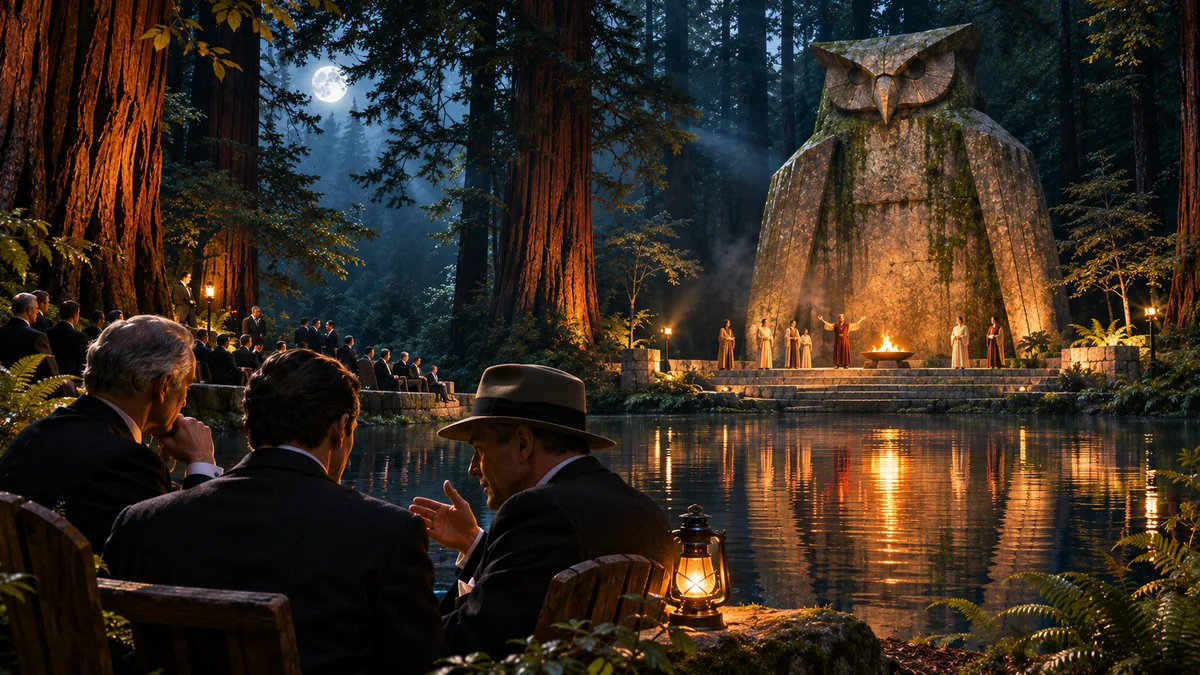
An artistic interpretation of Bohemian Grove and the Cremation of Care tradition; not documentary footage or a historically exact reconstruction.
A Meeting Among the Redwoods
In September 1942, as the American nuclear program moved from a research challenge toward an urgent government and military undertaking, the S-1 Executive Committee met in an unusual location: Bohemian Grove, a private wooded estate in Northern California. Vincent C. Jones's military history records the meeting on September 13 and 14, as well as concrete decisions about land for facilities and plans for producing nuclear materials. The National Security Archive describes a photograph taken on the second day, showing, among others, J. Robert Oppenheimer, Ernest Lawrence, Harold Urey, and James Conant. This is not a vague tale of a secret meeting but a documented event with a specific time, participants, decisions, and scientific context. [1] [2]
That is precisely what makes Bohemian Grove worth investigating. If it were merely the setting of invented legends, the inquiry could end quickly. But documents attest to actual ritual performances, gatherings of influential people, and, in some instances, entirely substantive political discussions. The next question is harder: what could be accomplished in such a setting, who had access to it, and do the documents also establish that public authority was being directed from there? A meeting of important people is not the same thing as the formation of a secret government. Equally, calling something a private “social gathering” does not erase the political significance of what actually happened there.
A Club Born in the World of the Arts
The Bohemian Club was founded in San Francisco in 1872. In its historical introduction, a club publication from 1901 distinguishes between initial discussions among journalists and creative artists in February, the formal organization of the club on April 1, and its legal incorporation on May 17 of the same year. The aim was to establish a space for literature, music, performances, and conversation. When investigating an institution of this kind, it is useful to begin with its own rules rather than with a later legend. [3]
Yet the club's history is not a simple story of an innocent community of artists taken over by millionaires only much later. In his examination of its origins, sociologist G. William Domhoff observes that the founders or early supporters also included wealthy people who appreciated the arts, financed activities, and brought social connections into the club. The tension between creative ideals and social standing appeared early enough that historians should not reduce it to a single supposed moment of “takeover.” [4] [5]
The constitution published in 1901 contains a particularly revealing provision: Article XII restricts the club's activities in support of religious or political objectives. At first glance, this seems almost the opposite of the image Bohemian Grove has acquired in contemporary theories of hidden power. But the rule is evidence of the institution's formal self-description. It does not tell us that all its members left their interests at the door throughout every decade; still less does it tell us whether they ever attempted to influence politics. Those questions require different sources. [3]
The San Francisco club and Bohemian Grove are not one and the same. The Grove is the club's private wooded gathering place near Monte Rio, where summer encampments, performances, and social traditions developed. Historical accounts date the first collective summer outing to 1878; that excursion took place elsewhere and does not in itself establish that the club already owned the present Grove near Monte Rio. The first outing, later use of a particular parcel, its purchase, and the recording of title are distinct events. An archived account of the property history refers to a purchase around 1901 and the recording of ownership in January 1902. Only by separating these stages can we trace the development of a real institution rather than imagine a mythical setting without a beginning or owners. [4] [9]
A Ritual That Needs No Inventing
Cremation of Care is a theatrical and ritualized performance in which everyday worries are personified as Dull Care, a figure symbolically banished at the beginning of the summer gathering. Music, costumes, procession, script, lighting, and the repetition of tradition all play a part. Its existence does not depend on secret testimony circulating online: its history is described in club publications, sociological accounts, and archival inventories of photographs. [4] [6] [7] [8]
The San Francisco Public Library's inventory of collection SFP 104 lists 397 photographic prints of club events dating from 1890 to 1950. The subjects recorded include a 1921 ceremony. That inventory provides persuasive evidence that such performances formed part of the club's actual life. But a title in an archival finding aid is not the same as viewing every photograph, and the existence of a photograph does not automatically confer permission to publish it online. Any individual image selected for the article would need to be assessed separately. [7]
The ritual's exact starting year is less firmly established than is often suggested. Domhoff dates the tradition to 1880, while an earlier research lead from Porter Garnett's 1908 historical study associates the first Cremation of Care performance with 1881 and James F. Bowman. The difference may reflect a distinction between broader summer performances and the first ceremony known by that particular name. Until the original text and club chronicles have been compared directly, page by page, it is more accurate to describe the tradition as taking shape around 1880–1881 than to settle the historical question prematurely. The bibliographically identified 1930 script by James G. Swinnerton likewise awaits a complete examination of its original pages. Different historical versions must not be merged automatically into one unchanged ritual. [4] [6] [8]
The ritual form nevertheless tells us something about the club. A group that repeats the same scene over generations, the same symbolic release from everyday worries, and the same separation between ordinary life and a special place is constructing an identity. Such a ceremony can foster a sense of belonging and confidentiality among participants. Yet this social effect is not proof that the ritual issued political instructions. The first conclusion follows from the description of a social practice; the second would require firsthand testimony or documents concerning specific decisions.
The Owl, Moloch, and the Limits of Symbolic Interpretation
Among the most recognizable symbols of Bohemian Grove is its monumental owl. In the club's documented tradition, the owl is associated with wisdom and discretion; the imposing structure at the present ceremonial site is associated with sculptor Haig Patigian. The club's Library Notes, preserved among documents at the Ronald Reagan Presidential Library, expressly state that Patigian's Shrine of the Owl was dedicated in 1929. This detail can be checked in the source's extracted text; visual collation against the scanned page has not yet succeeded, so we do not present it as a facsimile we have inspected. Importantly, the ritual tradition predates this monumental setting: the modern site should not be portrayed as an untouched survival of some supposedly ancient religion. [9] [10]
The most widely publicized alternative interpretation links the owl to Moloch, a figure or name appearing in ancient religious texts and often associated with sacrifice in modern polemics. The meaning of that name is itself debated by historians; our concern here is whether a connection to this particular club symbol can be demonstrated. Symbolic resemblance, fire effects, and dramatic ritual language do not, by themselves, prove that members practiced actual human sacrifice. The documents examined establish a theatrical performance and a symbolic figure representing care; we found no direct evidence in them of real human sacrifice. This is not an absolute claim about everything that may ever have happened behind closed doors, but a precise statement of the limits of the available evidence. [4] [6] [8]
The origins of the Moloch interpretation itself also need historical investigation. In a critical review published in 2013, Terry Melanson describes how comparisons and much stronger claims about the identity of the owl and the ritual spread during the 1990s and afterward. An earlier research trail mentions Mark Walter Evans, David Icke, and Alex Jones, but their original publications or recordings have not yet been compared directly in this phase. It would therefore be improper, on the basis of a secondhand reconstruction, either to identify the definitive originator of the interpretation or to declare that there is reliable historical confirmation that the owl was intended to represent Moloch. [11]
A scene that is essentially theater can still evoke a sense of mystery. Responsible inquiry should not ridicule that feeling, but neither should it mistake the feeling for proof. If a symbolic interpretation is to be accepted as historical fact, it needs to be supported by traceable use, dating, texts, or statements by its creators—not simply by an image that resembles something else.
September 1942: A Real Meeting with Real Consequences
Let us return to the S-1 meeting. The U.S. Army history Manhattan: The Army and the Atomic Bomb dates it to September 13–14, 1942. Jones's section “Reaching Decisions: The Meeting at Bohemian Grove” describes the group's decision to acquire the selected site in Tennessee immediately and to proceed with plans for a large electromagnetic uranium-separation plant; it also considered relocating the planned experimental plutonium facility. The decisions were made within a government military-scientific program, not as demonstrable orders from the club. The National Security Archive published a description of a photograph taken at the event on September 14; it identifies Donald Cooksey as the photographer and the U.S. National Archives as the archival source. Oppenheimer and Ernest Lawrence are among the individuals named in the photograph's description. [1] [2]
The meeting matters for more than its location. It was connected to concrete government and scientific decisions, not merely to listening to music over dinner. It would therefore be wrong to say that matters of historical consequence were never discussed at the Grove. But it would be equally wrong to claim that the Manhattan Project began there, or that the Bohemian Club as an association conceived or directed it. The nuclear research program, its public institutions, military structures, and laboratories have their own documented chronology, which began before September 1942. [1] [2] [12]
The episode demonstrates why evaluating influence is harder than asking who was photographed with whom. To establish the club's organizational power, we would need to know not only where the meeting took place but who invited the participants, under whose authority they acted, what decisions resulted, and whether the club as an organization determined their substance. The research record does not currently establish such a chain. A meeting of government specialists on private club grounds proves that the property could be used for important work. It does not prove that the club's leadership was the government officials' superior authority.
This distinction must not become an excuse for indifference. A location accessible to a limited circle can facilitate conversation, personal bonds, or cooperation. When public decision-makers are present, legitimate questions arise about transparency, private benefits, and accountability. But answering them requires tracing the actual paths by which decisions were made, not merely making a dramatic proclamation about a hidden center of power.
Nixon's Speech: Politics Before a Private Audience
On July 29, 1967, Richard Nixon—then a former U.S. vice president, not yet the nation's president—addressed a gathering at Bohemian Grove. The speech has been preserved in the official diplomatic series Foreign Relations of the United States, which now publishes it in full. Nixon discussed American foreign policy, relations with the Soviet Union, the role of military power, foreign aid, and strategic questions of the second half of the twentieth century. Among other things, he considered how the United States should use international assistance and maintain its military advantage. These were not merely private anecdotes for a relaxing summer gathering, but positions on public policy presented to a select audience. [13]
At the same time, this was a politician's speech, not proof of a formal decision by the Bohemian Club. The official edition’s source note identifies the original transcript as “Off-the-Record; Not for Publication.” That context matters. Someone can speak more candidly to a private audience than at a public rally without automatically making the listeners their political superiors. The distinction between an idea, access to a speaker, an audience's sympathy, and policy actually implemented by the government is crucial here. [13]
On the one hand, the speech rebuts the notion that everything happening at the Grove was exclusively artistic. On the other, it does not entitle us to infer from the location alone a secret agreement governing all subsequent actions of the Nixon administration. Establishing that would require further records of conversations, connections, and consequences. The official transcript confirms the content of the speech, not the private intentions of every listener.
Letters from the White House: How Access Works
Correspondence from the first year of the Reagan administration offers an unusually concrete view of how private contacts intersect with political interests. In a letter dated August 6, 1981, presidential adviser Edwin Meese described a visit to Bohemian Grove to Howard Callaway as relaxing, but also as an opportunity to engage in some political activity on behalf of the administration. This is an important primary document: Meese himself indicates that leisure and political networking were not necessarily kept entirely separate in the same setting. [9]
In another letter, dated June 26, 1981, James Baker expressed his gratitude to William M. Spencer for assistance with his application for membership. Such correspondence reveals a mechanism often overlooked in discussions of “hidden power”: an intermediary, a recommendation, an application, and access to a social circle. We need not invent a secret command to understand why personal connections may matter. Yet these two letters do not, by themselves, prove that Baker was admitted because of the recommendation, that the club ordered any political decision, or that Meese's political networking produced a specific government action. [9]
These passages also need to be read with an archival caveat. The digitized Reagan Library folder was reviewed using extracted text; a renewed attempt during C2 to obtain images of the two specific pages also failed. The basic dates, addressees, and meaning of the statements are traceable, but visual collation against the facsimiles remains outstanding. We therefore do not invent verbatim quotations or handwritten markings. Nor should every person involved be labeled a member without individual confirmation: an invited guest, a speaker, an applicant, and a longstanding member are not the same category. Baker's letter confirms an application and a recommendation, not the final outcome of the admission process.
Such documents support a conclusion that is more modest, yet stronger, than a grand theory of a secret government: a private setting could facilitate political conversations and access to influential individuals. How much influence was actually achieved remains to be established case by case. Research integrity does not diminish the significance of the letters; it merely prevents us from making them say more than they do.
Who Is Inside the Circle, and Who Is Left Outside?
Private power is not only about what influential members do. It is also about who receives an invitation, who must seek a recommendation, who keeps the venue running, and what rights people outside the membership possess. The Bohemian Club's long history of exclusivity created an environment in which social access was unevenly distributed. Domhoff sees it as a place where people who already occupied influential positions in other institutions strengthened their ties. This sociological interpretation does not posit a single command structure; it emphasizes that lasting relationships can themselves confer a social advantage. [4]
The lawsuit Bohemian Club v. Fair Employment & Housing Commission, decided in 1986, shows how private autonomy encounters public law. A California appellate court considered the club's practice of excluding women from numerous jobs in Monte Rio and San Francisco. It rejected the argument that the club's private nature or its members' preferences could by themselves justify such broad sex-based distinctions in employment. The court largely reversed the contrary lower-court ruling and ordered reinstatement of the relevant findings of the responsible commission. The ruling concerned employment and the interpretation of the law at the time; it was not an order to admit women as club members, nor does it by itself describe the club's membership policy today. [14]
This is an example of power less mysterious than a ceremony beside an owl sculpture, but legally very real. A private group has a right to associate within the limits of the law; the people who work for it do not lose their legal protections merely because their employer invokes privacy. Here the philosophical question of freedom becomes sharper: freedom of association matters, but it is not an unlimited right to shift the costs of that freedom onto people with less influence.
Informal Influence Is Not the Same as Secret Command
Two opposing simplifications are inadequate for understanding Bohemian Grove. The first says it is nothing but an old-fashioned pastime for wealthy men and that politics has never mattered there. The documented S-1 meeting, Nixon's speech, and Meese's letter disprove such an absolute claim. The second turns every familiar face, ritual image, and private conversation into part of a unified worldwide command system. The available documents do not establish such a chain linking club leadership, orders, government officials carrying them out, and specific political outcomes. [1] [13] [9]
Domhoff's research offers an explanation that is less dramatic but deserves serious consideration: gatherings foster social cohesion, trust, a shared milieu, and enduring acquaintances. A sense of personal closeness may later translate into a recommendation, an invitation, a job, or easier access to someone who makes decisions. But in each case, the investigator must also ask whether the result was caused by the club or by an already existing social position. Successful and influential people may belong to the same club because they were connected beforehand. Without comparative evidence, we cannot automatically attribute all their later achievements to membership. [4]
Serious investigation should therefore focus on verifiable cases: who recommended whom, what was exchanged, when a decision occurred, whether there was a conflict of interest, and what alternative explanations account for the outcome. A conversation among the redwoods may be inconsequential—or historically important. The historian must demonstrate the difference rather than assume it. Asking “Who has access?” remains legitimate even where there is no proof of illegality or a hidden common plan.
What Does Bohemian Grove Actually Tell Us About Power?
Bohemian Grove is not merely an imagined setting for conspiracy theories. The club exists, its rituals have a documented history, its members and guests have met in private, and politically and scientifically significant events have taken place on the property. Historical documents show clearly enough that the boundary between a social setting and public influence is not impermeable. They do not, however, show that the club as a single body governed the American state or that actual human sacrifices took place during the Cremation of Care. These stronger claims lack adequate direct corroboration in the sources examined.
That does not close every question. The precise history of early ritual texts, the dating of the first performance, the meaning of individual symbols, examination of photographs and original letters, and the documentation of specific channels of influence all require further work. An absence of evidence does not automatically prove that a particular agreement never took place. It is, however, a boundary that responsible writing cannot cross with a degree of certainty the sources do not allow.
Perhaps the most important question is less spectacular than the flames beside the stone owl. How much private access to influential people is compatible with public accountability? Freedom of association is a value; democratic accountability requires public decisions to be justified, open to scrutiny, and not covertly subordinated to personal favors. There is no simple formula for balancing these principles. But there is a difference between an inquiry that follows the documents and a story that first chooses its culprit and only then looks for signs of their presence. That difference determines how much truth we can discover about hidden power.
Documentary sources and archive links
These links lead to documents, archival records or photographs hosted by their original source institutions.
- Cremation of Care in 1907, photographed by Gabriel Moulin and published in 1908. The scene predates Patigian’s 1929 owl shrine. Source: Wikimedia Commons / The Bohemian Jinks; public-domain assessment subject to territorial limits.
- Owl Shrine at Bohemian Grove, photograph by Aarkwilde (2004). Wikimedia Commons, CC BY-SA 3.0; the actual sculpture, in contrast to the artistic hero illustration. Cropped Wikimedia Commons version.
- Historical photograph of S-1 Committee members at Bohemian Grove, September 13, 1942 (Wikimedia Commons).
Sources and further reading
- Vincent C. Jones, Manhattan: The Army and the Atomic Bomb, U.S. Army Center of Military History, 1985, especially printed pp. 70–72 (S-1 committee meeting, September 13–14, 1942). source Source
- William Burr (ed.), “Manhattan Project Director’s Files Illuminate Early History of Atomic Bomb,” National Security Archive, George Washington University, August 8, 2024; description of a photograph of the meeting on September 14, 1942. source Source
- Bohemian Club, Certificate of Incorporation, Constitution, By-Laws and Rules, Officers, Committees and Members, San Francisco, 1901; historical introduction and constitution, particularly Article XII. source Source
- G. William Domhoff, “The Bohemian Grove and Social Cohesion,” Who Rules America?, University of California, Santa Cruz; online study, sections on the club's origins, the ritual, the membership, and social cohesion. source Source
- “The Bohemian Club,” American Heritage, 1980; historical account of the club, its artistic traditions, and the development of its membership. source Source
- Porter Garnett, The Bohemian Jinks: A Treatise, 1908; bibliographically identified primary work. Limitation: The exact passages (pp. 19, 27–29, and 75 in the earlier record) have not yet been collated again directly; the date of the first performance remains provisional. source Source
- San Francisco Public Library / Online Archive of California, Collection of Bohemian Grove Photographs, 1890–1950, collection SFP 104, archival finding aid (397 prints; including a 1921 ceremony). source Source
- James G. Swinnerton / Bohemian Club, The Cremation of Care: Semi-centennial Celebration, 1930; bibliographically identified club ritual script. Limitation: The complete original text has not yet been examined directly. source Source
- Ronald Reagan Presidential Library, White House Office of Records Management Alphabetical File: Bohemian Grove / Bohemian Club; a collection containing historical club materials about the property and buildings, and correspondence from Edwin Meese dated August 6, 1981, and James Baker dated June 26, 1981. Limitation: Extracted text reviewed; visual collation of both letters remains outstanding (renewed C2 attempt: cache miss). source Source
- Bohemian Club, Library Notes (reference to Haig Patigian and the “Shrine of the Owl,” including the 1929 dedication date), a document held by the Ronald Reagan Presidential Library; textual excerpt checked, but the exact printed page and visual facsimile still require further collation. source Source
- Terry Melanson, “Bohemian Grove: Molochs, Moles and Rituals,” Conspiracy Archive, December 16, 2013; critical secondary reconstruction of later interpretations of the symbol. Limitation: The original publications discussed have not been independently collated. source Source
- National Park Service, “The Life of J. Robert Oppenheimer: The Manhattan Project Years, 1941–1946”; chronological context for the development of the nuclear program. source Source
- Richard M. Nixon, “Address to the Bohemian Club,” July 29, 1967, in Foreign Relations of the United States, 1969–1976, vol. I, doc. 2, Office of the Historian, U.S. Department of State. Full published text reviewed on November 18, 2026; the official editorial note identifies the original as “Off-the-Record; Not for Publication.” source Source
- Bohemian Club v. Fair Employment & Housing Commission, 187 Cal. App. 3d 1, 231 Cal. Rptr. 769, California Court of Appeal, November 20, 1986; dispute concerning women's employment and provisions of the California Fair Employment and Housing Act (FEHA). source Source