Bilderberg: Conversations Behind Closed Doors
An article in the Hidden Power research series.
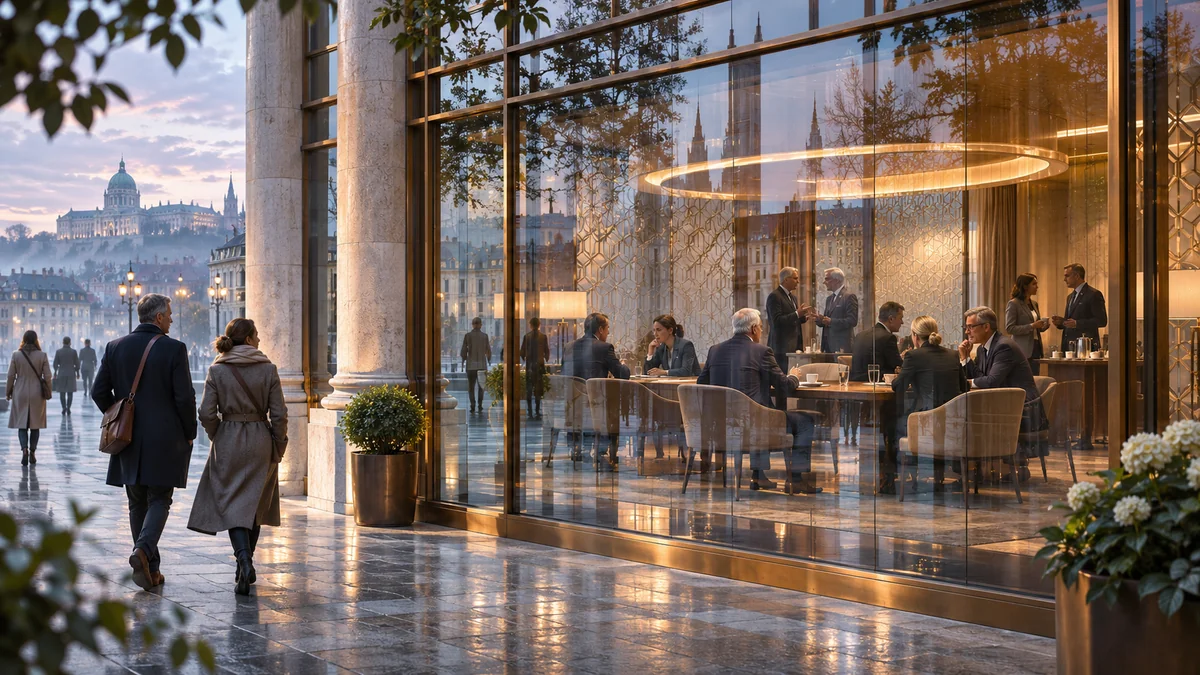
Symbolic editorial illustration of private discussions and limited public visibility; not a depiction of a documented Bilderberg meeting.
A List of Names, but No Record of the Conversation
In April 2026, the organizers of the Bilderberg Meetings published a list of expected participants at the 72nd meeting in Washington, D.C. Among those listed were NATO Secretary General Mark Rutte, Finnish President Alexander Stubb, artificial intelligence researcher Demis Hassabis, Palantir chief executive Alex Karp, The Economist editor Zanny Minton Beddoes, and banker Marcus Wallenberg. The organizers also published discussion topics, including artificial intelligence, China, energy, digital finance, trade, the defense industry, Ukraine, and the future of warfare. If so much key information is published, what exactly is secret about Bilderberg? [4] [5]
The answer lies not in total invisibility but in the difference between who can take a seat at the table and what can be learned about the conversation taking place there. The official list tells us whom the organizers named as participants, while the list of topics indicates areas of interest. It does not tell us what any individual said, what objections they heard, whom they agreed with, or whether they changed their conduct after the meeting. Nor is the published list an independently verified record of who was physically present at every discussion. This distinction is a starting point for investigating informal power, not proof of an already coordinated plan. [4] [5]
Two overly simple interpretations have therefore developed around Bilderberg. The first insists that it is merely an informal gathering of people who could just as easily talk anywhere else. The second sees every meeting as a secret government making decisions in place of elected institutions, leaving no trace. Both avoid the hardest question: when can access to influential people, repeated acquaintanceship, and the exchange of ideas turn into real political power—and how could we prove that it happened? To answer, we must return to the forum's beginnings and the documents it left behind.
Oosterbeek, 1954: Why Bring the Two Sides of the Atlantic Together?
The first meeting took place from 29 to 31 May 1954 at the Hotel de Bilderberg in Oosterbeek, the Netherlands. According to the organizers' official historical account, its purpose was to bring European and North American representatives of politics, business, and other parts of society into conversation about relations after the Second World War. The forum took its name from the hotel, not from an ancient initiatory order. It emerged during the Cold War, when alliances were important but did not eliminate disagreement among allies. [1]
Historian Thomas W. Gijswijt, who has studied archival material on the early meetings, shows just how varied Western views were. Alongside fears of Soviet influence, there were objections to American policies and disagreements over anti-communism. Early Bilderberg is therefore not convincingly described as a venue where every participant already thought alike. The evidence instead points to a forum where influential figures discussed their differences while seeking common ground on some political and social questions. That, too, can be a form of influence, but it is not the same as issuing formal orders. [8]
That these meetings are not simply a legend without documents is demonstrated by the Dutch National Archives. Fonds 2.19.045, covering the records of the Bilderberg Conferences secretariat for 1952–2017, inventories correspondence, invitations, lists, working papers, press releases, and reports. Some recordings of discussions were transferred to a Dutch institute for sound and vision. The finding aid also identifies files relating to the early meetings in Oosterbeek, Barbizon, and Garmisch-Partenkirchen. But an inventory of documents is not an examination of their full contents. To establish precisely who said what in certain cases, we would need the original report, the relevant page, and its context. This article cannot replace those with conjecture. [7]
An Invitation as a Form of Access
Bilderberg is not an open conference that anyone can register to attend. According to the organizers, participants are selected by a Steering Committee. Contemporary meetings are organized by the Foundation Bilderberg Meetings; its chair and committee members help prepare the agenda and select invitees. There is, then, an identifiable organizational structure, not an impersonal force operating beyond every institutional form. But that structure is not the same thing as a list of everyone ever invited, and an invitation does not amount to permanent membership in some kind of world government. [2] [3]
The distinction matters for funding as well. The organizers state that private contributions cover the costs of a small secretariat, that the host country's committee members meet the costs of hosting, and that invitees pay their own travel and accommodation expenses. No participation fee is charged. This is a documented statement by the organizers about their funding model, not an independent audit of every transfer, donor, or possible conflict of interest. Anyone claiming that a particular funder influenced a particular political position would need more specific financial and communications evidence. [2] [3]
Private selection of invitees is nevertheless socially significant. Access to several days of conversation with senior figures in politics, banking, business, the military, and the media is not evenly distributed. Exclusivity does not by itself prove corruption, but it allows us to ask by what criteria someone receives the opportunity to present their interpretation of the world directly to people with considerable decision-making power. That question need not be reduced to a hunt for secret orders. It is serious enough in its own right.
The Chatham House Rule: Privacy Is Not Absolute Secrecy
Bilderberg discussions take place under the Chatham House Rule. At its core, the rule allows participants to use information received during a discussion but prohibits disclosure of the identity or affiliation of speakers or other participants. Precision is needed when discussing the publication of names: Chatham House generally advises against circulating participant lists outside a meeting, whereas Bilderberg publishes a list entitled Participants before its meetings. This difference in organizational practice must not be obscured by simply claiming perfect consistency. The crucial point here is that the published list does not disclose who said what during the discussions, nor does it establish attendance at every individual session. [3] [6]
The organizers say that this arrangement encourages candid conversation among people who, in front of cameras, might otherwise defend prepared positions. According to them, there are no formal votes, binding resolutions, or collective policy statements. This is an important counterargument to the idea of Bilderberg as a legally constituted parliament above nations. Yet the absence of formal voting does not, on its own, exclude the possibility that participants exchange useful contacts, develop a shared understanding of a problem in private, or later draw upon what they heard. An official organizational decision is one thing; an individual acting after a conversation is another. [3] [4]
Nor is it sufficiently accurate to claim that no journalist is ever allowed to attend a meeting. According to the organizers' official explanation, there is no accreditation for journalists wishing to cover the meeting, but some media representatives have been invited in a personal capacity. This arrangement does not make the content of discussions publicly verifiable. Yet neither does it mean that people from the media world are entirely absent. Quite the opposite: it raises a further question about what it means when someone who helps shape public debate every day privately listens to people on whom they would ordinarily report. [3]
Privacy itself, of course, is not a violation of democracy. No one can expect every conversation involving public officials to be public at all times. But when such an official subsequently makes decisions about laws, public money, or strategic direction, the public's right to scrutinize their official conduct is not extinguished by the possibility that an idea was first encountered in private. The boundary between legitimate confidentiality and necessary accountability thus remains a political and moral question, not merely a matter of conference etiquette.
Europe Behind Closed Doors: What Was Discussed in 1955?
One of the better-documented historical examples concerns European integration. According to Gijswijt's research, discussions in Barbizon, France, in March 1955 focused mainly on how to strengthen the appeal of Western democracies during the Cold War, including through a different approach to anti-communism. Out of those discussions, the organizers placed European integration high on the agenda for the next meeting, held in Garmisch-Partenkirchen that September. There the conversation became more concrete, touching on plans for a European common market. [8]
Gijswijt identifies Walter Hallstein, Robert Marjolin, and Guy Mollet among those who advocated European integration and later participated in processes connected with the 1957 Treaties of Rome. This is an important historical point of contact between a private forum and events in public life. We are not dealing simply with an abstract list of wealthy or influential individuals: they discussed a specific political and economic question that became central to Western Europe's future during that decade. [8]
But the evidentiary force of this observation has limits. The fact that someone discussed a common market and later took part in official negotiations does not show which idea originated at the meeting, who carried it into a negotiating document, or whether a particular provision was adopted because of it. Perhaps the forum strengthened a conviction that already existed; perhaps it connected people who had long advocated similar policies. Distinguishing these possibilities requires comparing original meeting records with dated official proposals. The existence of archival files must not be mistaken for proof of a particular causal connection.
Messina Came Before Garmisch
Sometimes the best test of sweeping narratives is simple chronology. From 1 to 3 June 1955, the foreign ministers of the six member states of the European Coal and Steel Community met in Messina and adopted a communiqué calling for further European integration in economic and other fields. They established an intergovernmental committee chaired by Paul-Henri Spaak to prepare proposals for agreements. This is documented in the U.S. diplomatic series Foreign Relations of the United States. The September Bilderberg meeting in Garmisch-Partenkirchen came later. [9]
This does not erase the historical significance of the conversations in Garmisch. It does, however, disprove the narrower, verifiably incorrect claim that the idea of a European common market first arose there in September 1955, or that Bilderberg created European integration from nothing in the absence of prior official initiatives. Proposals, institutional mechanisms, economic interests, and political disagreements already existed. Bilderberg discussions may have formed part of the broader environment in which positions were reinforced and brought into contact, but that is a different claim from the thesis of a secret founding command.
The difference may seem small. In reality it changes the entire method of investigating power. When a similar idea appears in two settings, we must first establish which document is older and whether the actors referred to one another. Only then may we speak of an idea being transferred. If we skip the chronology, a private meeting can be made to look like the origin of a decision already being prepared by official actors. Such a story may be appealing, but it is not good history.
Kissinger, 1973: An Invitation Is Not the Power to Decide
A very different but instructive insight comes from the meeting scheduled for 11–13 May 1973 in Saltsjöbaden, Sweden. The organizers sought Henry Kissinger’s participation; he was then national security adviser to the U.S. president. According to a publication by the Dutch National Archives, the Swedish government led by Olof Palme opposed his attendance because of U.S. policy toward Vietnam and Kissinger's role in it. On 28 April, Kissinger wrote to Ernst van der Beugel that, under the circumstances that had arisen, he would not attend. [10]
The surviving correspondence, as summarized by the archive, shows that the organizers sought a solution and even considered moving the conference to The Hague. In the end, the meeting took place in Sweden, and Kissinger did not attend. This does not prove that he was unimportant or that the organizers lacked influential connections. It points in precisely the opposite direction: access to him clearly mattered enough for the organizers to try to overcome a diplomatic obstacle. At the same time, this is a concrete instance in which their wishes did not prevail over the host government's actions and the invitee's decision. [10]
The episode calls for important methodological caution. The archival article provides an account grounded in identified files and gives their inventory numbers; it does not mean that this research directly examined every page of Kissinger's letter or every exchanged draft. More importantly still, an invitation is not membership, a planned visit is not actual attendance, and a request for participation is not a successfully executed political order. Conflating these categories can lead us to overestimate or underestimate the significance of private networks.
What Does Washington 2026 Tell Us?
Let us return to the list at the beginning. The published topics of the Washington meeting from 9 to 12 April 2026 include fields in which public policy and private economic power often intersect: artificial intelligence, digital finance, energy, defense, international trade, and international relations. The published list brings together leading figures from public institutions, companies, and editorial organizations. The significance of such a meeting does not depend on fantasies about secret uniforms or rituals. Quite plainly, some invitees have the power to make decisions affecting large budgets, technological infrastructure, business risks, or public discourse. [4] [5]
At the same time, the list cannot tell us who actually spoke, who remained silent, who did not attend every part, or whether anyone made a decision because of a conversation. The organizers speak of roughly 120 to 140 invitees each year, but this typical figure must not be presented as an independently counted number of people present at a particular discussion in 2026. Nor would it be justified to proclaim two participants from the same field co-authors of a shared political plan without further evidence. [3] [4]
Something else matters to a critical public: the possibility that a smaller group of people privately tests ideas and develops relationships that most citizens can never directly scrutinize. That is a real asymmetry of access. Its political consequences, however, must be demonstrated through examples of subsequent public decisions, business conduct, legislative proceedings, and documented communications, not by guessing what was said behind closed doors.
Influence Without a Vote—and Accountability Without Sensationalism
Two things can be true of Bilderberg at once. Private discussion among different people can be useful, even when those involved are highly influential; an open exchange of concerns is often easier without immediate media pressure. At the same time, society is entitled to ask how public officeholders disclose potential conflicts of interest and how citizens can later scrutinize decisions taken in their name. The first position does not require uncritical trust in the organizers, while the second does not require an assumption of criminal collusion.
History, too, does not permit a single definitive answer. Archival material and historical scholarship support the forum's existence, its transatlantic purpose, significant political discussions, and selective access. The European integration case supports investigation of possible indirect influence, not a proven dependence of the Treaties of Rome on a private command. The Kissinger episode shows efforts to connect with the highest levels of diplomacy, but also the limits of that effort. Contemporary lists reveal publicly stated connections across spheres of power, not the content of conversations or a traceable chain of political execution. [7] [8] [9] [10]
The strongest version of the claim that Bilderberg makes decisions in place of states would require a precise case: a documented instruction, the person or group that gave it, a trace of its transmission into an official process, and an outcome not better explained by political processes already under way. The sources examined for this article have not established such a chain. Conversely, the mere absence of publicly attributed statements does not prove that no participant has ever influenced another. Both extremes go beyond the available evidence.
The question for further research is therefore very concrete: which idea can we trace from a particular private discussion to a dated document and then to a verifiable public decision? Until we can do that, a claim about a particular causal connection remains open. Confidentiality can make the investigation harder, but it cannot itself substitute for the missing link in the chain of evidence.
Bilderberg thus brings us to a broader question of freedom and responsibility. People are entitled to think, speak, and associate privately. But in a democratic society no one should use public office in a way that places a public decision beyond scrutiny merely because the preceding conversation took place behind closed doors. The distinction between the right to a private conversation and accountability for public power may be the most important boundary worth protecting—whether or not the meeting has an official record.
Documentary sources and archive links
These links lead to documents, archival records or photographs hosted by their original source institutions.
- Hotel De Bilderberg in Oosterbeek during the first Bilderberg meeting, 30 May 1954. Nationaal Archief / Anefo, photographer unknown, CC0 1.0; an exterior view, not a photograph of the discussions.
- Archival photograph of Prince Bernhard departing for a Bilderberg meeting, Schiphol, 11 February 1957 (Nationaal Archief).
Sources and further reading
- Bilderberg Meetings, Brief History, official account of the forum's origins and first meetings. source Source
- Bilderberg Meetings, Governance and Funding, official description of the foundation, steering committee, and funding arrangements. source Source
- Bilderberg Meetings, Frequently Asked Questions, explanations of invitations, confidentiality rules, journalists, and expenses. source Source
- Bilderberg Meetings, Press Release 2026, 9 April 2026, the 72nd meeting in Washington and the published topics. source Source
- Bilderberg Meetings, Participants 2026, list published by the organizers; not an independent record of physical attendance at individual discussions. source Source
- Chatham House, Chatham House Rule, official explanation of the use of information and protection against attribution of remarks. source Source
- Nationaal Archief, Inventaris van het archief van de Bilderberg Conferenties: Secretariaat, 1952–2017, archival fonds 2.19.045. source Source
- Thomas W. Gijswijt (2024), “Emotions and positive anti-communism during the early Cold War: the case of the Bilderberg Group,” Journal of Transatlantic Studies, DOI 10.1057/s42738-024-00117-3. source Source
- U.S. Department of State, Office of the Historian, Foreign Relations of the United States, 1955–1957, Western European Security and Integration, Volume IV, Document 96 (editorial note on the Messina Conference). source Source
- Nationaal Archief, “Henry Kissinger en de Bilderberg-conferentie van 1973,” 1 January 2024; based on fonds 2.19.045, inventory items 138–141. source Source