Skull and Bones: The Brotherhood of the American Elite
An article in the Hidden Power research series.
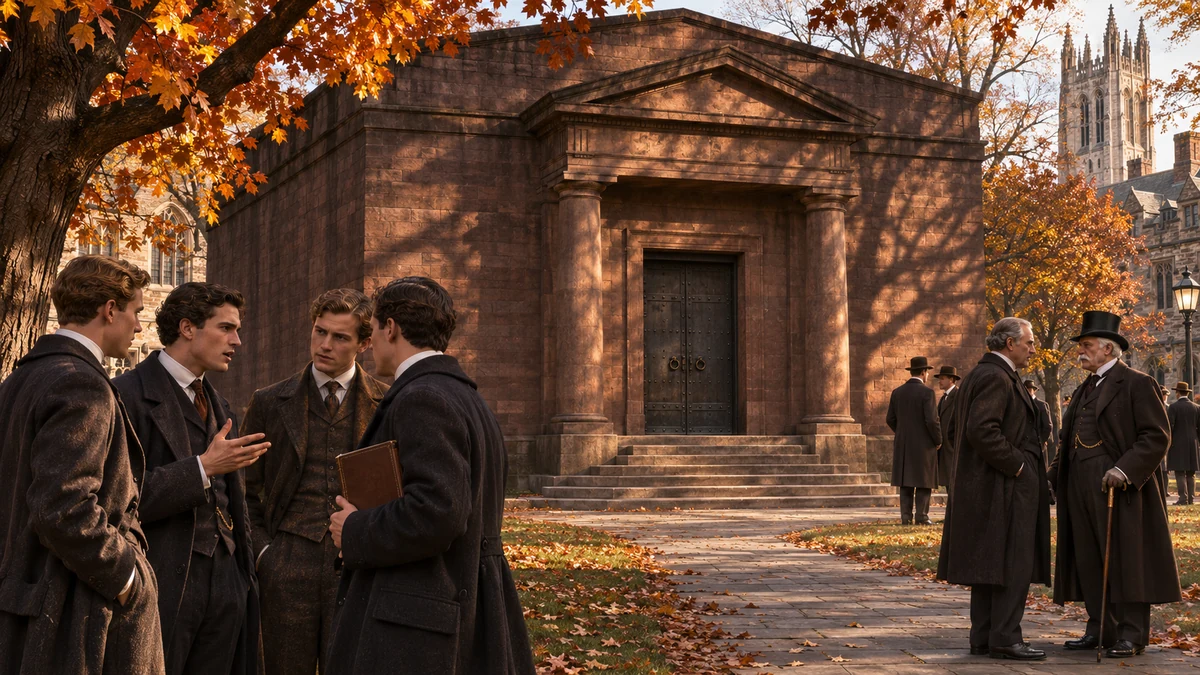
Symbolic editorial illustration of a private collegiate society and intergenerational connections; the building is not an exact historical reconstruction of the Tomb.
A Small Society, Large Questions
In 2004, George W. Bush and John Kerry competed for the presidency of the United States. They belonged to different parties, represented different political programs, and faced each other as rivals. Yet they shared an unusual biographical detail, one rarely discussed in an ordinary election campaign: as Yale students, both had been inducted into Skull and Bones, a private student society with a long tradition of confidentiality. That fact does not prove that they secretly cooperated. It does, however, raise a question: how does membership in such a small circle repeatedly appear so close to the highest offices in American public life? [1]
Investigating a network of this kind involves more than counting familiar names. We need to examine who selects new members, what connects them after graduation, whether enduring organizational and financial structures exist, how reputation and access are preserved across generations, and when we can demonstrate an actual consequence of those ties. At the same time, a boundary must be drawn: membership does not prove subordination, acquaintance does not prove an order was given, and similar biographies do not in themselves prove a coordinated political agenda.
Yale in 1832: The Society Before the Legend
Skull and Bones was founded at Yale in 1832, in a setting where student associations, debating circles, and honor societies already had an established place. In an article about the origins of the society's building, David Alan Richards, a historian of Yale societies, identifies William Huntington Russell as a central initiator. The founders also included Alphonso Taft, later the father of U.S. President William Howard Taft. Richards writes that Russell, Taft, and four other cofounders knew one another through Phi Beta Kappa and invited additional classmates into the new group. This is a far more tangible origin story than later images of an ancient order supposedly governing the world from behind the scenes. [2]
The society developed its own symbolic language. According to one early account, the skull-and-crossbones device began as a provocative drawing on a meeting notice; later it became the society's recognizable emblem. Beneath it stands the number 322, which has long attracted competing explanations. Richards also mentions Greek-inspired names for internal roles. All this points to the deliberate formation of a group identity, but not, by itself, to a political mission or a superior international organization. [2]

In its founding years, the group was not untouchable. University authorities treated some of its activities as a disciplinary problem and threatened students with sanctions, yet the society survived. Its early history therefore tells us not of a secret order that controlled institutions from day one, but of a student association that still had to build its own traditions, premises, and permanence. [2]
How a Private Circle Becomes a Lasting Institution
A turning point came in 1856, when former members provided the society with a building of its own in New Haven. Its enclosed, almost windowless appearance gave rise to the nickname Tomb. The building remains the most visible symbol of Skull and Bones: something entirely tangible from the outside, yet inaccessible to most people within. Its historical significance is above all institutional. The society was no longer merely a yearly cohort of students renting a meeting place, but an organization capable of preserving property, memories, and rules across generations. [2]
Richards explains the importance of creating the legal structure known as the Russell Trust Association for that continuity. Yale's official archival finding aid, Russell Trust Association Records (RU 1135), states that the organization was incorporated in 1856 and oversees the society's finances and the upkeep of its property. The inventory separately identifies George Ingersoll Wood's 1884 recollections (accession 2017-A-040), copies of the constitution and building contract (2015-A-036), and a photographic album of the class of 1910 (2026-A-0041). The distinction between an annually changing student group and a lasting alumni organization is fundamental: premises, resources, and institutional memory can survive even as individual members come and go. We have checked the finding aid, but that is not the same as inspecting all the original documents; the archive also notes access restrictions. [2] [3]
Such continuity matters even without mysterious imagery. Many groups disappear with their founding generation. Those that acquire property, financial backing, and an expectation of returning favors to successors have a better chance of surviving for decades or centuries. This does not mean that their members act as a single political body. It does mean that relationships, reputation, and a sense of belonging can be reproduced long beyond a single academic year.
Selection, Secrecy, and Ritual: What Do We Actually Know?
Skull and Bones belongs to the Yale tradition of so-called senior societies, associations for students in their final undergraduate year. In 2014, journalist Mark Alden Branch described how these societies selected members, met, and maintained varying degrees of privacy on Yale's campus. Crucially, we should not automatically attribute every observation about the many societies he discussed to Skull and Bones. He noted specifically, for instance, that according to students at the time, Skull and Bones did not use the same candidate-interview process as many other clubs. [4]
Confidentiality is not complete invisibility. At various times, members' names were known and even published; what is far less accessible are private conversations, individual rituals, and relationships among alumni. This is precisely where legends flourish. Some accounts of symbols and internal titles have historical anchors, but descriptions of contemporary initiations may be secondhand, incomplete, or dependent on individual memories. This article therefore does not treat every sensational account of a ritual as a verified fact. [2] [4] [5]
Why do rituals matter at all? Because they can serve a social function. A group with recurring symbols, a ceremonial passage into membership, and a shared secret can strengthen belonging and trust. This is an explanation of a possible mechanism, not evidence that any specific ritual caused a later political decision. To demonstrate political influence, we must move beyond the psychology of belonging to documents showing actual contacts, recommendations, appointments, and decisions.
Names That Resonate Far Beyond the University
The Taft family provides a well-documented example of society membership across generations. Alphonso Taft helped found the society in 1832; his son William Howard Taft, later president of the United States, is identified in Yale's archival finding aid as a member of the class of 1878. The same official inventory, in RU 1135, accession 2026-A-0041, explicitly identifies a photographic album for the society's class of 1910 and describes Robert A. Taft as the grandson of Alphonso Taft and son of William Howard Taft. We therefore have an independent archival anchor for three successive generations, although a description in an inventory is still not the same as directly examining and identifying individual portraits on the album pages. Nor does continuity of membership within a family prove that the society dictated any of the Tafts' political decisions. [2] [3]
Membership across several generations of the Bush family is also frequently reported, but it must still be described without shortcuts. In the Yale alumni magazine, three members of the family—Prescott Bush, George H. W. Bush, and George W. Bush—are named in material appended as readers' comments to an article about Sinclair Lewis. This is not the same as the author's historical account or an official membership list, so we do not treat that comment as conclusive archival evidence for all three individuals. George W. Bush’s membership is separately confirmed in an editorial item concerning the 2004 election. A precise family membership matrix would require direct alumni records for the other individuals. [1] [7]
The 2004 election provides a particularly instructive test of interpretation because of Bush and Kerry. Their shared membership is verifiable: Yale Alumni Magazine explicitly mentions it. Yet their publicly known partisan rivalry and political differences are a warning against assuming that people who belonged to the same society necessarily pursued the same political goal. The hypothesis that personal contacts can assist careers is one claim; the assertion that the organization directed both campaigns is another, much stronger claim, for which very different evidence would be required. [1]
Where Does a Network's Real Power Lie?
Private associations do not need a written constitution for a secret government to create social advantages. Access to older members, a recommendation when looking for work, an invitation into an influential circle, or the exchange of confidential information are all possible channels of influence. But we must carefully distinguish possibility from proof. In the sources examined so far, we can demonstrate Skull and Bones' long-term existence, the confidentiality of some of its activities, its prominent alumni environment, and several members who became politically influential. The same sources do not yet allow us to establish a verified chain in which the society ordered a particular action, a member carried it out while in public office, and a specific government decision resulted.
A more precise investigation would need to select a concrete case. Is there a letter in which one former member recommends a candidate to another? Do records of appointments and business relationships correspond in time to documented communications? Did the expected benefit actually materialize, and were there other, stronger reasons for the outcome? Without such anchors, a discussion of network power would rest more on inferences from social position than on proof of a particular influence. It is more responsible to leave this gap open than to fill it with a dramatic list of names.
There is also a broader problem of selection. Yale itself offered a path into influential professional circles. If many members of a society later rise to high office, we must ask whether the society helped them reach those positions or whether it had already selected students with status, family connections, abilities, and future prospects. Both processes may operate together. Distinguishing their effects requires comparison with other graduates and other societies; a list of famous members alone cannot answer the question of causation.
The German Connection, 322, and the Illuminati Narrative
Explanations have accumulated around the number 322 and the society's origins, ranging from ancient symbolism to a supposed transplantation of a German secret order to the United States. Historical writings show that such stories circulated; their existence does not establish that they were true. Richards notes the competing interpretations of the symbol's origins, while historical writing also discusses the alleged German connection in the context of rumors and early descriptions. Without a document identifying the supposed parent organization, its relationship to Yale, and an uninterrupted organizational link, we cannot present the claim of a superior German order as fact. [2] [5]
More sweeping still are theories that declare Skull and Bones the successor of the Bavarian Illuminati or the command center of American politics. It is important to understand their appeal: a mysterious building, rituals, influential names, and a network lasting for centuries combine into a compelling narrative. But a compelling narrative is not the same as proven historical continuity. A serious connection to the Illuminati would require documented succession, transfer of authority, common organizational leadership, or another trace in primary sources; symbolic resemblance and proximity in time cannot substitute for such evidence.
More limited questions, which do not depend on a grand theory, are also worth investigating. Which German student customs influenced American campuses? Who was familiar with European fraternities? When did particular interpretations of the number 322 first appear? This requires returning to early primary accounts, especially Lyman Bagg's 1871 work, and comparing their wording with later retellings. Until that comparison is complete, the origin of the symbol remains open, while a link with the Illuminati remains unproven. [5]
When a Secret Also Becomes an Ethical Question
There is another sensitive example that shows how dangerous it is to confuse the existence of a document with proof of everything asserted in it. In 2009, Yale's alumni magazine reported on a lawsuit brought by a great-grandson of Geronimo; in 2023, it reported on two additional letters from 1918 in which Skull and Bones members described or celebrated the removal of remains from a grave at Fort Sill. The letters provide significant support for the conclusion that members claimed to have committed such an act. They do not, however, establish the actual identity of the grave or prove that any purported remains were Geronimo's. The case involved a demand by descendants, while Fort Sill representatives pointed to the grave's lack of a marker at the time. The ethical seriousness of the allegation thus remains, without turning uncertainty into certainty. [8] [9]
This raises a distinct moral boundary for elite associations: a closed group has a right to private conversations and friendships, but not a special exemption for conduct that would violate other people's dignity or rights. Historical allegations about interference with graves require both evidentiary and ethical scrutiny. We must not use allegations about unverified actions as a convenient confirmation of every other theory about the society; each alleged act has its own evidentiary trail.
Who Decides, and Who Is Allowed to Ask?
Secrecy by itself is not evidence of abuse. People have the right to associate privately, maintain traditions, and form friendships without every meeting becoming a public matter. Democratic questions become more pressing, however, when private networks reach into public decision-making. At that point, the central issue is not whether a member wears a skull emblem on a lapel, but whether closed relationships create unfair access to positions, information, or influence unavailable to other citizens.
Research into Skull and Bones is therefore least convincing when it attempts to turn a single society into an explanation of all American history. It is more convincing when it shows how prestigious institutions and selective associations survive across generations, how social proximity can become an advantage, and how difficult it is for outsiders to measure the actual influence of a closed network. The critical question is not simply whether someone possesses power, but how that power is acquired, to whom its holder is accountable, and whether the boundary between private trust and public duty is preserved.
Conclusion: A Real Network, Not a Proven Secret Government
Skull and Bones is a historically documented society with long institutional continuity, recognizable symbolism, selective membership, and an alumni network that has included people in high political office. That is sufficient reason to investigate informal ties among elites seriously. It is not sufficient to claim that the society, acting as a single body, directed presidents, state institutions, or world events. Between these conclusions lies no void that must be filled either by faith in an official account or by faith in conspiracy. It is a space for closer work with documents.
Until we have concrete examples of communication, mediation, and the resulting decisions, we can reasonably speak of the potential for network power, not of a proven hidden command structure. At the same time, a lack of evidence for the broadest theory does not remove the need to investigate real privileges and informal channels of influence. A free society has no need to prohibit private friendship. It does, however, need public accountability wherever private connections shape public affairs.
Documentary sources and archive links
These links lead to documents, archival records or photographs hosted by their original source institutions.
Sources and further reading
- Mark Alden Branch, “Throwback Thursday: Eli vs. Eli,” Yale Alumni Magazine, 16 July 2020. source Source
- David Alan Richards, “The origins of the tomb,” Yale Alumni Magazine, May/June 2015. source Source
- Yale University Library, Manuscripts and Archives, Guide to the Russell Trust Association Records, RU 1135, archival finding aid (William Massa, Michael Lotstein, Jeanne Lowrey; June 2015; exported 11 July 2026), pp. 3–7, especially Biographical / Historical, Collection Contents, and accession 2026-A-0041 (1910 photographic album). source — the finding aid was consulted, not the original archival documents; access restrictions apply. Source
- Mark Alden Branch, “Open secrets,” Yale Alumni Magazine, July/August 2014. source Source
- Kathrin Day Lassila, “The evolution of secret societies,” Yale Alumni Magazine, July/August 2017 (editorial review of Richards's book). source ; David Alan Richards, Skulls and Keys: The Hidden History of Yale's Secret Societies, Pegasus Books, 2017 (the book has not been examined directly in full). Source
- Protecting Sight, “A Skull and Bones Photo, Blackface, and Unanswered Questions at Yale,” 21 May 2026, a private description of the 1910 album. source — a collector's supplementary description; the archival placement and family relationships are now independently supported by Yale's finding aid [3]. This source is no longer needed as evidence in the article's main text. Source
- Judith Schiff, “Sinclair Lewis, student scribe,” Yale Alumni Magazine, November/December 2017. source — claims concerning three members of the Bush family appear in lengthy comments appended by a visitor, NOT in the editorial article; insufficient as individual proof. Source
- Carole Bass, “Apaches sue to recover Geronimo’s skull,” Yale Alumni Magazine, May/June 2009. source Source
- “Campus Clips,” Yale Alumni Magazine, July/August 2023, reporting on additional letters from 1918. source Source