The Illuminati: The History of a Banned Order
In 1784–1785, measures taken by the Bavarian authorities against secret societies also prohibited the Illuminati, an order whose founder believed society could be transformed by carefully educating people who would gradually assume positions of importance.
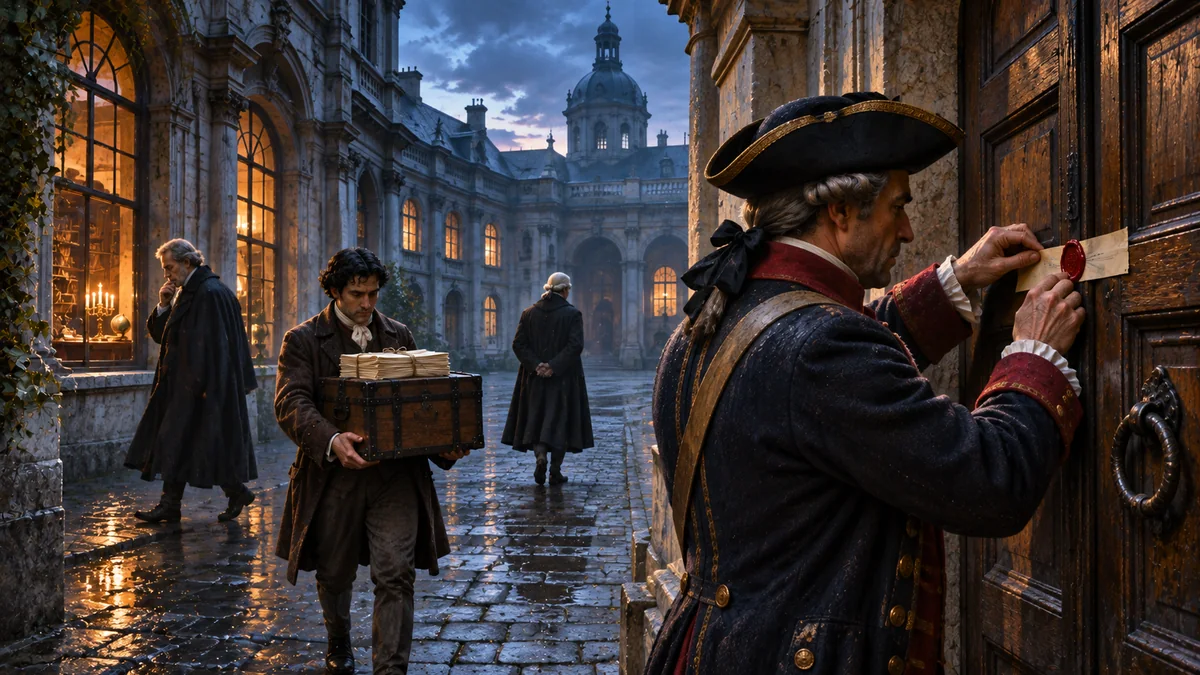
Artistic depiction of the suppression of the Illuminati and the seizure of papers; not a reconstruction of a specific documented event.
In 1784–1785, measures taken by the Bavarian authorities against secret societies also prohibited the Illuminati, an order whose founder believed society could be transformed by carefully educating people who would gradually assume positions of importance. The ban, the seizure of documents and the public exposure of its plans might have brought the story to an end. Yet the Illuminati became something far more enduring than their original order: a name for invisible power, invoked by later writers to explain revolutions, upheavals and, eventually, almost every major political change. [1] [6] [15] [16]
For the history of hidden power, the more important question is therefore not whether the Illuminati existed but what, precisely, they did. How did they select, educate and supervise their members? Did they actually influence other organisations and public authorities? What happened after the ban? And at what point do the documents cease to tell us about a particular eighteenth-century order and begin to tell us chiefly about its myth?
Ingolstadt: When the Enlightenment Acquired a Secret Organisation
Adam Weishaupt (1748–1830), a professor of canon law at the University of Ingolstadt, founded a small circle with students on 1 May 1776. Its members initially called themselves Perfectibilists and only later Illuminati. The name suggests an aspiration towards human improvement, but it does not yet reveal the organisational methods by which Weishaupt hoped to bring about social change. The order emerged in Enlightenment Europe, where scholars, officials and noblemen debated the role of ecclesiastical institutions, education, absolutist rulers and freedom of thought. [1] [2] [3]
Ludwig Maximilian University of Munich describes the order's programme in quite specific terms: through the education and supervision of members, it sought to develop an elite that would eventually occupy key positions in the state and thereby weaken the rule of territorial princes. This is not merely a retrospective accusation levelled by frightened opponents. It is a historical reconstruction of a genuine ambition in which education and political power became two sides of the same plan. Yet an objective must be distinguished from its achievement: evidence that someone planned to intervene in government does not in itself show that their association succeeded in controlling the state. [1]

This duality lies at the heart of the Illuminati case. The order promised its adherents moral and intellectual development while also demanding disciplined loyalty to a secret structure. Who decided which knowledge a member was ready to receive? Who assessed their progress? And how independent can a person be if the path towards supposedly greater freedom is prescribed by superiors whose intentions they know only in part? Such questions are not evidence that every individual member was abused; they do, however, expose a tension worth examining in the actual rules and correspondence. [4] [5]
Initiation, Internal Hierarchy and the Cultivation of Obedience
The Illuminati did not operate simply as an open forum for public debate. Their organisation had classes, degrees of initiation, internal correspondence, procedures for assessing candidates and material intended for different levels of membership. A University of Erfurt research project describes approximately 150 previously little-known essays from 1783–1787 preserved among Bode's papers. These texts address philosophy, moral questions and proposals for economic and social reform. They show that the order's inner life cannot be reduced either to political instructions alone or to mysterious rituals devoid of substance. [4]
Organisational communication mattered alongside instruction. A critical edition of the early correspondence, edited by Reinhard Markner, Monika Neugebauer-Wölk and Hermann Schüttler, contains nearly two hundred letters from the first six years. Its publicly available description specifically emphasises disputes between leaders, the development of doctrine and attempts to enter existing Masonic circles. These internal conflicts themselves show that the order was not a flawlessly coordinated machine: it had ambitions but also had to contend with disagreements among those who were supposed to lead it. [5]

Adolph von Knigge played an important role, taking part from 1780 in expanding the order and adapting it to Masonic structures. The Illuminati cannot, however, simply be equated with Freemasons. The former were a distinct organisation seeking to make use of particular existing social and ritual networks; Masonic lodges were numerous and diverse and did not all answer to the same leadership. A particular instance of gaining influence does not establish that every Masonic gathering became an Illuminati meeting. [3] [5] [10]
When a Secret Organisation Encounters State Persecution
Pressure against the order mounted in Bavaria during 1784 and 1785. Under the ruler Karl Theodor, official measures restricted and prohibited secret societies, while Weishaupt lost his university position and left Bavaria. This need not be turned either into a tale of innocent scholars frightened by an irrational government or into a story of an omnipotent conspiratorial leadership that the state could barely resist. The order really was constructing a covert political network; the authorities really did pursue it, and their own interests must also be investigated. [1] [3] [10]
A particularly revealing source is Einige Originalschriften des Illuminatenordens, published in 1787 following a house search at the premises of former government councillor Franz Xaver von Zwack in Landshut on 11 and 12 October 1786. A supplementary collection, Nachtrag von weitern Originalschriften, also appeared in 1787, drawing on documents seized at the estate in Sandersdorf. Both works can be identified in the Bavarian State Library's catalogue; their titles explicitly state that the records were published by order of the Elector. [6] [7]
Such documents provide a firmer basis for research than later legends, but they require care. A seized letter can be an authentic primary source and, at the same time, part of a politically motivated selection through which the authorities sought to justify persecution. We must distinguish a document's authenticity, the circumstances in which it was written, the way it was made public and the conclusions drawn from it by its publisher. The caution also applies in reverse: the fact that the authorities had an interest in discrediting the order does not establish that all the confiscated documents were forged. [6] [7]
The prohibition also shaped individual lives. Former members lost their jobs or left Bavaria, while others later found new political patrons. These consequences allow us to investigate networks of solidarity, hostility and returns to public office. But the loss of operations in one territory does not automatically mean that all connections beyond its borders were severed on the same day. [3] [11] [12]
Gotha: The Order Did Not Disappear with the Ban of 1785
For a long time the story of the Bavarian Illuminati was told as though 1785 marked their definitive end. Historical research in Gotha has revised that boundary. In April 2026, on the order's 250th anniversary, a University of Erfurt research team stressed that under Johann Joachim Christoph Bode's leadership the organisation continued to operate in Thuringia until the summer of 1787. Under the protection of Duke Ernst II of Saxe-Gotha-Altenburg, a province called Ionia arose there and became an important centre of the order in its later years. [2] [3]
This conclusion does not rest on similar symbols appearing two centuries apart. It rests on a preserved collection known as the Schwedenkiste (‘Swedish Chest’), which includes Bode's archive and correspondence. Rediscovered towards the end of the 1980s, these materials changed our understanding of the order's geographical spread and chronology; even today they have not been fully exhausted by researchers. In 2026, a comprehensive new synthesis by the research team was still scheduled for publication in 2027. The university's research thus does not uncover a new, eternal organisation; it corrects an end date assigned too early to the documented historical association. [2] [3]
Gotha offers still more concrete evidence of internal influence. Erfurt University's 2023 presentation of the exhibition Freimaurer und Mysterien Ägyptens in Gotha states that from 1782 Duke Ernst II supported the covert direction of the local Masonic lodge through the Illuminati; he himself joined the order in 1783. This is not merely a case of two influential men belonging to different associations. Historians describe an organisational mechanism through which members of one closed organisation influenced the running of another. The evidential limits, however, remain local and historically specific. [8]
Descriptions of individual meetings have even survived. FactGrid, a database associated with research on the Gotha material, records a meeting of the Illuminati magistrate on 31 October 1786, its participants and a discussion of a candidate's advancement in an affiliated Masonic lodge. The University of Erfurt also reports minutes and papers from a meeting of a Minerval group on 18 December 1786, which made it possible to stage a historically informed public reconstruction. Such records allow us to examine the organisation's actual procedures, while reminding us not to mistake a modern stage performance for the original event. [9] [18]
Gotha therefore establishes two things. First, the secret order possessed real internal discipline, connections and methods of influencing neighbouring associations. Second, the existence of a particular documented network does not allow us to draw a line to present-day political institutions without further evidence. A historical case becomes more interesting when its true limits are established, not when unlimited powers are attributed to it. [2] [8] [9]
Bode's Paris Journey in 1787: Contact Is Not Revolution
Johann Joachim Christoph Bode travelled to Paris in 1787. Researchers associate the journey with Masonic contacts, attempts to recruit new members and his interest in contemporary discussions of animal magnetism, or Mesmerism. This documented journey later became a convenient point of reference for a much wider accusation: that the Illuminati had secretly set the French Revolution in motion in 1789 and directed it from behind the scenes. [3] [14]
The University of Erfurt expressly notes that Bode recruited only a few French Freemasons and that this does not provide historical grounds for inferring that he directed a revolution two years later. Such a far-reaching conclusion would require tracing specific instructions, individuals, funds, orders and their implementation through the events that transformed France. A journey to Paris, even if undertaken with the intention of expanding the order, does not by itself establish that chain. [3]
A further question is whether Bode wished to reshape the order and give it a different name in France. The research material discusses such ideas, but a plan, a discussion of a plan and a lasting organisation actually put into operation are not the same thing. There is no reason to reject the possibility of reorganisation merely because the original name later disappears; nor is it fair to declare the plan proof that a successful secret hierarchy was established without identifying its new statutes, leadership, membership and period of activity. [14]
Montgelas: A Former Member at the Summit of Bavarian Government
If we seek an example of a political career continuing after the ban, Maximilian Joseph von Montgelas (1759–1838) is more significant than countless undocumented suppositions. Bavaria's historical portal confirms that he was a member of the Illuminati and lost his position in public service as a result in 1785. In 1796 he prepared the Ansbacher Mémoire, a programme of state reforms, and in 1799 he became a leading minister under Bavaria's new ruler. His subsequent policies genuinely transformed the administration and relations between the state and religious institutions. [11] [1]
We therefore have a verifiable sequence: a former member of a secret order, followed by an influential state decision-maker. Does that mean the minister was carrying out instructions from a secret leadership after 1799? No. Evidence of membership is one thing; evidence that an organisation directly guided a minister's work is another. Between those two periods we would need documented communications, powers of authority and instructions carried out, not merely similar Enlightenment ideas. [11] [12]
In his study of Bavarian secularisation in 1802–1803, the historian Eberhard Weis found that Montgelas's associates included former Illuminati; among the secularisation commissioners, however, they remained a minority, even though they were relatively numerous. Some former members were themselves opponents of these measures. This undermines the image of all former Illuminati following a single plan without disagreement after the order's collapse. At the same time, it remains a legitimate question what advantages old acquaintances might have provided in choosing associates and shaping reforms. [12]
Did It End in 1787, or Only Around 1790?
Recent research from Erfurt identifies Gotha as the order's last major centre, active until the summer of 1787. The earlier historian Eberhard Weis and a later study of Joseph von Utzschneider, however, draw attention to Bode's attempts to continue or reorganise activity outside Bavaria, discussed in the literature around 1790. At first sight the two dates appear contradictory. Yet a claim about the end of an identifiable province's operations in Gotha and a claim about subsequent attempts at organisation do not necessarily concern the same thing. [2] [10] [13]
A fuller answer would require closer comparison of correspondence after 1787, establishing the names under which groups operated, how they selected superiors, which rules they adopted and whether participants understood the organisation as the same order or as a new initiative. The available sources for this article do not yet reconstruct such an unbroken chain in full. It would therefore be unwarranted to say that the story ended completely on one precise day; it would be even less warranted to turn an open question about a few years into proof of centuries of uninterrupted worldwide direction. [2] [10] [13]
Collapse and continuation can mean several different things. Members may remain acquainted long after an association has been dissolved, ideas may outlive their founder, new organisers may attempt to revive old forms, and entirely different people may later adopt its name. Organisational succession, however, requires more: legal or internal authority, identifiable people exercising decision-making power, regular communication and documents connecting successive generations. Without such a chain, we may speak of influence, memory, attempts and legend, but not of the proven continuation of a single commanding centre.
From a Real Order to an Explanation for Every Revolution
When the French Revolution erupted a few years after the Illuminati were banned, the search for hidden instigators held considerable political appeal. From 1797, Augustin Barruel developed an elaborate account of revolutionary conspiracy in Mémoires pour servir à l'histoire du Jacobinisme; in the same year John Robison published Proofs of a Conspiracy, combining allegations against the Illuminati, Freemasons and other associations. Both books really exist, and their authorship and publication dates can be checked bibliographically. But the existence of a book alleging a conspiracy primarily demonstrates that someone publicly advanced such an allegation. [15] [16]
The historian Michael Taylor connected the emergence and spread of these interpretations with the political struggles of British conservative circles between 1797 and 1802. The University of Erfurt similarly observes that the image of the Illuminati as an almost unlimited secret force was shaped partly by later narratives rather than by the order's archival documents alone. We must therefore ask not only what happened in 1787, but also who wrote about it after 1789 and which political needs such explanations served. [17] [3]
This does not mean that investigating historically documented covert political activity is inherently unfounded. Quite the contrary: Gotha demonstrates real organisational influence, while Montgelas demonstrates the continuation of individual political careers. Precisely for that reason, consistency matters. The best safeguard against exaggeration is not to deny hidden power, but to demand precise sources, distinguishable roles, verifiable mechanisms and an acknowledgement of limits. If we replace one documented covert intervention with an unproven theory that the same order controlled every subsequent event, we lose our ability to identify the people who were actually responsible. [8] [11] [12]
Hidden Power, Responsibility and Freedom of Judgement
The Bavarian Illuminati were a real secret order that sought to shape individuals and, through them, influence the state. Their members had internal degrees, rules and links with lodges; after the ban of 1785, part of the organisation in Gotha continued to operate until 1787. Later attempts and the paths taken by former members remain subjects of historical research. Yet the sources examined do not establish an uninterrupted central hierarchy stretching from the eighteenth century to today's centres of global power. [1] [2] [3] [10]
The story also reveals a contradiction that extends beyond any one association. How can a freer society be secured through an organisation in which people do not always know who decides matters affecting them or by what criteria? Education, knowledge and mutual assistance can be valuable; when combined with unaccountable supervision, secret superiors and deliberate concealment of political objectives, however, they may turn into the opposite of the ideal publicly professed. This is a philosophical and moral judgement about a mode of operation, not a judgement in advance upon every person belonging to the historical order.
For readers, it is important to retain two capacities: to recognise genuinely covert organisation where documents attest to it, and to reject demands that they believe in an invisible, all-encompassing power without an adequate chain of evidence. The history of the Illuminati is revealing enough without attributing omniscience to them. It shows why we should ask who holds information, who gives instructions, who bears the consequences and whether decisions can be scrutinised. Those questions, rather than the mere name of a secret order, are at the heart of investigating power.
Next: The Carbonari and Secret Revolutionary Brotherhoods.
Documentary sources and archive links
These links lead to documents, archival records or photographs hosted by their original source institutions.
Sources and further reading
- Ludwig-Maximilians-Universität München. 1776 – The Illuminati. Undated; university institutional history: the founding in Ingolstadt, the Perfectibilists and the programme of securing positions in the state. Access source. Source
- Universität Erfurt, Forschungsbibliothek Gotha. 250 Years of the Order of the Illuminati: New Research Puts Gotha in the Spotlight. 29 April 2026; the centre's move to Gotha, dissolution in 1787, the Schwedenkiste and the limits of the legend. Access source. Source
- Universität Erfurt, Forschungszentrum Gotha. Illuminati Research Unit. Undated; historical overview, Knigge, Bode, Ionia and the Paris journey of 1787. Access source. Source
- Markus Meumann and Olaf Simons; Universität Erfurt. Illuminatenaufsätze im Kontext der Spätaufklärung: Ein unbekanntes Quellenkorpus. Research project from 2013; description of approximately 150 essays dating from 1783–1787. Access source. Source
- Reinhard Markner, Monika Neugebauer-Wölk and Hermann Schüttler, eds. Die Korrespondenz des Illuminatenordens. Band 1: 1776–1781. 2005; publicly available description of the critical edition and internal disputes, not the full letters. Access source. Source
-
Kurpfalzbayerische Regierung, ed. Einige Originalschriften des Illuminatenordens (seized from Zwack on 11–12 October 1786). Munich, 1787; catalogue/digitisation at the Bayerische Staatsbibliothek, identifier
bsb11083748. Access source. Source -
Kurpfalzbayerische Regierung, ed. Nachtrag von weitern Originalschriften (Sandersdorf). Munich, 1787; catalogue/digitisation at the Bayerische Staatsbibliothek, identifier
bsb11099015. Access source. Source - Universität Erfurt. Exhibition about “Freemasons and Mysteries of Egypt in Gotha”. 13 April 2023; Ernst II and the covert direction of the Gotha lodge. Access source. Source
- FactGrid, research archive index. Session of the Illuminati Magistrate Gotha, 1786-10-31 (Q1780); participants, organisational questions and related material. Access source. Source
- Eberhard Weis. Der Illuminatenorden (1776–1786). Unter besonderer Berücksichtigung der Fragen seiner sozialen Zusammensetzung, seiner politischen Ziele und seiner Fortexistenz nach 1786. Bayerische Akademie der Wissenschaften, Sitzungsberichte, 1987/4; historical study of the order's dissolution and succession. Access source. Source
- Haus der Bayerischen Geschichte. Maximilian Joseph von Montgelas. Biographical entry; membership, loss of office and subsequent political reform career. Access source. Source
- Eberhard Weis. Die Säkularisation der bayerischen Klöster 1802/03: Neue Forschungen zu Vorgeschichte und Ergebnissen. Bayerische Akademie der Wissenschaften, Sitzungsberichte 1983/6, p. 43, note 53: former Illuminati in the commissions. Access source. Source
- Ivo Schneider. Joseph von Utzschneider – Vision und Wirklichkeit eines neuen Bayern. 2014, p. 47: Bode's later reorganisation outside Bavaria. Access source. Source
- Markus Meumann and Olaf Simons. Illuminatism Versus Mesmerism? Johann Joachim Christoph Bode’s Encounters With Animal Magnetism on His Journey to Paris in the Summer of 1787. 2025; scholarly study of Bode's journey, using the accessible excerpts. Access source. Source
- Augustin Barruel. Mémoires pour servir à l’histoire du Jacobinisme, vol. 1. 1797; the original polemic as a historical source for conspiracy claims, not evidence that the claims were true. Access source. Source
- John Robison. Proofs of a Conspiracy against all the Religions and Governments of Europe. Edinburgh, 1797; Wellcome Collection catalogue of the historical work. Access source. Source
- Michael Taylor. British Conservatism, the Illuminati, and the Conspiracy Theory of the French Revolution, 1797–1802. Eighteenth-Century Studies 47/3 (2014), p. 293 ff., DOI 10.1353/ecs.2014.0018; publicly available abstract. Access source. Source
- Universität Erfurt. Was besprachen die Illuminaten bei ihren geheimen Zusammenkünften? 7 September 2023; scholarly reconstruction of a documented meeting on 18 December 1786. Access source. Source