The Carbonari and Secret Revolutionary Brotherhoods
In 1821, European monarchs and diplomats assembled in Ljubljana to decide, among other things, the fate of the revolution in the Kingdom of Naples.
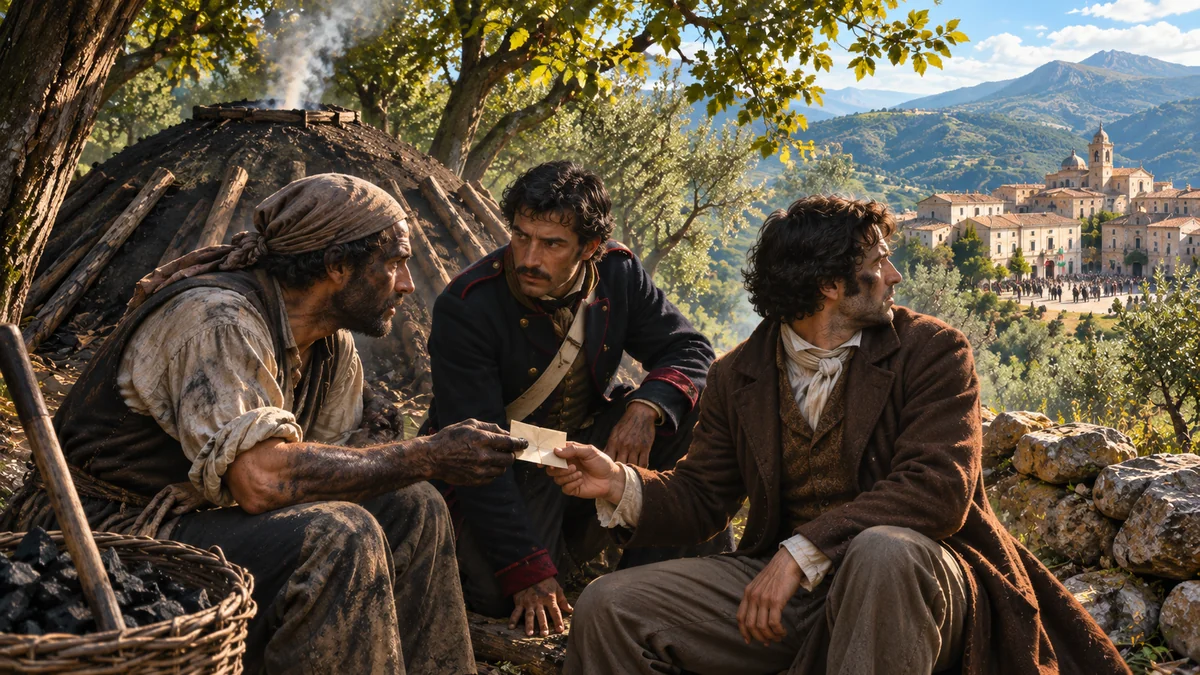
Artistic interpretation of clandestine Carbonari political connections beside a charcoal kiln; not a reconstruction of a documented meeting.
In 1821, European monarchs and diplomats assembled in Ljubljana to decide, among other things, the fate of the revolution in the Kingdom of Naples. While representatives of the recognized states met in the city's halls, people in Italy and France were forming connections because, under the political conditions of the time, they could not openly organize opposition without taking serious risks. Some belonged to the Carbonari, secret brotherhoods whose name evoked charcoal burners. The decision of Europe's rulers was clear: military force would be used against the constitutional order established in Naples. [8] [20]
The Carbonari cannot therefore be dismissed as an invented society created for later conspiracy theories. Ritual manuals, members' testimony, biographical records, evidence of recruitment and accounts of uprisings in which they genuinely participated have survived. A harder question is how far the local groups acted together, who made decisions in their name, and when similar rituals indicate a shared leadership. The story becomes more intriguing when we discover that the Carbonari name and some organizational traditions also appear in the twentieth century. [1] [4] [5] [12] [13]
Origins in a Restless Europe: Charcoal Burners, Freemasons and Politics
After Napoleon's fall and the Congress of Vienna in 1814–1815, Europe's monarchies sought to restore older forms of rule. There was no unified Italian state on the Apennine Peninsula: there were kingdoms, duchies, papal territories and regions under strong Austrian influence. The political conflict was therefore not merely between supporters and opponents of kings. It also concerned constitutional limits on power, freedom of the press and association, foreign domination, and competing ideas about who should represent the community. Secret societies spread in a setting where open opposition often had no secure institutional place. [6] [17] [20]
Carbonarism took shape as a recognizable political association in southern Italy, probably between 1807 and 1812, under the rule of Joachim Murat. Its origins, however, remain incompletely resolved. A more recent historical overview by Treccani mentions a probable offshoot of a Masonic network, while an older entry by Renato Soriga looks for precursors among the French craft brotherhoods known as charbonniers. When studying such a genealogy, the crucial question is what exactly we mean to establish: adoption of a name and ritual signs, movement of individual members, or the establishment of a single organization with uninterrupted command. Those are three different kinds of historical connection. [1] [2] [3] [17]
Some Carbonari opposed Napoleonic domination; others emerged from the military and administrative world of the Napoleonic period. Later, their orientations intersected with liberal, constitutional, republican and national demands. After 1815, the network spread from southern Italy into the Papal States, Romagna and farther north, where it encountered rival or related secret associations. The Carboneria was not from the beginning a party with one public manifesto and an unchanging program. It was a means of organizing people in a politically fragmented landscape. [1] [17]
The Secret Language of “Cousins”: Vendite, Degrees and Rituals
Carbonari addressed one another as cugini, or “cousins.” They called their local groups vendite, used ritual language drawn from charcoal burning, recognition signs, oaths and certain degrees of membership. Such practices fostered belonging and confidentiality. They also had a dual character: in a repressive political environment they protected people from espionage and persecution, while potentially concealing from ordinary members who set the goals and who possessed information unavailable to them. [1] [5] [9]
The existence of this system does not depend on later romanticized images of secret meetings. The digitized bibliographic record for the 1820 Codice di carboneria lists 76 pages; its indexed terms include ritual actions, admission, oaths, equipment and the division of duties. Yet that record does not justify assuming that every Carbonari meeting occurred precisely as described in one manual. Individual vendite existed in different regions, periods and political circumstances; the full contents of the original manual have not been critically collated at this stage of the research. [5] [1]
Symbols of the forest, wood, charcoal and fire conveyed ideas of transformation and labor. Some Carbonari rituals also incorporated borrowed Christian motifs, which papal authorities later condemned sharply. Yet the presence of a religious sign alone does not tell us whether a particular group was doctrinally orthodox, anticlerical, politically radical or primarily attached to ritual tradition. A symbol's meaning depends on its use and documented context, not on the assumption that everyone using the same sign received orders from the same center. [5] [9] [1]
1817: A Real Plan for Concealed Leadership
Carbonari history can be examined through the story of a man preserved not merely as a name in a legend. According to a biography by historian Maurizio Bertolotti, Antonio Francesco Villa was connected with Carbonari circles in the Polesine region in 1817. At his admission on 2 August, former military officers, officials, judicial employees and other men were present—people who could meet both inside and outside state institutions. After his admission, Villa recruited others, including landowners, an official and a priest. This is a tangible example of a concealed network crossing professional boundaries, not proof that it controlled the entire state administration. [4]
Among the people around Villa was Costantino Munari, author of a plan called the Costituzione latina. It envisaged establishing a Società Latina that would replace the existing Società Guelfa and become a coordinating center for Carbonari activity. The proposal matters precisely because it addresses a question often omitted from general accounts of “secret brotherhoods”: it is not enough to know that members existed; we must establish whether someone sought to create a superior authority within the association. Bertolotti documents such a plan. This alone does not demonstrate that the proposed organization actually came into existence in its intended form, or that it directed every European vendita. [4]
This case shows why documents not preserved by the revolutionaries themselves must also be read. Villa and other members came under investigation; after his arrest in December 1818, Villa named associates during questioning, described rituals, and connected particular places and people. Such testimony allows historians to reconstruct relationships that were not reported in the public press at the time. But an investigative record is not a neutral view from nowhere. Someone answering to the authorities while trying to limit his punishment may conceal facts, exaggerate or shift responsibility onto others. We must therefore distinguish the identification of individuals, the description of a document and a witness's assessment of his own intentions. [4]
Naples, 1820: When a Secret Network Helped Bring About Public Change
The first great test of Carbonari political power was not a mysterious ceremony but an uprising. In early July 1820, officers Michele Morelli and Giuseppe Silvati and their associates joined an uprising in the Kingdom of Naples. The Spanish example also matters: the constitutional revolution there demanded restoration of the constitution of 1812. In southern Italy, this wider European impulse intersected with domestic pressures, military discontent and Carbonari organizing. King Ferdinand I was compelled to accept a constitutional order. [6] [7] [19] [20]
This event confirms that some Carbonari did not stop at speeches about liberty and secret oaths. Among soldiers and politically active civilians, they helped form a network that had a real effect on public authority. Yet an honest history cannot attribute the entire revolution to one organization. The uprising spread because of military, political and social conditions, and its participants included people who cannot simply be counted as Carbonari members. Treccani's historical discussion of southern political culture even notes publicly accessible membership lists during the constitutional period: secrecy was not a permanent attribute of every phase of activity. [6] [19]
For several months, constitutional change was a reality. That was not proof that a single secret group could permanently remake society; it was proof that, at the right political moment, such a group could help bring about a breakthrough that would have been harder without coordination. A revolutionary network can open a door, but an oath alone cannot secure lasting legitimacy, popular support, economic stability or resistance to military intervention by other states. The congress meeting in Ljubljana soon exposed precisely that limitation. [8] [19] [20]

Ljubljana, 1821: Official Power Against Secret Opposition
The congress of European powers began in Ljubljana in January 1821. Participants included Austrian Emperor Francis I, Russian Tsar Alexander I, King Ferdinand I of Naples and Prince Metternich. Representatives of the monarchies had previously discussed revolutionary movements in Opava; according to the Government of the Republic of Slovenia, the decision to use force in the Kingdom of Naples was taken in Ljubljana. Austrian intervention helped bring the constitutional period to an end in March 1821 and restore absolutist rule. [8] [20]
Two kinds of organized influence confronted one another. On one side were secret meetings, personal recruitment and the oaths of people demanding limits on monarchical authority. On the other were internationally recognized ruling institutions, their diplomacy and an army prepared to defend the boundaries of domestic political change by force. “Visible” power was not necessarily more humane because it bore official titles; “hidden” opposition was not necessarily more just merely because it spoke of liberty. Both must be judged by their actions, methods and consequences. [8] [6]
Ljubljana is therefore more than a local curiosity for Slovenian readers. Decisions made in the city formed part of a European system for constraining revolutionary change. Here the history of the Carbonari shows that the question of who had the right to alter a constitution, and in whose name, was a struggle between political groups with unequal means in the early nineteenth century. There is no evidence that Ljubljana housed a Carbonari command center; the city was the scene of an interstate response to a constitutional movement. [8]
The Church, the Oath and Fear of Losing Authority
The Catholic Church also rejected the Carbonari. On 13 September 1821, Pope Pius VII issued the bull Ecclesiam a Jesu Christo, condemning Carbonari groups and forbidding Catholics to join them. The text contains accusations concerning secret oaths, different degrees, the concealment of information, and the organization's relationship to religion and state authority. This is an authentic primary source for understanding the Church's response. It does not follow, however, that every accusation in an instrument of prohibition is automatically an established historical fact. [9]
The papal criticism is especially interesting because of the tension between the Christian symbols used in some Carbonari rituals and the political danger that Church authorities perceived in them. A society presenting itself as a moral brotherhood could appear threatening to a spiritual hierarchy precisely because it claimed the right to decide questions of authority independently. This is a historical interpretation of relations between institutions; it does not mean that all Carbonari were equally hostile to religion or that every ecclesiastical concern was invented. The question of religious authority remained one of the battlegrounds of the era's political conflicts. [9] [1]
Historians must accordingly distinguish at least three levels: the existence of the bull, what the pope claimed in it, and what other sources confirm about specific events. The same standard must govern our reading of revolutionary manifestos and police reports. No document is immune to criticism merely because it is official; nor is any document worthless merely because an interested party produced it. [9] [4]
The French Charbonnerie: A Transfer of Methods, Not Necessarily of Command
The Italian organizational method crossed borders. In its authority record, the Bibliothèque nationale de France describes the French Charbonnerie, established in 1821 on the Italian model, with local units known as ventes and a higher body, the Haute vente. It links the society to organizers such as Saint-Amand Bazard and Philippe-Joseph-Benjamin Buchez. The political environment of Restoration France differed from that of Naples, but the question was similar: how could an opposition organize when its activity was persecuted or tightly monitored? [10] [1]
Among the best-known victims of French repression were the four sergeants of La Rochelle, executed in Paris in September 1822. Their case became a political symbol, but it cannot replace precise questions about who recruited whom within each vente, who transmitted messages, and how reliable the testimony was. A historical study available through Persée, for example, cautions that the available archival documents do not support some later descriptions of a separate, special military hierarchy of the Carbonari. Soldiers taking part is not the same as evidence of an independent army within the state. [10] [11]

Links with other organizations in Italy and France were a real subject for research, not a fanciful addition. Nevertheless, we must distinguish the travel of individuals, transmission of organizational rules, temporary alliances and joint command. A historiographical discussion of Corsican secret societies warns that police authorities and some later historians frequently imagined one great international organization, even when actual relationships were more fragmented. A police force that detects a genuine threat can still see more coordination in parallel uprisings than the documents actually establish. [18] [11]
Buonarroti, Mazzini and the Question of Whose Freedom
Filippo Buonarroti was among the revolutionaries who considered how to connect various secret associations in a more enduring political network. Treccani describes his role in reforming Carbonari structures, incorporating republican and social demands, and establishing links with other degree-based organizations. In that context, however, “Carbonari” did not always refer to one local group pursuing identical goals. Different organizers envisaged different forms of change: some wanted a constitution under a monarch, others a republic, while some raised questions of social equality as well. [1]
This is a fundamental objection to portraying secret associations as a completely unified force. A common oath does not erase ideological disagreements, and similar symbolism does not prove that all members followed the same political program. After the defeat of the uprisings, new initiatives developed alongside the survival of some Carbonari circles. Giuseppe Mazzini, himself connected with Carbonarism between 1827 and 1830, founded Giovine Italia (Young Italy) in Marseille in 1831. In the new organization, he sought to retain certain protective arrangements while allowing its program for an independent, republican Italy to become more widely known. [15] [16]

The shift had both political and moral dimensions. If a population is to understand and accept the goal of collective liberation, it is not enough for initiated members of small circles alone to decide on it. On the other hand, an open program helps little if declaring it exposes every organizer to imprisonment or execution. Under the Restoration, the conflict between the security of organizers and the community's right to make an informed decision was real, not merely an abstract debate about secrecy. [15] [16] [6]
The Carbonari Tradition in the Twentieth Century: Documented, but How Connected?
The story does not automatically end with the suppression of the Neapolitan uprising or Mazzini's founding of Young Italy. Researchers Gian Mario Cazzaniga and Marco Marinucci published material on Carbonari groups after Italian unification: in 2014, Per una storia della carboneria dopo l’unità d’Italia (1861–1975), and in 2015 a bibliographically distinct work, Carbonari del XX secolo. Publishers' and library descriptions discuss republican activities, involvement in antifascist circles, postwar networks, and surviving ritual objects and diplomas extending into the 1970s. Both publications are significant corrections to the simplified schoolbook notion that the Carbonari vanished without a trace in the 1830s. [12] [13] [14]
Yet this discovery does not automatically answer everything we would want to know about succession. Historians may find documents from later vendite, names of their members and even identical degrees without possessing an uninterrupted chain of organizational appointments, decisions and executed orders reaching back to the early nineteenth century. In a traditional synthesis, Treccani describes the dissolution of the old political network in the 1830s, while more recent documentary publications examine later Carbonari forms. These accounts need not contradict each other if we distinguish a particular historical organization from families of later associations, traditions and republican political circles. [1] [12] [13]
To verify continuity, we would need archival documents from several periods: lists of local groups, revisions of rules, correspondence between leadership bodies, evidence of actual subordination and records of political interventions. This article draws on verified publicly accessible descriptions of two documentary books, not a reading of their complete collections of archival records. It is therefore justified to say that Carbonari history extends into the twentieth century; the much stronger claim that a single unchanged clandestine European hierarchy survived until 1975 is not established by the material reviewed. That does not declare such succession impossible; it marks the limit of what we can currently demonstrate. [12] [13] [14]
What the Carbonari Teach Us About Hidden Power
The evidence supports several concrete conclusions. The Carbonari were a genuine network with local groups, rituals and methods of protecting information. A plan for higher leadership arose within their milieu; their members took part in uprisings that briefly altered constitutional arrangements; and adaptations of their methods across national borders were documented in France as well. States and the Church responded to this organizing with prohibitions, investigations, military intervention and punishment. Later research collections attest to the activity of certain Carbonari traditions in the twentieth century. None of these findings requires us to claim knowledge of one hidden center directing all European political events. [1] [4] [6] [8] [9] [10] [12]
This history also leaves a harder ethical question. Can people organizing in the name of liberty preserve their own members' freedom of thought when leaders disclose only part of the plan? And how should we judge rulers who suppressed constitutional demands by military force while justifying their decisions in the name of order and legality? The standard cannot simply be whether a group was secret or official. What matters is whom it allowed to participate, whom it excluded, who bore the risk and who could demand accountability from its leaders. [8] [9]
The Carbonari are not proof that all secret societies follow one plan, nor proof that covert association is always innocent. Their history makes a more precise view possible: there were real conspiracies and organizational plans, genuine repression and real conflicts between political goals. A historical figure could simultaneously oppose absolutism and belong to a group demanding obedience to an unknown superior. Readers can judge both sides without blind trust in official institutions and without admiring secrecy for its own sake.
Next in the series: Propaganda Due: When a Secret Lodge Becomes a Political Network.
Documentary sources and archive links
These links lead to documents, archival records or photographs hosted by their original source institutions.
Sources and further reading
- Renato Soriga / Istituto Treccani. Carboneria (Enciclopedia Italiana). 1930. Source: older secondary account with contested interpretation. Presents the earlier Franc-Comté/charbonniers hypothesis, in contrast to newer accounts of Italian political organizing. Access source. Source
- Luca Addante / Università di Torino. Note sui primi movimenti carbonari in Italia. 2012. Source: scholarly metadata only. University catalogue record; the full chapter was not read. Divergent pagination across editions requires collation. Access source. Source
- Maurizio Bertolotti / Treccani. VILLA, Antonio Francesco (Dizionario Biografico). 2020. Source: scholarly source, full text publicly accessible. Villa’s admission in 1817, names and official occupations, the Società Latina project, questioning in 1818 and archival limitations. Access source. Source
- Carbonari; Harvard University / Google Books. Codice di carboneria. 1820. Source: primary source, partial catalogue access. 76 pages; metadata and selected indexed terms. The complete scan and ritual text were not systematically collated. Access source. Source
- Istituto Treccani. Moti del 1820–21 (Dizionario di Storia). 2010. Source: secondary source, full text publicly accessible. Neapolitan and Piedmontese constitutional movements, the military’s role, the Spanish model and the international setting. Access source. Source
- Istituto Treccani. SILVATI, Giuseppe (Dizionario Biografico). n.d. Source: scholarly source, partially accessible. More precise bibliographic trail for uprisings and repression; not all archival material was reviewed. Access source. Source
- Vlada Republike Slovenije / GOV.SI. Družabne prireditve v času Ljubljanskega kongresa. 2021. Source: official source, full text publicly accessible. Ljubljana, January–May 1821; decision to use force and suppression of the uprising; wider congress context. Access source. Source
- Pij VII. / Sveti sedež. Ecclesiam a Jesu Christo. 1821-09-13. Source: primary source, full text publicly accessible. Papal condemnation and allegations about secrecy, degrees and politics. Its accusations must not be repeated as established facts without independent corroboration. Access source. Source
- Bibliothèque nationale de France. Charbonnerie (Société secrète; France): authority record. n.d. Source: institutional record, fully accessible. French network in 1821–1823, ventes, Haute vente and the four sergeants of La Rochelle. Access source. Source
- A. Calmette / Revue d’Histoire du XIXe siècle (Persée). Les Carbonari en France sous la Restauration, 1821–1830 (suite). 1913. Source: historical scholarship, partly accessible. French network; caution about exaggerated descriptions of its military organization. Bibliographic identification verified (1913, pp. 117–137, DOI 10.3406/r1848.1913.1516). Access source. Source
- Gian Mario Cazzaniga, Marco Marinucci / Grande Oriente d’Italia. Per una storia della carboneria dopo l’unità d’Italia (1861–1975): predstavitev. 2014. Source: book description issued by an interested institution. Gaffi, 2014; the archive of Francesco Siniscalchi and later republican vendite. A participant institution’s description, not a reading of the entire book. Access source. Source
- Treccani, Dizionario di Storia. 'Carboneria', 2010; history of a secret political movement, Buonarroti and layered organisation. Original page. Source
- Gian Mario Cazzaniga, Marco Marinucci / Edizioni ETS. Carbonari del XX secolo: fra rituali adelfici e intransigenza repubblicana. 2015. Source: publisher description, not the full book. Separate bibliographic publication from 2015, discussing nineteenth- and twentieth-century documents up to the 1970s; general outline only, without review of the document corpus. Access source. Source
- WorldCat. Carbonari del XX secolo (zapis OCLC 925740914). 2015. Source: bibliographic description. Independent catalogue record for the 2015 book and its publisher’s synopsis. Access source. Source
- Istituto Treccani. Giovine Italia (Dizionario di Storia). 2010. Source: secondary source, full text publicly accessible. Mazzini in 1831; shift from closed organizing toward a more publicly stated program. Access source. Source
- Istituto Treccani. MAZZINI, Giuseppe (L’Unificazione). 2011. Source: secondary source, full text publicly accessible. Carbonari membership in 1827–1830, imprisonment and the formation of Giovine Italia. Access source. Source
- 150anni.it / Museo del Risorgimento. La carboneria. n.d. Source: institutional overview. Origins and geographic distribution, with attention to competing networks and multiple hypotheses of origin. Access source. Source
- International Review of Social History / Cambridge UP. Some Reflections on Corsican Secret Societies in the Early Nineteenth Century. 1974. Source: scholarly abstract publicly accessible. Warning against exaggerating shared European command and against treating state-police interpretations as conclusive. Access source. Source
- Istituto Treccani. La cultura politica e i modelli istituzionali (L’Unificazione). 2011. Source: scholarly source, full text publicly accessible. Public membership lists in 1820 and social composition; the uprising was also a case of broader political mobilization. Access source. Source
- Istituto Treccani. Italia (Dizionario di Storia). 2010. Source: secondary source, full text publicly accessible. Spanish constitution of 1812, constitutional revolution and the Ljubljana congress of 1821; used for context. Access source. Source