Freemasonry and Political Power
When a public official and a member of a private fraternity sit at the same table, their encounter may lead to an ordinary acquaintance, a social obligation or a political alliance.
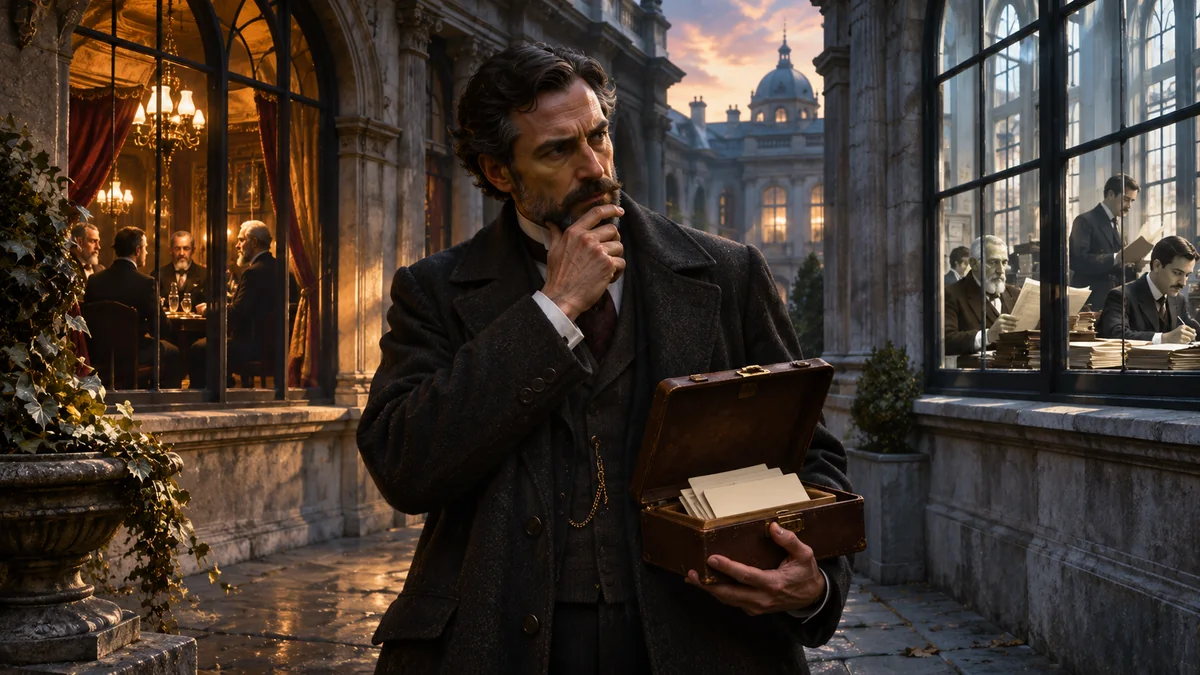
Editorial illustration of the relationship between private networks and public decision-making. The scene does not depict a documented historical event.
When a public official and a member of a private fraternity sit at the same table, their encounter may lead to an ordinary acquaintance, a social obligation or a political alliance. For the historian, however, these are possibilities that require different kinds of evidence. Membership of a lodge can be established through a membership list or minutes; evidence that someone influenced a government decision requires a trace of a specific action. That distinction is particularly important in the history of Freemasonry, where prominent citizens, aristocrats, military officers and politicians have met over the centuries. [13] [14] [17]
Were lodges primarily places for discussion and personal education, or did they at times also become instruments of political power? Historical sources suggest there is no single answer that applies to every country and period. Some organisations expressly prohibited political discussion; others openly advocated social change; and, in one documented case, a network of lodges participated in the clandestine collection of information for government personnel decisions. We must therefore investigate people, rules, documents and consequences, rather than merely the symbols on their aprons. [1] [2] [4]
When membership is not political command
A Masonic lodge is not a political party, but it can bring together people who make decisions in politics, the military, business or public administration. Such spaces foster trusted contacts, mutual recommendations and a sense of belonging. Those relationships have social value and can provide access to information or influential individuals. Yet not every connection is evidence of a shared political plan. The historical question is not simply who knew whom, but whether an acquaintance developed into organised action with an identifiable objective. [17] [18]
An analysis needs to distinguish five levels, none of which can automatically stand in for the next: membership, an internal office, influential patronage, documented political coordination, and claims of a supreme secret leadership. The fact that a minister is a Freemason belongs to the first level; if that minister is also a Grand Master, we have evidence of an internal office as well. Only letters, instructions, financial transactions, minutes or testimony linked to a particular decision can substantiate a conclusion about organised political activity. Without these distinctions, a map of personal relationships can quickly become a misleading diagram in which everyone connected to someone else is presumed to be secretly carrying out another's will. [10] [12]
There is another side to this caution. A rule prohibiting politics does not prove that no member has ever broken it. A private group can have genuine mechanisms for discipline, information exchange or privileged intermediation without being part of a single global hierarchy. Both extremes therefore deserve scrutiny: the unfounded assumption of an all-encompassing conspiracy, and the hasty assurance that no abuse could ever occur under the cover of privacy.
Two Masonic traditions, two approaches to politics
The United Grand Lodge of England (UGLE) uses unequivocal language in its published rules. The principles for the recognition of Grand Lodges, dating from 1929, prohibit discussion of politics and religion at lodge meetings and define each Grand Lodge's jurisdiction as independent. A statement on the aims of Freemasonry, originally agreed in 1938 and adopted by the English Grand Lodge in 1949, likewise distinguishes members' individual views on public affairs from statements made on behalf of the organisation. This is an important source of formal rules, not a complete account of everything its members have done throughout history. [1]
France's Grand Orient de France (GODF) describes a different approach. It traces its tradition to the Enlightenment and to an organisational reconfiguration in 1773; in its own account, social questions are not an area from which members must abstain, but part of their responsibilities as human beings and citizens. The Grand Orient publicly advocates republican values and laïcité, the principle of state secularism. Thus, behind the seemingly uniform term 'Freemasonry' lie different organisations that cannot automatically be assumed to follow one political rulebook. [2] [3]
This does not mean that all members of British lodges are apolitical or that all members of French lodges are political activists. It means only that the organisations differ in their published rules and historical relationships with the state. Recognising these differences is a prerequisite for investigating any alleged shared authority: we must first establish which institutions, if any, had the power to make decisions for one another. Differences in rules do not, of course, preclude personal links between members of different traditions where such links are documented. [1] [2]
George Washington: genuine membership, overextended interpretations
George Washington joined the Masonic lodge at Fredericksburg, Virginia, in 1752 and completed the three foundational degrees by 1753. Several other prominent public figures of the American Revolution were Freemasons, among them Benjamin Franklin and Paul Revere. Mount Vernon's historical overview, however, specifically distinguishes the political actions of individuals from the positions of lodges as institutions. Without further evidence, the membership of several revolutionaries does not establish that a lodge directed the American Revolution as a unified command organisation. [14]

Washington's own letter from September 1798 is revealing. At a time when allegations about Illuminati influence were circulating in the United States, he responded to the clergyman G. W. Snyder by correcting the idea that he headed the English lodges in the United States: he stated that he held no such office. This is direct testimony limiting one specific historical misattribution. On its own, however, it cannot settle every question concerning other members' personal political connections. [15]
What makes this case instructive for political history is the gap between Washington's actual biography and later portrayals of his associations. His public image as a lodge member, statesman and symbolic founder of the nation lent itself to stories of immense organisational power. But the decisive question remains: do we possess a document showing that he received a particular decision as an instruction from a lodge? Similar ritual symbols or group portraits cannot establish that. [14] [15]
The Netherlands: when a monarchy sees lodges as a political instrument
After Napoleon's fall, the United Kingdom of the Netherlands was created in 1815. Its rulers sought to bring together northern and southern territories with different political, religious and cultural histories. In 1816 Prince Frederik, the second son of King William I, became Grand Master of the Dutch Masonic order, a position he held until 1881. His role is also confirmed by the Dutch Restitutions Committee, which investigated the fate of Masonic collections during the occupation in the Second World War. [7]

Stichting OVN, a Dutch organisation researching Masonic history, describes the political intentions of Frederik's father and the royal court: by bringing northern and southern lodges together, the prince was expected to help consolidate the new state and reduce French influence over the southern lodges. This takes us beyond the personal membership of a royal relative. The source describes an intention to use a Masonic organisation to foster political cohesion within society. Yet intention is a different category of evidence from an achieved result; this information alone does not tell us how far the initiative affected popular loyalty or later events. [8]
There is an evident tension in this account. The same historical presentation of the Dutch order says that Frederik insisted on prohibiting disputes about politics and religion within lodges. That is not necessarily a contradiction: a leader could regard the political benefits of bringing people together as a matter of wider social integration, rather than permission for party-political arguments in a ritual setting. Nevertheless, the example reminds us that political patronage, internal rules and actual practice are separate categories. The records of individual Dutch and Belgian lodges would need to be examined to assess how these distinctions worked in practice. [8] [9]
Hesse: an archive of letters and the princes' dual roles
More tangible evidence survives in the Hessian State Archives in Darmstadt. According to its official catalogue, the collection HStAD, D 4, 590/1–2, dated 1817–1830, contains approximately 240 letters from Karl of Hesse-Kassel, together with extracts in Christian's own handwriting, as well as 44 applications for higher Masonic degrees. They came from places including Darmstadt, Frankfurt, Hanau, Homburg and Mainz. The catalogue also records that Karl forwarded the applications, with his endorsements, to Christian, a provincial superior; the applicants included the future Grand Duke Ludwig II. This is not a rumour about an unidentified group, but a traceable archival collection identifying offices, dates and individuals. [10]
Another official source explains the political significance of this case. A Hessian parliamentary biography of Christian Ludwig states that from 1816 he was a co-founder of the Darmstadt lodge and a Provincial Grand Master, while from 1820 to 1830 he was a member of the First Chamber of the Parliament of the Grand Duchy of Hesse. Karl likewise combined dynastic and military-administrative roles with documented leadership positions in particular Masonic structures. The same individuals thus occupied positions within two genuine, overlapping hierarchies: one concerned with government and politics, the other with initiation and organisation. [12] [13]
The catalogue, however, does not show that Christian received instructions on how to vote on specific legislation, or that Karl directed government offices through a Masonic chain of command. Such a conclusion would require, for example, the same political matter to appear in lodge correspondence and parliamentary records, with a traceable instruction and response. Moreover, a related collection, HStAD, D 4, 582/2, carries a notice that an archival item was found to be missing in 2024; without a further archival examination, we must not claim that every document mentioned is currently available. Being precise about these limitations does not deny the relationships; it is a condition of interpreting them fairly. [10] [11]
France: republicanism, secularism and the limits of public advocacy
A different relationship between Freemasonry, the state and public ideas developed in nineteenth-century France. The Grand Orient de France made republicanism and laïcité part of its public identity. Its campaigns must be understood within broader disputes over the role of the Catholic Church, education and citizens' rights, not treated as evidence that every lodge followed a single command. In a public document, the organisation defends laïcité as a political and social principle; such a source matters when establishing the organisation's own programme. [2] [3]
In 1905 France adopted the law separating Church and State. The National Assembly's chronology describes several different legislative proposals, a parliamentary commission, its rapporteur Aristide Briand, and the turbulent political setting of 1902–1905. Masonic advocates of secularism formed part of that history, but it does not follow that a single lodge secretly drafted every provision of the law or dictated how all deputies voted. Verifiable political participation does not erase the public parliament, competing parties, opponents or social conflicts. [3] [6]
This distinction matters when assessing values, too. Separating religious and state authority can be the subject of legitimate political advocacy or opposition; advocacy alone does not amount to a secret conspiracy. It is a different question whether political campaigns used methods that violated privacy, the fairness of personnel procedures or the equal treatment of citizens. Here French history leads us to a considerably more concrete example than debates over principles alone.
The *affaire des fiches*: when information from lodges enters government administration
In 1904 a scandal broke in France that became known as the affaire des fiches. The Bibliothèque nationale de France describes the exposure of a system compiling information on military officers' political and religious views, gathered through cooperation with the Grand Orient de France for the purpose of promoting officers sympathetic to republican and anticlerical positions. The system had been developing since 1900; its political exposure in the autumn of 1904 caused a major scandal and led to the resignation of the Minister of War, General Louis André. Here we have an identifiable sphere of government activity — military personnel decisions — and a documented information link to a network of lodges. [4]
In his study of reactions among Grand Orient members in Lower Normandy, historian Emmanuel Thiébot reconstructed further organisational details. He describes cooperation between representatives of the War Ministry, the Grand Orient's secretariat and selected trusted members who passed on information about officers, their beliefs and their contacts. This case is particularly valuable because we need not infer the connection from a shared symbol or a membership photograph: we can investigate an actual exchange of information, the organisational selection of participants and its political use. [5]
The degree of personal responsibility of each participant, how much the leadership as a whole knew, and the effect of each individual file must be judged from a wider body of archival records, rather than through collective blame. Yet the core of the episode is sufficiently well documented that it cannot be dismissed as an invention. The French National Assembly lists the affair among the events that weakened Émile Combes's government in the autumn of 1904; it fell in January 1905. In this instance, a lodge network was involved in a concrete episode of political history, rather than merely being the subject of rumours. [4] [5] [6]
This example also shows why it is not enough either to claim that secrecy necessarily amounts to criminality or to insist that private organisations can never threaten public accountability. Public-sector appointments call for verifiable professional criteria, fair procedures and protection of individuals' beliefs. If a confidential network helps select people according to their political or religious affiliation, serious questions of accountability are warranted. Such an assessment must rest on documented conduct, not on a prior condemnation of every member of the same movement.
When secrecy faces organised political opposition
The history also includes Freemasonry's political opponents. After William Morgan disappeared in New York State in 1826, having intended to reveal Masonic secrets, an anti-Masonic movement grew in the United States. The Smithsonian preserves an almanac from 1832 and describes the Anti-Masonic Party, founded in 1828, which subsequently contested elections. This contemporary piece of political propaganda reveals the strength of public fears about hidden links between a social fraternity and government, but its existence does not make every allegation it contains a proven historical fact. [16]

Masonic membership could therefore affect politics indirectly, too — by provoking strong political opposition. The allegations and responses are part of the same history of public trust, but they demand different standards of proof. An actual crime, a rumour about an entire organisation and the formation of a party to oppose it are not the same thing. This matters particularly when investigating conspiracy theories: history can contain genuine abuses by individual networks alongside exaggerated or fabricated accounts of how far their power extends. [16]
Informal power: who meets, and who decides?
Even in countries without a documented system like the French one in 1904, lodges may influence society through membership, ideas and social interaction. In his research into German Freemasonry between 1840 and 1918, historian Stefan-Ludwig Hoffmann described how a universalist ideal of brotherhood coexisted with social selectivity and political divisions. Meanwhile, Floor Meijer's research on Amsterdam lodges between 1848 and 1906 points to the involvement of lawyers, teachers, police officers and other members of the urban middle classes. Her publicly reported assessment also cautions that a large number of prominent members does not, by itself, demonstrate a large, directly measurable influence on city politics. [17] [18]
These distinctions lead to practical questions. Who nominated a candidate? Who had the formal right to decide? What information was passed on, and to whom? Did a particular government decision first appear in private correspondence? Are there minutes, budgets, letters and independent accounts? Without such evidence, we have a list of acquaintances. With it, we can begin to reconstruct a mechanism of actual influence. But proof concerning one historical network does not automatically prove that the same leadership stands behind others.
If we are to discuss hidden power, we must also consider who was excluded from such connections. Historical lodges maintained rules concerning membership, gender, reputation or social status; their ideal of equality among members did not automatically mean equal access for society as a whole. Informal access to influential people can confer an advantage even without written orders or a unified conspiracy. Yet such advantages must be established within a particular social setting, rather than attributed identically to every period and organisation. [17] [18]
Where does the document end and conjecture begin?
The cases examined support several different conclusions. Washington's membership is a historical fact; the Dutch royal attempt to bring lodges together represents a documented political intention; the Hessian correspondence confirms an organisational network involving individuals who held state offices; and the affaire des fiches demonstrates actual interference with government personnel information. These are not equivalent levels of proof of political influence, and they must not be merged into one sensational conclusion. [7] [10] [14] [4]
It would therefore be unwarranted to declare that all politics is subordinate to Freemasonry. Equally, it would be untrue to say that historical Masonic organisations never played a political role. Rather than a single picture, the evidence reveals multiple connections and differing institutional interests: from public advocacy of republican values to dynastic patronage and the improper use of a confidential information network. Where a hypothesis of broader covert coordination arises, it may be investigated, but it requires its own body of evidence, not merely another collection of names. [1] [5] [8]
The remaining question is not whether every closed room is dangerous. It is more demanding: how can a society protect freedom of association and its members' privacy while ensuring that public offices remain accountable to the public? The answer requires consistent standards for Freemasons, other interest groups, religious institutions, political parties and influential business circles alike. Confidentiality is not proof of guilt; but public power should never become immune from scrutiny simply because those exercising it meet others behind closed doors.
Next article: Illuminati: The History of a Banned Order.
Documentary sources and archive links
These links lead to documents, archival records or photographs hosted by their original source institutions.
Sources and further reading
- United Grand Lodge of England. Information for the Guidance of Members of the Craft. 2024. Aims and Relationships of the Craft (1938/1949), paras 6–9; Basic Principles for Grand Lodge Recognition (1929), points 5 and 7. Access the source. Source
- Grand Orient de France. Notre histoire. Undated. 1773; account of civic and social debate. Access the source. Source
- Grand Orient de France. Qu’est-ce que la Laïcité?. 2013. Statement on the political importance of laïcité; 9 December 1905. Access the source. Source
- Bibliothèque nationale de France. Fiches, Affaire des (France ; 1904). Updated catalogue note. Description of the affair, 1900–1904, and Grand Orient cooperation. Access the source. Source
- Emmanuel Thiébot. L’affaire des fiches vue par les francs-maçons du Grand Orient de France en Basse-Normandie. 2005. Revue historique des armées 241, pp. 107–121; local involvement, Vadecard, Mollin. Access the source. Source
- French National Assembly. Les jalons historiques – Séparation des Églises et de l’État. Official chronology. 1902–1905; Combes, the scandale des fiches, 9 December 1905. Access the source. Source
- Netherlands Restitutions Committee. Order of Freemasons – Establishing the Facts. 2025. Prince Frederik as Grand Master, 1816–1881; archives from the occupation. Access the source. Source
- Stichting OVN. Geschiedenis: Invloed. Undated. King William I's 1816 plan to link the north and south through Freemasonry. Access the source. Source
- Stichting OVN. Geschiedenis: De negentiende eeuw. Undated. Frederik, 1816–1881; prohibition on political debate; civil servants and officers in lodges. Access the source. Source
- Hessisches Staatsarchiv Darmstadt. Freimaurerischer Briefwechsel Landgraf Christians mit Landgraf Karl, HStAD D 4, 590/1–2. 1817–1830. Archival catalogue describing approximately 240 letters and 44 applications; Karl and Christian. Access the source. Source
- Hessisches Staatsarchiv Darmstadt. Ordenspatente des Landgrafen Christian, HStAD D 4, 582/2. 1778–1820. Catalogue of documents; missing item recorded on 12 March 2024. Access the source. Source
- Hessische Parlamentarismusgeschichte. Christian Landgraf von Hessen-Darmstadt. Undated. Provincial Grand Master, 1816; member of the First Chamber, 1820–1830. Access the source. Source
- Hessen Kassel Heritage. Porträt Landgraf Carl von Hessen-Kassel. Museum catalogue note. Karl, 1774; lodge head, 1778; Provincial Grand Master, 1782. Access the source. Source
- George Washington's Mount Vernon, Mark A. Tabbert. Freemasonry. Undated. Washington's initiation, 1752–1753; history and revolutionary membership. Access the source. Source
- Library of Congress, George Washington Papers. George Washington, letter to G. W. Snyder, 25 September 1798. 1798. Washington rejects the claim that he heads all the English lodges in the United States. Access the source. Source
- Smithsonian Institution. Anti-Masonic Almanac, 1832. 1832; collection description. Anti-Masonic Party, 1828–1838; reaction to William Morgan. Access the source. Source
- Stefan-Ludwig Hoffmann. The Politics of Sociability: Freemasonry and German Civil Society, 1840–1918. 2007. Publisher's abstract: social selection, liberal social groups and intellectual influences. Access the source. Source
- Floor Meijer; interview with the author in Ons Amsterdam. Geheimzinnige wereldburgers. 2010. Amsterdam, 1848–1906; civil society and the limits of influence. Access the source. Source