Degrees of Initiation: The Inner Hierarchy of Secret Orders
In many secret and initiatory societies, a new member does not immediately enter every inner circle. First comes the crossing of a threshold; then an acquaintance with the rules, ritual language and symbolic teachings.
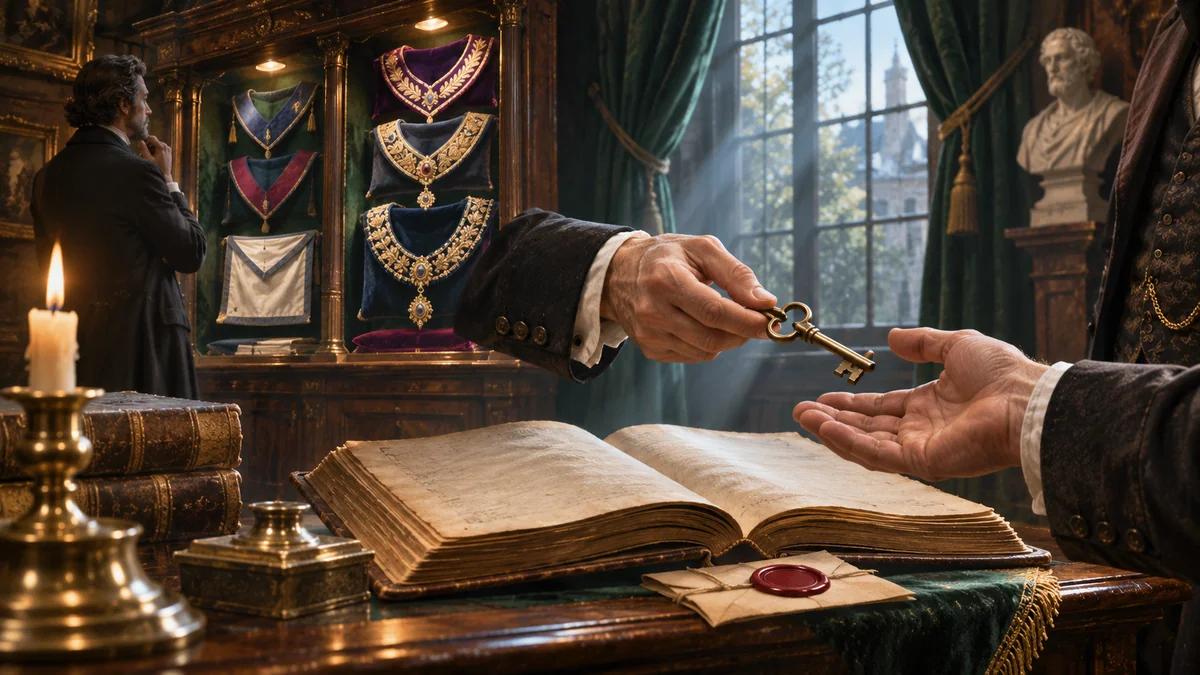
An artistic illustration contrasting ceremonial rank with authority to make decisions; not evidence of an actual ritual or an exact reproduction of regalia.
In many secret and initiatory societies, a new member does not immediately enter every inner circle. First comes the crossing of a threshold; then an acquaintance with the rules, ritual language and symbolic teachings. Sometimes only after progressing through several degrees may a member participate in particular decisions or in admitting new members. From the outside, such a structure resembles a pyramid: novices at its base, and people bearing titles that sound like supreme authority at its summit. Yet the appearance of a hierarchy tells us little about who holds real power.
Why do some orders disclose knowledge gradually? Does the highest degree mean deeper understanding, the right to conduct rituals, control over property or authority over other people? And how can we investigate the claim that an unknown circle of superiors stands behind the visible leadership? Answering these questions requires comparing the historical rules of different organisations, not combining their titles into an imaginary worldwide hierarchy.
Initiation Is a Passage, Not Proof of Control
Initiation is a ritually marked entry into a new status or community. In a publicly accessible abstract, anthropologist J. S. La Fontaine describes initiation as admission to a new social status or group. A community can recognise someone as a member after a ceremony even if that person was already familiar with its ideas. In his study of initiatory rites, scholar Henrik Bogdan also draws attention to the importance of secrecy and personal experience. Such a passage is therefore more than an entry on a membership card: it can be an event through which a person comes to understand themselves and their place among others differently. [1] [2]
A ritual may involve a test, an oath, a symbolic scene or a new form of address. Its psychological significance is not necessarily the same as its legal or organisational effect. Someone may undergo a profound personal change without gaining any authority to decide matters for others. Conversely, a person holding a modest ritual title may perform an important administrative function by election or appointment. To investigate hidden power, we must therefore distinguish from the outset between experience, membership, access to teaching and delegated authority. [2] [3]
This distinction guards against two equally superficial conclusions. One holds that every private initiation must be a means of manipulation; the other, that closed rituals are invariably harmless tradition. Both claims must be judged against particular rules, conduct and consequences. If a group teaches perseverance or responsibility, that is not evidence of abuse. If, however, it uses confidentiality to conceal actions, it is those actions and the actual powers of those who enable them that must be examined.
The Three Degrees of Craft Freemasonry

Freemasonry provides an instructive example for understanding Western initiatory systems because its basic titles and organisational rules are publicly known. The United Grand Lodge of England (UGLE) describes three degrees: Entered Apprentice, Fellow Craft and Master Mason. Each has its own ritual significance, linking the metaphor of building with moral and personal education. Historian Jan A. M. Snoek stresses that Freemasonry does not have one universally binding interpretation of every symbol and ceremony across all lodges. [3] [4]
However, the third degree, Master Mason, is not the same as an elected or appointed office as the head of a lodge. A person may attain the third degree while the conduct of meetings, the work of officers and lodge decisions depend on offices, elections and the applicable regulations. According to UGLE's public description, its meetings include an administrative part — admissions and elections, along with organisational business — and a ceremonial part. Degree and organisational office may therefore overlap, but they should not be equated. [4] [14]
Following the union of the English Grand Lodges in 1813, the Royal Arch acquired a particular position. In the English system it is regarded as connected with the three fundamental degrees and as a continuation of the same initiatory journey. It has a separate administrative framework associated with the Supreme Grand Chapter. It would therefore be wrong to present it simply as a universal fourth degree for all Freemasons, let alone to infer that a body associated with it governs every lodge in the world. Similar ritual expressions can refer to different legal and symbolic relationships in different jurisdictions. [5]
The Scottish Rite: What Does the 33rd Degree Actually Mean?
The thirty-third Masonic degree frequently appears in public discussions of secret hierarchies. Its number can sound like proof that someone outranks 'ordinary' Master Masons and can consequently command all Craft lodges. The documented arrangement is more complex. The Scottish Rite's Northern Masonic Jurisdiction in the United States lists twenty-nine additional degrees after the three Craft degrees — the fourth through the thirty-second — plus a special honorary thirty-third degree. This is a further ritual system built upon membership in Craft Freemasonry, not evidence of a single worldwide administrative ladder. [6]
The Northern Masonic Jurisdiction expressly explains that its thirty-third degree recognises outstanding service to the Rite or society, and that it does not in itself confer additional administrative authority over ordinary Masonic lodges. That does not mean the Scottish Rite has no leadership. Its Supreme Council has active members who decide matters concerning its work. The honorary degree, active membership of a governing body and appointment to an administrative office must be distinguished. The precise relationship between these categories has also changed over time. [7]
Here lies the central problem with sensational accounts of the 'top of the pyramid'. We cannot conclude from a person's thirty-third-degree title that they control members of other jurisdictions. Nor would it be accurate to claim that no holder of that degree can possess organisational power: some are also elected active members of governing bodies, but their authority stems from the office and rules of a particular jurisdiction. The real question is whether an individual also holds a documented mandate, which body grants it, to whom the person is accountable and which decisions fall within that authority. [6] [7]
The Golden Dawn: An Outer School and an Inner Order

In the late nineteenth century, the London-based Hermetic Order of the Golden Dawn used graded initiation for a different kind of education. As historian Egil Asprem describes, from 1888 to the early twentieth century the classical Golden Dawn developed a social organisation for teaching and practising ritual magic. Its members included women, such as Florence Farr and Mina Bergson Mathers, reminding us that initiatory orders did not all apply the same membership rules. [8]
Surviving descriptions of its system give the degrees Neophyte 0=0, Zelator 1=10, Theoricus 2=9, Practicus 3=8 and Philosophus 4=7, followed by passage to an inner order beginning with Adeptus Minor 5=6 and extending to further grades. The paired numbers relate to a symbolic map of the Kabbalistic Tree of Life, rather than to a purely numerical chain of command. Degrees were associated with ritual, a curriculum, examinations and differing kinds of access to internal materials. The complete symbolic scheme of higher and so-called third-order grades does not prove that all its degrees were actually conferred at a given historical time; still less does it establish the existence of all the alleged 'Secret Chiefs'. [9] [10]
The position of the so-called Secret Chiefs, or hidden superiors, is especially revealing. Historical writings used by Golden Dawn leaders linked the highest grades to a spiritual authority whose origins were supposedly largely inaccessible to ordinary members. That is a documented claim within the tradition, not independent confirmation that a demonstrable circle of superior persons stood behind the organisation. How could such a claim be tested? We would need documented identities, traceable instructions, mandates and observable effects, rather than merely repeated accounts of hidden leadership. [8] [9]
At the same time, it would be a mistake to overlook the real authority of visible leaders. Those who decided upon admission, education, examinations and the distribution of materials influenced the life of the group without needing any proven supernatural powers. The history of Golden Dawn schisms shows that internal leadership was disputed and challenged. For an investigation into organisational power, such tensions are often more tangible than the legend of flawless, uncontested invisible authority. [8] [10]
O.T.O.: Degrees, Powers and a Different Tradition
The Ordo Templi Orientis (O.T.O.) offers another example of an order organised around gradual advancement, but its system cannot simply be superimposed on a Masonic ladder. The U.S. Grand Lodge of O.T.O. currently lists twenty-one initiatory degrees, including thirteen numbered degrees and eight intermediate or sub-degrees. These are grouped into three symbolic divisions which the organisation calls Man of Earth, Lover and Hermit. The names express part of its own religious-esoteric system, not generally accepted administrative ranks in other orders. [11]
More important than a list of impressive-sounding titles is the rule that an initiation may be performed only by an initiator duly authorised to conduct it. The published membership rules also distinguish between the initial Minerval degree and degrees at which a member may exercise particular functions in a local body. Here the degree of membership may have a direct organisational consequence, but authority to conduct a rite is a separate matter: it requires the appropriate mandate, not merely a claim to mystical knowledge. [11] [12]
In its public rules, O.T.O. also explicitly states that O.T.O. membership or degree does not in itself confer a Masonic degree or standing. This is crucial when interpreting arguments that assume two organisations share a leadership because their titles, historical borrowings or symbols resemble each other. Similar language may indicate influence or an adopted tradition, but it does not establish an uninterrupted organisational chain of subordination. The history of O.T.O., its ritual practices and Crowley's Thelema will be examined in greater detail in SM-25. [8] [11]
The Carbonari: When Degrees Become a Political Mechanism

The examples so far might suggest that graded initiation is primarily a path of internal learning. History, however, also records secret societies in which organisational discipline and political action were central to their purpose. In the early nineteenth century, the Carbonari spread across Italy and other parts of Europe. They used oaths, secret communication and differently structured local groups known as vendite. The Treccani historical dictionary places them within struggles against absolutist rulers and the history of constitutional and, later, republican aspirations. [13]
The role of Filippo Buonarroti is particularly important. In parts of the Carbonari milieu, he developed the idea of linking a wider movement to higher, narrower political circles. Treccani refers in this connection to the Sublimi maestri perfetti, a separate, higher-level secret society for which the Carboneria could serve as a preparatory organisational environment. In such a case, unequal access to a political programme and to the direction of others could mean more than a ritual distinction between novice and master. The reach of particular political plans must nevertheless be examined in their specific time and place. [13]
The Carbonari example is therefore not proof that all secret groups are run by the same people, or that every initiatory degree is a rung in a political chain of command. It shows something more precise: in certain historical circumstances, degrees of membership can also be used for covert selection, direction and coordination of political activity. Whether a particular plan was implemented, which groups actually followed it and whether an organisation had power over state decisions require further sources. These questions belong to SM-20. [13]
Who Decides, Who Knows and Who Commands?
The comparison reveals at least four distinct levels: ritual degree, access to knowledge, formal authorisation and external influence. Some orders link them closely; others deliberately keep them separate. A novice may advance to a higher degree without becoming a leader. A governing-council member may direct an organisation even when their title alone does not explain that mandate. And an informally influential person may operate outside official leadership altogether. If these distinctions are blurred, the result is a spectacular but unverifiable picture of a hidden pyramid. [3] [7] [11]
Investigating a specific hierarchy therefore requires questions beyond 'what degree does this person hold?'. Who approves admission and advancement? Who can access materials and membership lists? Who can issue authorisations, convene meetings, revoke an office or allocate money? Are instructions passing between bodies traceable? And what evidence shows that an internal decision caused an action outside the group? Each affirmative claim must be connected to regulations, appointments, minutes, correspondence or other independent material, not merely to the symbolic meaning of a title.
It is possible to leave questions open while applying these standards. Confidential arrangements are possible even between otherwise independent organisations; official rules cannot rule out every potential abuse in advance. But a possible connection is not yet a proven command relationship. The claim that a particular degree provides control over a state or all other orders would need especially strong documentary support. The sources examined here do not establish such a universal supreme chain. That does not prove that no concealed connection could ever have existed. [5] [7] [8]
A Higher Degree or Greater Responsibility?
Initiation can give someone a sense of passage, security, duty and shared identity. It can provide access to writings and rituals or bring a person into contact with others they might never otherwise meet. It can also become a way for a smaller circle to control advancement and information. The real meaning depends not on the mystery surrounding a title, but on rules, relationships, conduct and the possibility of holding decision-makers accountable. The same standards of evidence must apply to defenders and critics of these organisations alike.
The moral question is therefore broader than fear of initiation. Does a group encourage personal integrity and respect for others? Does it permit doubt and accountability? Does loyalty to fellow members ever take precedence over truth or the public interest? We cannot give a single answer for an entire tradition on the basis of a symbol, degree or oath alone. Investigating hidden power is more substantial when it shows precisely who had a real ability to decide, over whom, and with what consequences.
Next: Freemasonry and Political Power.
Documentary sources and archive links
These links lead to documents, archival records or photographs hosted by their original source institutions.
Sources and further reading
- J. S. La Fontaine. 'Initiation', in The International Encyclopedia of Anthropology. Wiley, 2017, publicly accessible abstract. DOI 10.1002/9781118924396.wbiea2330. Source
- Henrik Bogdan. 'Initiations and Transitions', in Michael Stausberg and Steven Engler (eds), The Oxford Handbook of the Study of Religion, 2017, pp. 582–595, publicly accessible abstract. DOI 10.1093/oxfordhb/9780198729570.013.41. Source
- Jan A. M. Snoek. 'Freemasonry', in Glenn Alexander Magee (ed.), The Cambridge Handbook of Western Mysticism and Esotericism, 2016, pp. 200–210, public abstract. DOI 10.1017/CBO9781139027649.018. Source
- United Grand Lodge of England. The Supreme Grand Chapter – Completing the Journey, 2023; connection under the Act of Union (1813) between the three degrees and Royal Arch, and the distinction in governance. Original page. Source
- Scottish Rite, Northern Masonic Jurisdiction. How Many Degrees Are There in 32nd Degree Scottish Rite Freemasonry?, official public FAQ on degrees 4–32 and the honorary 33rd, undated. Original page. Source
- Scottish Rite, Northern Masonic Jurisdiction. What Is a 33rd Degree Mason?, official description of the honorary degree, active Supreme Council members and limits of administrative authority; date of online publication not reliably established. Original page. Source
- United Grand Lodge of England. What is Freemasonry? and Freemasonry FAQs, statements concerning lodges, activities and privacy. Overview · Frequently asked questions. Source 1 Source 2
- Egil Asprem. 'The Golden Dawn and the O.T.O.', in Glenn Alexander Magee (ed.), The Cambridge Handbook of Western Mysticism and Esotericism, 2016, pp. 272–283, public abstract. DOI 10.1017/CBO9781139027649.024. Source
- William Wynn Westcott (signed S.A.). Historical Lecture, historical introductory account of the Golden Dawn; available online reproduction, not independently collated against the original manuscript. Reproduction. Source
- Thelemagick Library. The History of the Golden Dawn and The Initiatory Structure of the G.D., online overviews of the order's development, grading and disputes; original authorship and fidelity to the archives have not been fully verified. History · Degrees. Source 1 Source 2
- Ordo Templi Orientis, U.S. Grand Lodge. Initiation, official description of the degree structure and its distinction from Freemasonry, undated. Original page. Source
- O.T.O., U.S. Grand Lodge Treasury. Membership Status, rules concerning Minerval membership and functions in local bodies, undated. Original page. Source
- Treccani, Dizionario di Storia. 'Carboneria', 2010; history of a secret political movement, Buonarroti and layered organisation. Original page. Source
- United Grand Lodge of England. Book of Constitutions, official overview of UGLE's current rules and historical development since 1723; not evidence that all members always followed every rule. Original page. Source