Freemasons: A Brotherhood Behind Closed Doors
Freemasonry has attracted attention for centuries precisely because it brings together things that seem contradictory: publicly identifiable institutions, charitable work and an emphasis on personal ethics on the one hand, and closed meetings, initiation ceremonies and traditional means of recognising fellow members on the other.
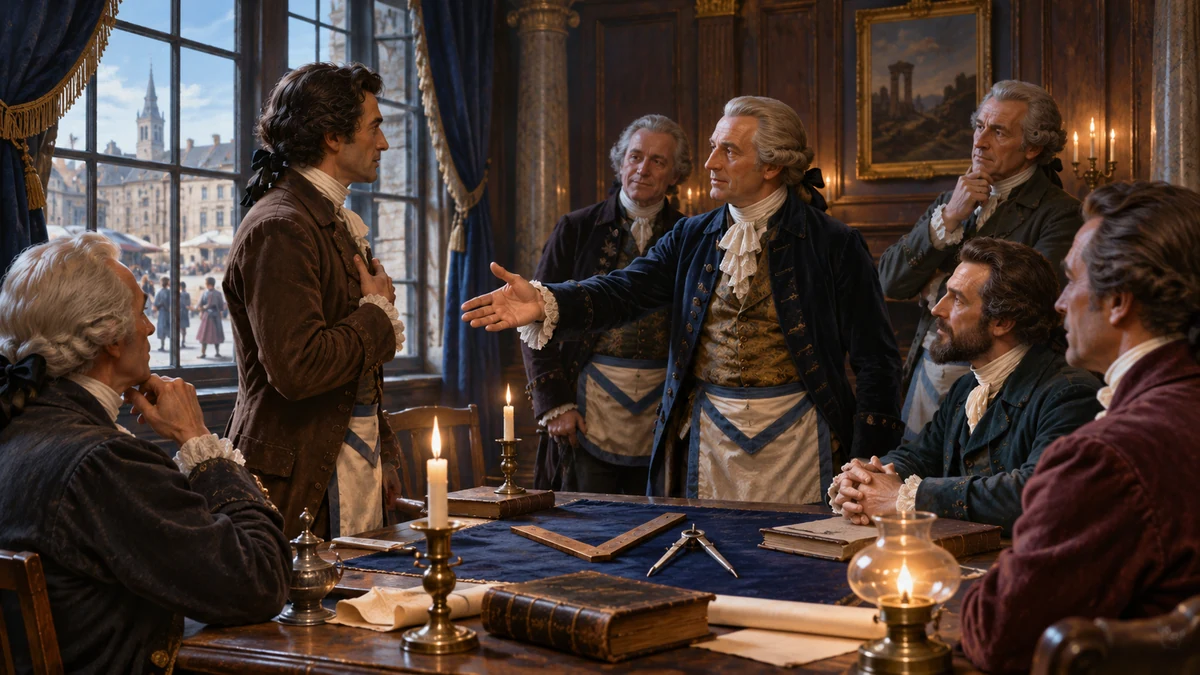
An artistic illustration of a historical Masonic lodge, not a photograph or evidence of a particular ritual, lodge or individual.
Freemasonry has attracted attention for centuries precisely because it brings together things that seem contradictory: publicly identifiable institutions, charitable work and an emphasis on personal ethics on the one hand, and closed meetings, initiation ceremonies and traditional means of recognising fellow members on the other. The same historic fraternity can be a setting for friendship and education, a social network of people with standing and influence, or the subject of fierce religious and political disputes. To understand its power, we must first establish which organisation we are talking about.
Are the Freemasons a secret organisation with a single worldwide leadership, or a family of different lodges and orders? What is actually kept within the membership, and what is openly set out in their rules? And when can ties formed behind closed doors become influence beyond them? Symbols and lists of famous members cannot answer these questions on their own. We need historical documents, organisational rules and demonstrable links between individuals and their actions.
Before London: Crafts, Lodges and Secrets
In Freemasonry today we recognise stonemasons' tools, aprons, architectural metaphors and the word lodge. These elements are connected with the traditions of working stonemasons, but the transition from a craft to a new kind of fraternity was gradual. Through his study of Scottish sources, historian David Stevenson showed that organised lodges, membership rules and ritual practices were present by the late sixteenth and seventeenth centuries. Their members were not always working masons: over time, people whose occupations had nothing to do with building also joined them. [1]
That distinction between the beginnings of a tradition and the founding of a particular institution matters. Early records establish that certain lodges existed by a given date, but do not necessarily tell us when they were actually founded. The history of Freemasonry therefore predates the celebrated year 1717, even though that date became one of its best-known milestones. According to the United Grand Lodge of England's historical account, for example, Elias Ashmole was admitted to an English lodge as early as 1646. [1][2]
Later traditions sometimes trace Freemasonry back to Solomon's Temple, ancient builders or medieval orders of knighthood. Such narratives may have symbolic value and help shape a group's identity, but a symbolic origin is not the same as documented organisational continuity. Demonstrating an unbroken historical succession would require a traceable sequence of documents, memberships and jurisdictions, rather than similarities between rituals or names alone.
1717 and 1723: A Brotherhood Acquires Its Rules
According to the traditional institutional chronology, representatives of four London lodges came together to form a grand lodge on 24 June 1717 and elected Anthony Sayer as Grand Master. The event became a landmark in modern organised Freemasonry, although historians have debated some details of its earliest history. A firmer written basis for the movement's developing rules comes from 1723, when James Anderson's The Constitutions of the Free-Masons was published. [2][3]
Anderson's Constitutions are particularly revealing because they combine several different kinds of writing. They contain a legendary account of the craft's past, standards of conduct, members' obligations and organisational regulations. The historical legends in the opening account cannot therefore be treated as testimony as reliable as the provisions governing how lodges should operate. Above all, the document shows how Freemasons in the early eighteenth century sought to organise themselves and present their institution to the public. [3][4]

These rules express a marked moral and social ambition. Members were expected to respect the law, act honestly, avoid discord and cultivate companionship across differences of religious belief. Such principles mattered in an age of religious and political conflict. But just as a country's constitution sets out its principles without proving that every citizen follows them, the rules of a fraternity tell us what it demands or promises; they do not, by themselves, show that every member always acted accordingly.
A Lodge Is Not a World Government
The lodge is the basic unit of Masonic life. Members meet there, admit new members, manage internal affairs and take part in rituals. Lodges are associated with grand lodges or obediences, which set rules and exercise jurisdiction within their respective spheres. Holding a senior office in one such body does not automatically confer authority over others, even where they use similar symbols or their members recognise one another as Freemasons. [5][6]
English history itself shows why the idea of a single, unchanging hierarchy is misleading. In 1751, a rival grand lodge emerged, associated with a different understanding of the tradition. The groups later known as the Moderns and the Antients operated separately until their union on 27 December 1813, which created the United Grand Lodge of England (UGLE). This was no minor episode: almost six decades of institutional rivalry demonstrate that even within one country there was not always a common leadership. [2]
An even more direct example comes from UGLE's principles for recognising other grand lodges, adopted in 1929 and reprinted in an official 2024 publication. They require a recognised grand lodge to be independent and to hold jurisdiction over the three basic Masonic degrees within its own jurisdiction. The document expressly rejects making those degrees subordinate to a higher council belonging to another ritual system. We must therefore distinguish the symbolic prestige of particular titles, the internal hierarchy of a given order and actual governing authority. [5]
This does not establish that members of different organisations never cooperate informally. It does show, however, that the claim of a single official worldwide chain of command is at odds with these institutions' documented arrangements. Anyone arguing that a parallel chain exists despite their public rules would need specific documents, decisions and relationships to support that further conclusion.
From the English Tradition to a Different French Approach
Freemasonry developed along a somewhat different path in France. In 1773, a reorganisation of older lodges gave shape to the Grand Orient de France, with lodge representation, elected delegates and more clearly defined administrative procedures. Historian Pierre Mollier makes an important distinction between the Duke of Chartres, who lent prestige to the institution as Grand Master, and Sigismond de Montmorency-Luxembourg, who took part in the practical organisation of the reforms. This reveals an important mechanism of power: an organisation's best-known figure is not always the person who directs its everyday workings. [6]
Another turning point came in 1877, when the Grand Orient removed the requirement that members believe in God and the immortality of the soul. Today this branch emphasises freedom of conscience, secularism and room for different metaphysical positions. UGLE, by contrast, retains belief in the Great Architect of the Universe among the conditions for recognition, alongside particular rules concerning religious and political discussion within lodges. This is more than a verbal difference: it affects which grand lodges recognise one another and what they regard as legitimate Masonic tradition. [5][7]
The distinction also extends to activity in wider society. UGLE presents itself as politically non-partisan and as a community built around friendship, integrity, respect and charity. The French Grand Orient, meanwhile, publicly emphasises secularism and reflection on social questions. French state archives also describe the Grand Orient's historical participation in initiatives involving public education and social reform during the Third Republic. It would therefore be wrong to attribute the characteristics of one tradition to all of Freemasonry without further examination. [8][9]
Who Was Allowed to Join?
Modern language about brotherhood and equality does not remove the historical question of who actually had access to the fraternity. The limitation is visible even in its early rules: Anderson's Constitutions of 1723 explicitly refer to men as eligible members and impose restrictions linked to social standing and personal circumstances. The document thus reveals the historical limits of the equality proclaimed, not merely its ideals. As European Freemasonry developed, other paths opened up. [3] In 1893, Maria Deraismes and Georges Martin founded a mixed lodge in Paris, from which the international order Le Droit Humain grew; it admits both women and men. [10]

In Britain, an organisation founded in 1908 eventually became today's Order of Women Freemasons. Its history shows that even 'women's Freemasonry' did not develop in just one form: its founders initially admitted both sexes, but the organisation later became exclusively female. Understanding Freemasonry therefore requires us to identify the particular grand lodge, period and membership rules in question. Judging the whole tradition by one present-day practice would be historically misleading. [11]
What Happens Behind Closed Doors?
Masonic ritual uses metaphors of building, moral self-development and learning by stages. In some traditions, the three principal degrees are those of Entered Apprentice, Fellow Craft and Master Mason. Particular ceremonies involve symbolic objects, prescribed forms of speech and episodes experienced by members as part of their initiation. Aprons, squares and compasses can thus serve as teaching aids and signs of belonging; they are not necessarily coded instructions for political activity. [5][12]

Some Masonic meetings are restricted to members, and parts of their ritual practice remain private. UGLE publicly explains that its activities are better understood in terms of privacy than the secret existence of an organisation: its premises, some of its governing rules and many of its public activities are well known. But precision matters when we investigate power. The privacy of a meeting is not, in itself, evidence of a harmful plan; nor does a public account of charitable work prove that no one ever abuses confidentiality. [8][12]

The crucial distinction is between secrecy as part of a ritual experience, protection of members' personal information, and concealed coordination of decisions that have consequences beyond the group. The first two may be found in many voluntary associations. Establishing the third would require evidence of specific actions: minutes, letters, testimony corroborated by other evidence, or traceable decisions. The mere existence of an oath, a symbolic sign or a room closed to outsiders does not bridge that evidential gap.
Reputation, Belonging and Informal Power
Why, then, examine Freemasonry in a series about hidden power? Because any enduring network of trust, especially one that includes people in prominent professional and social positions, can affect access to information, personal recommendations and the perception of shared interests. A grand lodge need not be part of a single worldwide conspiracy to be a significant social setting. The same is true of university societies, professional clubs, religious communities and other associations where lasting relationships develop.
The French reorganisation of 1773 offers an even more specific distinction. A Grand Master may be a symbolic authority, while an administrator shapes rules and procedures. The difference between prestige and operational responsibility is not proof of covert control over a state; it is a reminder of why investigation cannot end with portraits of eminent figures. To understand actual power, we need to examine mandates, appointment procedures, documented powers and the effects of particular decisions. [6]
If we want to establish whether a particular lodge influenced a specific political decision at a given time, we must investigate that lodge, its members, correspondence, state records and the sequence of events. Membership of a Masonic organisation is not, by itself, evidence that someone acted against the public interest; nor does an isolated documented abuse establish the guilt of all lodges. This series therefore treats political connections in a separate article, as it does the history of the Italian P2 lodge.
Opponents, Fears and Historical Controversies
Freemasonry has also faced serious religious opposition. In 1983, the Congregation for the Doctrine of the Faith reaffirmed the Catholic Church's position that membership of Masonic associations is incompatible with Catholic doctrine. This is an important document in a philosophical and religious dispute, not independent proof that Masonic lodges conducted secret criminal or political operations. A fair account must distinguish theological judgement, institutions' historical experiences and empirical evidence of particular conduct. [13]
Anti-Masonic narratives have also included historically documented deceptions. Researchers have, for example, analysed Léo Taxil's fabricated story of a secret 'Palladium', which he himself exposed in 1897. This does not mean that every critical allegation about Freemasons is fictitious. It means that a story featuring powerful symbols, elaborate rituals and famous names does not become true simply because it sounds like a confidential confession. An excessively apologetic narrative, in which all members are presumed always to have lived up to their institution's ideals, fails the same evidential test. [14]
Moral judgement matters just as much as historical analysis here. An association may advocate brotherhood while each of its members remains answerable for their own decisions; a closed community may encourage solidarity, but it may also improperly protect influential people within it. Neither possibility should be assumed in advance. The strongest test remains how an organisation behaves when loyalty to its members comes into conflict with truth and public accountability.
Where Does Secrecy End and Accountability Begin?
The history of Freemasonry does not describe one unchanging global pyramid. It tells of early craft lodges, the admission of people from other occupations, the emergence of grand lodges, divisions, differing choices of principle and institutions that sometimes resemble one another but at other times disagree on important questions. Part of the tradition is publicly recorded in rules; part of its inner experience is reserved for members. Neither circumstance alone is sufficient to prove the existence of a secret leadership directing every lodge in the world.
Yet open questions should not be dismissed with an equally superficial assertion to the contrary. From historical and sociological perspectives, it is reasonable to investigate membership, patronage, authority conferred by initiation and circumstances in which belonging to a group influences public decisions. Throughout, we must distinguish what is possible, what is a well-founded hypothesis and what has been demonstrated. Without those distinctions, an investigation into hidden power could itself become a victim of the images and stories it seeks to understand.
We therefore turn next to a mechanism found in many initiatory societies, not just among Freemasons: how degrees of initiation, access to internal knowledge and hierarchies of authority operate.
Next in the series: Degrees of Initiation: The Inner Hierarchy of Secret Orders.
Sources and further reading
- David Stevenson. The Origins of Freemasonry: Scotland's Century, 1590–1710, Chapter 8, 'The early Scottish lodges'. Cambridge University Press, 1988; digital edition 2010. Chapter abstract. Source
- United Grand Lodge of England. History of Freemasonry, institutional chronology: 1646, 1717, 1723, 1751, 1813. Source. Source
- James Anderson. The Constitutions of the Free-Masons. London, 1723, 'The Charges of a Free-Mason' and 'General Regulations'. Transcription of the original Charges, § III · Contents of the historical edition. Source 1 Source 2
- Museum of Freemasonry. Anderson's Constitutions (1723), museum account of the publication's structure and historical influence. Source. Source
- United Grand Lodge of England. Information for the Guidance of Members of the Craft, 2024 edition, p. 3, 'Basic Principles for Grand Lodge Recognition' (adopted 4 September 1929), especially points 2, 5 and 7. Official PDF. Source
- Pierre Mollier. Fondation du Grand Orient de France, France Mémoire, 2023; the 1773 organisational reform and Montmorency-Luxembourg's role. Source. Source
- Musée du Grand Orient de France. 1877 et la liberté de conscience, historical account of the change in religious conditions for membership. Source. Source
- United Grand Lodge of England. What is Freemasonry? and Freemasonry FAQs, statements concerning lodges, activities and privacy. Overview · Frequently asked questions. Source 1 Source 2
- Service des archives économiques et financières (France). Graveurs et maçons, archival account of the Grand Orient, the French Third Republic and Freemasonry's role. Source. Source
- Ordre Maçonnique Mixte International Le Droit Humain. History of Le Droit Humain, founding on 4 April 1893. Source. Additional bibliographical confirmation: BnF, institutional record. Source 1 Source 2
- The Order of Women Freemasons. Our History, founding in 1908 and the development of membership. Source. Source
- The Order of Women Freemasons. What is Freemasonry?, 'Structure': three basic degrees and lodge offices. Source. Source
- Congregation for the Doctrine of the Faith. Declaration on Masonic Associations, 26 November 1983. Vatican source. Source
- Ruben van Luijk. 'Léo Taxil, Le Palladium régénéré et libre (1895)', in Satanism, Oxford University Press, 2023, pp. 93–103; publicly available abstract. DOI 10.1093/oso/9780199913534.003.0006. Source