The Knights Templar: Between History and Legend
Among the historical orders that continue to capture the imagination, the Knights Templar occupy a special place. Their story brings together faith, knighthood, military power, wealth, political conflict and accusations of secret rituals.
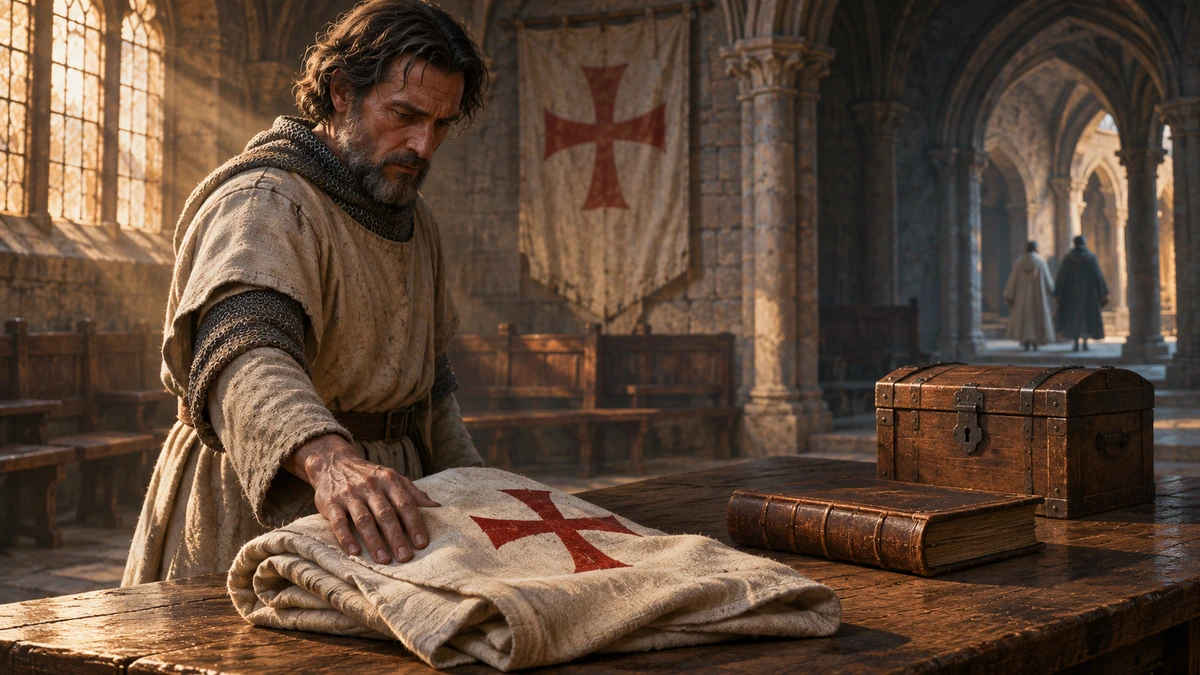
An artistic illustration of the end of the Templar order and its legacy; it does not depict a documented event or surviving artefact.
Among the historical orders that continue to capture the imagination, the Knights Templar occupy a special place. Their story brings together faith, knighthood, military power, wealth, political conflict and accusations of secret rituals. An order that had enjoyed the support of popes and rulers for almost two centuries lost its privileges, property and right to exist within just a few years. Its historical demise was followed by a long afterlife in legends, symbols and the traditions of other associations.
What enabled the Templars to become so influential? Why was their power so suddenly broken? And, above all, what happened after the order's suppression to the people, property, knowledge and connections it had built up over nearly two centuries?
Knights and monks
The Order of the Temple took shape in Jerusalem during the first decades of the twelfth century. The medieval chronicler William of Tyre dates its beginnings to 1118 and names Hugues de Payens and Geoffroy de Saint-Omer as its principal founders. Yet the historian Malcolm Barber, drawing on earlier charters, concludes that the order was most probably formed around 1120. The precise date of its foundation is therefore disputed. The community's original task was to protect pilgrims on dangerous routes around Jerusalem. It took its name from its quarters on a site the Crusaders associated with Solomon's Temple. William wrote several decades after the events he described: his account is valuable, but it is not a first-hand record left by the founders. [1][18][19]
At the Council of Troyes in January 1129, the order received a written rule governing communal life, obedience, discipline and relations among its members. The surviving text gives the year as 1128; the discrepancy results from the contemporary convention for determining when a new year began. What distinguished the Templars was their combination of religious life and military service: an institutional union of two ways of life that had traditionally been separate. [2][18]

Their allegiance was not owed solely to any individual secular ruler. On 29 March 1139, Pope Innocent II issued the bull Omne datum optimum, strengthening the order's legal protection, its property rights and numerous privileges. Papal patronage gave the Templars considerable autonomy. This was a major advantage, but it also led to disputes with local Church authorities over dues and jurisdiction. [3]
How the order acquired power
At first sight, it may seem contradictory that individuals who had taken vows of religious poverty belonged to a wealthy institution. Yet the personal property of a member and the collective property of an order are not the same thing. While personal ownership was restricted, the order as an organisation could acquire and administer the assets it needed to operate. [2]
During the twelfth and thirteenth centuries, the Templars amassed extensive property in the eastern Mediterranean and western Europe. They acted as financial intermediaries for rulers and Church institutions, while their international connections facilitated the management of resources across the borders of individual kingdoms. Among other things, these resources sustained their military operations in the Crusader states. That activity should not be idealised: the Templars took part in the Crusades and their violent conflicts; they were not merely guardians of pilgrimage routes. [4][18]
For an understanding of hidden power, this form of organisation is especially important. Lasting institutional power need not come from the personal wealth of leaders. It can also emerge from a combination of collective property, legal privileges, discipline, mutual trust and connections between distant places. An organisation may retain its influence even as its individual members change.
The Templars thus offer a historical example of a concentration of power outside the direct hierarchy of any one kingdom. This is not evidence of their alleged control over the whole of Europe. Rather, it shows how an international institution can develop interests of its own and achieve considerable independence from secular authorities.
From the fall of Acre to the arrests
In 1291, the fall of Acre fundamentally changed the Templars' position. The loss of a major Crusader stronghold raised questions about the future purpose of their military activity in the Holy Land. Nevertheless, the order still possessed property, international connections and an organisational infrastructure. [4][18]
On Friday, 13 October 1307, officials of King Philip IV of France (Philip the Fair) began coordinated mass arrests of Templars within his kingdom and took action against the order's property. This was an operation by the French Crown, not a simultaneous arrest of Templars in every country where the order was active. [4][12][19]

Why did the king decide on such a decisive intervention? One interpretation stresses the financial interests of the French Crown. Another points to the king's understanding of religious and political order, and to the possibility that he regarded the accusations as a genuine threat. The historian Malcolm Barber emphasises that these interpretations are not mutually exclusive. The prospect of financial gain and a conviction that religious action was necessary could have existed side by side; the precise balance between these motives remains a subject of historical debate. [5]
The king may have seen the Templars as an organisation with property, connections and exceptional legal protection. But neither the scale of their wealth nor their conflict with the Crown, taken alone, proves that the order planned to seize political power.
Secret rituals and the question of guilt
Among the gravest allegations against the Templars were charges of denying Christ, desecrating the cross and worshipping idols. The accusations concerned, above all, alleged acts during the admission of new members and at closed meetings. A later list of charges also included other purported departures from the religious and moral rules of the Church at the time. [6]
The accusations themselves are historically documented. Whether they were true is a separate question. Many imprisoned Templars confessed to the acts alleged against them, but the interrogations also involved coercion, including torture. We therefore cannot treat all the confessions as if they had been made freely and under identical circumstances. [7]

It remains possible that individual members committed prohibited acts, that certain rituals differed from the order's official rule, or that some accounts resulted from pressure exerted by interrogators. Distinguishing between these possibilities would require comparison of individual trial records, the circumstances of questioning and testimony from different territories. The existence of a closed ritual does not, by itself, establish what took place within it, just as an official rule does not prove how every member behaved.
The Chinon parchment and the suppression of the order
A document from Chinon, associated with the interrogation of the order's leaders in August 1308, occupies a special place in this debate. Research by Barbara Frale and the description accompanying the archival edition indicate that papal commissioners examined leading Templars and, after hearing their confessions, granted them absolution. [8][9]
The document matters because it shows that the papal proceedings were not simply identical to the measures taken by the French Crown. However, absolution is not the same as a historical finding that every accusation was false, nor does it constitute a collective acquittal of the entire order. A more precise interpretation under canon law requires examination of the complete document in a critical edition.
The decisive measure was the bull Vox in excelso, dated 22 March 1312 and confirmed at the second session of the Council of Vienne, in France, on 3 April that year. Pope Clement V suppressed the Order of the Temple, its rule, religious habit and name. The text expressly distinguishes a definitive condemnatory judgement from suppression by papal administrative or institutional action. The pope referred to the accusations, the scandal and the damage to the order's reputation. Suppression in itself, however, neither amounted to a general acquittal of all its members nor brought every individual proceeding to an end. [10][19]
In March 1314, after retracting their confessions, the last grand master, Jacques de Molay, and Geoffroy de Charnay were executed. Their deaths became one of the most recognisable starting points of later Templar legend. [11][12]
What survived the suppression?
The suppression of a legal institution does not mean that everything it created disappears in an instant. Its buildings, lands, archives and people remain, and may take on new roles in other organisations. In the Templars' case, there is a direct documentary trail for some such transfers.
By the bull Ad providam of 2 May 1312, the pope assigned most former Templar property to the Hospitallers, the Order of St John of Jerusalem. He provided an exception for possessions in certain Iberian kingdoms, whose disposition was to be settled later. The decree shows the intended legal allocation of property; it does not establish that every individual holding was actually and immediately handed over. [10]
The Order of Montesa was founded in the Kingdom of Valencia in 1317. It inherited part of the former Templar legacy, including some of the archives. Documents concerning lands and rights once administered by the Templars thus survived the suppression of the original order. [13]
Similarly, though under different political circumstances, the Order of Christ was established in Portugal in 1319. Its foundation resulted from negotiations between the Portuguese Crown and the papacy, in which other actors also participated. Some former Templar property passed to the new order. [14]

These are important examples of historical continuity, but we need to be precise about what continued. The transfer of property or archives, possible further activity by former members, and the legally recognised foundation of a new order are not equivalent to the survival of an unchanged, secret leadership of the original organisation.
Secret successors to the Templars?
In the modern era, the Templars became part of the historical symbolism of certain Masonic traditions. Chivalric ideals, names and accounts of older orders could give newer associations a sense of historical belonging and spiritual authority. Yet symbolic or ritual connections do not, by themselves, establish a demonstrable organisational link with the medieval Templars. [15]
Another interesting example is the modern Ordo Templi Orientis (O.T.O.). Its manifesto Liber LII, published in 1919, explicitly names the Order of the Temple among the many traditions whose wisdom and knowledge it claims to bring together. This is a documented instance of an organisation invoking the Templar legacy in its own account of itself. It is not, however, independent evidence that such knowledge was passed down through an unbroken line of medieval initiates. [16]
Baphomet calls for similar caution. The widely familiar image associated with the name today is closely linked to a figure devised in the mid-nineteenth century by the French occultist Éliphas Lévi. The historian Julian Strube interprets it within the context of Lévi's theory of magic and the intellectual environment of his time. This later image therefore cannot serve as a direct depiction of an object supposedly worshipped by the Templars in the Middle Ages. [17]
Could former members of the order have maintained connections after its suppression or passed on aspects of their traditions? There is no need to dismiss such a question in advance. But demonstrating an unbroken secret succession would require more than similar symbols, titles and stories. It would require documents of ascertainable provenance, traceable links between generations and independent evidence bridging the interval between the medieval order and later associations. The sources examined here do not establish such an uninterrupted chain.
History, legend and the nature of hidden power
The Templar story offers insight into two forms of power. The first is the power of a historical institution built on property, disciplined organisation, privileges and international connections. The second is the power of its name, which can outlive the institution itself and enable later organisations to invoke its authority.
In studying secret societies, it is also important to distinguish secrecy from the abuse of secrecy. Privacy can protect internal knowledge, a sense of belonging or members' personal lives, but it can also make scrutiny of an organisation's activities more difficult. The moral responsibility of an individual or institution should therefore be judged by actions, evidence and consequences, not by membership or symbols alone.
The historical Templars were a real and influential organisation. Some transfers of their legacy and later revivals of their name are equally real. Whether those revivals conceal a deeper, historically unbroken connection remains a question that cannot be answered by the power of legend alone.
Next: Freemasons: A Brotherhood Behind Closed Doors.
Sources and further reading
- William of Tyre; translated by James Brundage. Historia rerum in partibus transmarinis gestarum – Foundation of the Order of Knights Templar. Twelfth century; translation 1962; section 3, Foundation of the Order of Knights Templar. Access source. Source
- Council of Troyes; translated by J. Upton-Ward. The Primitive Rule of the Templars. 1129; translation 1992; introduction; §§ 34–43, 45–47. Access source. Source
- FOVOG Dresden, TU Dresden. Templerlexikon: Omne Datum Optimum. Undated; bull of 1139; entry Omne Datum Optimum. Access source. Source
- Malcolm Barber. The Trial of the Templars: Introduction. 2012; online 2014; pp. 1–4, publicly available abstract. Access source. Source
- Malcolm Barber. The world picture of Philip the fair. 1982; abstract; pp. 13–27. Access source. Source
- Malcolm Barber. The Trial of the Templars: The Charges. 2012; online 2014; pp. 202–216, publicly available abstract. Access source. Source
- Malcolm Barber. The Trial of the Templars: The Suppression. 2006; online 2015; chapter 9, pp. 259–282, publicly available abstract. Access source. Source
- Barbara Frale. The Chinon chart: Papal absolution to the last Templar, Master Jacques de Molay. 2004; abstract, Journal of Medieval History 30(2), 109–134. Access source. Source
- Scrinium; Archivio Segreto Vaticano. Processus contra Templarios. 2007; Archivum Arcis Arm. D208–210, D217; description of facsimiles. Access source. Source
- Clement V; online edition of council documents. Council of Vienne 1311–1312: Vox in excelso; Ad providam. 1312; bulls and ordinances [1], [2]; 22 March and 2 May. Access source. Source
- Philippe Josserand. Jacques de Molay, portrait de maître en martyr. 2021 (presentation 2016); opening paragraph, p. 249. Access source. Source
- The Medieval Review. Review: Courtenay and Ubi, Gelehrte Gutachten und königliche Politik im Templerprozeß. 2012; paragraph on the 1314 execution, notes 13–18. Access source. Source
- Enric Guinot-Rodríguez. El destino del Archivo del Temple del reino medieval de Valencia. Expropiación, selección e integración en el de la Orden de Montesa. 2024; abstract, Memoria y civilización 27(2), 41–62. Access source. Source
- Giulia Rossi Vairo. The dissolution of the Order of the Temple and the creation of the Order of Christ in Portugal. 2016; abstract; founding bull, March 1319. Access source. Source
- Andreas Önnerfors. Historical legacies. 2017; abstract, Freemasonry: A Very Short Introduction, chapter 3. Access source. Source
- Aleister Crowley / O.T.O. Liber LII: Manifesto of the O.T.O.. 1919; especially § 1. Access text – accessible copy verified previously; alternative O.T.O. library – unavailable when checked. Source 1 Source 2
- Julian Strube. The “Baphomet” of Eliphas Lévi: Its Meaning and Historical Context. 2016; abstract; Correspondences 4, 37–79. Access source. Source
- Malcolm Barber. The New Knighthood: A History of the Order of the Temple. Cambridge University Press; publicly available excerpt of the chapter “Origins”, especially printed pp. 6–9 (PDF pp. 6–9), accessed 17 November 2026. Publisher's excerpt (PDF). Source
- Archives nationales (France). Les Templiers. Official thematic overview with a documentary chronology: Nablus 1120, Troyes 1129, arrests 1307, Vox in excelso 1312. Accessed 17 November 2026. Access source. Source