Thirteen Secret Bloodlines
Where did the thirteen-bloodlines theory begin? Springmeier’s editions, the historical Illuminati and genealogy reveal where evidence is missing.

Editorial illustration of the investigation of alleged family connections; not an archival photograph, document or evidence of a shared secret organization.
The list of thirteen alleged bloodlines of global power reveals a noteworthy difference in how the text is presented. In the table of contents of a digitized Springmeier text internally dated 1995, the second chapter is entitled Allied Families. In the publisher's later description of the 2019 reprint, the surname Bundy appears in the corresponding position. Yet the earlier digital text already contains a section headed The Bundy Bloodline. The difference therefore concerns, at a minimum, the heading and classification; it does not establish that the Bundy family was absent from the earlier text. Nor does this tell us anything about whether the central theory is true. It does, however, show why, before investigating “the thirteen,” we need to know which list, which edition and which evidentiary basis we are discussing. [1] [2] [3]
History offers examples of families with enormous fortunes, influence over banks and industry, direct access to politicians and positions in government. Genuine secret societies have also existed. The question, then, is not whether wealth, kinship and organized networks can be sources of political power—we have documents showing that they can. The more demanding question is whether, across generations, very different countries and institutions, we can reconstruct one continuous, coordinated, hereditarily led organization to which the author attributes global control. [4] [5] [6]
The book from which a sweeping explanation grew
The accessible digital copy of Fritz Springmeier's Bloodlines of Illuminati bears the date 10 February 1995. The PDF also contains a note indicating digital conversion in 2001, so without further collation we cannot simply equate that copy with the alleged first printed edition. Google Books lists a third edition published by Ambassador House in 1998, comprising 598 pages; we have not examined the entire printed edition. A later reprint from 2019 is described by its publisher as comprising three volumes. That description tells us how the later publisher presents the material; it does not by itself establish when any particular section was moved or substantively changed. [1] [2] [3]
Springmeier's purpose is not merely to assemble family trees. He seeks to build a unified explanation of the world from family relationships, business successes, alleged ritual ties, individual historical meetings and testimonies. In the introduction he presents his account as a revelation rather than as a hypothesis open to testing. He describes people he says he met and hidden sources, but the materials examined do not establish their identities and independent verifiability to the degree needed to substantiate accusations of crimes or secret command. This distinction does not dismiss testimony: testimony can initiate an investigation, but cannot on its own complete the process of verification. [1]
The background to this kind of explanation also matters. By the 1990s, narratives about a new world order, political elites, occult societies and religious apocalypticism were already intertwined. Political scientist Michael Barkun examines the culture of conspiracy explanations in A Culture of Conspiracy; here we rely on the publisher's accessible description, not on having read the entire monograph firsthand. This research framework helps us ask how a broad narrative can combine very different themes, but it does not establish that any particular statement about family businesses is true or false. [18]
Who or what are “the thirteen”?
In the table of contents of the digital version examined, the first thirteen chapters run as follows: Astor, Allied Families, Collins, Du Pont, Freeman, Kennedy, Li, Onassis, Rockefeller, Rothschild, “Russel” (spelled that way in the contents), Van Duyn and Merovingian. Chapters on Disney, Reynolds, McDonalds, and Krupp and the Illuminati follow. Within the text of Allied Families, however, the subheading The Bundy Bloodline already appears. The publisher's description of the three-volume 2019 reprint lists Astor, Bundy, Collins, DuPont, Freeman, Kennedy, Li and Onassis among the first eight; the remaining five are Rockefeller, Rothschild, Russell, Van Duyn and Merovingian, while the other entries are treated as additional material. A difference in cataloguing or editorial division is therefore not proof that the author first added the Bundys after 1995. Without a comparison of the complete 1998 and 2019 editions, we do not know when or why their boundaries or headings were reorganized. [1] [3]
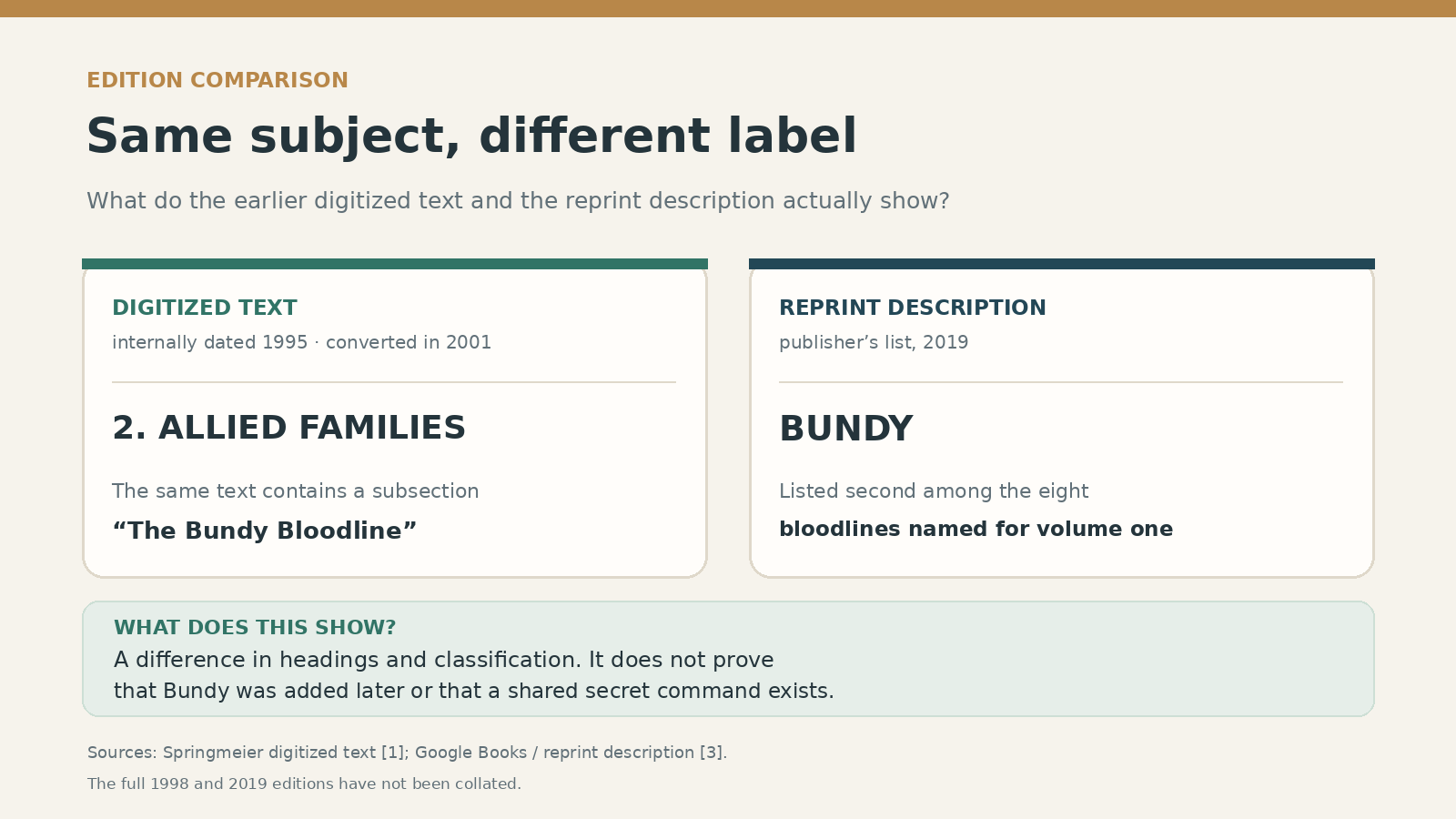
This is more than a bibliographic detail. Allied Families does not designate a single, clearly identified family, even though the earlier copy discusses the Bundys within it; Li is a widely shared surname, while the Merovingian dynasty is a historical category, not an unambiguously identifiable modern household. Treating all thirteen as equivalent, clearly defined genealogical groups would assume a conclusion the evidence does not support. Nor can we assume that everyone bearing the same surname belongs to the same branch of a family or holds the same political views. A name is a starting point for research, not evidence of identity, kinship or intent.
That is precisely why we must distinguish three objects of inquiry. The first is Springmeier's list as a historically identifiable text. The second consists of particular families and individuals for whom independent archives exist. The third is the author's central claim that those families make up an overarching secret organization. Evidence that the first and second objects are real—the book exists, and some of the families are historically significant—does not establish the third. Without this distinction, the very act of listing famous names can give the impression that the conclusion has been verified.
When a persuasive story meets a verifiable date
We need not immediately investigate every page and every family tree to understand the problem. We can begin with a statement for which a clear, independently verifiable answer exists. In his first chapter Springmeier gives John Jacob Astor's lifespan as 1763–1884. The Smithsonian's National Portrait Gallery records 17 July 1763 and 29 March 1848; library and archival records corroborate the year of death. This is not a disagreement about the interpretation of symbolism but a discrepancy in a basic biographical fact. Because the PDF examined is a later conversion, collation would be required to determine whether the error originated with the author, a transcription or the digitization. [1] [9] [10] [19]
One incorrect date does not mean that every other statement in the book is wrong. But when a text confidently connects centuries, families and hidden causes, the quality of its checking of elementary facts becomes especially important. If a claim of kinship is true, it should be possible to identify the relationship between particular people, the time frame and the document on which it rests. If an allegation of a secret agreement is true, it should be possible to produce at least comparable evidence of coordinated conduct, communication or a decision. Vague references to “good sources” and repetitions of the same allegation on different websites do not amount to two independent confirmations.
Nor is this preliminary examination an exhaustive audit of Springmeier's book. The Astor example is a single illustration of a verification method, not a representative sample or a statistical estimate of the proportion of errors in all his claims. A systematic assessment would need to sample a defined number of precisely specified claims, identify the original passage for each, locate primary records and report cases in which the author gave correct information as well. Without that, the criticism itself would amount to selecting only convenient evidence. [7] [8]
The historical Illuminati in the archives
The name Illuminati is not an invention of the modern publishing industry. In 1776 Adam Weishaupt founded a secret association in Ingolstadt whose members initially called themselves Perfectibilists. Historical letters show deliberate recruitment, internal discipline and efforts to extend influence. Weishaupt instructed his confidant Franz Anton von Massenhausen to observe and recruit younger people; an editorial summary of the correspondence also describes the desired abilities and social standing of prospective members. Ludwig Maximilian University of Munich characterizes the order's aims still more directly: through gradual education and control, its members sought to develop an elite capable of occupying key positions in government. These are genuinely documented ambitions of a secret order, not proof that they were fully realized or that a later global organization inherited its command structure. [4] [5]
Scholarly research on the order today reaches far beyond old popular summaries. The research group in Gotha at the University of Erfurt examines archival correspondence, membership, actual local connections and the order's subsequent fate. According to the group's current overview, the organization operated until approximately 1787, although the broader historical period is also described as extending to 1787/88; its geographical reach was primarily associated with the territory of the Holy Roman Empire. The order had a real organization and ambitions, yet a vast difference remains between its historically verifiable reach and later images of ubiquitous global power. [6]
This is where investigation can become more rigorous, not less. Anyone asserting that the same order survived without interruption from Weishaupt to the business dynasties of the twentieth century would need intermediate membership records, correspondence, transfers of authority, financial records or other traceable institutional evidence spanning the periods in which it supposedly operated. Having ancestors who lived in the same countries, the resemblance of symbols and the later reuse of a name are not equivalent to such an evidentiary chain. The history of a secret society does not become less real when we refrain from attaching undocumented centuries to it; it becomes clearer.
A family tree is not a governing body
Genealogy can establish with considerable precision who was whose parent, child, spouse or relative. In its introductory guidance on family-history research, the U.S. National Archives emphasizes original records identifying people, dates, places and relationships. The professional standard known as the Genealogical Proof Standard requires reasonably exhaustive research, accurate citations, comparison of evidence, resolution of conflicting information and a reasoned conclusion. Such a standard becomes even more important when claims span many centuries and numerous branches of a family. [7] [8]
Yet even an excellent family tree answers only a specific question. Proving that a businessperson and a politician are related does not tell us whether they coordinated any decision. Finding a marriage between two wealthy families establishes the marriage, not the existence of a secret executive committee. If someone serves on several boards, that provides grounds to investigate potential conflicts of interest and concentrations of influence, not automatic proof of a hereditary, transnational plan.
Even a possible genetic relationship among distant descendants would not resolve the political question. Properly interpreted, genetic information can help establish biological kinship; it cannot tell us who wrote a policy memorandum, who approved funding or what two people said at a meeting. Influence may also pass between generations through education, property, reputation and connections, without any special hereditary organization. Those mechanisms must be studied through institutional records, not family trees alone.
A serious research process might proceed as follows: first establish the family relationship between two specifically identified individuals; then determine whether they actually worked together in the same institution during the relevant period; next examine what that institution had the authority to decide and whether the decision was implemented. Only then should intent and influence be discussed. Demonstrating a worldwide network of thirteen families would require many such consecutive links on a much larger scale. The sources examined in C0 and the C1 supplement do not establish such an independent, unbroken chain. That describes the present state of the research; it does not mean that nothing more about particular families deserves investigation.
Real families, real levers of power—and the limits of a collective conclusion
The Astor family exemplifies a real historical rise in American trade and real estate. Its history is preserved in archival collections and biographical sources; we need no unnamed occult explanation to understand the origins of its wealth. For the DuPonts, we can trace the emergence of an industrial enterprise even more directly: the Hagley Museum and Library documents the organization of E. I. du Pont de Nemours in 1801–1802, the beginning of construction of a gunpowder works on the Brandywine in 1802, and early business ledgers. These are concrete records of manufacturing, capital, ownership and labor. [11] [19]
The historical influence of oil wealth associated with the Rockefellers is equally documented; the Rockefeller Archive Center specifically describes John D. Rockefeller's role in establishing Standard Oil and the subsequent philanthropic institutions. In the Kennedy family, we can trace the passage from a prosperous family background to a democratic political career. The U.S. National Archives identifies Joseph Kennedy, the father, as a successful businessman and records John F. Kennedy's election to the House of Representatives in 1946, the Senate in 1952 and the presidency in 1960. The source of wealth and a privileged starting position are important questions, but electoral processes, individual choices and actual terms in office are separate from the question of secret organizational membership. [12] [13]
These examples matter precisely because they reveal where power can be analyzed without exaggeration. Industrial capital can fund political campaigns and research institutions; ownership can confer positions in governing bodies; family ties can facilitate access to people others have little chance of reaching. Earlier articles in this series examined these mechanisms through evidence specific to each case. SM-14 should not simply rewrite them all as one grand history and append an unproven joint command structure. If particular families collaborated, that collaboration must have its own documentary trail.
There is a danger in the opposite direction as well: the unreliability of the theory of thirteen bloodlines might lead us to avoid investigating actual economic power. Court cases, shareholder registers, tax policy, government contracts, foundation grants and lobbying are publicly verifiable fields of inquiry. They are no less important if an overarching secret genealogy turns out to lack adequate evidence. Rejecting an unproven total explanation is no excuse for ignoring documented individual forms of influence.
The Merovingians and a secret order that appeared in the twentieth century
The Merovingian dynasty is a historical reality of early medieval Europe; historical overviews examine its succession of Frankish rulers from the late fifth through the eighth century. Springmeier's “Merovingian bloodline,” however, carries a much broader supposition: it attempts to move from medieval genealogy to a special modern position within a hidden world order. In his text, this section connects with a modern popular narrative about a mysterious pedigree. A genealogical inquiry would need verifiable links from particular historical individuals to precisely identified later descendants. The medieval name alone cannot establish them. [1] [20]
The example of the Prieuré de Sion, often invoked in similar stories, is particularly instructive. The catalogue of the Bibliothèque nationale de France dates the association's founding to 7 May 1956 in Annemasse and names its founders, including Pierre Plantard. The same bibliographic entry explains that Plantard tried to create the impression that the association had existed secretly since the Middle Ages. Another BnF entry links him with the documents known as Dossiers secrets d'Henri Lobineau, produced with Philippe de Chérisey. We therefore have documented people and an association as well as a documented modern attempt to attribute an older origin to it. [14] [15]
Precision matters here: a BnF catalogue entry is not the same thing as an examination of every page of the Dossiers secrets. Nevertheless, these facts constitute substantial counterevidence to the basic assertion that the Prieuré de Sion is a proven, continuously existing medieval secret leadership. Without independent medieval documents and a reliable chain linking them to the modern association, that continuity cannot be presented as fact. The very creation of an ancient genealogy in modern times is a historical phenomenon worthy of investigation.
Occult explanation, religious judgment and inherited guilt
Springmeier frequently interprets his narrative through theological and occult categories. For his readers, such a framework may represent a spiritual account of evil, a religious warning or a symbolic portrayal of political corruption. As a subject of research it is entirely legitimate: the text can show us what the author believed, what symbols he employed and how he linked religion with history. But it does not allow us to infer directly that a particular family possesses supernatural qualities, that its descendants are morally guilty by birth or that specific people perform rituals for which no independent documentation exists. [1]
A spiritual or philosophical critique of greed, coercion and abuse of office does not depend on such claims. An individual's conduct must be judged by what they have done, not by their surname. To demonstrate ritual activity, we need an authentic, specifically dated source and a verifiable context. To discuss a criminal act, we need especially rigorous evidence and a clear distinction among allegation, testimony, investigation and any eventual judicial finding. No symbolic narrative should replace those steps.
Perhaps this is where the theory poses its greatest philosophical challenge. Investigating power can be a pursuit of human freedom; but if that pursuit becomes a declaration that someone is a bearer of secret evil from birth because of their blood, it adopts the very method it seeks to criticize. Freedom of thought does not require us to reject every unusual hypothesis. It does require us not to condemn others when all we have is suggestion.
When financial history becomes a collective stereotype
Among the surnames Springmeier includes in his explanation is Rothschild. The history of particular bankers, transactions and financial institutions is a legitimate subject of research, just as it is for other influential families. But claims that assign unified worldwide power to an entire religious or ethnic community belong to a different category. The United States Holocaust Memorial Museum documents a long history of antisemitic narratives falsely portraying Jews as the hidden controllers of wars, politics and finance. The best-known is the forgery The Protocols of the Elders of Zion, which is not a historical record of actual meetings. [16] [17]
This distinction must not become an excuse to prevent scrutiny of a particular bank's transactions or any individual's political decisions. On the contrary, leaving collective stereotypes aside makes it possible to ask more precise questions about ownership, lending, contracts, conflicts of interest and responsibility. A stereotype supplies a shortcut, often replacing specific documents with assumptions about the supposed group character of people. For research seeking real relationships of power, such a shortcut is methodologically dangerous and can cause genuine injustice.
The same principle applies to non-Jewish and non-European families. It is unfair to attribute secret cooperation to every descendant of a dynasty simply because one of their ancestors was historically influential. Nor is it fair to infer from the documented collaboration of a few people that every institution carrying the same name today was involved. Evidence must follow people, dates and actions, not an inherited label.
What evidence would be required to establish the sweeping theory?
Let us start with the strongest possible version of Springmeier's claim, rather than a caricature of it. Suppose that some members of the elite genuinely share an interest, that certain family members know one another, that they cooperate in financing projects and that some information is not available to the public. All of this is historically possible and sometimes documented for particular institutions. But these suppositions do not establish precisely thirteen hereditary branches, one and the same secret order, shared responsibility over several centuries or direct control of every government. Each additional claim requires additional evidence.
First we would need to identify the members of each alleged line and construct verified family trees. Next we would need evidence of a common organization—rules, membership, actual communications, finances or decisions. Third, we would need to demonstrate continuity across time, without skipping centuries, through archival evidence linking one period to the next. The fourth would be to examine specific political and economic outcomes, looking for orders, coordinated actions and actual effects. Finally, we would need to consider competing explanations: ordinary business interests, institutional procedures, chance acquaintances, political disagreements or documented differences between members of the same family. These are not impossible standards; they are ordinary requirements for a claim of such scale and gravity. [7] [8]
The research dossier underpinning this draft establishes the authorship and existence of the text, the historical reality of the Bavarian Illuminati, the modern origin of an important part of the Prieuré de Sion narrative, and genuine biographical and institutional traces of some of the families named. It does not, however, establish an independently verified chain turning all thirteen into a single proven hereditary command organization. Outstanding tasks include a complete comparison of the 1995, 1998 and 2019 editions, a larger sample of genealogical claims, the original Dossiers secrets documents and independent verification of the alleged informants. Those gaps should be acknowledged, not filled with a certainty the sources cannot sustain.
Conclusion: hidden power needs evidence, not an inherited enemy
The theory of thirteen secret bloodlines exists as a published narrative and is of research interest as a map of questions about wealth, family succession, religious symbolism and distrust of power. But the sources examined do not establish its strongest claim—one unified, centuries-long and hereditarily led global organization. On the contrary, a few basic checks reveal bibliographic discrepancies, a specific biographical error and an example of a modern narrative portraying an institution as ancient. These findings do not invalidate the need to continue investigating actual power; they establish what has been demonstrated so far and what remains unknown. [1] [3] [9] [14]
Once we set aside the notion of an enemy defined by heredity, questions remain that may be harder but more useful: who finances a decision, who holds the voting power, which institution drafts a recommendation, who accepts responsibility and who bears the consequences? This is where critical inquiry can return to documents and individual actions. The aim is not to shield influential families from scrutiny, but to attribute to them—as to anyone else—only what we have reasons and evidence to attribute. Such consistency protects the researcher's independence and the dignity of the people being investigated.
Sources and further reading
- Fritz Springmeier. Bloodlines of Illuminati (internally dated 10 February 1995; accessible digital conversion marked 2001), introduction, table of contents, chapter on the Astors and section “The Bundy Bloodline”. source Source
- Google Books / Fritz Springmeier, Ambassador House. Bloodlines of the Illuminati, 3rd edition (1998), 598 pages; bibliographic record (complete edition not examined). source Source
- Google Books / later publisher's information. Fritz Springmeier, Bloodlines of the Illuminati, description of the three-volume reprint (2019); catalogued edition, not a direct collation of the complete texts. source Source
- German History Intersections / German Historical Institute. Two Letters from Adam Weishaupt, Founder of the Order of the Illuminati (1776), from the edited collection Die Korrespondenz des Illuminatenordens, vol. I (2005), pp. 4–5, 8–11. source Source
- Ludwig-Maximilians-Universität München. 1776 — The Illuminati, historical overview of Weishaupt's order. source Source
- Universität Erfurt, Gotha Research Centre. Illuminati Research Department, the order's historical period, archives, correspondence and research infrastructure. source Source
- Board for Certification of Genealogists. Ethics and Standards — Genealogical Proof Standard, criteria for establishing genealogical claims. source Source
- National Archives and Records Administration. How to Begin Genealogical Research, methodology of genealogical sources. source Source
- Smithsonian Institution, National Portrait Gallery. John Jacob Astor (1763–1848), biographical metadata. source Source
- Library of Congress, Inside Adams. A Fortune Made from Fur: John Jacob Astor (2012), biographical article. source Source
- Hagley Museum and Library. DuPont Company Chronology: 1801–1834, archival chronology of the company's founding. source Source
- Rockefeller Archive Center. John D. Rockefeller, 1839–1937, founder of Standard Oil and philanthropic institutions. source Source
- National Archives and Records Administration. JFK Biography, biography and public offices of John F. Kennedy. source Source
- Bibliothèque nationale de France. Prieuré de Sion, catalogue record FRBNF15055993, founding on 7 May 1956 and the narrative of an alleged older history. source Source
- Bibliothèque nationale de France. Plantard, Pierre (1920–2000), catalogue record FRBNF13010669 and the association with Dossiers secrets d'Henri Lobineau. source Source
- United States Holocaust Memorial Museum. An Antisemitic Conspiracy: The Protocols of the Elders of Zion, the history and exposure of the forgery. source Source
- United States Holocaust Memorial Museum. Antisemitism, historical account of collective stereotypes and conspiracy accusations. source Source
- Michael Barkun. A Culture of Conspiracy: Apocalyptic Visions in Contemporary America, University of California Press (2003; expanded edition 2013), publisher's description and table of contents reviewed; the full monograph was not examined. source Source
- New York Public Library. Astor family papers, archival collection description and family details. source Source
- EBSCO Research. Merovingian Dynasty, historical overview of the Frankish dynasty and the transition to Carolingian rule. source Source