Industrial Dynasties and Political Power in Europe
Krupp’s industrial history and Wallenberg ownership illuminate distinct links between companies, foundations, the state and political influence.

Editorial illustration of institutional relationships, not an archival depiction of any Krupp or Wallenberg facility.
Who controls an industrial company when its largest shareholder is no longer a member of the founding family but a foundation? And who has the decisive say when a shareholder holds a much smaller proportion of the capital than of the voting rights? In European economic history, influence is not transmitted solely through family trees. It also passes into ownership agreements, boards of directors, foundations, banks, industrial associations and relationships with the state. Some of these mechanisms are public and lawful; others were concealed in particular historical circumstances. Their actual significance can only be assessed by examining who owned what, what decisions each actor was empowered to make, and what consequences actually followed.
Two contrasting European cases make such an investigation possible. The Krupp story runs from heavy industry and arms production to the Nuremberg convictions of responsible senior executives and a later charitable foundation. The Wallenberg story follows a different trajectory: a bank, investment holding companies, generations of business management and shares whose voting power differs from their proportion of the capital. Between these examples lies a third field of inquiry—the institutional route from economic interests to political debate in Europe. This does not prove that the two families belonged to a single secret command structure; it does provide a sufficiently concrete basis for asking how private power can outlast repeated changes of political leadership. [1] [10] [12]
Krupp: when a factory becomes part of a country's history
Krupp's early steelmaking activities in Essen date back to the beginning of the nineteenth century. The foundation that now bears Alfried Krupp's name gives 1811 as the year the company began; the introduction to the Harvard archive of the Nuremberg trial uses 1812. This discrepancy between institutional chronologies is not decisive for the central argument. More important is that, as the company expanded, it brought together mining, steelmaking, railway equipment, shipbuilding and arms production. Its strength came not merely from one invention, but from the capacity to combine capital, raw materials, technical expertise, production and major orders. [1] [4]
Military contracts created a particularly sensitive relationship with the state. The state needed industrial output, while government policy and military programs generated demand for the company on a scale that ordinary consumer markets could not replace. Yet such a relationship does not in itself mean that a factory owner makes decisions in place of a government. A purchase order, a contract, an administrative arrangement and a political command are different kinds of acts. At the point where we leap from industrial dependence to a claim of secret rule, we would need a direct document—not simply a large factory and an influential surname. [1]
German history in the first half of the twentieth century also reveals the darker side of the relationship between industry and the state. Under National Socialist rule, economic cooperation could amount to participation in a system of conquest, exploitation of occupied territories and forced labor. In the case of Krupp's management, such questions need not be investigated through rumor: they were adjudicated in court on the basis of extensive documentary evidence and witness testimony. [1] [2]
Nuremberg: what was proved, and what was not
The trial United States v. Alfried Krupp et al. took place in 1947–1948. Twelve senior representatives of the company were charged; the prosecution submitted more than 1,400 documentary exhibits, the defense more than 2,800, and over two hundred witnesses were heard. Such a major proceeding cannot fairly be reduced to the claim that the entire industry was either innocent or uniformly convicted on every charge. The judgment required distinctions among individuals, specific acts and individual counts of the indictment. [1]
On 5 April 1948, the tribunal ruled that the available evidence was insufficient for convictions on Counts I and IV, concerning crimes against peace and the common plan, respectively. This is recorded in the original hearing transcript, not merely in a later summary. The remaining counts concerned plunder and exploitation of occupied territories, and deportation, slave or forced labor and associated crimes. The dismissal of two counts does not erase convictions on the other two; equally, convictions on those two counts do not justify attributing every charge originally brought to a person. [2] [3]
On 31 July 1948, the tribunal found eleven defendants guilty and acquitted Karl Pfirsch. Alfried Krupp was convicted under Counts II and III and sentenced to twelve years' imprisonment, with an order for the forfeiture of his property. Here, the connection between an industrial decision and a grave violation of human dignity is not a theory about a network: it is the subject of a historically documented judgment. At the same time, responsibility must be attributed to the specific convicted executives, not extended into unfounded hereditary guilt for their descendants, every employee, or every present-day company bearing a related name. [1] [2]
The judgment also matters for understanding power. It demonstrates that a company can participate in state repression without formally taking over the state. The legal problem is not solely who issued the highest command; it is also who obtained, allocated or used forced labor, and what responsibility they bore for actions in which they participated. This distinction between political hierarchy and actual operational power remains useful when examining later cases as well. [1] [2]
1951: conviction, clemency and Cold War interests
The criminal judgment was not the end of the story. On 31 January 1951, John J. McCloy, the U.S. High Commissioner for Germany, intervened in the sentences of prisoners held at Landsberg. In Alfried Krupp's case, the prison sentence was reduced so that he was released, and the order confiscating his property was also set aside. This does not mean that the court retrospectively reversed its findings of guilt. It means that the postwar executive authority, through an act of clemency, altered the enforcement of the sentence and the property-related consequences of the conviction. The distinction between a judicial finding, clemency and the restoration of property is crucial. [5] [6]
Why did this happen? Historians place the decision in the new security and foreign-policy setting in which West Germany was becoming important to Western European recovery and the Cold War alliance. British parliamentary records from 1952 show that questions about renewed economic concentration and the handling of Krupp's property did not end with the criminal proceedings. It would be unfair to claim that one motive explains every Allied action; but it would be equally misleading to omit the political context in which decisions about the sentence and industrial property were made. [5] [6]
This case raises an uncomfortable question about the consistency of public authority: how can a state ensure that a company's strategic usefulness does not become an excuse to forget its violations? The rule of law is tested even when it must separately weigh criminal responsibility, public security, property consequences and the rights of those affected. Clemency may have reasons of its own, but it cannot in itself turn past violence into something that never occurred.
A foundation: the same history, a different owner
Alfried Krupp died on 30 July 1967. Under his will, his private and business assets passed to a nonprofit foundation, which began operating on 1 January 1968. That transfer changed the form of ownership and the arrangements for governance. The foundation is not merely a stand-in for a living heir; it is a legal and organizational entity with its own governance responsibilities and publicly stated charitable aims. Anyone who describes the “Krupp family” today as the direct owner of the entire former industrial system therefore overlooks a fundamental historical change. [4] [7]
According to the foundation, its holding in thyssenkrupp AG was 20.93 percent. In its September 2025 description of the shareholder structure, the company attributed approximately 21 percent to the foundation and approximately 79 percent to free float. These figures demonstrate a significant but non-majority stake in a particular publicly traded company. On their own, they do not establish control over every corporate decision, much less direct personal family ownership of all German industry. A meaningful assessment of influence would also require the composition of management and supervisory bodies, specific votes and any agreements among other shareholders. [7] [8]
With the funds it receives, the foundation supports science, education, culture, health and sport. Such activities should be assessed by their actual effects, not automatically rejected because the founder bears historical responsibility. At the same time, a charitable mission does not demonstrate that the past has been fully confronted. In 2022 the foundation launched a dedicated project to study Alfried's relationship to National Socialism, and in December 2024 announced the start of a more extensive second phase, with a multi-author volume planned. The official pages reviewed up to 18 November 2026 did not confirm that this volume had been published; that alone does not prove it has not appeared. Further results will require separate verification. [7] [9]
The question therefore changes. It is no longer only whether a wealthy family can retain a factory, but how a nonprofit shareholder exercises its ownership rights, which public purposes receive the surplus, and how it explains difficult parts of its inheritance to the public. Philanthropy and accountability are not opposites; that is precisely why neither can substitute for the other.
Wallenberg: a bank, a holding company and longevity
The Wallenberg family’s business history took a different course. In 1856, André Oscar Wallenberg founded the bank from which today's SEB traces its origins. Through banking and investment ties, the family gradually acquired a significant role in Swedish industry. Investor AB, established in 1916, is now a publicly listed investment company; alongside it operate a number of Wallenberg foundations and FAM. These are not identical institutions, nor are they the personal account of a single family member. [10] [11]
The Wallenberg network publicly describes itself as a system of active, long-term ownership that supports portfolio companies through boards of directors and strategic collaboration. Such an approach can provide continuity where dispersed ownership might otherwise lead to rapidly changing strategic priorities. Yet longevity alone does not establish that every business decision is sound or democratically accountable. The central questions are who represents the shareholders and what rules allow a competing interest or minority shareholder to object. [10] [12]
In this model, philanthropy plays a different role than it does in the postwar Krupp foundation. The Wallenberg foundations form part of a broader ownership ecosystem and support scientific research and education. According to the Wallenberg institutions, their foundations awarded approximately SEK 3.1 billion for research and education in 2025. Such resources can create long-term public benefits. At the same time, the selection of research fields, professional communities and institutions raises the question of how priorities are set. We need not assume a hidden plan to acknowledge that the allocation of private funds influences the conditions under which knowledge is produced. [10] [13]
Twenty percent of the capital, nearly forty-three percent of the votes
In Investor AB's official register of major shareholders dated 30 September 2026, the Knut and Alice Wallenberg Foundation was listed as its largest individual shareholder, with 20.07 percent of the capital but 42.96 percent of the voting rights. The same statement expressly distinguishes Class A and Class B shares. The two figures therefore measure different things: the capital stake describes the shareholder's economic interest, whereas the votes indicate its weight in decisions to which voting rights apply. That divergence is a verifiable corporate mechanism, not a suggestive gap to be filled with a conspiracy theory. [11]
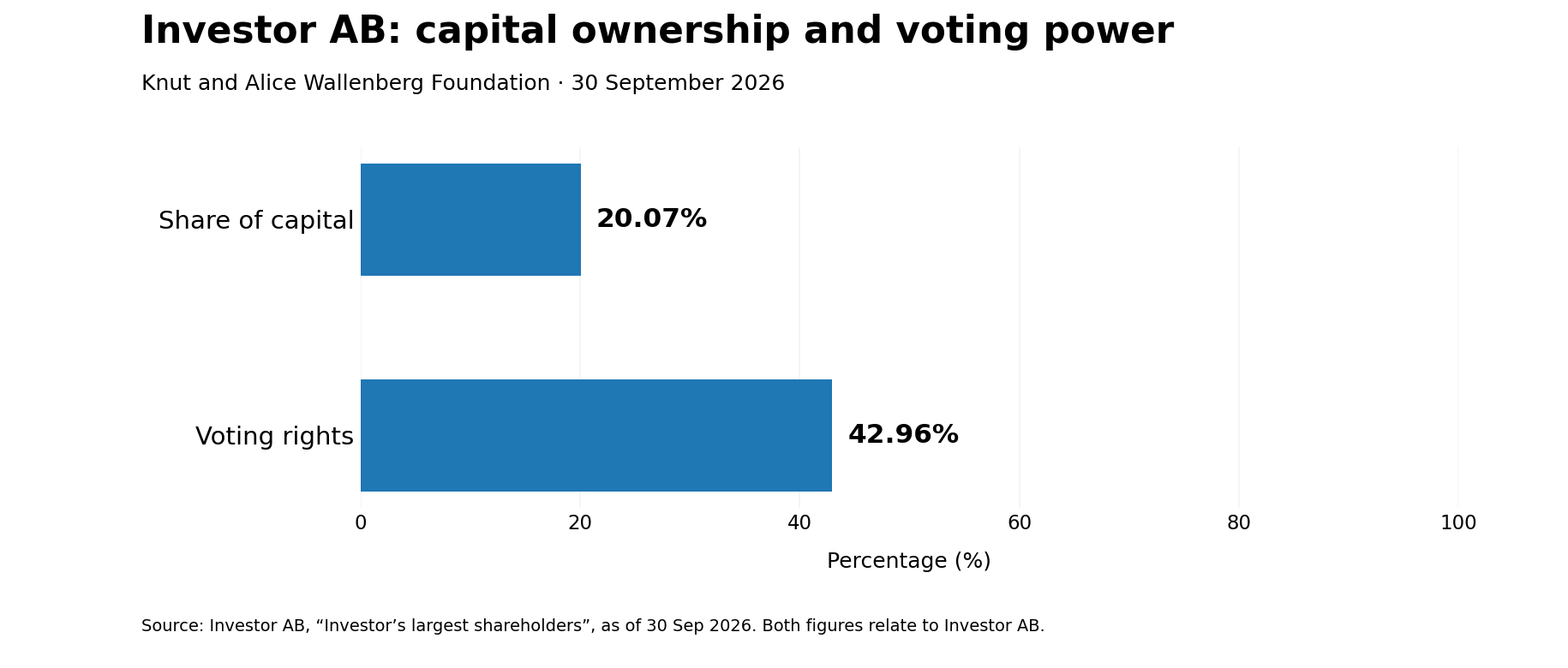
This example emphatically does not mean that the foundation owns 42.96 percent of “all Swedish companies” or that it can unilaterally decide every matter at Investor AB. The significance of votes depends on other shareholders' participation, applicable majority thresholds, the authority of corporate bodies and the particular decision. Nor is Investor AB identical to every company in its portfolio. Several legal layers separate the foundation's stake in Investor, Investor's stake in another company and the actual authority of that company's board. Those distinctions cannot simply be overlooked. [11] [12]
In its 2026 report on the Swedish equity market, the OECD described the important place of family investment companies and shares with differentiated voting rights in Sweden's corporate environment. Supporters point to the potential for stable, long-term ownership; critics highlight the gap between economic exposure and governance power and the position of minority shareholders. Neither perspective has to be declared universally correct: the documented rules and their effects in particular companies are what need examination. [12]
When a private network reaches the intelligence apparatus
Perhaps the most sensitive chapter in the Wallenberg story concerns not today's published shareholdings but cooperation between business institutions and state intelligence during the Cold War. In a study first published online in 2025 and appearing in the print journal in 2026, historian Rikard Westerberg examined the Wallenberg business group's relationships with military intelligence organizations between 1945 and 1989, drawing on Sweden's military archives and the SEB archive. This is not a conclusion drawn from photographs showing people together, or speculation based on a surname: the author identifies archival collections, correspondence, diary entries and organizational records. [14]
A particular focus of the study is the economic intelligence organization Öst Ekonomiska Byrån (ÖEB), which gathered and analyzed information about Eastern Bloc economies. Westerberg describes how the bank and other businesses could supply information, financial support and services, while state security organizations required knowledge of trade, raw materials, industrial capacities and technological development. National security and commercial interests were not necessarily entirely separate spheres. This raises a research question about mutual benefits and the boundary between a public mission and possible private informational advantages. [14]
Research of this kind, however, requires particular care over the strength of the evidence. We can accurately report the author's interpretation as a historical finding grounded in archives; we cannot claim that reading the article amounts to independently examining every archival file he used. Nor does Cold War cooperation demonstrate that today's companies still employ the same mechanisms or that the family directs Swedish government agencies. Such conclusions would require new documents, present-day powers and concrete actions. [14]
The scholarly publication also contains an important correction. In the published corrigendum, Westerberg corrected a terminological mistake: a sum exceeding one million Swedish kronor is not a six-figure amount. The correction itself does not independently verify that a payment was made. Accordingly, neither the reported amount nor its conversion is treated here as independent evidence that the payment occurred. The correction does not invalidate the entire historical investigation; it does show why a study that supports a researcher's initial interest must be checked just as rigorously as any other. [15]
From an interest network to European policy
The European Round Table for Industry (ERT), an association of leaders of major European industrial companies founded in 1983, represents a different, publicly documented form of economic networking. Its members publish recommendations on European economic, trade and industrial policy. Jacob Wallenberg is listed among its members and as one of the co-chairs of the Trade & Economic Security committee. He is not the President of the European Commission, an EU legislator or the chair of ERT as a whole; Jonathan Symonds assumed the latter role in 2026. [16] [17]
European policy rules allow organized interest representation, but for that very reason also provide for oversight of contacts. The European Commission explains that meetings with certain interest representatives about the preparation or implementation of policies may take place only where the representatives are entered in the Transparency Register. Registration by itself does not imply wrongdoing; an unregistered or concealed contact would raise a different research question. Nor does a publicly issued proposal from an industry forum establish that the forum drafted a law or supplanted elected representatives. [18]
In January 2026, ERT publicly called for the rapid provisional application of the relevant trade provisions of the EU–Mercosur agreements. This appeal can be compared with the official chronology: on 9 January 2026, the Council of the EU authorized the signing of the agreements, before that ERT appeal. The agreements were signed on 17 January, and provisional application of the separate interim Trade Agreement (iTA) began on 1 May 2026. This sequence documents public advocacy by an industry association in a debate also involving legislative and interstate decision-makers. The fact that a significant Council decision preceded the ERT appeal limits any claim that the appeal caused that earlier decision. [19] [20] [21]
That chronology tells us more than a general assertion that industry influences Brussels. To establish that ERT caused a particular provision of an agreement, we would have to compare its specific proposals against official drafts, meeting records, the positions of member states, negotiations and the adopted text. For now, we can demonstrate organized public advocacy and dated official decisions, not a proven decisive role for one family or one forum in the outcome. [18] [19] [20]
Three forms of influence, three different limits
The Krupp case is the starkest because it involves the established criminal responsibility of specific historical executives and political decisions about the consequences of their convictions. The postwar transfer of assets to a foundation illustrates the continuity of an industrial legacy in a new legal form, not the uninterrupted personal ownership of the same individual. For the Wallenbergs, public documents demonstrate concentrated voting rights at Investor AB and an infrastructure of corporate governance, while historical research documents relationships, partly concealed, with intelligence organizations during a defined period. ERT, in turn, illustrates organized and generally public advocacy of interests in the European institutional sphere. These three forms cannot fairly be merged into a single model. [1] [7] [11] [14] [16]
Economic power is not solely harmful. Industrial groups have developed manufacturing and technologies; long-term investors can support investment, while research institutions can carry out genuinely valuable scientific work. Yet public benefits do not settle questions of accountability, transparency and the ability to object. A sound economic system must allow us to investigate who determines a company's strategy, whose interests prevail in difficult decisions, who bears the consequences and how wrongdoing can be brought to light. Consistent standards matter more than whether we like or dislike a particular family.
The comparison also tells us something about the limits of investigating hidden power. Even particularly strong evidence of cooperation does not automatically establish a general conspiracy. Shares, foundation charters, court decisions, intelligence archives and interest-group records each answer different questions. Only by carefully connecting them can we establish whether a particular political decision was in fact directed, who shaped it and who could have stopped it.
Conclusion: power without a crown
An industrial dynasty in modern Europe is not necessarily a family sitting at the top of one company and issuing orders to everyone. It may be a historical network of capital and management practices that survives through foundations, holding companies, share classes and personal connections. Krupp and Wallenberg illustrate two markedly different paths. The first teaches us how dangerous the combination of industrial capacity and state violence can be, and how complex questions of accountability and property remain even after judgment. The second demonstrates that the longevity of influence can be measured precisely through shares and governance, while historical intelligence ties call for especially patient documentary verification. [1] [11] [14]
The strongest conclusion, then, is not the existence of a single secret center of European power—for which there is no evidence here. More tangible is the recognition that a person holding no government office may still play an important part in shaping the options from which public authorities subsequently choose. This is not invariably unlawful, immoral or hidden. But in a democratic society, power and influence must remain open to scrutiny, opposition and accountability for their consequences. A family's worth cannot rest on a supposed hereditary right to rule others; we must examine its concrete actions, institutional rules and the rights of people affected by its decisions.
Documentary sources and archive links
These links lead to documents, archival records or photographs hosted by their original source institutions.
Sources and further reading
- Harvard Law School Library, Nuremberg Trials Project. Nuremberg – Case 10: The Krupp Case (historical trial, 1947–1948; online archive, accessed 2026). source Source
- United States Holocaust Memorial Museum. Subsequent Nuremberg Proceedings, Case #10: The Krupp Case (historical overview). source Source
- Harvard Law School Library, Nuremberg Trials Project. Transcript for NMT 10: Krupp Case — ruling on Counts I and IV, 5 April 1948. source Source
- Alfried Krupp von Bohlen und Halbach-Stiftung. Krupp Historical Exhibition (historical overview, no single publication date). source Source
- Thomas Alan Schwartz. John J. McCloy and the Landsberg Cases, in American Policy and the Reconstruction of West Germany, 1945–1955, eds. Jeffry M. Diefendorf, Axel Frohn and Hermann-Josef Rupieper (Cambridge University Press, 1994), pp. 433–454; online edition 2013, DOI: 10.1017/CBO9781139052559.021. source Source
- UK Parliament, Hansard. Herr Krupp (Compensation), House of Commons, 15 October 1952. source Source
- Alfried Krupp von Bohlen und Halbach-Stiftung. History (institutional history, undated). source Source
- Alfried Krupp von Bohlen und Halbach-Stiftung; thyssenkrupp AG. thyssenkrupp AG and Stock (foundation's 20.93% stake; thyssenkrupp shareholder statement, September 2025). source ; source Source 1 Source 2
- Alfried Krupp von Bohlen und Halbach-Stiftung. Krupp Foundation takes research project on the position of Alfried Krupp to National Socialism into second phase, 13 December 2024. source Source
- Wallenberg.com. The Ecosystem (foundations, Investor AB, FAM and SEB; checked in 2026). source Source
- Investor AB. Investor’s Largest Shareholders, 30 September 2026 (capital interest, voting rights, Class A/B shares). source Source
- OECD. The Swedish Equity Market: Assessment and Policy Recommendations 2026, sections on family investment companies, differentiated voting rights and shareholder rights. source Source
- Investor AB. About Investor (dividends and long-term ownership; read together with Wallenberg's description of the ecosystem). source Source
- Rikard Westerberg. The Firm, the Bank, and the Family: Military Intelligence and the Wallenbergs in Sweden’s Cold War. Enterprise & Society, 27(2), 2026, 417–446; first published online 2025. source Source
- Rikard Westerberg. The Firm, the Bank and the Family: Military Intelligence and the Wallenbergs in Sweden’s Cold War — Corrigendum. Enterprise & Society, 27(2), 2026, 447; published online 6 November 2025. source Source
- European Round Table for Industry (ERT). About ERT; Members (foundation, membership and activities, 2026). source ; source Source 1 Source 2
- European Round Table for Industry (ERT). Trade & Economic Security (committee role and public positions, 2026). source Source
- European Commission. Transparency Register (rules for meetings with interest representatives). source Source
- European Round Table for Industry (ERT). ERT calls for provisional application of EU–Mercosur, 22 January 2026. source Source
- Council of the European Union. EU–Mercosur: Council greenlights signature of the comprehensive partnership and trade agreement, 9 January 2026. source Source
- Council of the European Union. Interim Agreement on Trade between the EU and Mercosur — treaty details (signed 17 January 2026; provisional application from 1 May 2026). source Source