Secret and Suppressed — Jim Keith: Forbidden Ideas, Hidden History, and Alternative Research
A presentation of *Secret and Suppressed*: mind control, Jonestown, Casolaro, Waco, disinformation, the Vatican, AIDS, and the hidden-history culture of the early 1990s.
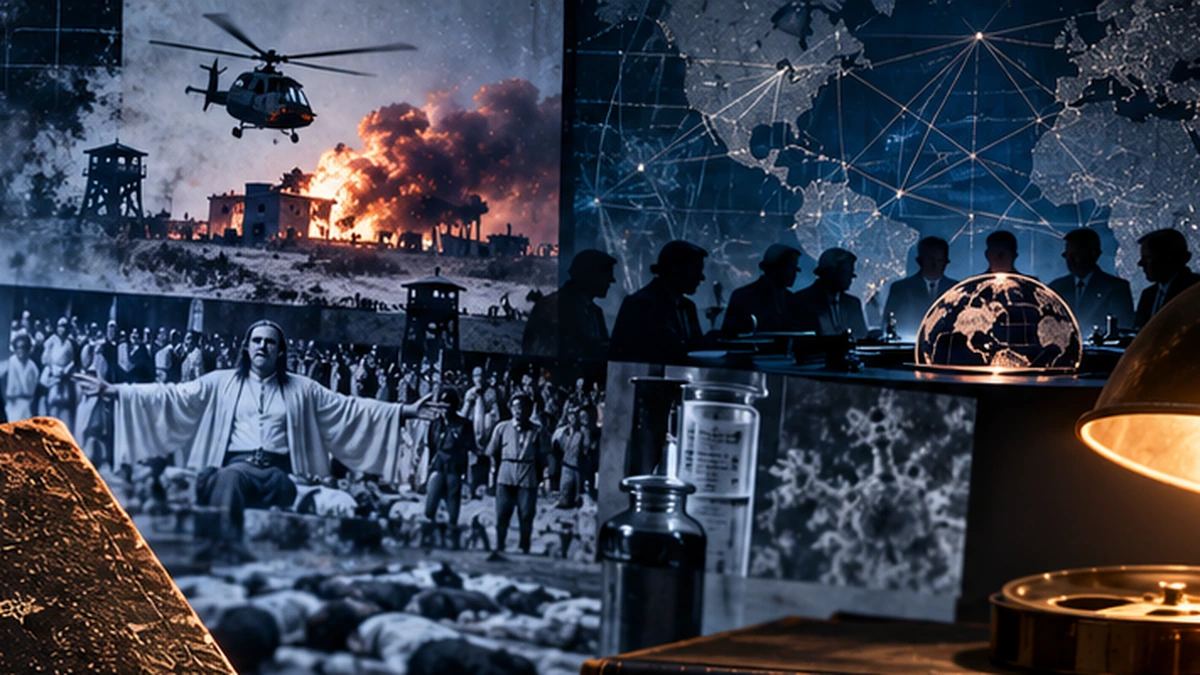
Secret and Suppressed: Banned Ideas & Hidden History was published by Feral House in 1993. The first edition runs to 309 pages and is bibliographically described as a work edited by Jim Keith, rather than a single-author monograph written entirely by him. The anthology is divided into four broad thematic parts — Menticide, Cults & Casualties, The Disinformational Plague, and The Elite Controllers — and brings together contributions on behavioral control, electromagnetic technologies, Jonestown, Danny Casolaro, Waco, disinformation, Freemasonry, the Vatican, AIDS, postwar Nazi networks, and other subjects.[1][2]
The Anthology as an Archive of Alternative Research
Secret and Suppressed is also valuable as a time capsule. It appeared before mass internet access, before the major post–Cold War wave of declassification, before the Nazi War Crimes Disclosure Act, and before the later digital archives of the CIA, FBI, National Archives, and other institutions. Much of what an independent researcher had to obtain in 1993 through photocopies, newsletters, private collections, and correspondence networks is now directly available on official websites.
The anthology is also interesting today as a snapshot of questions circulating in alternative research in 1993, before many later archives and public discussions became available.
The opening section turns to mind control, coercive influence, and electromagnetic technologies. The table of contents includes My Father Is a Clone, An Open Letter to the Swedish Prime Minister From a Survivor of Electromagnetic Terror, Anna Keeler’s Remote Mind Control Technology, and Kerry Thornley’s Is Paranoia a Form of Awareness?.
MKULTRA and the Motif of Destroyed Documents. There is no longer any need to speculate about whether the CIA conducted covert programs involving behavioral control.
On 3 August 1977, the Senate held a public hearing titled Project MKULTRA, the CIA’s Program of Research in Behavioral Modification.
The historical record therefore establishes that “mind control” or “behavioral modification” were not merely later folklore in the history of intelligence agencies. There were real programs, real budgets, real subprojects, and real experiments involving human subjects.
The anthology also gives an important role to the motif of incomplete or destroyed archives, reinforcing its theme of hidden history.
That matters. Destruction of records reduces the possibility of reconstructing a program in full and means historians cannot simply assume that everything absent from the surviving archive never existed.
In the anthology, destroyed and missing records have a special narrative role: gaps in the archive become part of the larger theme of secrecy, concealment, and inaccessible history.[2][4]
Electromagnetic Influence and “Paranoia as Awareness”
Anna Keeler’s Remote Mind Control Technology argues that electromagnetic fields and microwave technologies were also investigated for anti-personnel and behavioral applications.
In the anthology, such research themes expand into much broader ideas about remote mind reading, behavioral programming, and invisible control of complex human decisions.
Kerry Thornley’s title Is Paranoia a Form of Awareness? poses a more philosophical question. How should a person reason in a world where some concealments genuinely exist while accidental events can also be assembled into almost any desired pattern?
After MKULTRA, that question becomes more difficult, not less. If history shows that institutions have sometimes carried out secret and unauthorized experiments, the label “paranoia” is not enough to dismiss a claim.
But the existence of covert programs also does not eliminate the need to distinguish signal from coincidence. The strongest answer is not a psychological label but a documentary method: person, date, program, funding, order, technology, archive, and consequence.[7]
Jonestown and “Cults & Casualties”
The second major part of the book links symbolism, Freemasonry, the death of Jim Morrison, Peoples Temple, Jonestown, Danny Casolaro, and Waco.
After the attack on Ryan’s group at Port Kaituma and the mass deaths at Jonestown, the FBI and Guyanese authorities carried out a major investigation. The FBI interviewed survivors, identified victims, and later built a criminal case against Larry Layton, who was convicted in the United States for his role in the attack.
In the anthology, Jonestown is presented not only as a religious tragedy but also as a case of coercive control, abuse, violence, and possible wider connections.
Danny Casolaro and the “Octopus”. John Judge’s The Black Hole of Guyana goes further and places Jonestown within a larger framework of intelligence, political, and experimental connections.
The anthology includes draft material associated with Danny Casolaro, a journalist who investigated INSLAW, PROMIS, Iran-Contra, BCCI, and other scandals and attempted to connect them into a system he called the “Octopus.”
Casolaro was found dead in a hotel room in Martinsburg, West Virginia, in August 1991. The medical investigation concluded that he died from blood loss caused by slashed wrists, and the official inquiry treated the death as suicide. The autopsy reportedly found no signs of physical struggle.[2][9][2][2][10]
Waco and the Moment of Publication
The inclusion of Why Waco? is especially interesting chronologically. The Branch Davidian siege ended on 19 April 1993, and Secret and Suppressed appeared that same year. The contribution was therefore close to contemporary commentary, not a retrospective written after decades of document releases.
Today much more is known. DOJ records document that the initial ATF raid on 28 February ended with four agents and several people inside the compound dead, followed by 51 days of negotiation. On 19 April the FBI used armored Combat Engineering Vehicles and CS tear gas; around noon the compound was engulfed in fire.
The DOJ arson investigation in 1993 concluded that the fire was intentionally set from inside the compound and that fuel had been used to accelerate its spread. Special Counsel John Danforth’s additional inquiry in 2000 again concluded that federal agents did not start the fire and did not fire on the Branch Davidians during the blaze.
The Waco material also focuses on the final assault, the use of CS gas, armored vehicles, the tension between negotiation and tactical strategy, and the escalation of pressure.[1][2][12][13][14][15][12][13]

Disinformation and April Glaspie
The third part of the anthology deals with the information environment: war propaganda, the IRA, media portrayals of violence, and The Anarchist Cookbook.
One notable case is An Invitation to War, connected with U.S. Ambassador April Glaspie and Saddam Hussein shortly before Iraq invaded Kuwait.
There is enough documentation today that the issue cannot be reduced either to the slogan that the United States simply “gave Saddam a green light” or to the claim that American messaging before the invasion was entirely unambiguous.
The Iraqi transcript of Glaspie’s 25 July 1990 meeting with Saddam contains her statement that the United States had no position on “Arab-Arab conflicts” such as the border dispute with Kuwait. A later released U.S. cable, however, also shows that Glaspie explicitly emphasized that the United States could not accept the settlement of disputes by anything other than peaceful means.
“Silent Weapons for Quiet Wars”. The fourth part, The Elite Controllers, includes the famous text Silent Weapons for Quiet Wars.
The document circulates as an alleged secret manual of social and economic engineering, claiming to describe a “silent war” against the population. Its commonly repeated origin story — discovery in a discarded IBM copier in 1986 and an alleged connection with Bilderberg — appears in many reproductions.[2][17][2][18]
The Vatican Archives
Secrets From the Vatican Library participates in a long cultural image of the Vatican as an institution holding a vast hidden archive.
The Archive itself explains, however, that the Latin secretum meant primarily “separate, private, reserved” — an archive reserved to the pope and authorized officials — rather than necessarily “secret” in the modern sense. In 2019 Pope Francis restored the name Vatican Apostolic Archive.
Qualified scholars have been admitted since 1881, and today records are open through the end of the pontificate of Pius XII in 1958. Access is therefore restricted and chronologically regulated, not completely closed to historical research.
AIDS as a Subject of Alternative Research. G. J. Krupey’s contribution raises one of the anthology’s strongest biological claims: the possibility that AIDS was connected with U.S. military biological research.
The historical story contains an additional information-war layer. U.S. diplomatic records from the 1980s show that claims that HIV originated at Fort Detrick became the subject of a major Soviet disinformation campaign. By 1985 the State Department was tracking articles alleging that the U.S. government had created the virus and treating the narrative as Soviet active-measures disinformation.
Phylogenetic research on HIV and related SIV viruses has allowed scientists to reconstruct the virus’s evolution. Reviews in the scientific literature show that HIV-1 arose from multiple independent cross-species transmissions of simian immunodeficiency viruses from African primates to humans; the pandemic group M is most closely related to viruses found in central African chimpanzees, and molecular-clock analyses place its emergence in the early twentieth century.
That genetic and temporal history predates the alleged Cold War laboratory event by decades.[2][19][20][21][2][22][23][24]
The “Nazi International” and Postwar Networks
One of the most significant subjects for retrospective analysis is the closing material on a “Nazi International.”
The “Nazi International” contribution brings postwar intelligence networks, Reinhard Gehlen, Klaus Barbie, and the wider use of former Nazi personnel during the Cold War into the anthology’s theme of hidden history.
These are concrete cases of postwar continuity in personnel, knowledge, and networks from the Nazi system into the Cold War intelligence environment.
Whether all such networks formed one central “Nazi International” is a stronger organizational proposition. But the underlying fact — that Western intelligence services used former Nazis and collaborators and that some war criminals received protection — is now part of the declassified record rather than mere rumor.[2][25][26][25][26]
What “Suppressed” Means in the Anthology
The review shows that Secret and Suppressed actually combines several very different kinds of information.
The Anthology as a Snapshot of 1993. That permits a more precise model than the old binary of “official story versus forbidden story.”
Sources and further reading
- Open Library / WorldCat — Jim Keith (ed.), Secret and Suppressed: Banned Ideas & Hidden History, Feral House, 1993 Source
- Better World Books — table of contents, Secret and Suppressed, 1993 edition Source
- CIA Reading Room — MKULTRA correspondence concerning unwitting testing Source
- U.S. Senate Select Committee on Intelligence — Project MKULTRA hearing, 3 August 1977 Source
- National Archives — Nazi War Crimes Disclosure Act / postwar intelligence use of former Nazis Source
- Washington Post — House Judiciary reporting on Danny Casolaro and INSLAW, 1992 Source
- Anna Keeler — Remote Mind Control Technology, reprinted from Secret and Suppressed Source
- James C. Lin / review literature — microwave auditory effect and thermoelastic mechanism Source
- FBI — Jonestown historical case file and investigation summary Source
- UPI — contemporary reporting on Casolaro autopsy and investigation, August 1991 Source
- Washington Post — House Judiciary request for further investigation into Casolaro’s death Source
- U.S. Department of Justice — Report on the Events at Waco, Texas, 1993 Source
- U.S. Department of Justice — Events of 19 April 1993 / tear gas and CEV operation Source
- U.S. Department of Justice — Waco Arson Report Source
- John C. Danforth, Special Counsel — final Waco investigation, 8 November 2000 Source
- U.S. Department of State, Office of the Historian — Gulf War, 1990–1991 Source
- Washington Post — State Department cable traffic and Glaspie–Saddam meeting, July 1990 Source
- Silent Weapons for Quiet Wars — circulating document and provenance claims Source
- Vatican Apostolic Archive — history, holdings and meaning of secretum Source
- Pope Francis — L’esperienza storica, 22 October 2019 Source
- Vatican Apostolic Archive — access and consultation rules Source
- U.S. Department of State, FRUS — Soviet AIDS/Fort Detrick disinformation allegations Source
- Paul M. Sharp & Beatrice H. Hahn — The evolution of HIV-1 and the origin of AIDS Source
- Beatrice H. Hahn et al. — Origins of HIV and the AIDS Pandemic Source
- National Archives — Hitler’s Shadow: Nazi War Criminals, U.S. Intelligence, and the Cold War Source
- United States Holocaust Memorial Museum — Klaus Barbie and U.S. Counter-Intelligence Corps Source