Pharaoh: Throne, Temple, and the Production of Social Reality
Here Pharaoh functions primarily as an allegory of power: whoever controls knowledge has power. From the eclipse to archives, data and interpretation, the article examines how information asymmetry can turn formal authority into operational power.
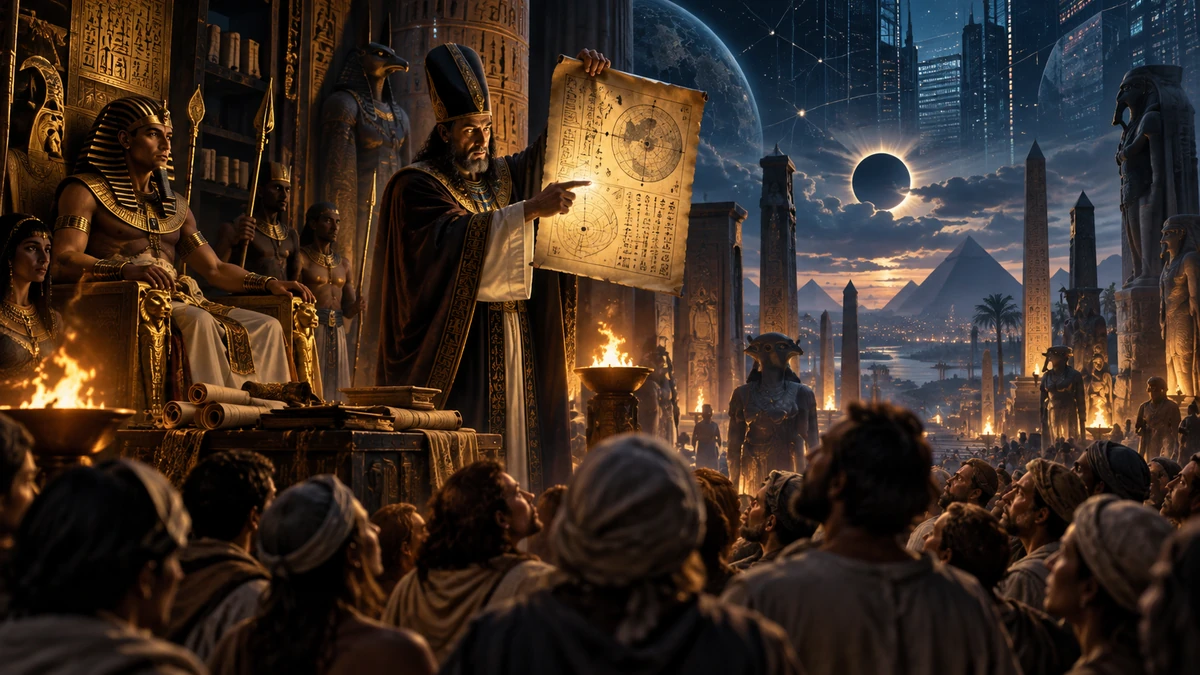
In Pharaoh, our main concern is not whether every scene is historically exact. We use the film as a political and philosophical allegory for a much broader mechanism: whoever controls knowledge has power. When one group understands a phenomenon, an archive, a flow of money or the rules of a system while another sees only the consequences, the difference is not merely informational; it can become a difference in power.
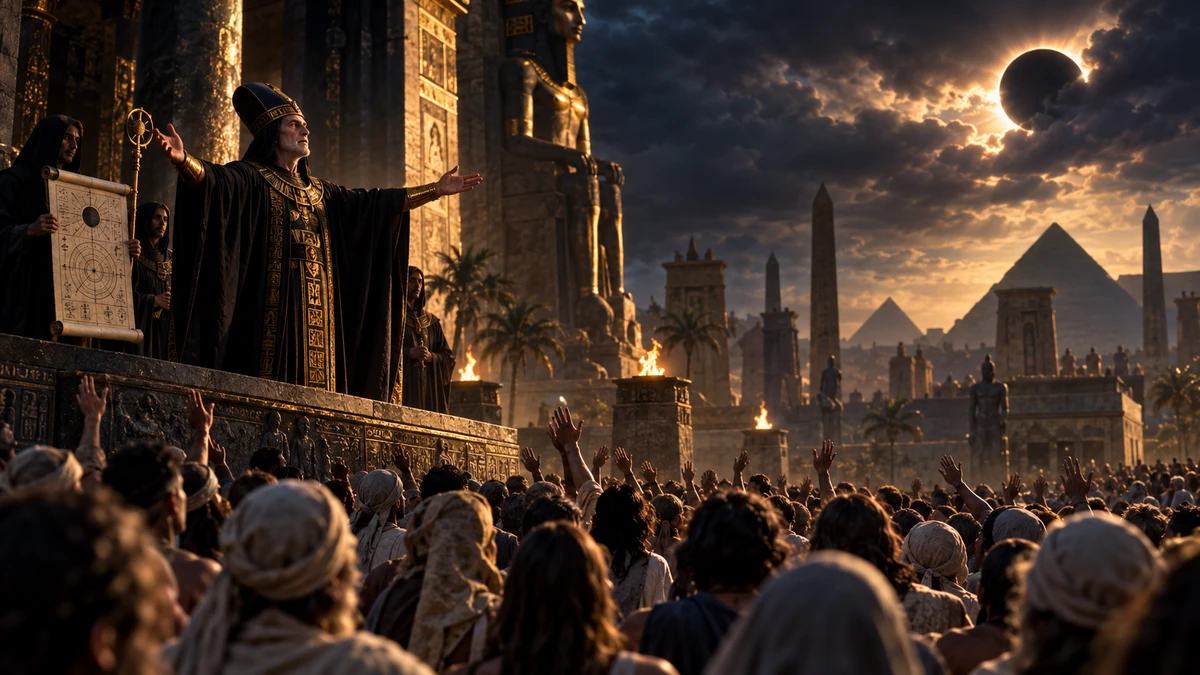
The clearest image is the solar eclipse. For someone who knows what is happening and when it will end, the eclipse is a natural event. For a crowd without that knowledge, the same event can be presented as an omen, punishment or proof of higher authority. Whether historical Egyptian priests literally performed the cinematic trick is not the central point. The structure is: one side knows, the other does not — and the first can convert that gap into obedience.
This structure is not confined to an ancient temple. In modern societies, knowledge and access are distributed across public institutions, expert bureaucracies, intelligence systems, financial networks, corporations, media, data brokers and digital platforms. This does not mean they form one unified hidden centre. It does mean that formal political office is not the only form of power: it also matters who knows, who measures, who classifies, who sees the data, and who can make an interpretation function as a norm.
A more radical theory also exists: that connected initiatory, occult or other hidden elites operate above visible politics and that politicians mainly execute a deeper structure. The article neither declares this proven nor dismisses it merely because it is uncomfortable or undocumented. It separates demonstrable mechanisms of less-visible influence from the much stronger claim of a single coordinated occult apex, for which the reviewed corpus does not provide a direct evidentiary chain.
Whoever controls knowledge has power
This is the article’s central thesis. Knowledge is not merely a collection of facts. Power also comes from the ability to measure, compare, store, connect data and understand in time what it means. An informational advantage becomes politically significant when one side can act on a mechanism the other side cannot even see.
The classic economics of information asymmetry shows that unequal access to information can change behaviour and outcomes even without a conspiracy. Akerlof’s model concerned markets, but the broader lesson applies here: when one side knows materially more about the relevant thing than the other, the relationship changes. Knowledge becomes leverage.
The eclipse: a perfect allegory of information asymmetry
The cinematic eclipse is the clearest symbol of this mechanism. The priest knows the timing; the crowd does not. The same event therefore has two realities: for one side it is a predictable natural phenomenon, for the other an existential shock. Whoever possesses the explanation in advance can also shape the meaning of the event.
Historically, it is not firmly established that late-New-Kingdom Theban priests could predict solar eclipses with the precision shown in the film. For this analysis, however, the more important point is different: the film shows how true knowledge can become an instrument of deception when the mechanism is deliberately withheld and a false meaning is supplied instead.
Knowledge is more than information: timing, archives, classification and interpretation
Whoever holds an archive does not merely possess the past; they gain an advantage in decisions about the present. Whoever runs the accounts knows where resources are. Whoever controls statistics can see patterns unavailable to an individual through personal experience. Whoever knows the rules of a system can anticipate how it will react.
Foucault described the link between knowledge and power more radically: in modern institutions, collecting data, classifying and setting norms do not merely describe people but can also direct conduct. The article does not use this as proof of one central authority. It uses it to show that power often grows together with the capacity to observe, document and define what counts as normal.

Visible authority and operational power are not always the same
The pharaoh wears the crown, yet the film repeatedly shows that the crown alone is insufficient. A decision requires money, administration, specialists, archives, military force, logistics and legitimacy. A formal order can therefore sit in one place while the capacity to execute it sits elsewhere.
The same distinction exists today without requiring a secret conspiracy. Elected bodies make formal decisions but depend on administrations, expert bodies, information systems, budgets, contractual networks and other institutions. This is why an analysis of power should ask not only “who decides?” but also “who knows what can be done, and who has the infrastructure to do it?”
The temple as a model: knowledge, resources and long institutional memory
Historical Egypt remains useful only as a supporting case. Temples were not merely ritual spaces: they administered land, grain, staff, treasuries, records and logistics. The Great Harris Papyrus and administrative evidence confirm very large institutional resources.
For our theme, the crucial link is this: material resources become more powerful when accompanied by knowledge about them. An unrecorded stockpile is a limited resource; a recorded stockpile integrated into an administrative system is organisational capacity. The film concentrates this into a labyrinth and treasure; real power is often closer to a network of records, rules and people.

People experience outcomes, not necessarily the mechanism
An individual normally sees a price, ban, decision, headline, payment, war, crisis or rule change. They less often see the full chain of models, meetings, data, contracts, recommendations and interests that shaped it. This does not by itself prove manipulation; it creates a natural informational inequality.
When that inequality is large, people become dependent on intermediaries: experts, media, institutions and platforms. Such dependence can be legitimate and necessary. It becomes problematic when an intermediary deliberately restricts access, converts uncertainty into certainty, or exploits another person’s ignorance for behavioural control.
Whoever selects what we see can influence what we consider important
Classic agenda-setting theory does not say that media directly dictate what people must think. It does show that selection, volume and prominence of information influence which issues the public treats as important. This is a weaker but very real form of informational power.
A similar question now applies to recommender systems. The EU Digital Services Act therefore imposes transparency obligations around recommendation systems and additional duties on very large platforms. The existence of such rules itself reflects that control over ordering and visibility of information is not a neutral technical detail.
Data: the modern archive that can know more than the individual
The FTC documented a data-broker business model in which companies collect information from many sources, combine it and infer attributes or interests about individuals, often without a direct relationship with those people. This is a modern form of asymmetry: the system may know something about the person while the person knows little about the system.
This is not evidence of a hidden world government. It is a concrete example of the article’s thesis: whoever possesses a data collection, analytical tools and the ability to build profiles possesses a kind of knowledge that can become economic or behavioural power.
Expertise and lobbying: influence can be real without a secret command
The OECD notes that lobbying can legitimately bring expertise and evidence into decision-making while also creating risks of disproportionate influence, especially where it is unclear who influences whom, who funds research or expert centres, and which arguments enter policy through less visible channels.
This corrects the simple model that “politicians decide everything.” Influence can be distributed across companies, interest groups, NGOs, expert networks, advisers and state bodies. Less-visible power is a documented phenomenon; it does not follow that all such power has one common master.
The politician as the face of a system: when is the “puppet” metaphor useful?
The word “puppet” is useful only if unpacked. A politician can be formally free yet constrained by law, budgets, coalitions, bureaucracy, international obligations, expert information and interest pressure. Such constraints are normal features of complex government and are not proof of secret control.
The stronger claim — that a person merely executes orders from a specific hidden centre — requires a concrete evidentiary chain: communications, financing, instructions, coordination or another direct link. The article therefore preserves the difference between structural dependence and proven covert command.
The occult-apex hypothesis: an open question, not an established fact
Modern culture contains a long tradition of theories in which a secret elite stands above visible governments — described as Illuminati, Masonic, initiatory, satanic or otherwise occult. Michael Barkun has documented the genealogy of such narratives and their convergence into claims about a secret group directing world events.
The article does not use these theories as proof. History contains real secret societies, closed networks, ritual organisations and covert political operations; secrecy itself is not an impossible category. But there is a large evidentiary jump between the existence of particular closed networks and the claim of one coordinated occult apex. The reviewed corpus does not bridge that gap.
The possibility therefore remains a hypothesis: we neither certify it nor dismiss it by label alone. We ask what is concretely documented, where the trail stops, and what additional evidence would be needed for the stronger claim to become a historical finding.
Divide, frighten, interpret: when knowledge becomes a steering mechanism
Information asymmetry alone is not manipulation. Manipulation begins when the better-informed side deliberately uses the gap so the other side cannot judge reasonably. The cinematic eclipse shows this in one image: the event is real, the interpretation is deliberately directed, and the emotional outcome is fear.
The same mechanism is possible in any era: select part of the information, hide context, amplify urgency, offer a single permitted interpretation and then demand obedience. The strongest manipulation therefore need not invent an event; it can monopolise its interpretation.
Natural law: knowledge should serve reason, not bypass it
The article’s natural-law judgment concerns acts, not professions or institutions. There is nothing wrong with being an expert, collecting data, preserving an archive or understanding a phenomenon better than others. The problem begins when that advantage is deliberately used for falsehood, unjustified fear, coercion or the obstruction of reasonable judgment.
If a person cannot decide freely because relevant knowledge is deliberately withheld or systematically distorted, their consent is not equally informed. The central moral issue of both the film and the modern analogy is therefore the same: knowledge gives power; the question is whether power serves truth and the common good or control over the person.
Evidence matrix: what can be said and what cannot yet be said
| Claim | Status | Boundary |
|---|---|---|
| Relevant knowledge can give operational advantage over those who lack it. | CONFIRMED AS A GENERAL MECHANISM | Information asymmetry is well documented; outcomes depend on context. |
| The film’s eclipse is a useful model of information asymmetry. | INTERPRETATION | The exact historical eclipse-prediction capability is not the point of this use of the film. |
| Temples combined knowledge, archives and large material resources. | CONFIRMED | This does not prove one hidden central treasury or an all-encompassing secret government. |
| Modern policymaking also depends on less-visible expert, administrative, financial and interest structures. | CONFIRMED IN GENERAL | Scale and direction of influence must be established case by case. |
| Media and platforms can influence visibility and perceived importance of information. | CONFIRMED | This is not equivalent to total control over individual thought. |
| Data collection and profiling create new information asymmetries. | CONFIRMED | They do not demonstrate a common political centre. |
| Politicians are always mere puppets of hidden masters. | UNCONFIRMED GENERALISATION | Concrete covert command requires a concrete evidentiary chain. |
| A single occult apex governs the world. | OPEN / UNCONFIRMED HYPOTHESIS | The existence of occult or closed groups does not establish a unified global command. |
Conclusion: the deepest power may be power over who gets to know
The article therefore uses Pharaoh not as a lesson about Egypt but as a map of the relationship between knowledge and power. The throne is visible. Archives, expertise, data, classifications, financial flows and infrastructure are less visible, yet formal authority can be blind without them.
The central thesis remains simple: whoever controls knowledge has power. The deeper question is who controls access to knowledge, who can declare an interpretation authoritative, who is able to verify that interpretation, and who must accept consequences without seeing the mechanism.
The timeless lesson of the cinematic eclipse is therefore this: a crowd need not be defeated by greater force if it can be persuaded that only one institution understands what is happening. A free society depends on the opposite principle: more verifiability, broader access, plural sources and less monopoly over the interpretation of reality.
Sources and further reading
- Polish Film Academy. Faraon (1965): production record, plot, credits and reception notes for Jerzy Kawalerowicz’s adaptation of Bolesław Prus.
- Culture.pl. Pharaoh — Jerzy Kawalerowicz: overview of the film’s political conflict, including the temple wealth, Assyrian treaty and eclipse episode.
- Culture.pl. Jerzy Kawalerowicz biography: describes Pharaoh as a universal study of mechanisms of power and religion’s influence on social life.
- Culture.pl. The Most Important Films of Jerzy Kawalerowicz: production history and cultural reception of Pharaoh.
- Project Gutenberg. Bolesław Prus, The Pharaoh and the Priest: public-domain English text of the novel underlying the film.
- Google Books. Bolesław Prus, The Pharaoh and the Priest, Little, Brown, 1902: digitized historical edition and translator’s introduction.
- UCL Digital Egypt. Kings of the New Kingdom: ruler list ending Dynasty 20 with Ramesses XI; useful for distinguishing fictional Ramesses XIII from historical chronology.
- UCL Digital Egypt. Ramesses XI: attested final ruler of Dynasty 20, ca. 1103/1099–1070/1069 BCE.
- British Museum. Herihor: High Priest of Amun active under Ramesses XI, claiming kingship in the Theban area.
- The Metropolitan Museum of Art. Egypt in the Third Intermediate Period: Egypt divided between Tanite kings in the north and High Priests of Amun at Thebes in the south after Ramesses XI.
- The Metropolitan Museum of Art. Shabti of Painedjem I: High Priest of Amun who became a king in the south while a Tanite king ruled in the north.
- The Metropolitan Museum of Art. Brick stamped with the cartouches of High Priest Menkheperre: material evidence of divided political power in Dynasty 21.
- British Museum. Statue of High Priest Roy: notes the great power commanded by the Theban High Priest of Amun.
- Cambridge University Press, Religion and Ritual in Ancient Egypt, chapter ‘Priests’: priesthood as a major economic institution; priests acted as proxies for the king in temple ritual.
- Bickel, Susanne (2024). ‘Kings as Gods in the New Kingdom.’ Orient 59:37–57. Open-access study of New Kingdom divine kingship and its cultural logic.
- UCL Digital Egypt. Ideology and Belief — Cult: temple imagery presents the reigning king as the ritual actor, while actual performance was delegated to priests.
- UCL Digital Egypt. What is a temple in ancient Egypt?: temples as dedicated institutional spaces sustaining gods, kings and the blessed dead through cult.
- British Museum. Great Harris Papyrus, frame 61: records colossal temple holdings and donations under Ramesses III, including grain, metals and other resources.
- British Museum. Great Harris Papyrus, frame 2: Ramesses III before the Theban triad; part of the royal discourse describing donations to major temples.
- British Museum. Great Harris Papyrus, frame 8: achievements and donations of Ramesses III in honour of Amun.
- UCL Digital Egypt. Assessment and levy in kind: the Egyptian economy relied heavily on deliveries in kind, assessment, transport and storage.
- UCL Digital Egypt. Inventory: institutional holdings included grain, livestock, labour and transport; temple estates are directly documented.
- UCL Digital Egypt. Ancient Egyptian sources for the history of accountancy: granaries, treasuries, temple administration and labour as central economic institutions.
- UCL Digital Egypt. Sources in the Petrie Museum: primary accountancy sources from temple, palace and village administration across Egyptian history.
- UCL Digital Egypt. Social classes in ancient Egypt: strongly stratified society and source bias toward elites.
- UCL Digital Egypt. Measuring time in Egypt: New Kingdom water clocks and shadow clocks as evidence of real astronomical/timekeeping expertise.
- Cambridge History of Science, chapter ‘Egypt’: cautions that claims about Egyptian knowledge of eclipse prediction have often been exaggerated in later scholarship.
- Cambridge University Press. Architecture, Astronomy and Sacred Landscape in Ancient Egypt: examines the interplay of astronomy, monumental architecture and dynastic power.
- Kemp, Barry J. ‘How Religious were the Ancient Egyptians?’ Cambridge Archaeological Journal 5(1):25–54: cautions against projecting modern assumptions about religion onto ancient Egypt.
- UCL Digital Egypt. Trade in Ancient Egypt: formal art and inscriptions often project ideal order into eternity rather than provide neutral documentary snapshots.
- The Metropolitan Museum of Art. Linen mark of Masaharta: High Priest of Amun controlled the Theban area and used materials from the Temple of Amun’s treasuries.
- British Museum. Amun and Amun-Ra: overview of Amun’s royal associations and the centrality of Karnak in the New Kingdom.
- Akerlof, George A. (1970). “The Market for ‘Lemons’: Quality Uncertainty and the Market Mechanism.” Quarterly Journal of Economics 84(3):488–500. Foundational analysis of information asymmetry.
- McCombs, Maxwell E., and Donald L. Shaw (1972). “The Agenda-Setting Function of Mass Media.” Public Opinion Quarterly 36(2):176–187. Classic empirical study of issue salience and media agenda setting.
- Stanford Encyclopedia of Philosophy. “Michel Foucault.” Overview of Foucault’s power/knowledge, disciplinary observation, documentation and governmentality.
- OECD (2021). Lobbying in the 21st Century: Transparency, Integrity and Access. Documents legitimate expert input as well as risks of undue and opaque influence.
- OECD (2024). Anti-Corruption and Integrity Outlook 2024 — Lobbying. Notes continuing transparency gaps and risks of undue influence in policymaking.
- U.S. Federal Trade Commission (2014). Data Brokers: A Call for Transparency and Accountability. Documents aggregation, inference and sale/use of personal data by data brokers.
- European Commission. Digital Services Act transparency framework: transparency reporting, recommender-system accountability and researcher access.
- Barkun, Michael (2003). A Culture of Conspiracy: Apocalyptic Visions in Contemporary America, chapter on New World Order and Illuminati narratives. Used to document the existence and genealogy of the hidden-occult-elite theory, not to validate it.
- Thomas Aquinas, Summa Theologiae I–II, q.94, “The Natural Law.” Classical natural-law framework used only for the article’s explicitly philosophical moral assessment.