Bethel and Jacob’s Stone: Sacred Pillar, Temple, and Later Interpretations
What does Genesis actually say about Jacob’s stone at Bethel? From the maṣṣēbāh and the northern Israelite sanctuary to archaeology, the prophets, Jubilees, and the later Stone of Scone legend, we separate text, cultic memory, and later mythology.
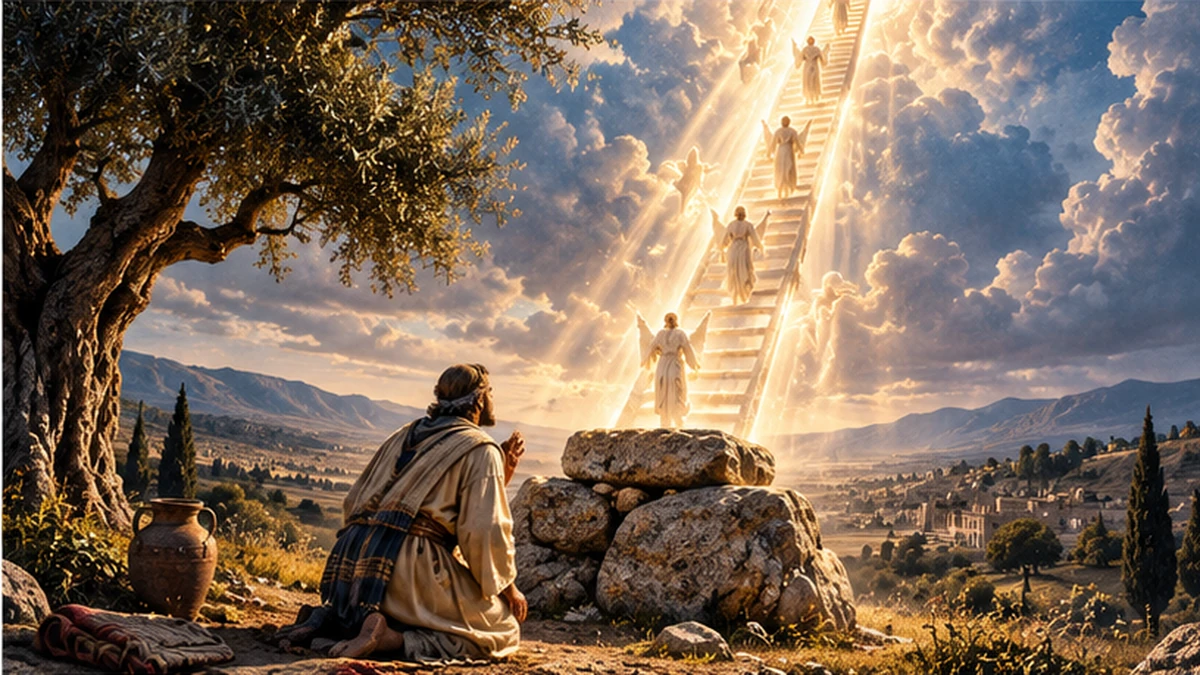
Genesis narrates that Jacob, travelling out of Canaan, slept at a place he later named Bethel — “House of God.” The stone he had used beside his head was set upright the next morning as a maṣṣēbāh, anointed with oil, and linked in Jacob’s vow with the house of God. That brief scene later became a meeting point of biblical theology, the archaeology of sacred stones, and a very long history of later legends.
Three levels, however, must be kept separate. The Genesis text describes a ritual stone and a holy place; the history of Bethel points to an important northern Israelite cult centre; later traditions attempted to locate, move, or identify Jacob’s stone with other famous stones. When those levels are collapsed, literary memory can quietly turn into an assumed archaeological biography of a physical object.
This article therefore does not begin by asking whether the stone was “only a symbol” or “certainly a historical artefact.” It first examines what maṣṣēbāh actually means, what can be known about Bethel as a sanctuary, how later biblical and Jewish texts evaluated the site, and why the geology of today’s Stone of Scone cannot support its identification as a stone transported from biblical Palestine.
What Does Genesis Actually Do with the Stone?
In Gen 28:10–22 Jacob does not arrive at a constructed temple. He sleeps at “the place,” experiences a dream-theophany, and wakes declaring the location to be the “house of God” and the “gate of heaven.” He then takes the stone used during the night, sets it upright as a maṣṣēbāh, pours oil on it, names the place Bethel, and vows that this stone will be a “house of God.”
The story therefore describes more than an unritualized memorial stone. Erecting it and anointing it are cultic actions, yet the text does not say that the stone itself is a god or that Jacob has fashioned an image of a deity. The safest formulation is that the stone marks and ritually establishes the sacred character of the place that Jacob associates with divine presence.
Genesis 35 returns to the motif. Jacob builds an altar at Bethel after his return, and a later section again says that he erected a stone pillar where God spoke with him and poured a drink offering and oil upon it. The repetition shows that the link between Jacob, a standing stone, and Bethel is not a marginal detail but one of the central cultic motifs in the Jacob cycle.
Maṣṣēbāh: What Was a Sacred Standing Stone?
The Hebrew word maṣṣēbāh denotes an upright stone or pillar, but such stones do not have a single function in biblical texts. They can mark a remembered event, covenant, or boundary, while in other contexts they are cultic objects. Archaeology in the Levant, especially in desert regions such as the Negev, has documented hundreds of standing stones, frequently in shrines or other ritual installations, with practices extending far earlier than the Iron Age.
This comparative material matters because it shows that Jacob’s action is culturally intelligible rather than unique. In the ancient Near East, an unworked or lightly worked stone could represent divine presence, function as a cult marker, or serve as a memorial object. Yet the archaeological category “standing stone” by itself does not tell us which deity, ritual, or narrative a particular stone represented.
Later biblical law is not uniformly positive toward the maṣṣēbāh. Deuteronomy 16:22 prohibits erecting such a pillar, creating an instructive tension with Jacob’s positive act in Genesis. Historically, that difference is valuable because it shows that Israelite attitudes toward legitimate cult objects and sacred spaces changed over time.
Bethel: Place-Name, Theology, and a Possible Older Layer
The name Bethel literally means “House of El” or “House of God.” Genesis itself supplies an etiology: after the revelation Jacob renames a place whose former name is said to have been Luz. Historically, however, the story need not preserve the first actual naming of the site; it may be a literary explanation of an already known sacred name and its meaning within Israelite tradition.
Some scholars therefore read the toponym as a trace of an older West Semitic cultic environment associated with the god El. That is a plausible history-of-religions interpretation, not direct archaeological proof that a specific pre-Israelite temple of El has been identified at the site. The picture is further complicated because a deity named Bethel is attested in later Aramaic sources, so the same sequence of sounds in different periods does not automatically denote the same cult.
The phrase “gate of heaven” is also important. Jacob’s vision links an earthly location with access to the heavenly realm, so Bethel’s significance in the story is not primarily architectural but concerns a point of encounter between realms. This helps explain why an upright stone can carry such weight in the narrative even before a monumental temple is described.
Was Bethel a Temple? The Archaeology Is Less Simple
Ancient Bethel has long been widely identified with modern Beitin, north of Jerusalem. Twentieth-century excavations in the Albright–Kelso tradition revealed a long settlement history but did not uncover the monumental Iron Age temple many expected from the site’s biblical importance. The absence of such a building became an archaeological problem in its own right.
Recent work asks whether the expectation itself may be wrong: a sanctuary need not have stood inside the urban core or have been monumental. Aharon Tavger has proposed looking for Bethel’s cult area at Elevation Point 914, roughly 900 metres east of Beitin, where topography and Iron Age remains fit an open sanctuary outside the settlement. The proposal is argued in detail but remains a research hypothesis, not a universally established identification of “Jacob’s temple.”
This is strikingly compatible with Genesis, which first speaks of a “place,” stone, oil, and altar rather than a built temple structure. At the same time, the sanctuary’s later history cannot simply be projected backward into the patriarchal period: archaeology can establish patterns of site use in particular periods, not verify a single episode in Jacob’s biography.

From Jacob’s Place to a Royal Sanctuary
In biblical memory Bethel becomes an increasingly important cult centre. First Samuel refers to people going “to God at Bethel,” while 1 Kings 12 attributes to Jeroboam I the installation of calf images at Bethel and Dan together with a festival and priesthood designed to redirect northern worship away from Jerusalem. The account is written from a Judahite, Jerusalem-oriented perspective and presents Jeroboam’s action as a foundational sin of the northern kingdom.
Historically, Jeroboam need not have created the sanctuary from nothing. Some scholars read 1 Kings 12 as a renovation or royal appropriation of a much older cult site, which would help explain why Bethel carries so much earlier sacred memory. Nadav Na’aman has even proposed that Bethel was the central sanctuary of “YHWH of Samaria” in the northern kingdom.
The strongest evidence for its political-cultic importance comes from the Amos tradition: in Amos 7 the priest Amaziah calls Bethel the “king’s sanctuary” and a “temple of the kingdom.” That phrase does not verify every detail of 1 Kings 12, but it strongly supports Bethel’s exceptional institutional importance in the eighth century BCE.
When the Same Holy Place Becomes a Problem: Hosea, Amos, and Josiah
The prophets do not deny that Bethel is religiously important; its importance makes the polemic sharper. Amos attacks pilgrimage and cult at Bethel, while Hosea uses the derisive wordplay Beth-aven — “house of wickedness/nothingness” — and criticizes the calf cult. The same place presented in the Jacob tradition as a gate of heaven becomes, from another theological perspective, a symbol of illegitimate worship.
Second Kings then narrates King Josiah destroying Bethel’s altar and high place and burning cultic remains. That account belongs to a Deuteronomistic theology of centralization in Jerusalem, and historians debate the reform’s extent and precise historical setting. Even so, the textual trajectory from Genesis to Kings clearly records a shift in the evaluation of sacred space.
This matters for Jacob’s stone: the later prohibition of maṣṣēbôt and criticism of Bethel do not erase the older tradition but preserve it precisely by arguing with it. At this point the Bible does not offer one frozen religious picture; it preserves traces of change in which legitimate cult, royal power, and the location of divine presence are repeatedly redefined.
What Do We Have — and What Do We Not Have?
Once the different kinds of evidence are arranged by date and evidential strength, the question becomes much clearer. The strongest evidence does not describe an uninterrupted biography of one stone; it points instead to a long memory of a holy place and cult stones that was reshaped across centuries.
Two distinctions therefore matter. Archaeological confirmation of standing-stone practices does not prove Jacob’s individual act, and historical confirmation of a Bethel sanctuary does not show that the later sanctuary preserved the very same physical stone described in Genesis.
| Layer | What it can support | What it does not prove |
|---|---|---|
| Genesis 28 and 35 | Jacob tradition links Bethel with a stone pillar, oil, altar, and divine presence | an independent patriarchal-era record or a surviving artefact |
| Comparative maṣṣēbāh archaeology | cultic standing stones were a real and ancient Levantine practice | that any particular excavated stone belonged to Jacob |
| Iron Age Bethel | the site was an important northern sanctuary; Amos knows it as a royal sanctuary | the precise architecture or identity of Jacob’s pillar |
| Prophetic/Deuteronomistic criticism | Bethel and maṣṣēbôt became objects of internal religious polemic | that the older tradition was therefore invented or historically verified |
| Book of Jubilees | later Jewish reception limits Bethel’s permanent sanctity and subordinates it to another cult centre | what happened in the patriarchal period |
| Stone of Scone | a medieval and modern legend links the coronation stone with Jacob | a physical connection to Palestine; geology places the present stone near Scone |
Jubilees: An Ancient Reinterpretation of Bethel
Later Jewish literature shows that the Bethel question did not end with biblical redaction. The Book of Jubilees, composed in the second century BCE, retells Jacob’s story but more explicitly turns the stone into a sign while limiting the possibility that Bethel could become an eternal sanctuary. In a key episode an angel prevents Jacob from constructing a permanent sanctuary there.
John Will Rice reads this reworking as a significant theological shift: the author preserves Jacob’s holy place while reducing the direct cultic weight of the stone and subordinating Bethel to another conception of legitimate sacred geography. It is a useful example of how reception does not erase an older story but adapts it to a later sacred map.
It is therefore misleading to speak of “Jewish tradition” as one unchanged interpretation of Jacob’s stone. Already in antiquity Jewish texts display different strategies, from preserving Bethel as a place of revelation to limiting its permanent cultic status.
Betyl, Bethel, and Other Sacred Stones: Similarity Is Not Object-Migration
Historians of religion often use the term betyl/baetyl for aniconic sacred stones. The word has traditionally been linked with Greek baitylos and Semitic bēt-ʾēl, though current scholarship cautions that the etymological relationship is less straightforward than older accounts suggested. In any case, the term describes a type of religious object, not evidence that one individual stone travelled through multiple cultures.
Nabataean Petra, for example, preserves many betyls representing the presence of different deities. Elsewhere we find omphaloi, meteorite stones, stelae, and unworked cult stones, but similarities of form and function must be distinguished from common provenance. Two sacred stones are not the same object merely because both are sacred and made of stone.
That methodological boundary matters whenever Jacob’s stone is compared in popular literature with other famous stones of the Near East or Europe. Comparison may reveal a recurring religious language in which stone carries presence, memory, or authority, but without a historical chain it cannot establish object identity.
The Stone of Scone: Medieval Legend and Geological Boundary
The most famous later identification is the Scottish Stone of Scone, or Stone of Destiny, used in the inauguration of Scottish and later British monarchs. The claim that it is Jacob’s pillow from Bethel is not an original biblical or ancient Israelite tradition. Modern research on the stone’s historiography shows that Scottish origin legends developed in the Middle Ages, while an English identification with Jacob’s pillow appears around the fourteenth century and later accumulated richer versions.
In the nineteenth century the story gained new life in British Israelism, where it became part of a larger claim that the British people or monarchy were connected with the Lost Tribes of Israel or the Davidic dynasty. In some versions the prophet Jeremiah carried the stone away after Jerusalem’s fall and it eventually reached Scotland through Ireland. The movement therefore did not invent the earliest Scone–Jacob connection; it systematized an older medieval legend within its own identity genealogy.
With the Stone of Scone we can test something that is impossible for many old legends: the material of the object itself. The British Geological Survey and Historic Environment Scotland have used petrographic and newer non-invasive analyses to identify the stone as sandstone of the Scone Sandstone Formation, matching outcrops in the immediate region of Scone in Perthshire. The present stone therefore cannot be historically supported as an object formed in Palestine and physically transported through Egypt, Spain, or Ireland to Scotland.
Geology does not settle every debate about hypothetical medieval substitutions or replicas, but HES treats the present stone as the object Edward I removed from Scone in 1296. Anyone proposing a hypothetical lost “real” stone would need a separate evidential chain for it. Symbolic genealogy and geological genealogy are not the same thing: the legend matters historically as a history of meaning, not as material proof of a journey from Bethel to Scotland.
What, in the End, Remains of Jacob’s Stone?
The strongest picture is layered. Genesis preserves an old tradition in which Jacob erects and anoints a stone pillar at a holy place; comparative archaeology shows that such religious use of standing stones is culturally plausible; and Iron Age sources indicate that Bethel did become one of northern Israel’s major sanctuaries. Yet those three observations cannot simply be connected into the biography of one stone identifiable today.
Bethel then became a site of internal religious dispute: the place sanctified in patriarchal tradition is criticized or subordinated to Jerusalem by prophetic and Deuteronomistic traditions, and Jubilees reinterprets it again. The history of Jacob’s stone is therefore above all a history of meaning — of how stone can mark divine presence, sanctuary foundation, conflict over legitimate worship, and later even royal identity.
The material boundary remains simple: we do not possess an archaeologically identified stone of Jacob. That does not make the narrative insignificant; it helps explain why the story became so fertile. Once an object leaves verifiable material history, its symbolic biography can travel much farther — but when does such a biography still preserve memory of an old cult place, and when does it mainly begin to tell us about the needs of later communities?
Sources and further reading
- Bible Gateway — Genesis 28:10–22 (NRSVUE) — primary text for Jacob’s dream, the standing stone, oil, the naming of Bethel, and the vow that the stone will be God’s house.
- Bible Gateway — Genesis 31:13 and 35:1–15 (NRSVUE) — later Jacob-cycle references to Bethel, the anointed pillar, altar, drink offering, and oil.
- Bible Gateway — Deuteronomy 16:21–22 (NRSVUE) — later legal prohibition of a sacred pillar (maṣṣēbāh), important for changing evaluations of cult stones.
- Bible Gateway — 1 Kings 12:25–33 (NRSVUE) — primary biblical account of Jeroboam’s cult installations at Bethel and Dan.
- Bible Gateway — Amos 4:4; 5:5; 7:10–17 (NRSVUE) — prophetic criticism of Bethel and the description of it as the king’s sanctuary and a temple of the kingdom.
- Bible Gateway — Hosea 4:15; 10:5–8; 12:4–5 (NRSVUE) — Bethel/Beth-aven polemic, calf tradition, and Jacob-at-Bethel memory.
- Bible Gateway — 2 Kings 23:15–20 (NRSVUE) — Deuteronomistic account of Josiah’s destruction of the Bethel altar and high place.
- James L. Kelso, The Excavations at Bethel (1934–1960), Annual of the American Schools of Oriental Research 39 (1968) — foundational excavation report for Beitin/Bethel.
- Israel Finkelstein and Lily Singer-Avitz, “Reevaluating Bethel,” Zeitschrift des Deutschen Palästina-Vereins 125 (2009), 33–48 — reassessment of Bethel’s settlement history and archaeological profile.
- Oded Lipschits, “Bethel Revisited,” in Rethinking Israel (Eisenbrauns/Penn State University Press, 2017), 233–246 — historical and archaeological reassessment of Bethel.
- Aharon Tavger, “And He Called the Name of that Place Bethel” (Gen 28:19): Historical Geography and Archaeology of the Sanctuary of Bethel, in The History of the Jacob Cycle (Mohr Siebeck, 2021) — proposes an open-air sanctuary at Elevation Point 914 east of Beitin.
- Uri Golinets et al., “Three-dimensional documentation of masseboth sites in the ‘Uvda Valley area, southern Negev, Israel,” Digital Applications in Archaeology and Cultural Heritage 3.1 (2016), 9–21 — archaeological documentation of standing-stone cult sites and the wider masseboth phenomenon.
- Thomas Römer, “Biblical Aniconism? Representing the Gods of Ancient Israel and Judah,” in When Children Draw Gods (Springer, 2023) — discusses the multiple functions of maṣṣēbôt, the Genesis 28 Bethel pillar, and the limits of treating standing stones as straightforward evidence for aniconism.
- Nadav Na’aman, “In Search of the Temples of YHWH of Samaria and YHWH of Teman,” Journal of Ancient Near Eastern Religions 17.1 (2017), 76–95 — argues for Bethel as the main sanctuary of YHWH of Samaria in the northern kingdom.
- John Will Rice, “The Place and the Stone: Reassessing the Priestly Writing’s Relationship to Bethel,” Journal for the Study of the Old Testament (2024) — examines Bethel’s place/stone traditions and the reception of Genesis in Jubilees.
- Itzhak Amar, “Priestly and Post-Priestly Voices on Bethel: A Diachronic Analysis of Genesis 28:10–22 and 35:9–15,” Religions 17.2 (2026), 274 — recent diachronic study of the compositional and cultic tensions in the Bethel narratives.
- Robert Wenning, “The Betyls of Petra,” Bulletin of the American Schools of Oriental Research 324 (2001), 79–95 — study of Nabataean betyls as aniconic representations of divine presence and a caution against collapsing diverse sacred stones into one tradition.
- Historic Environment Scotland, “Research shines new light on the Stone of Destiny” (2023) and subsequent scientific report — confirms the present stone’s geology as matching the Scone Sandstone Formation in the Scone area.
- Warwick Rodwell, The Coronation Chair and Stone of Scone: History, Archaeology and Conservation (Oxbow Books, 2013) — major archaeological and historical study of the coronation stone, its medieval history, and attached mythology.
- Sally Foster, “Life in Pieces: Lessons in the Value of Fragments from the Secret Lives of the Stone of Scone/Destiny,” The Antiquaries Journal (2025) — chronology of the Stone’s medieval origin legends, including the emergence of the Jacob’s Pillow claim around the fourteenth century.