Painted Beehive Panels: Folk Art, Satire, and a World of Images
From a Madonna dated 1758 to the devil sharpening a tongue: how did the front boards of Carniolan hives become a visual archive of belief, humour, politics, and everyday life?
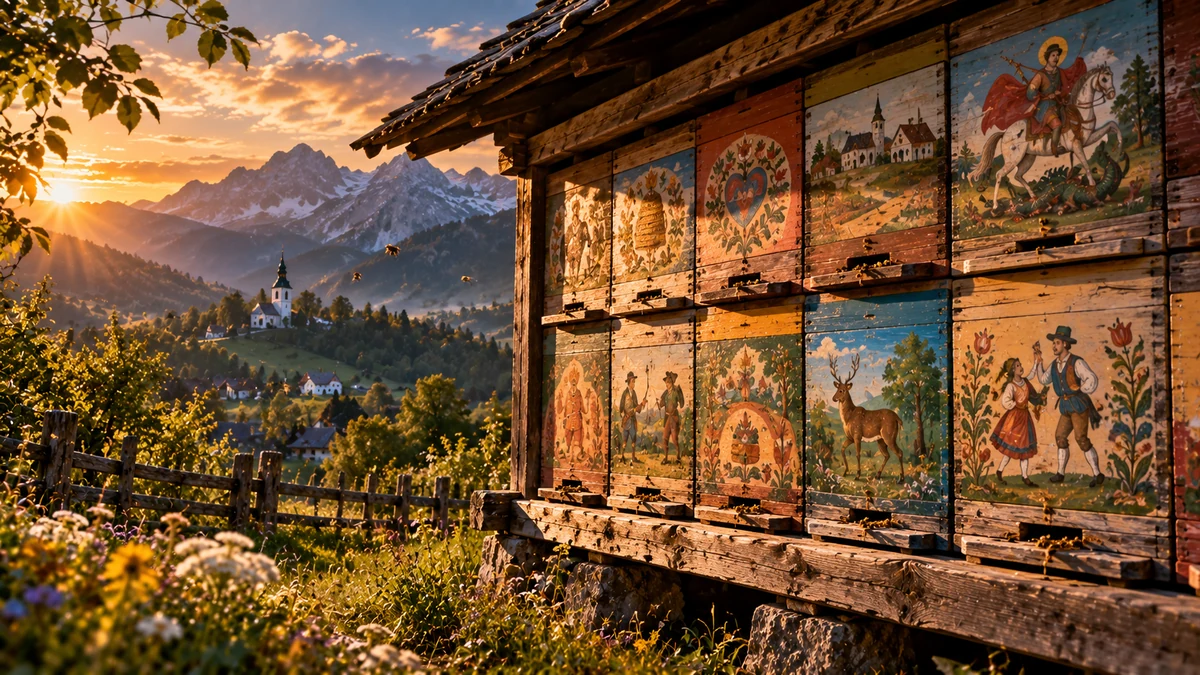
There was room for only a narrow image on the front of an old wooden hive, yet within those few dozen centimetres an entire world could open. Saints stood beside tavern scenes, Napoleon beside devils, hunters beside foxes, and biblical stories beside village jokes. Painted beehive panels are therefore one of the most unusual visual archives of Slovene rural culture. [1][2][5]
But they should not be read as a direct window into an unchanging “folk soul.” Motifs were made in workshops, circulated through models, came from church prints, books, newspapers, and European satire, and were adapted to the wishes of beekeepers. This mixture of local and imported, sacred and comic, useful and artistic is precisely what makes them so valuable. [5][7]
A Small Board That Opens onto an Entire World
A painted beehive panel was first of all a very concrete part of a hive: the elongated front board, with an entrance opening, on the wooden box hive known as the kranjič. Yet across part of Slovene territory between the eighteenth and early twentieth centuries, this small surface became an unusually rich visual medium. Mary and the saints appear beside soldiers and hunters, tavern quarrels, devils, exotic scenes, historical events, animals acting like people, and scenes of everyday work. [1][2][5]
This is why painted beehive panels matter as more than apiary decoration. They are simultaneously objects of beekeeping practice, folk visual art, and a visual archive of the world as makers and owners knew it, transformed it, or laughed at it. Their imagery is not a photographic record of rural life, but a mixture of belief, humour, printed graphics, local experience, and workshop imagination. [2][7]
Why Paint the Front of a Hive at All?
Kranjiči were low wooden hives stacked in rows inside an apiary. A painted front panel therefore made individual boxes easier to distinguish, which mattered for ownership and when bee colonies were transported to seasonal forage. The Slovene Ethnographic Museum explicitly identifies the relationship between migratory beekeeping, distinguishing hives, and the development of painted panels as an important part of the tradition’s emergence. [1][4]
Practical use alone, however, cannot explain the richness of the imagery. If identification had been the only purpose, numbers, colour patches, or simple marks would have been enough. The panel became a place where an owner could choose a patron saint, story, joke, or scene, and a painter could translate it into a small rectangular stage. The combination of utilitarian object and narrative image is what makes the genre distinctive. [2][5]
1758: The Oldest Known Dated Panel
The Museum of Apiculture in Radovljica preserves the oldest currently known dated painted beehive panel. It shows a pilgrimage Madonna with the Child, while the numbers 17 and 58 form the year 1758. The work measures about 34 by 16.5 centimetres and belongs to a post-Baroque painting tradition. [3][9]
The date matters, but it should not be mistaken for an absolute “birth date” of the tradition. It marks the oldest currently known dated object, not proof that no painted hives existed before 1758. Museum surveys place the emergence of the genre around the middle or second half of the eighteenth century, with its great flourishing roughly between 1820 and 1880. Classical use declined rapidly in the early twentieth century. [1][2][4]
Where Were They Painted?
The classical area of painted beehive panels did not cover all of present-day Slovenia. They are most strongly documented in southern Carinthia, north-western Styria, central and northern Carniola, and part of the Gorizia region. Their geographically limited distribution is one reason museums treat them as a particularly characteristic form of Slovene folk painting. [1][5]
At the same time, the images did not remain sealed inside those valleys. The lively trade in bees and hives carried kranjiči into other European lands, and the painted boards travelled with them. This is a useful reminder that cultural distinctiveness is not the same as cultural isolation: an object can be strongly local while also participating in wider commercial, craft, and visual networks. [1]

Saints, Mary, and Biblical Stories
The oldest surviving layer of panels is strongly religious. Mary, Christ, saints, and scenes from the Old and New Testaments gave the apiary a protective and narrative face. Pilgrimage images, church prints, and other graphic models supplied compositions that painters simplified and adapted to the narrow format of a wooden board. [2][5]
This did not amount to mechanical copying. The same subject appears across many panels in different compositions, colours, and degrees of skill. We can therefore watch large-scale church iconography change when it enters a rural workshop: it becomes more direct, typified, and adapted to a surface that had to remain legible from some distance. [2][3]
The Secular World: Taverns, War, Hunting, and Distant Lands
Secular imagery is what makes the panels especially unusual. The Škofja Loka Museum records more than 600 different motifs; alongside religious subjects we encounter village life, hunting, military scenes, history, occupations, legends, and comic animal reversals. In the Selca workshop, customers could choose among at least 141 motifs, almost evenly divided between religious and secular subjects. [5]
One panel could show the 1821 Congress of the Holy Alliance in Ljubljana, another beekeeping itself, and another an initiation among the North American Mandan that entered local painting through a book by the Slovene missionary Frederic Baraga. The lesson is surprising: the apiary was not merely a local mirror. Through books, prints, newspapers, and stories, images of European politics and distant worlds entered it as well. [5][6]
Satire: Laughter, Criticism, and Prejudice
Painted beehive panels form one of the richest collections of early Slovene visual satire. A fox may shave a hunter, animals may judge a human, wives may drag husbands away from cards, and the devil may “sharpen an old woman’s tongue.” Such images worked as visual jokes and moral tales and were often adapted from popular prints circulating more broadly in Europe. [7][8][10]
But humour is not neutral evidence. Some motifs reproduce distinctly misogynistic, occupational, or status-based stereotypes of their period. The museum description of “The Devil Sharpens an Old Woman’s Tongue” explicitly identifies the underlying idea as misogynistic. A double reading is therefore valuable today: a panel shows what people laughed at, but also exposes prejudices and power relations that humour helped normalize. [7][8]
From Anonymous Painter to Workshop Production
The common idea that each panel was spontaneously painted by an unknown farmer for his own hive is too simple. Many works are anonymous, but organized workshops and named makers are also known. In Selca, Andrej Pavlič and his daughter Marija, known as Micka, ran a workshop active roughly between 1840 and 1891; it used stencils and produced motifs serially. [5][6]
Another important circle was the Šubic family in the Poljane Valley, while panels were also produced within the painting tradition associated with Leopold Layer in Kranj. The boundary between “folk,” artisanal, and professional art is therefore much more porous than the phrase naïve painting suggests. The panels formed a market of images in which self-taught painters, village craftsmen, workshops, and academically trained artists could all participate. [2][6] Serial production therefore did not make the panels culturally insignificant; on the contrary, it allowed recognizable motifs to circulate among many beekeepers and become part of a shared visual repertoire.

The Image Did Not Originate in an Isolated Village
Painters drew subjects from devotional cards, prints, book and newspaper illustrations, already painted panels, and their own invention. Satirical subjects can often be traced to European popular prints, while some exotic themes can be connected with Slovene books and reports. Similarity between two panels therefore does not necessarily mean that one painter copied the other; both may have used the same or a related printed model. [5][7]
This is one of the most revealing aspects of the genre. An apparently very local object exposes a premodern media network: a printed image travels from an urban centre to the countryside, is simplified in a workshop, adapted to a narrow wooden surface, and then becomes part of the everyday landscape on an apiary. A beehive panel can thus be local and transnational at the same time. [2][7]
From the End of Classical Use to a Heritage Symbol
As economic, social, and beekeeping conditions changed, classical panel painting lost its former function in the early twentieth century. The panels did not disappear, however. Museum collections, beekeeping culture, reproductions of old motifs, and souvenir use gradually turned them into one of the most recognizable symbols of Slovene heritage. [1][2]
Painting beehive panels was entered in Slovenia’s Register of Intangible Cultural Heritage in 2018, and in 2022 UNESCO inscribed the broader element “Beekeeping in Slovenia, a way of life” on the Representative List; painted panels are explicitly named there as part of the artistic heritage of beekeeping. This does not mean that every modern panel directly continues the same nineteenth-century market. It does mean that techniques, motifs, and knowledge are now consciously transmitted as heritage. [11][12][13]
Sources and further reading
- Museum overview for origin, geographical distribution, the 1820–1880 flourishing, early-twentieth-century decline, and export of painted hives. Source
- Foundational museum monograph and SEM catalogue used for the historical, thematic, and social framework of the genre. Source
- Source for the oldest known dated panel, bearing 1758, its subject, dimensions, and post-Baroque context. Source
- Museum summary of the practical function of distinguishing hives and ownership, chronology, and the scope of the SEM collection. Source
- Source for more than 600 motifs, the Selca workshop, Andrej and Marija Pavlič, stencils, serial production, and concrete religious, secular, and exotic themes. Source
- Source for the Šubic painters, distribution of panels from the Poljane Valley, and the Selca workshop’s activity from 1840 to 1891. Source
- Scholarly source for satirical motifs, their European graphic models, and their social and historical context. Source
- Museum description explicitly identifying the motif’s misogynistic content and probable graphic source. Source
- Public-domain documentary visual of the oldest known dated panel. Source
- Public-domain documentary visual of a satirical 1878 panel. Source
- Official register entry for the contemporary heritage practice, technique, and the 2018 inscription of beehive-panel painting. Source
- Official UNESCO source; painted beehive panels are named as part of the artistic heritage of the broader Slovenian beekeeping element. Source
- Official source explaining that beehive-panel painting is one of the heritage units combined within the broader UNESCO nomination for Slovenian beekeeping. Source