The Oracle of Delphi: Prophecy, Geology, and Altered States of Consciousness
The Pythia, Apollo, mysterious pneuma, and faults beneath the temple: what ancient sources and modern geology really tell us about Delphi and the disputed ethylene hypothesis.
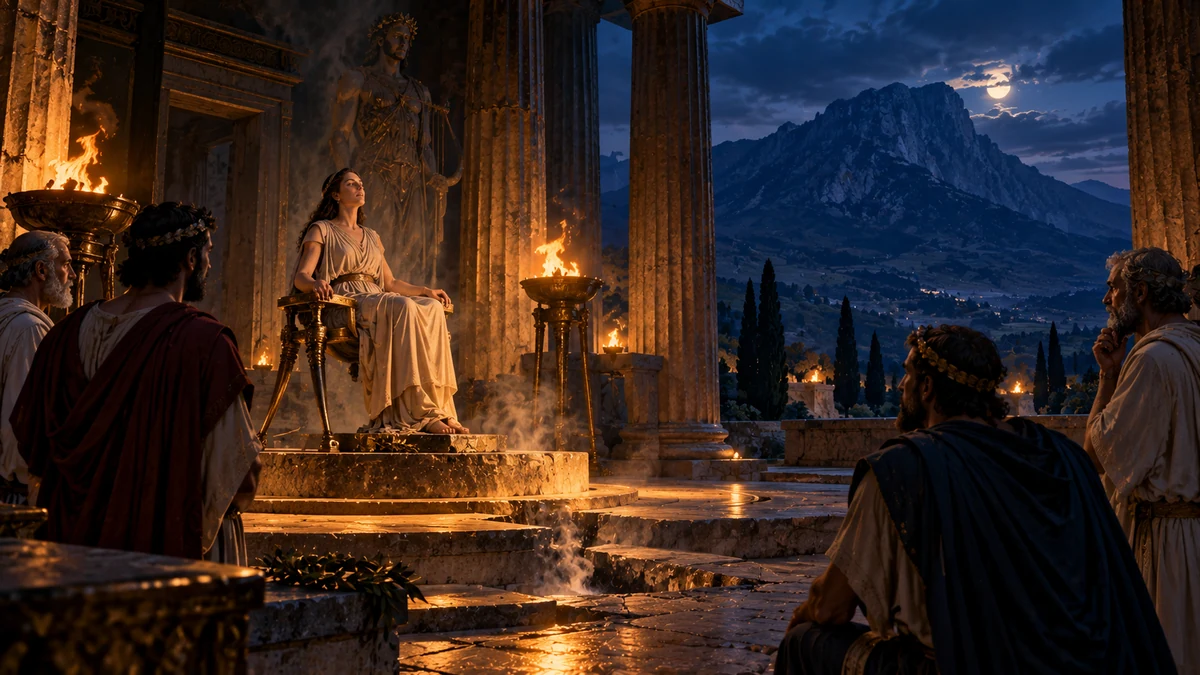
The Delphic oracle was one of the most influential religious and political centres of the ancient Greek world. Cities, rulers, and private individuals came to Delphi to seek an answer from Apollo, delivered through the Pythia, the priestess of the temple. Yet the familiar modern scene — a woman in hallucinatory frenzy above a crack emitting narcotic gas while male priests convert incoherent sounds into ambiguous prophecies — combines several different layers of interpretation that are not equally supported by the evidence. [1][3][4][6]
Today we can say with considerable confidence that Delphi stands in an actively faulted geological setting and that pathways existed for groundwater and gases to move upward. It is much less certain, however, whether a particular concentration of ethylene caused the Pythia's prophetic states. Modern geology has restored plausibility to some ancient reports of natural emissions, but the specific ethylene-intoxication model remains disputed. [8][10][11][12][13]
Delphi: the place where Apollo spoke
The sanctuary of Delphi lies on the slope of Mount Parnassus above the Pleistos valley, beneath the steep Phaedriades cliffs. Archaeology attests occupation in the Mycenaean period, while the development of Apollo's sanctuary and oracle becomes clear from the eighth century BCE onward. By the sixth century BCE Delphi had become a Panhellenic centre receiving delegations from many Greek cities and rulers beyond the Greek world. [1][2]
The oracle was not merely a private religious service. Delphic responses were associated with colonization, lawgiving, warfare, dynastic questions, and civic crises. Its influence therefore did not arise only from belief in divine prophecy; Delphi also functioned as an information and diplomatic hub. Over generations the sanctuary received visitors from many political environments and could accumulate knowledge unavailable to any one consultant. [1][2][3]
How a consultation worked
The precise procedure changed over time, but ancient testimony and later reconstruction point to a highly regulated ritual process. A consultant did not simply walk into the temple and ask a question. Purification, offerings, and a test of whether the day was suitable for consultation preceded the oracle. The official Delphi site summarizes the tradition that consultation was initially tied to one annual day and later to the seventh day of individual months, except during the winter season. [2][13]
The Pythia was associated with the adyton — the innermost restricted part of Apollo's temple — and with the sacred tripod. The image of a seated female seer on a tripod facing a consultant is not merely modern invention: a fifth-century BCE Attic red-figure kylix depicts a consultation at Delphi with precisely this iconography. But a visual source cannot tell us what the Pythia experienced physiologically or what substance, if any, caused her state. [7]
The Pythia did not necessarily speak in incoherent delirium
One of the most persistent modern images is that the Pythia produced chaotic sounds that male priests then translated into an orderly oracle. Lisa Maurizio has shown that this model is poorly supported by ancient evidence: ancient sources normally present the Pythia herself as the speaker of the oracular response. This does not mean there were no other officials at the sanctuary or that responses were never recorded and transmitted; it means that the picture of meaningless babbling followed by priestly “translation” should not be treated as established history. [6]
The word “trance” can also mislead if it is understood only as loss of control. Across religious cultures, possession or inspiration may involve altered consciousness while retaining intelligible speech. Maurizio therefore argues against reducing the Pythia's role to pathology: within Delphic religion her speech was understood as Apollo speaking through a human medium. [6]

Ambiguous prophecies and the problem of later storytelling
Delphic responses became famous for ambiguity. The best-known example is the Lydian king Croesus, who according to Herodotus asked whether he should attack Persia and received an answer that by crossing the river he would destroy a great empire. Croesus took this as a promise of Persian defeat; the empire destroyed was his own. Herodotus' story is central to the cultural image of Delphi, but it should not be treated as a stenographic record of a consultation. [3][7]
Maurizio has emphasized that many Delphic oracle stories circulated orally for generations before being written down and are narratively shaped so that the oracle is fulfilled. Such stories are therefore excellent evidence for how Greek communities understood the authority of Delphi, but less secure evidence for the verbatim wording of a specific historical response. [7]
What ancient sources say about the pneuma
The most important ancient witness for natural emissions is Plutarch, who was not merely an outside observer but served as a priest at Delphi. In his discussions of the oracle he speaks of a pneuma, an inspiring exhalation, and reflects on relationships among earth, water, scent, and prophetic capacity. In one account he also describes a failed consultation in which the Pythia was forced to proceed against her inclination and entered a dangerous, abnormal condition. [4][5]
Yet Plutarch was writing in the Roman period, centuries after Delphi's classical peak, and his works are philosophical dialogues rather than laboratory reports. The Greek word pneuma can mean breath, wind, vapor, or a subtle vital principle. Plutarch's language therefore does not directly identify a chemical compound, a concentration, or a substance that must have caused every prophetic state. [4][5][12]
Geology: the faults beneath Delphi are real
Early twentieth-century excavations were often treated as a blow to the story of earth-born vapors because archaeologists did not find a large open chasm beneath the temple. For much of the twentieth century this encouraged the view that the fissure was simply myth. Later geological work produced a more complicated picture. [8]
De Boer, Hale, and Chanton reported in 2001 that young fault structures occur at the sanctuary and proposed that Apollo's temple lies near intersecting faults capable of channeling groundwater and light hydrocarbons upward through bituminous limestone. A later geochemical study by Etiope and colleagues in 2006 confirmed that the wider area does release thermogenic gases, including methane, ethane, and carbon dioxide. A geological pathway for gas release is therefore plausible; a huge open cavern is not required. [8][10]
Why ethylene became such an attractive explanation
After the geological work, Henry Spiller, John Hale, and Jelle de Boer linked the Delphic emissions especially to ethylene. Ethylene was used as an inhalational anesthetic in the twentieth century; at lower concentrations it can produce dizziness, euphoria, and altered perception. The researchers argued that these effects resembled some ancient descriptions of the Pythia and that gas might have accumulated in the confined space of the adyton. [8][9]
The hypothesis became exceptionally attractive in popular accounts because it offered an almost cinematic explanation: a real fault, a real gas, and known pharmacology seemed to explain ancient prophecy in one stroke. But this is precisely where we must distinguish a possible mechanism from a demonstrated historical cause. Modern gas measurements, residues in travertine, and the pharmacology of ethylene do not amount to a direct measurement of air in the ancient adyton during an oracular session. [9][12]

Why the ethylene hypothesis remains disputed
Foster and Lehoux mounted a detailed critique in 2007. They argued that the chain connecting ancient texts, the Pythia's reported behavior, and a specific concentration of ethylene contains several unsupported steps. The crucial point is not necessarily that gases were never present at Delphi, but that their geological possibility does not establish that the Pythia was routinely exposed to ethylene at exactly the concentration required to produce the proposed state. [12]
A 2008 geochemical reassessment by Etiope and colleagues complicated the picture further. The authors found no present-day surface hydrocarbon anomaly supporting a continuously active emission beneath the temple and proposed a more episodic model in which earthquakes and fault rupture could at times release gases from deeper systems. That leaves room for a geological background to the Delphic tradition, but it does not confirm a simple, permanently operating ethylene “vent” beneath the Pythia's tripod. [11]
Altered consciousness: what can we actually claim?
The safest conclusion is that Delphic prophecy took place in a highly ritualized altered state understood by participants as divine inspiration or possession by Apollo. Expectation, the authority of the sanctuary, preparation, repetitive ritual, the sensory environment, social role, and perhaps natural emissions could all have contributed. But the surviving evidence does not allow us to calculate a chemical dose or establish pharmacological intoxication as a necessary condition of the oracle. [4][5][6][11][12]
Nor should altered consciousness automatically be equated with an inability to speak intelligibly. Anthropological comparison and the ancient evidence allow a state in which the Pythia was religiously “possessed” while still producing responses. This blocks two opposite simplifications: a romantic story of pure supernatural prophecy and an equally reductive story in which the entire Delphic system was merely the side effect of a narcotic gas. [6]
So what is the mystery of Delphi?
Delphi is a strong example of how myth, ritual, geology, and politics can coexist without collapsing into a single explanation. The faults beneath the sanctuary are real. Natural gas emissions are geologically plausible. The Pythia and her oracular office are historically well documented. The specific claim that ethylene caused her prophecies is not established. [1][6][8][10][11][12]
That layered answer may be exactly why Delphi remains compelling. The natural setting may have contributed to the making of sacred space, while ritual could incorporate bodily and psychological phenomena into religious meaning. But geology does not thereby “explain away” Apollo, nor can an ancient religious experience be reduced to one molecule. The strongest reconstruction remains plural: Delphi was at once a sanctuary, an institution, a theatre of authority, an information hub, and a place where an unusual landscape may genuinely have shaped the experience of prophecy. [1][2][6][11]
Sources and further reading
- Institutional overview of Delphi as a Panhellenic sanctuary, the development of the oracle, and its World Heritage significance. Source
- Official archaeological context for the development of Apollo’s sanctuary, tripods, colonization, and Delphi’s political role. Source
- Primary literary source for Croesus’s consultation and the cultural model of the ambiguous Delphic response. Source
- Primary source by Plutarch, a Delphic priest, for the oracle’s operation, the Pythia’s voice, and inspiration. Source
- Primary source for pneuma, changing oracular activity, and the Pythia’s abnormal condition during a failed consultation. Source
- Key scholarly study challenging the incoherent-babbling model; ancient sources present the Pythia herself as the speaker of the response. Source
- Scholarly source on oral transmission of Delphic oracles and the limits of treating them as verbatim historical records. Source
- Foundational modern geological study on faults at the temple site and possible migration of light hydrocarbons. Source
- Primary modern source for the ethylene hypothesis and comparison with known pharmacological effects of ethylene. Source
- Independent geochemical reassessment confirming thermogenic gas release in the Delphi area. Source
- Geochemical and tectonic reassessment finding no present surface hydrocarbon anomaly and proposing episodic emissions linked to seismic activity. Source
- Key scholarly critique of the ethylene hypothesis, especially the links among texts, gas concentration, and the Pythia’s behavior. Source
- Official overview of reconstructed consultation procedure, adyton, tripod, sacrifice, and archaeological limits. Source