The Eleusinian Mysteries: What Happened Behind Closed Doors?
What we actually know about the Eleusinian Mysteries: Demeter and Persephone, the procession, Telesterion, kykeon, afterlife hope, and the disputed psychedelic hypothesis.
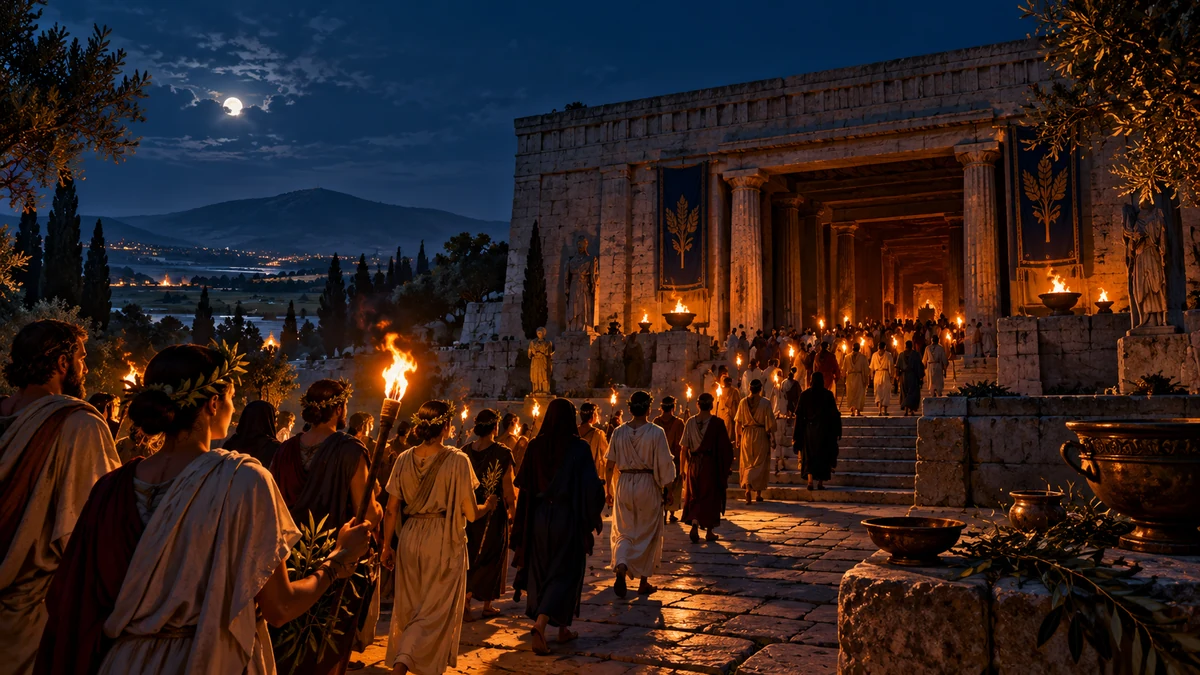
The Eleusinian Mysteries were among the most famous initiation rites of the ancient Greek world, yet their fame rests on a striking paradox: we know a good deal about the outer framework of the festival, but very little about the central events inside the Telesterion. Ancient texts, inscriptions, archaeology, and iconography allow us to reconstruct the journey from Athens to Eleusis, purification, fasting, procession, the ritual drink, and the expectation of a better fate after death; what initiates were actually shown or revealed at the climax of the rite remained protected. [1][2][3][6]
The subject therefore requires a strict distinction between documented framework, probable reconstruction, and modern hypothesis. This is especially true of the famous kykeon: the drink itself, and the Homeric Hymn's association of it with water, barley, and fragrant mint or pennyroyal, are well documented; whether it contained a psychoactive substance remains an open question. A new chemical study published in 2026 showed that some ergot alkaloids could be converted into psychoactive compounds using procedures available in antiquity, but chemical feasibility is not historical proof that this was actually done at Eleusis. [1][10][11][12][13]
What Were the Eleusinian Mysteries?
The Mysteries were an initiation cult of Demeter and her daughter Kore, or Persephone, centered at Eleusis west of Athens. Over the centuries the cult expanded beyond a local setting and drew participants from across the Greek world. Thomas Martin summarizes that, when ritual qualifications were met, men and women, adults and children, and even some slaves could be eligible for initiation; the key conditions concerned ritual pollution and participation in the Greek ritual environment. [6]
Archaeology shows that the sanctuary had a long developmental history reaching back into the Bronze Age, but the origins of the Mysteries themselves cannot simply be projected unchanged into the earliest settlement layers. Cosmopoulos stresses that the cult's development must be reconstructed gradually from architecture, finds, and later texts rather than assuming that the Classical form existed from the beginning. [2][3]
Demeter, Persephone, and the Story That Held the Rite Together
The most important literary framework is the Homeric Hymn to Demeter. Persephone is abducted by Hades; Demeter searches for her and, in grief, stops the fertility of the earth; Zeus eventually brokers an arrangement under which the daughter returns to her mother for part of the year. The story links loss, descent to the underworld, return, grain, and renewed vegetation. At the end of the hymn Demeter reveals her rites to the leaders of Eleusis, while the text stresses that they are not to be disclosed to outsiders. [1]
This matters because the Mysteries should not be reduced to a secret object or a secret drink. The entire initiatory experience was embedded in a myth of separation and return and in the relationship among death, fertility, and hope. The hymn describes the initiated person as specially blessed, while the uninitiated do not receive the same portion after death. [1][6]
From Athens to Eleusis
Much of the festival was public, or at least externally visible. Archaeological study of the procession documents an organized route between the Athenian Eleusinion and the sanctuary at Eleusis along the Sacred Way. The procession linked civic and sacred space, and in the Roman period it can still be traced through architecture, inscriptions, and topography. [4][8]
Purification, sacrifice, and fasting were important before the central initiation. Particularly well attested is the washing of the so-called mystic piglets in the sea, a rare example of the purification of sacrificial animals in Greek cult. This does not mean every day of the festival can be reconstructed in minute detail; it does show that the Mysteries were a multi-day process of preparation rather than one isolated secret moment. [7][8]
The Telesterion: Where Our Knowledge Runs Out
The procession ended in the sanctuary of Demeter and Kore, and the central action was associated with the Telesterion, the great initiation hall. Museum and archaeological presentations emphasize its special design and central function in the Mysteries; its interior was intended for a crowd of initiates and ritual action rather than ordinary temple worship. [3][4][5]
At precisely this point the evidence becomes surprisingly thin. Martin summarizes the traditional limit of our knowledge as something done, said, and shown, but we cannot reconstruct a minute-by-minute script with confidence. Later authors supply fragments, often from polemical or very late contexts; combining them without caution can create an apparently precise rite that no single ancient source actually describes. [6]
What the Ninnion Tablet Tells Us
Among the most important visual witnesses is the so-called Ninnion Tablet, a fourth-century BCE votive plaque found at Eleusis. It depicts Demeter, Persephone, a procession of initiates, torches, ritual staffs and vessels, and other elements of the Eleusinian iconographic world. The plaque confirms that the cult was visually rich and processional, but it does not reveal the secret climax of initiation. [4][9]
Such images are valuable precisely because they supplement the texts without pretending to say more than they show. They reveal which figures, objects, and gestures belonged to the cultic world; they do not allow us to derive a complete Telesterion script from a single scene.

Kykeon: What Is Actually Documented
The Homeric Hymn to Demeter contains the clearest early description of the drink accepted by Demeter: she refuses wine and asks for a mixture of water, barley meal, and the fragrant plant glechon, usually understood as pennyroyal or a related mint. The text therefore securely links kykeon with the myth and Demeter's ritual world. [1]
Later sources connect fasting and drinking kykeon with initiatory language as well, but some of the most frequently quoted testimony is late and polemical. The safest conclusion is narrower: kykeon was a real ritual drink associated with barley and Demeter's cult; its complete historical recipe has not survived. [1][6][11]

Revelation, Drama, or Vision?
Because the myth itself is dramatic — searching in darkness, loss, the arrival of torches, and Persephone's return — scholars have understandably proposed ritual enactment or sequences of lighting and visual effects. A nocturnal procession, torches, fasting, a crowd, heightened expectation, and entrance into a purpose-built hall already created an intense sensory framework. [4][6][9]
But the word 'vision' is ambiguous. It may refer to religious experience, symbolic revelation, dramatic display, or an altered state of consciousness. The surviving evidence does not prove that every initiate was required to undergo a pharmacologically induced hallucination. Nor does it rule out ritual techniques designed to heighten emotional and perceptual intensity.
The Psychedelic Hypothesis: From *The Road to Eleusis* to 2026
In 1978 R. Gordon Wasson, Albert Hofmann, and Carl A. P. Ruck proposed in The Road to Eleusis that the secret ingredient of kykeon derived from ergot, the fungus Claviceps purpurea, which can infect cereals and contains ergot alkaloids. The hypothesis became highly influential but remained controversial from the beginning because direct evidence from Eleusis itself is lacking. [10][11]
In 2026 a team publishing in Scientific Reports experimentally showed that an alkaline process achievable with simple technology can reduce certain toxic ergot peptides and produce psychoactive lysergic-acid derivatives. This materially strengthens the chemical feasibility of the hypothesis. The same paper highlights the archaeological case of Mas Castellar de Pontós in Spain, where ergot remains were found in a cultic context linked with Demeter and Persephone. But this is not a find from the Eleusinian Telesterion and therefore does not establish the composition of the Eleusinian kykeon. [12]
At almost the same time, Sharday Mosurinjohn and Richard Ascough published a sharp methodological critique of psychedelic Eleusis. They warn against turning a chain of circumstantial clues into an apparent fact by repetition. Their criticism does not erase the new chemistry; it emphasizes the difference between a possible preparation and a demonstrated historical practice. [13]
Why Did the Mysteries Matter So Much?
Their importance did not lie in secrecy alone. The cult combined large public processions, a local sanctuary, Panhellenic participation, a myth of grain and return, and personal initiation. Collections from Eleusis preserve votive objects, reliefs, ritual vessels, and representations of Demeter, Kore, and Triptolemos; the whole complex operated for centuries and adapted across historical periods. [2][3][4][5]
The strongest ancient testimony about the effect of the Mysteries is not a description of a secret trick but a promise of a transformed relationship to death. The Homeric Hymn assigns the initiate a different, more blessed fate. It is therefore probably a mistake to search for a single device, object, or molecule that by itself explains the entire phenomenon. [1][6]
So What Happened Behind Closed Doors?
The most precise answer is: we know the framework, not the core. We know the myth of Demeter and Persephone, preparation and purification, the procession from Athens, fasting, kykeon, torches, the Telesterion, ritual objects, and the hope for a better fate after death. We also know that the central action was deliberately protected and that initiates treated it as something to be experienced rather than publicly explained. [1][4][6]
What we do not know with certainty is which object was revealed at the decisive moment, which words were spoken, exactly how darkness, light, and performance were sequenced, or whether kykeon was pharmacologically active. Because of new chemical results, the psychedelic interpretation is now more feasible than before, but it is still not demonstrated for Eleusis. Preserving that distinction lets us understand the Mysteries without either of two opposite errors: treating every later hypothesis as fact, or claiming that secrecy means we know nothing at all. [12][13]
Sources and further reading
- Primary literary source for the Demeter–Persephone myth, kykeon, institution of the rites, secrecy, and the promise to initiates. Source
- Modern archaeological synthesis of Eleusis and the problem of the origins of the Mysteries. Source
- Classic archaeological monograph on the sanctuary, architecture, and cult history. Source
- Institutional overview of artefacts, the Sacred Way, procession, and Telesterion. Source
- Official museum context for finds from the Sanctuary of Demeter and Kore from prehistory through Roman times. Source
- Overview of eligibility, afterlife expectations, the Telesterion, and the limits of knowledge about the secret core. Source
- Scholarly source on purification, including the washing of Eleusinian “mystic piglets” in the sea. Source
- Archaeological and topographic analysis of the procession between Athens and Eleusis. Source
- Documentation and licensing for the Ninnion plaque, a visual witness to procession and Eleusinian iconography. Source
- Primary modern source for the influential ergot/psychoactive-kykeon hypothesis. Source
- Review of scholarly debate over entheogenic hypotheses and their evidentiary status. Source
- Experimental chemistry of ergot-alkaloid conversion and discussion of Mas Castellar de Pontós; supports feasibility, not direct proof for Eleusis. Source
- Recent methodological critique of claims that psychedelic use at Eleusis is historically established. Source