The Flower of Life: How Old Is It Really?
Overlapping-circle geometry is ancient, but is the “Flower of Life” symbol equally old? Abydos, Rome, East Asia, Leonardo, and modern esotericism under evidence review.
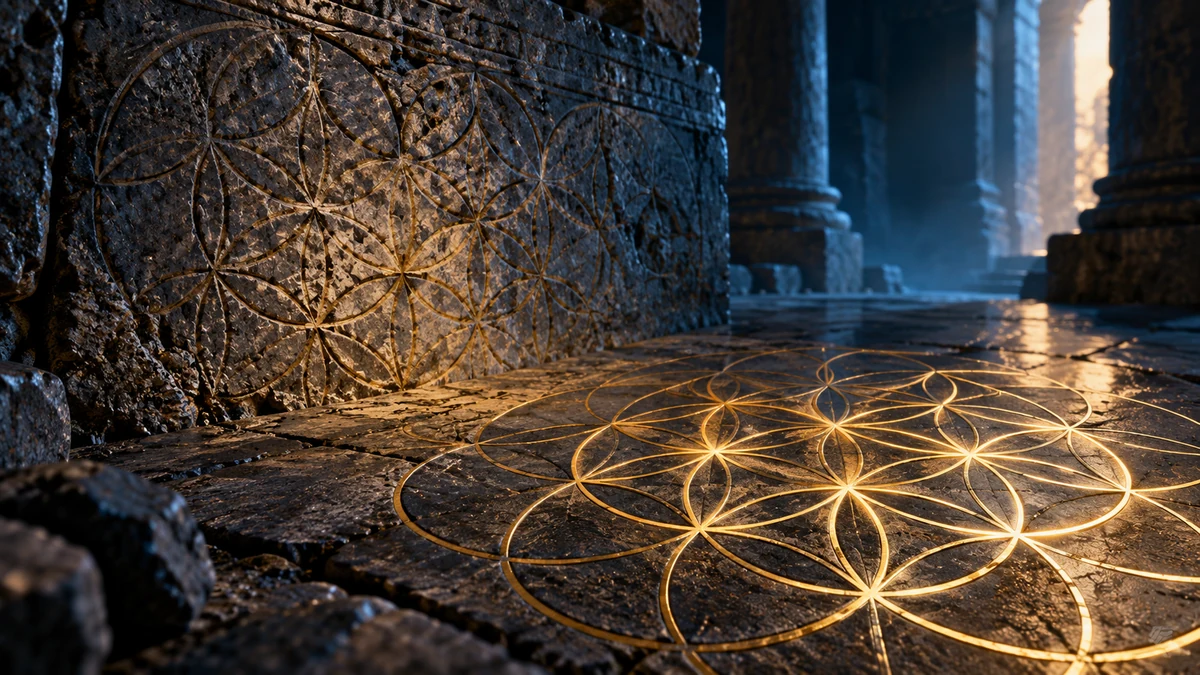
Few geometric images are as recognizable in contemporary esotericism as the Flower of Life: a network of equal overlapping circles forming a repeating sixfold floral pattern. Online, it is often accompanied by sweeping historical claims. The pattern is said to have been known to the earliest Egyptians, to appear in nearly every major civilization, and to encode a fundamental blueprint of creation. [1][2][8][9]
There is a genuine historical core to the story: overlapping-circle geometry is very old, and related designs occur on objects from many periods. But this does not mean that all of those objects represented the same symbol, or that their makers knew the modern name and interpretation. The famous example at Abydos in Egypt shows why we must distinguish the age of a building from the age of a drawing added to it, geometric resemblance from historical connection, and an old motif from a modern interpretive system. [4][5][6]
What We Now Call the Flower of Life
In modern usage, the Flower of Life is normally built from equal circles whose centers lie on the circumferences of neighboring circles. Repeating this process in six directions creates a hexagonal lattice. Within it appear petal-like forms, six-petalled rosettes, and the almond-shaped intersection of two circles commonly called a vesica piscis.
There is nothing mathematically mysterious about the construction. Draw one circle with a compass, keep the same radius, and place the point of the compass on existing intersections; the network can be extended with very little measurement. That makes this family of geometry especially useful for ornament: a simple rule produces a visually complex repeated design.
The historical problem begins when the modern name is projected backward. An ancient object containing overlapping circles may be geometrically related to today’s Flower of Life without having been historically understood as “the Flower of Life.” To establish that stronger claim, we would need evidence for a shared name, shared symbolic meaning, or a demonstrable line of transmission.
Why the Geometry Appears So Easily
The circle is one of the simplest forms to repeat accurately with a basic geometric tool. If the compass radius remains unchanged, new circles can be centered on the circumference of earlier ones. Six circles naturally arrange themselves around a central circle and generate sixfold symmetry. Continuing the same operation fills the plane with a regular network of circular arcs.
This has an important historical consequence. If two distant cultures use similar circle grids, the resemblance alone is not surprising. The geometry can be independently discovered through a very simple procedure. Cultural transmission may have happened in particular cases, but it cannot be demonstrated merely by placing photographs of two similar ornaments side by side.
The more useful historical question is therefore: what do we know about the specific object, its date, its function, and its cultural setting?
Ancient Relatives: The Same Shape Is Not Yet the Same Symbol
Ancient Near Eastern art contains rosettes and many forms of regular geometric ornament. The Metropolitan Museum of Art, for example, preserves a Neo-Assyrian stone threshold of about the seventh century BCE designed as an elaborate “carpet in stone,” with geometric and vegetal decoration. Such objects document a long tradition of precise repeating geometry, but they do not by themselves establish the standardized pattern now called the Flower of Life. [1]
Such objects matter because they show that repeating circular geometry is not a modern invention. Yet it would be misleading simply to rename them “Flowers of Life.” The museum interprets the threshold in the context of Assyrian palace decoration and the imitation of textile patterns, not as evidence for a universal esoteric doctrine. [1]
This is one of the central rules of this review: modern visual identification and historical naming are not the same thing.
Abydos: The Most Frequently Cited Example
The most commonly cited ancient “Flowers of Life” are circular designs in the Osireion behind the Temple of Seti I at Abydos. Overlapping circles are visible on granite surfaces and closely resemble the pattern now marketed under that name. The markings are real and photographable. What is disputed is not their existence but their age and meaning. [6]
The Osireion belongs to the monumental complex of Seti I at Abydos. Archaeological literature places it within the New Kingdom context of the Nineteenth Dynasty, with construction and decoration extending into the reign of Merneptah. The monument itself is therefore more than three thousand years old. [5]
But the date of a building is not automatically the date of every mark later placed on its stones. This distinction matters especially at Abydos, a major sacred and pilgrimage center that accumulated inscriptions and graffiti from visitors over many centuries. [4]
The Age of the Building Is Not the Age of the Graffito
In her 1904 archaeological publication Margaret Murray described Greek, Phoenician, and Coptic graffiti in the Seti temple area and noted that its walls had been used for centuries by visitors and pilgrims. Some Greek inscriptions belong to the centuries before the Common Era, while Coptic markings belong to much later Christian occupation. [4]
The circular motifs in the Osireion present an additional problem: they are not part of the monument’s carved hieroglyphic or relief program. They appear as surface drawings or graffiti. An independent photographic inspection by David Furlong noted multiple examples high on the columns and in an environment that also contains later Greek or Christian inscriptions. This is consistent with the possibility that the drawings were added only after sediment had accumulated and formerly high surfaces had become easier to reach. [6]
This is still not a direct laboratory date of the pigment itself. The most responsible wording is therefore cautious: the circular graffiti have not been shown to be contemporary with the Osireion; a later date is entirely plausible and is supported by the broader graffiti context. Presenting Abydos as proof of a 3,300-year-old Flower of Life goes beyond what the present evidence establishes.
Rome and East Asia: A Long History of Interlocking Circles
The history of the geometry does not end in Egypt. The Metropolitan Museum preserves a Roman glass jug from the second or third century CE whose body is decorated with nine interlocking circles, each with a central dot. Here the motif does not have to be reconstructed from approximate lines: the museum catalogue explicitly describes the decoration as intersecting or interlocking circles. [2]
Related geometry also has a long history in East Asia. An eighteenth-century Japanese Buddhist vestment, or kesa, uses an interlocking-circle pattern that the Met describes as having a long history in East Asian art, with related textiles already present in the eighth-century Shōsō-in imperial repository. In the Japanese object, the endless continuation of the circles also carried auspicious associations. [3]
These examples are historically valuable precisely because they reveal different contexts for the same geometric possibility. A Roman glass vessel and a Japanese textile are not therefore two pieces of evidence for one hidden school; they are evidence that repeating circle patterns can recur, travel, change, and acquire different meanings.
Leonardo and Geometric Play
Leonardo da Vinci is also frequently brought into the story, and this connection is not wholly invented. The Codex Atlanticus contains studies of overlapping circles and complex rosettes. Folio 307 verso, dated to around 1517, is institutionally described as part of Leonardo’s ludo geometrico — a form of geometric play or investigation involving stars and rosette-like structures. [7]
Leonardo therefore did investigate geometry that is visually and constructively related to parts of the modern Flower of Life. But this does not show that he used the modern name or subscribed to the modern esoteric system. The more careful and historically interesting conclusion is that the same family of circular constructions also attracted Renaissance mathematical and artistic inquiry.
Again, the distinction is between form and interpretation: the geometry can survive for centuries while its name and meaning change.

How the Modern “Flower of Life” Emerged
The twentieth century is crucial to the symbol’s modern esoteric identity. One of its most influential popularizers was Drunvalo Melchizedek. WorldCat records the first volume of The Ancient Secret of the Flower of Life as a 1998 publication and describes it as an edited transcript of workshops presented between 1985 and 1994. [8]
Within this modern system, the pattern is no longer merely an ornament or geometric exercise. It becomes a map of creation, consciousness, and the cosmos, and is connected with Egypt, the human body, meditation, Platonic solids, and other esoteric themes. These claims are an important part of the history of modern spirituality, but they should be attributed to their author and historical setting. [8]
Independent catalogues such as Marko Manninen’s Artifacts of the Flower of Life are useful for locating visually related historical objects. But such collections bring together artifacts that may have had very different names, functions, and meanings in their original cultures, so they are best used as orientation rather than evidence of one continuous tradition. [9]

Seed of Life, Fruit of Life, and Metatron’s Cube
Modern Flower of Life literature commonly adds the Seed of Life, Fruit of Life, Egg of Life, and Metatron’s Cube. Mathematically, many of these images can indeed be constructed by selecting circles or centers within the same hexagonal lattice. In that sense, the relationships are geometric and testable.
The historical conclusion is different. If we can select thirteen centers from an ancient ornament and join them into a modern diagram, that does not demonstrate that the ancient maker conceived of a “Fruit of Life” or “Metatron’s Cube.” Likewise, the fact that modern overlays can trace projections resembling some Platonic solids does not prove that the original ornament was designed as a code for those solids.
This is the broader lesson of this geometry sequence: the mathematical possibility of deriving something from an image is not the same as historical evidence that the derivation was originally intended.
So How Old Is the Flower of Life?
The answer depends on what, exactly, we mean. If we mean overlapping-circle geometry, it is unquestionably ancient and appears in many historical objects. If we mean the specific standardized image now recognized as the Flower of Life, there are several historical relatives and some very close parallels, but each requires its own dating and cultural context. [1][2][3][7]
If, however, we mean the name “Flower of Life” and the modern esoteric system in which the pattern is said to encode a universal blueprint of creation and to contain a family of other named diagrams, the securely documented history is much younger. Melchizedek’s workshops of the 1980s and 1990s and the 1998 book provide a firm documentary anchor for its modern popularization. [8]
The most accurate conclusion is therefore neither “the symbol was invented by the New Age movement” nor “the symbol has remained unchanged for thousands of years.” The geometry is old; some of the motifs are old; their meanings depend on their cultures; the large modern narrative that unifies them all under the name Flower of Life is much newer.
Sources and further reading
- Neo-Assyrian stone threshold as a documented example of repeating geometric and vegetal ornament in a palace context. Source
- Roman glass jug with nine interlocking circles explicitly described in the museum catalogue. Source
- Japanese Buddhist vestment with an interlocking-circle pattern; the Met documents the motif’s long East Asian history and related eighth-century textiles. Source
- Early archaeological report for the Osireion and the wider context of later Greek, Phoenician, and Coptic graffiti in the Seti temple area. Source
- Archaeological context and dating of the Osireion/Cenotaph of Seti I within the New Kingdom Nineteenth Dynasty. Source
- Independent photographic field record for the location of the circular graffiti and nearby later inscriptions; used cautiously, not as sole authority for dating. Source
- Institutional record of Leonardo’s ludo geometrico with rosettes and related circular constructions. Source
- Bibliographic anchor for the modern popularization of the name and esoteric system; workshops 1985–1994, book published 1998. Source
- Independent orientation catalogue of visually related historical examples; used for discovery and cross-checking rather than as final authority. Source