Opium for China — How British Trade Became an Instrument of Imperial Power
How opium revenues in colonial India, British trade and military force shaped unequal relations with China and the treaties of 1842 and 1858.
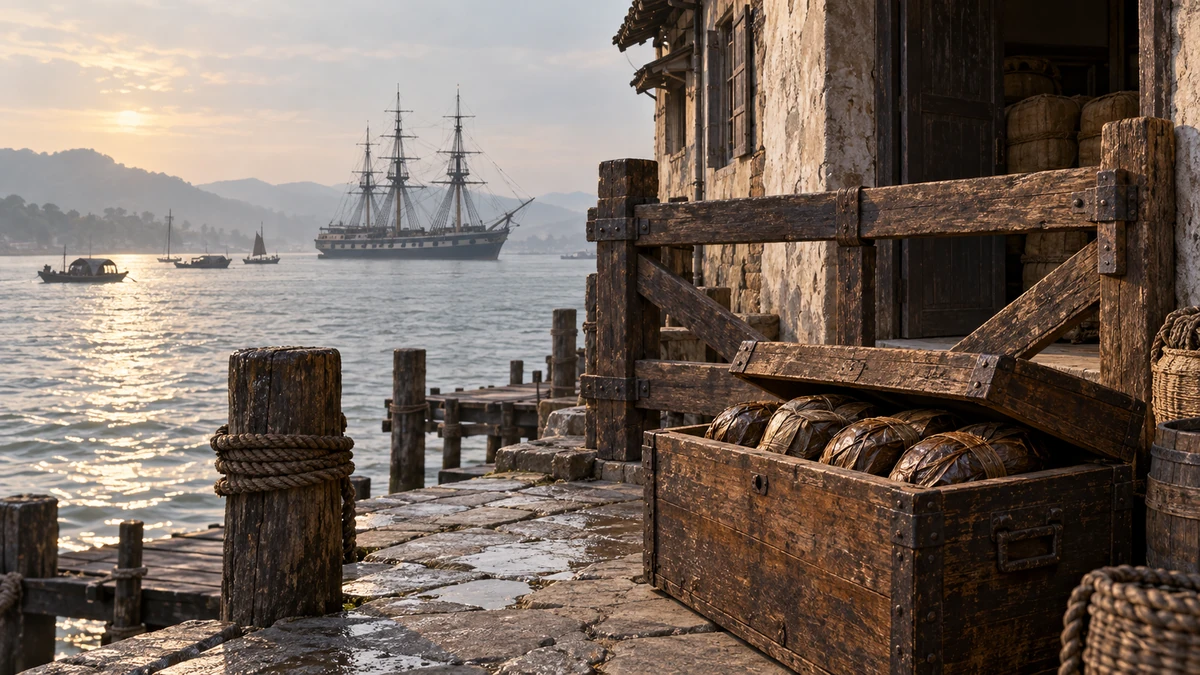
Historically inspired editorial illustration of the prohibited opium trade and British naval power; not a depiction of a documented single event.
China prohibited opium. British merchants continued to sell it, while the colonial authorities in India profited from its production and sale. When the Chinese state took firmer action against the illegal trade in 1839, the dispute did not end with respect for its law. The British government intervened with military force. After its defeat, China was required, among other things, to pay compensation for the opium that had been destroyed. [V25; V20; V07]
This is not a story about a misunderstanding between two trading cultures. It is a story about a colonial economy that profited from prohibited goods, and an imperial power that enforced economic and diplomatic demands by military means. Individual merchants, the colonial administration, London and the Chinese authorities did not play identical roles — and precisely these relationships show how “free trade” could be defended while another state's sovereignty was curtailed. [V07; V08; V20]
The Chests of Opium China Wanted Destroyed
In 1839, the conflict between the Chinese authorities and foreign merchants in Canton, now Guangzhou, escalated to a point where it could no longer be treated as an ordinary customs violation. Imperial Commissioner Lin Zexu was charged with suppressing the prohibited opium trade. He demanded the surrender of stocks, increased pressure on foreign merchants, including measures affecting their access to trading premises, and sought an undertaking that they would no longer import opium. On 27 March 1839, the British representative Charles Elliot demanded that the merchants surrender their opium and pledged, on behalf of the British government, that it would assume responsibility for their loss. The text of his proclamation was also read in the British Parliament in 1842. A total of 20,283 chests of opium were surrendered and subsequently destroyed by the Chinese authorities. This was therefore more than a dispute between the Chinese state and private smugglers: a British state representative had turned the loss of prohibited goods into a matter of British government responsibility. [V26; V25]
China confiscated goods whose importation was prohibited under its laws. A historical reconstruction by UNODC estimates the quantity at approximately 1,300 metric tonnes of opium; this figure does not come from the modern weighing of every chest. The weight of the cargo tells us nothing reliable about the number of users or people with dependence. It does, however, show the scale of the business at stake. British merchants lost valuable stocks, Elliot assumed responsibility for the compensation question, and Chinese enforcement of its own law became part of a wider British diplomatic and military dispute. [V11; V25; V20]
Clashes intensified in 1839, and a British military expedition reached the Chinese coast in 1840. The First Opium War ended in 1842. The destruction of the opium was not the war's only cause: long-standing British trading and diplomatic demands, and disputes over legal jurisdiction, also lay behind it. But this broader context does not erase the decisive fact. In a dispute over its interests, London chose military coercion and directed it against a state that was, among other things, trying to halt prohibited imports. [V07; V25]

Tea, Silver and the Trading Triangle
The British wanted Chinese tea, silk and porcelain, while demand for British goods in the Chinese market was not comparably strong. Silver therefore played an important role in settling trade flows. For British merchants and colonial administrators, opium grown in India offered an especially lucrative response: a commodity that could be sold in China, with the proceeds helping to finance further trade. For the Chinese state, those imports were illegal. The conflict between commercial profitability and the importing country's laws was built into the trading arrangement itself. [V07; V08; V11]
There was no single, direct chain of payments running from an Indian poppy field to a British cup of tea. But there was an interconnected system: colonially controlled production, auctions, private merchant vessels, flows of silver and sales of Chinese goods. That is why China's prohibition threatened more than a handful of smugglers. It threatened a business linking private profits with colonial revenues. In British demands, the word “trade” concealed a question that no price list could resolve: must a country accept goods it has prohibited simply because foreigners make substantial profits from selling them? [V07; V08]
The British East India Company was not merely a commercial enterprise: its privileges were intertwined with colonial rule in parts of the Indian subcontinent. In 1834, it lost its exclusive right to conduct British trade with China, which was opened to private British merchants. But the opening of maritime commerce did not abolish colonial control over opium production and sales in British-administered territories in India. Private merchants assumed commercial risks and reaped profits; the system of colonial revenues remained in place. [V22; V07]
The Company did not itself carry every chest of opium to the Chinese coast. That distinction matters: it reveals how colonial authorities could control and tax crucial parts of production while private merchants handled much of the prohibited overseas distribution. Separating the administrative treasury from the smuggling ship did not separate political power from financial benefit. [V08; V23]
When Opium Filled the Colonial Treasury
In parts of Bengal and the Patna–Benares areas, the colonial system incorporated opium into a managed production structure. Indian farmers grew poppies; supervised agencies bought the crop; government factories processed and packed the opium; and the colonial administration sold it at auctions in Calcutta. A historical account by the Indian government's opium agency describes a reorganisation of the system in 1797. The difference between production costs and auction proceeds was no incidental side effect: it was a source of revenue for the colonial administration. [V23; V08]
This arrangement rested on an unequal relationship. In a parliamentary debate on 25 June 1875, the Bengal system was described as a process in which growers obtained licences, received advances, delivered opium to official agents and were paid through an administrative procedure; the opium was then processed in government factories. This is a specifically documented later account of the system, not proof that every farmer in every decade was compelled to accept identical terms. The essential point remains: the colonial authorities set the rules of production and purchase and collected the revenue from sales. [V27; V23; V08]
Alongside the Bengal model, opium was also produced in Malwa, in central India, where the relationships among local rulers, merchants and British authorities differed. The British administration also derived substantial revenue from controlling transit routes and charging duties on opium passing through its territories towards export ports. Thus the phrase “Indian opium monopoly” does not fully describe every producing region, even though it appropriately draws attention to the power of the colonial fiscal apparatus. [4]
The colonial government's responsibility did not begin only on the deck of a ship smuggling opium. It began earlier — with organising cultivation, controlling supply, collecting duties and accepting the revenue. Private merchants were crucial intermediaries, but their role cannot serve as an alibi for an administration that benefited from the entire system. Distinguishing carefully between the state and private actors does not lessen British responsibility. It shows how the system worked in the first place. [V08; V07]
China's Prohibition and the Question of Sovereignty
Chinese regulations governing opium changed during the eighteenth and early nineteenth centuries, while local smugglers and corrupt officials frequently undermined the prohibition. Yet breaking a law is not the same as having legal permission. British official correspondence summarised by the Earl of Stanhope in the House of Lords in 1840 reported Chinese measures against smugglers even before Lin took office. These records show that the Chinese prohibition was not invented as a convenient excuse after fighting had begun. [V04; V10]
In 1839, Lin Zexu took office with instructions to enforce the prohibition in earnest. In a text addressed to Queen Victoria and published in English translation in the Chinese Repository in February 1840, he condemned an arrangement in which China exported tea and other goods while receiving opium sold illegally through the British colonial trading system. He demanded that foreign merchants obey Chinese law. Later transcriptions variously date the letter to 1839 or early 1840; its precise date of composition and route of delivery remain unresolved. Neither personal receipt by the Queen nor a reply from her has been established, and this article assumes neither. [V24; V07]
Lin's writings are the words of a state official, not a modern epidemiological study; his assessments of harm cannot be converted into a proven count of people with dependence. But the central issue does not depend on such a number. The Chinese state was seeking to restrict prohibited imports, while influential British commercial and colonial interests benefited from that same trade. From this conflict, British policy helped create a confrontation in which the stronger side used its military capabilities. [V04; V24; V07]
China's imperial administration was not free of corruption, harsh punishments or internal contradictions. None of these failings, however, gave Britain the right to impose its will by gunboat. That is the heart of the colonial problem: in practice, one state's sovereignty was subordinated to the economic and strategic demands of another, militarily stronger state. [V04; V07]
War and the Treaty of Nanjing, 1842
The British navy turned a commercial and diplomatic dispute into a relationship of military coercion. Attacks on the Chinese coast and ports brought the Qing government to negotiations as the defeated party. The Treaty of Nanjing, signed on 29 August 1842 aboard the British ship Cornwallis, was therefore not the product of negotiations between equal partners. It was a treaty concluded after a British military victory. [V20; V07]
The treaty opened five ports to British trade and residence: Canton (Guangzhou), Amoy (Xiamen), Foochow (Fuzhou), Ningpo (Ningbo) and Shanghai. China was required to cede Hong Kong Island to Britain — not the entire territory that later became Hong Kong — and to end the restriction of trade to selected merchants under the Cohong system. New diplomatic and customs arrangements were also established, including provision for British representatives to be present in the open ports. [7]
The price of defeat was written in figures. Article IV stipulated 6 million dollars of the period for the opium surrendered in 1839; the British treaty wording presented the payment as a ransom arising from the allegedly endangered lives of British representatives and merchants. This is a claim made in the treaty text, not an independently established fact about the degree of danger to their lives. Article V added 3 million for debts owed by certain Chinese merchants to British creditors, while Article VI added 12 million for the costs of the British military expedition. Article VII brought the total to 21 million. Not all of those millions were payments for opium; what is especially revealing is that the liability for the lost prohibited cargo became an explicit condition of peace. [V20; V25; V26]
| Treaty provision | Purpose of payment | Millions of contemporary treaty dollars |
|---|---|---|
| Article IV | For surrendered opium, according to the British treaty rationale | 6 |
| Article V | Debts owed by certain merchants to British creditors | 3 |
| Article VI | Expenses of the British military expedition | 12 |
| Article VII | Total (with payment schedule) | 21 |
Table note: these are the amounts specified in the 1842 treaty, not today's US dollars. The treaty's rationale is not an independently established account of events. Digitized Article IV — view the document and reuse terms.
This treaty provision lays bare the character of British colonial policy. China had seized goods whose importation it prohibited. After defeat in a war in which British military power prevailed, China was required to pay for them. British economic interests thus took precedence over China's ability to enforce its own prohibition. This does not mean that the treaty of 1842 legalised opium; it does mean that the country which tried to stop it was made to bear the burden of compensation. [V20; V07]
Why 1842 Did Not Yet Mean the Legalisation of Opium
Precisely because of this consequence of Britain's military victory, accuracy matters: the Treaty of Nanjing did not legalise opium in 1842. It contains provisions about ports, Hong Kong, financial obligations and trading procedures, but no article abolishing China's prohibition of opium. The British victory radically reshaped the trading order and weakened China's negotiating position. A change in the legal regime governing opium followed later. Conflating these two steps would obscure the continuing pressure rather than strengthen the criticism. [V20; V07]
A second Opium War followed between 1856 and 1860, this time involving British and French military intervention. Its immediate triggers and diplomatic demands were not identical to the events in Canton in 1839; an important part of the dispute concerned demands for further trading, diplomatic and legal privileges for foreign powers. “Second Opium War” is the established historical term, but neither its causes nor its consequences can properly be reduced to one commodity. [V07; V10]
Much more precise legal evidence comes from the Agreement containing Rules of Trade, signed in Shanghai on 8 November 1858, in connection with the British–Chinese Treaty of Tianjin of 26 June that year. Rule 5 explicitly relaxes restrictions on several previously prohibited commodities, including opium. It sets an import duty of 30 taels per picul on opium; a foreign importer may sell it at the port, but only Chinese people may carry it inland, as Chinese property. The agreement therefore did not grant foreigners an unrestricted right to trade in opium anywhere in China. [8]
The Shanghai rules, signed in 1858, are thus explicit documentary evidence of an agreed transition from prohibited imports to tariff-regulated imports of opium. Signing alone does not prove that the rule took effect identically in every port from that very day; further documents are needed to establish implementation, ratification and local practice. The unequal negotiating position and the continuation of the second war until 1860 are therefore essential context. Yet that caution does not change the content of Rule 5: a previously prohibited commodity was incorporated into a customs regime shaped under British military pressure. [V21; V07; V25]
Revenue, Consumption and the Cost of the Imperial Enterprise
How much did the colonial administration make? In the British Parliament on 19 July 1866, Samuel Laing gave the following net opium revenues for the Indian administration: £4,910,000 for the financial year 1861/62, £6,199,000 for 1862/63, £4,525,000 for 1863/64, £4,993,000 for 1864/65 and £6,702,000 for 1865/66. These are the reported net revenues of the Indian administration, not the total turnover of private merchants or the combined revenue of the British state. That distinction itself shows that opium was a recognisable budget item of colonial government, not merely a disorderly trade on its fringes. [2]
In the same debate, Laing compared opium revenue with revenue from gin and whisky and warned against restricting production so heavily that profitability would be threatened. He acknowledged the possibility of serious consequences from excessive use, but did not conduct the discussion primarily as one about Chinese sovereignty or public health. These are his statements, not objective statistics on the habits of the Chinese population. They are, however, direct evidence of the fiscal thinking that treated opium as a source of income to be preserved by British colonial authorities. [2]
In a historical report from 2008, UNODC summarised an estimated rise in opium imports into China from approximately 2,500 metric tonnes in 1839 to about 6,500 tonnes in 1880. This is a reconstruction of historical import quantities from past records and unit conversions, not a direct modern statistical measurement. The figures do not tell us how many people used opium regularly, how many used it for medical purposes or how many developed dependence. Domestic Chinese production was also present later in the nineteenth century, so imports alone were neither the total supply nor total consumption. [V11; V06; V07]
There is no need to invent millions of victims or claim that “all of China” was addicted in order to describe the harm. Opium was also used medicinally, while repeated use could lead to dependence and serious consequences for individuals and families. Historical import volumes cannot establish a precise proportion of people with dependence or a death toll. That is no reason to soften the criticism. Quite the opposite: the documented connection among colonial revenue, prohibited trade and military coercion is damning enough without attaching unverified statistics to it. [V07; V11]
It matters equally that the discussion should not revolve solely around British merchants and Chinese officials. Indian growers worked within colonial power relationships; Chinese residents were consumers, critics, intermediaries, smugglers or people trying to manage the trade's consequences. None of these groups was uniform. Their participation in an economy shaped by a great power does not mean that they enjoyed equal power in negotiations or in setting the rules. [V08; V07]
The Britons Who Called It an Injustice at the Time
Criticism of Britain's opium policy is not a modern invention. In the House of Lords on 12 May 1840, the Earl of Stanhope explicitly argued that foreigners were obliged to respect the laws of the country in which they traded, even if they disagreed with the reasons for a prohibition. He added that this was true whether China had acted because of harm to health or the outflow of silver. His intervention exposed a simple question that advocates of trading privileges preferred to avoid: why should illegal commerce merit British protection while China's prohibition merited no respect? [1]
Likewise, the young William Gladstone regarded the first war as profoundly unjust in his private diary. The historian Philip Harling cites his judgement and documents wider disagreements in British public life, including those who saw the trade as a moral scandal and those who defended merchants' rights, compared opium to alcohol or emphasised economic benefits. Gladstone's diary entry was not a speech by the Earl of Stanhope, nor is it evidence that the British Parliament as a whole opposed the war. It demonstrates something narrower but significant: support for the opium business was not unanimous in Britain. [V07; V04]
The debate was also conducted in terms that deserve critical scrutiny today. Some opponents of opium condemned it from religious, civilisational or paternalistic premises, not necessarily from the same understanding of China's equality that we might defend today. Some supporters invoked freedom of trade while refusing to accept the Chinese state's freedom to set its own restrictions. It was precisely the gap between a publicly proclaimed principle and its actual application that was at issue in the debate. [V07; V04]
British public opinion was not united on the issue. But that does not diminish the government's responsibility: the decision to use military force and accept the resulting treaty advantages did not depend on the private views of every British person. The criticism concerns specific government and colonial policies, and the decisions of those with the power to act. [V07; V20]
Free Trade — But Who Was Allowed to Set the Rules?
Free trade for whom? British merchants demanded protection for their interests, and the British state possessed a navy capable of backing those demands. China had laws prohibiting opium imports. When it tried to enforce them, that effort became part of a conflict in which British military capabilities also determined the outcome. The relationship was not equal: one side had the power to shape the terms, while the other bore their consequences after defeat. [V04; V20; V21]
It is convenient to depict the Opium Wars as a contest between British “openness” and Chinese “closedness”. Yet the opening of five ports in 1842 was imposed after a military defeat. Opium was incorporated into tariff rules in 1858 amid another war and unequal bargaining power. This was not a neutral story of the modernisation of commerce. It was also a story of how a militarily stronger state secured changes to another state's rules for the benefit of its own trading interests. [V20; V21; V07]
Even the word “Britain” can be too broad here if it conceals the distribution of responsibility. Colonial authorities in India benefited financially; private merchants controlled significant parts of maritime commerce; British diplomats and political decision-makers shaped the response; armed forces imposed the terms; while Indian growers and Chinese inhabitants did not exercise equivalent control over the system. Colonial trade must be understood as a network of roles, not as a single ship or a single order from the Queen. [V08; V07; V22; V23]
The heart of this history is found not in moral adjectives but in documents. The colonial government in India received substantial revenues from opium. China tried to prohibit it. In a wider commercial and diplomatic dispute, the British state used military force. The treaty of 1842 required defeated China to pay for the destroyed opium as well; the document of 1858 then brought opium within a new customs regime. [V06; V20; V21; V07]
The contradiction in British imperial policy is recorded in its own documents: it collected colonial revenues from opium, gave commercial demands the backing of military power, and after defeat required the state that had been stopping the prohibited imports to pay for the seized opium as well. This conclusion requires neither inflated casualty figures nor the claim that every British citizen was responsible. It is enough to examine who set the terms and who had to accept them: commercial gain, colonial authority and armed power sustained an order in which the rules did not apply equally to everyone. [V06; V20; V21; V26]
Sources and further reading
- [1] UK Parliament, Hansard, War with China, House of Lords, 12 May 1840. source Source
- [2] UK Parliament, Hansard, East India Revenue Accounts, House of Commons, 19 July 1866. source Source
- [3] Philip Harling, Opium, ‘civilisation’ and the Anglo-Chinese wars, 1839–60, University of London Press. source Source
- [4] John F. Richards, The Opium Industry in British India, Indian Economic & Social History Review 39 (2002). source Source
- [5] UNODC, A Century of International Drug Control — Historical Origins, World Drug Report 2008. source Source
- [6] UNODC, World Drug Report 2008, historical estimates of imports and the seizure in 1839. source Source
- [7] Treaty of Nanjing (1842), complete text hosted by USC US-China Institute. source Source
- [8] Agreement containing Rules of Trade, Shanghai, 8 November 1858, especially Rule 5, The World and Japan Database (University of Tokyo / GRIPS). source Source
- [9] China Trade Act 1833 (3 & 4 Will. IV c. 93), UK legislation, implementation from 22 April 1834. source Source
- [10] Government of India, Government Opium & Alkaloid Factories, Opium — History (retrospective institutional history). source Source
- [11] Lin Zexu and co-authors, Letter to Queen Victoria, English transcription from the Chinese Repository 8 (February 1840), pp. 497–503, via Fordham University, Internet Modern History Sourcebook. source Source
- [12] Hong Kong Government, Hong Kong Yearbook 2011, historical overview (20,283 chests; Charles Elliot; departure of the expedition and subsequent war). source Source
- [13] UK Parliament, Hansard, Address to the Crown—Compensation for Opium Seized by the Chinese, House of Commons, 17 March 1842, including a transcription of Elliot's proclamation of 27 March 1839. source Source
- [14] UK Parliament, Hansard, India and China—The Opium Traffic—Resolution, House of Commons, 25 June 1875, description of the Indian system of cultivation, purchase and taxation. source Source