Old Age, Dependency, and Dignity
Old age can increase the need for help without reducing a person’s moral worth. This article shows how to connect care, autonomy, safety, and protection from domination.
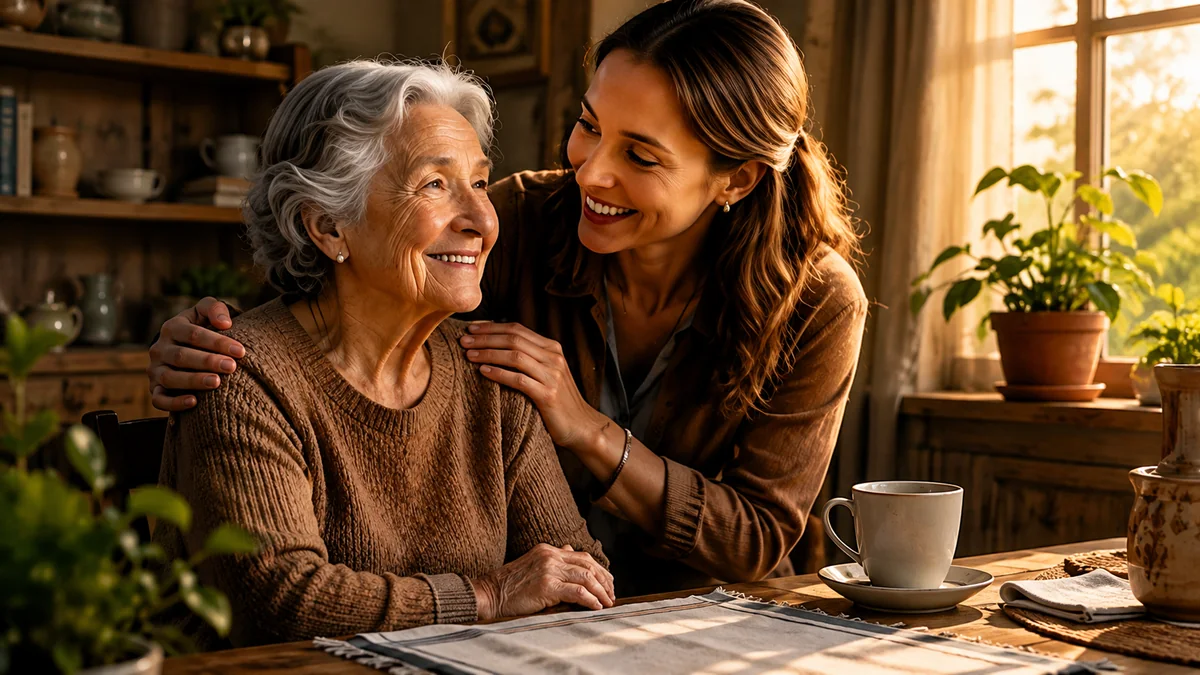
“Education Without One Center: Freedom, Quality, and Common Standards” asked how education can prepare a person for increasing independence. This article reverses the direction of view. A person who made decisions for decades may later need increasing help because of illness, loss of strength, sight, hearing, mobility, or memory. The central question is therefore not how to eliminate dependency at any cost, but how to help without taking away dignity, voice, and authorship of one’s own life together with lost abilities.
For THY-REALITY this is an important test of Natural Law and personal sovereignty. A person’s worth cannot plausibly fluctuate only with productivity or bodily independence. Human bodies are vulnerable, all of us depend on others at different stages of life, and care is not an anomaly outside human life but one of its enduring relationships. The source manuscript Prebujenje v Naravni zakon emphasizes care as the opposite of apathy; this article retains that direction while translating it into testable requirements for dignified, non-dominating care.
Needing help is not a transfer of ownership over a person. Dependency can increase our duty of care; it does not automatically create a right to decide in another person’s place.
This does not romanticize old age or deny real losses of capacity. It makes a stricter claim: support should be proportionate to actual need, strengthen remaining abilities, and include safeguards where power asymmetries become large. This article therefore connects dignity, autonomy, long-term care, protection from abuse, and practical community action.
Age, dependency, dignity, and autonomy
Old age is not one capacity or one diagnosis Chronological age is a poor proxy for what a particular person can do. Two people of the same age may differ dramatically in health, mobility, memory, social networks, income, and preferences. WHO therefore approaches healthy ageing through functional ability: what a person can do and what their environment enables, not merely how many years they have lived or how many diagnoses they carry.
This is an important defence against ageism. When age becomes a shortcut for incapacity, we quickly begin speaking over the person, deciding without them, and treating disagreement as evidence that they “no longer understand.” The first step in dignified care is therefore individual assessment rather than stereotype.
Dependency is not a switch between “independent” and “incapable” Dependency is multidimensional. Someone may need transport but still manage their own finances. They may need help dressing while remaining completely clear about where they want to live. They may have memory difficulties and still reliably express preferences about daily routine, relationships, and personal space.
A better question is: which tasks require support, which decisions can the person still make, what can they do with appropriate assistance, and where is risk genuinely high enough to require additional protection? This preserves precision and prevents one limitation from being generalized to the whole person.
Dignity is not a reward for productivity Modern societies often link human worth, sometimes implicitly, to work, speed, economic efficiency, and self-sufficiency. Old age exposes the moral weakness of that logic. If dignity belongs only to those who produce enough, people lose moral value precisely when they become most vulnerable.
The United Nations Principles for Older Persons explicitly say that older people should be valued independently of their economic contribution. This article treats this as an important normative boundary: usefulness may affect the allocation of some roles or responsibilities, but it cannot be the measure of basic human dignity.
A person is not more of a person at 45 than at 85. Capacity can change; basic moral worth does not become a percentage of productivity.
Autonomy is not the same as complete independence In everyday language autonomy is often confused with self-sufficiency: the autonomous person is imagined as someone who needs nobody. That is a very narrow model of human life. Healthy adults also live through networks of knowledge, food, infrastructure, relationships, and services. Total independence is rare; the deeper question is how far a person can continue directing their life within the relationships they need.
Research on relational autonomy in older people highlights how social environments can either constrain or enable autonomy. Good assistance is therefore not the opposite of autonomy. A walking aid, hearing device, accessible transport, a person who explains options clearly, or a neighbour delivering food may give someone more practical self-direction, not less.
Support without paternalism
Good support expands remaining capacity This leads to a practical rule: support first; substitute only when necessary. If a person can perform a task more slowly, with an aid, or in steps, we do not automatically need to take it over. If a decision becomes understandable with clearer information or more time, another person does not automatically need to decide instead.
WHO’s ICOPE approach is built around capacity, functioning, personal needs, and individualized care planning. That fits this article’s logic: the purpose of care is not merely to complete as many tasks as possible for a person, but to preserve or expand their ability to live a life they still recognize as their own.
Ageism often arrives disguised as kindness Ageism is not only open hostility toward older people. It can appear as patronizing speech, automatic simplification, deciding around someone, speaking to their companion instead of to them, or assuming that an older person no longer wants risk, learning, intimacy, work, or participation.
WHO defines ageism through stereotypes, prejudice, and discrimination based on age. Its subtle form is especially dangerous because assistance can turn into infantilization while the caregiver mistakes their own convenience for the older person’s good.
“For your own good” is a reason, not a blank cheque Care always carries the possibility of paternalism. When someone is vulnerable, a caregiver can quickly justify a restriction by saying “this is safer for you.” Sometimes that is correct. But safety is not an absolute value that automatically cancels privacy, freedom of movement, personal habits, relationships, or a right to reasonable risk.
Any substantial restriction should therefore answer at least four questions: What concrete danger does it prevent? How likely and serious is that danger? Is there a less restrictive option? When will the restriction be reviewed? Without those answers, protection can quietly become management of the person.
Decision-making capacity and caregiver power
Decision-making capacity is not all-or-nothing The issue becomes especially difficult with dementia and other cognitive changes. But a diagnosis does not mean a person can no longer decide anything. WHO has explicitly noted in the context of dementia that the presence of the condition does not justify assuming incapacity in all areas of life.
Supported decision-making therefore looks for ways to help a person understand options, communicate their will, involve trusted people, and retain control as far as possible. Where capacity is seriously impaired, previously expressed wishes, values, powers of attorney, and clear legal safeguards become important. This article does not offer a legal recipe for every jurisdiction; it sets a moral direction: lose a person’s decision-making authority as slowly as possible and replace it as narrowly as necessary.
Small everyday decisions are part of dignity Research on autonomy in residential care shows that self-direction is not lost only in major legal decisions. It can disappear through wake-up times, clothing, food, privacy, visitors, daily activities, and who may enter a room.
These may be organizationally small matters, yet together they determine whether a person still feels they are living their own life or have become an object in someone else’s schedule. Good care therefore measures more than the absence of injury. It also asks how much of life still remains meaningfully the person’s own.
Caregivers hold power — and therefore need limits Dependency creates a real asymmetry of power. A person who controls transport, medication, food, money, keys, a phone, or contact with others can shape an older person’s life even without a formal title. Good intentions are not a sufficient safeguard.
Conflicts of interest may be very human: an exhausted caregiver wants quiet, an heir has a financial interest, an institution wants an easier schedule, or a family wants to reduce risk or cost. Important decisions therefore need clarity about whose interest is being served, who can object, and who can independently review the decision.
Abuse of older people is dependency’s extreme failure mode
WHO includes physical, psychological, sexual, and financial abuse, neglect, and serious loss of dignity and respect within abuse of older people. This matters for THY-REALITY: dependency does not create only a need for care; it also creates opportunities to convert control over essential resources into coercion or exploitation.
A community that wants to care for vulnerable people therefore cannot rely only on personal trust. It needs confidential reporting routes, more than one contact person, clear boundaries around money and property, records of important decisions, and access to professional or legal protection when serious abuse is suspected.
Where and at what scale care should be organised
Home, community, or institution: there is no single moral formula “Ageing in place” is an important preference for many people, and WHO emphasizes the role of communities in enabling people to age in an environment that suits them. But home is not automatically the safest or most dignified place. Isolation, stairs, absent care, family violence, or complex health needs may mean that another arrangement provides more freedom and safety.
Institutional care is not automatically a loss of dignity either. The relevant question is whether care is high-quality and person-centred, with privacy, relationships, meaningful choice, and protection from abuse. This article therefore does not choose one type of building. It chooses criteria.
Local while competent — networked when scale is necessary Health Care Close to People: What Can Be Local and What Requires a Larger Scale? introduced the rule of the smallest competent scale. The same applies in older age. A neighbour can help with transport, a family with meals, and a local network with social contact and minor tasks. But complex clinical care, rehabilitation, palliative care, legal protection, or 24-hour long-term care may require professional and wider networks.
The alternative to a centralized system is therefore not “the family should do everything.” A healthier direction is a layered network: as much proximity and personal relationship as possible; as much expertise, reserve capacity, and wider coordination as necessary.
Do not romanticize unpaid care When formal care is insufficient, the burden often falls on partners, adult children, and especially women. It may arise from love and solidarity, but without support it can also produce exhaustion, lost income, social isolation, and poorer care for both people.
WHO’s long-term-care work therefore emphasizes support for informal caregivers as well as a properly trained workforce. A community that speaks of mutual aid must include respite, burden-sharing, and the right to say “I cannot carry this alone anymore.” Care without boundaries can destroy the very relationship it is supposed to protect.
Long-term care is both relationship and infrastructure Dignity cannot be secured by warmth alone when there is no transport, accessible housing, personal assistance, healthcare support, or sustainable financing. Nor can money alone secure dignity if a person is treated as a case number and decisions are made around them.
Ageing well therefore requires a connection between relationships, environments, and services. WHO’s person-centred care and age-friendly community models emphasize precisely this: the same level of bodily capacity can result in much more or much less real freedom depending on the surrounding environment.
Intergenerational reciprocity and its limits
Intergenerational reciprocity is not same-day accounting Communities often think in reciprocal terms: I contribute because others contribute. Old age reveals the limits of a narrow version of that principle. A person may spend decades raising children, working, caring for relatives, building knowledge, or serving a community, and later enter a period in which they receive more than they can currently return.
This does not settle every question of fair burden-sharing. It does show that reciprocity must sometimes be understood across time, relationships, and generations, not merely as an immediate exchange of service for service. What Do We Owe a Person Who Cannot Reciprocally Contribute? will then pose the harder case: what do we owe a person who cannot reciprocally contribute even in that broader sense?
Boundary to *What Do We Owe a Person Who Cannot Reciprocally Contribute?*: dignity is not a claim to everything Saying that dignity is independent of productivity does not yet tell us who must provide every possible service, how many resources may justly be demanded, or how conflicts among several people’s needs should be resolved. This article deliberately leaves that problem visible.
Its narrower conclusion is: inability to contribute does not by itself erase moral status or legitimate domination. What Do We Owe a Person Who Cannot Reciprocally Contribute? will test which positive obligations follow from that premise and where their limits lie.
A practical model for dignified care
Start today: dignified ageing network v0.1 A first step does not require waiting for complete pension, health, or social-care reform. A small community can already build a supplementary support network that does not replace professional care but reduces isolation, practical gaps, and dependency on a single person or institution.
- Listen to older people first. Do not design a system for them without their voice; ask what they actually lack and what they do not want.
- Map capacities as well as needs. Record what a person can still do, wants to do, and can contribute, not only deficits.
- Create a voluntary contact network. Transport, minor tasks, meals, companionship, digital help, and accompaniment can be shared among several people.
- Define competence boundaries. Medication, clinical decisions, complex personal care, and legal matters should remain with appropriately qualified people.
- Build in caregiver respite. The network should support the person carrying most of the daily burden too.
- Record preferences before crisis. Where local law allows, people should express wishes about care, trusted people, and major decisions in advance.
- Protect privacy. A needs map is not a public list of health and personal information.
- Create a second channel. Nobody should depend completely on one person without another route for help.
- Review the arrangement regularly. Capacities, needs, and preferences change; support must adapt.
- Set a clear escalation threshold. Serious suspicion of violence, financial abuse, neglect, or medical danger requires professional or legal pathways, not only an internal conversation.
A minimum compact for dignified care
- The person remains a person. Age, illness, or dependency do not turn someone into another person’s project.
- Support comes before takeover. What someone can do alone or with reasonable support should remain in their hands.
- Their voice remains present. Do not speak about someone as if they are absent when they can participate.
- Restrictions require reasons. Safety restrictions must be concrete, proportionate, and regularly reviewed.
- Privacy is not a luxury. Body, room, communications, finances, and personal information need clear boundaries.
- Money and property require extra safeguards. Caregiving closeness must not become unchecked financial authority.
- Caregivers have a right to support. Exhaustion is not a moral failure and should not remain hidden until collapse.
- Use expertise where it is needed. Community warmth does not replace clinical, legal, or specialist competence.
- Preserve choice for as long as possible. Small daily preferences are part of autonomy.
- Abuse has no local immunity. The reputation of a family, institution, or community is not a reason to conceal harm.
Decision audit and power check
Ten questions before deciding for an older person
- Does this decision genuinely require someone else to make it?
- What does the person say they want?
- Could they decide with more time, clearer explanation, or support?
- Is the restriction tied to a concrete risk, or mostly to our general discomfort?
- Is there a less restrictive option?
- Who has a financial, time, or organizational interest in this decision?
- Are we considering the person’s earlier values and established choices?
- Who can object to or independently review the decision?
- When will the decision be reviewed?
- Would we accept the same standard if we ourselves depended on help?
Power check: when care becomes management of a person Every care system contains a distinctive concentration of power because the person may not be able simply to leave. Warning signs include one individual controlling money, transport, and communication; every decision being justified through safety; complaints being treated as ingratitude; privacy being framed as an obstacle; contact with others shrinking; or a caregiver or institution refusing outside review.
Good care therefore distributes critical functions where possible: multiple contacts, clear authorities, traceable finances, access to a second opinion, regular review, and routes to external protection. The greater the dependency, the stronger the safeguards against domination must be.
Conclusion: dignified ageing is not life without help
Freedom is often imagined as a condition in which we need nobody. Old age reveals that this is too simple. A person can need substantial support and still remain the author of their life in an important sense—if the environment strengthens remaining abilities, respects their voice, and does not use dependency as permission to control.
Dignified care does not ask only: “What can we do for this person?” It also asks: “What can we do so that as much of their life as possible can still be lived as their own?”
This article therefore does not oppose autonomy to care. It tries to unite them. Care without autonomy can become domination; autonomy without support can become an empty word. A mature community learns to help without erasing the person. What Do We Owe a Person Who Cannot Reciprocally Contribute? will intensify the test: what remains of our moral logic when a person can no longer reciprocally contribute?
Sources and further reading
- World Health Organization. Ageism. WHO Health Topic. Source
- World Health Organization. Long-term care for older people: package for universal health coverage. 2024. Source
- World Health Organization. Integrated care for older people (ICOPE): guidance for person-centred assessment and pathways in primary care, 2nd ed. 2025. Source
- World Health Organization. Creating age-friendly cities and communities. Source
- United Nations. United Nations Principles for Older Persons: independence, participation, care, self-fulfilment and dignity. Source
- United Nations Human Rights (OHCHR). Human Rights of Older Persons. Source
- World Health Organization. Abuse of older people. Fact sheet. Source
- Sherwin, S., & Winsby, M. (2011). A relational perspective on autonomy for older adults residing in nursing homes. Health Expectations. Source
- Moilanen, T. et al. Older people’s perceived autonomy in residential care: An integrative review. Source
- Udkunta, K., Efstathiou, N., & Guo, P. (2026). Models of Care and Interventions to Improve Person-Centred Care for Older People in Long-Term Care Facilities: A Mixed Methods Systematic Review. Source
- Dignity of Older Adults in Long-Term Care Facilities: A Systematic Review of Qualitative Evidence from Residents, Staff, and Relatives. 2025. Source
- World Health Organization. WHO QualityRights module on supported decision-making & advance planning. 2019. Source